Day 1101: Thomas Hardy

Cover for Thomas HardyThomas Hardy has long been one of my favorite Victorian writers, so when I learned that Claire Tomalin had written his biography, I set about getting a copy. Tomalin has made a career of writing interesting and readable but meticulously documented biographies of mostly literary figures and has become one of my favorite biographers.

Tomalin shows that Hardy was a contradictory man—shy but eager to socialize in intellectual circles, resenting early snubs but nevertheless a snob himself, an inner-living man who still welcomed all who came to see him. Hardy was the son of an uneducated builder and a house servant, both of whom encouraged him in his efforts to gain an education and better himself. But in those days this was difficult, and he never achieved his dream of a Cambridge education. Instead, he went to work at 16 in an architect’s office.

Above all else, Hardy became a writer who challenged conventional attitudes toward women, sex in literature, and religion. Almost from the beginning of his career, while still writing formula novels, he ran into trouble with editors wanting to censor his work. His publication of Tess of the D’Urbervilles, with its subtitle “A Pure Woman,” caused an uproar. Although I have read many of his novels, it was fascinating to read about them in terms of events going on in his own life.

What I had not read much of is his poetry. Hardy always considered himself a poet rather than a novelist, and at the height of his career, after publication of Jude the Obscure, he caused another furor by quitting his novel-writing career to concentrate on poetry. Tomalin is obviously a fan of his poetry, and although I am not much of a poetry reader, the snippets she reproduces are musical and beautiful, and the context she gives them fascinating.

Tomalin begins her book with the story of Hardy’s regret after his first wife’s death that they had grown apart. The story of that relationship, as well as that with his second wife, is also very interesting.

Tomalin has a gift for breathing life into her subjects so that you feel as if you understand them, at least a little. If you have any interest in Thomas Hardy, you’ll find this a compelling book.

Related Posts

Charles Dickens, A Life

Tess of the D’Urbervilles

Far From the Madding Crowd

First Classics Club List Complete!

I have not posted all of the reviews yet, but with Henry VI, Part III, I just finished all of the books on my first Classics Club list. I completed my list almost two years ahead of my posted deadline of February 12, 2019!

That means that I am ready to post my second Classics Club list! I will continue to show my first list in my Classics Club page until all my reviews are posted, and then I will copy it off to a subsidiary page and post my new list.

My first list was an experiment, as I had never belonged to a blogging club before, so many of my selections were old favorites that I hadn’t read in a long time. I think a brief summary of my reading for this first list is called for.

Top Five Books from My First List

Least Favorite Books from My First List

My New List!

I can’t seem to bring myself to make a list of 100 books at a time for the Classics Club. I think it is more satisfying for me to finish shorter lists faster than to finish a long list more slowly. This list is different from my previous one in that I have only previously read about half a dozen of the books on this list. I am posting this list on June 30, 2017, and I plan to finish it by June 29, 2021.

I made this list some time ago, so I see that I have already finished one of the books, The Lark, by E. Nesbitt.

15th Century

  • Le Morte D’arthur by Thomas Malory (1485)

16th Century

  • The Prince by Machievelli (1532)
  • Edward II by Christopher Marlowe (1592)
  • Titus Andronicus by William Shakespeare (1588-1593)

17th Century

  • Oroonoko by Aphra Behn (1688)
  • The Duchess of Malfi by John Webster (1612-13)

18th Century

  • Evelina by Frances Burney (1778)
  • The Expedition of Humphry Clinker by Tobias Smollett (1771)

19th Century

  • Mansfield Park by Jane Austen (1814)
  • Aurora Floyd by Mary Elizabeth Braddon (1863)
  • The Tenant of Wildfell Hall by Anne Brontë (1848)
  • The Haunted Hotel by Wilkie Collins (1879)
  • The Brothers Karamazov by Fyodor Dostoevsky (1880)
  • The Viscounte de Bragelonne by Alexandre Dumas (1848)
  • Letters from Egypt by Lucie Duff-Gordon (1865)
  • The Mystery of Mrs. Blencarrow by Mrs. Oliphant (1890)
  • Kenilworth by Sir Walter Scott (1821)
  • The Heir of Redclyff by Charlotte M. Yonge (1853)

20th Century

  • The Shuttle by Frances Hodgson Burnett (1907)
  • My Mortal Enemy by Willa Cather (1926)
  • The Old Man’s Birthday by Richmal Crompton (1934)
  • Consequences by E. M. Delafield (1930)
  • Vanishing Cornwall by Daphne du Maurier (1967)
  • This Side of Paradise by F. Scott Fitzgerald (1920)
  • The Good Soldier by Ford Madox Ford (1915)
  • Owls Do Cry by Janet Frame (1957)
  • The Winged Horse by Pamela Frankau (1953)
  • My Brilliant Career by Miles Franklin (1901)
  • Three Weeks by Elinor Glyn (1907)
  • The Lady and the Unicorn by Rumer Godden (1937)
  • Harriet by Elizabeth Jenkins (1934)
  • Joanna Godden by Sheila Kay-Smith (1921)
  • The Victorian Chaise-longue by Marghanita Laski (1953)
  • Greenery Street by Denis MacKail (1925)
  • West with the Night by Beryl Markham (1942)
  • Anne of Avonlea by L. M. Montgomery (1909)
  • The Lark by E. Nesbit (1902)
  • Mary Lavelle by Kate O’Brien (1936)
  • The Last of the Wine by Mary Renault (1956)
  • The Sea Hawk by Rafael Sabatini (1915)
  • Memories: From Moscow to the Black Sea by Teffi (2016, but written around 1920)
  • Challenge by Vita Sackville-West (1923)
  • Miss Buncle’s Book by D. E. Stevenson (1934)
  • August Folly by Angela Thirkell (1936)
  • I Go by Land, I Go by Sea by P. L. Travers (1941)
  • Madame de Treymes by Edith Wharton (1907)
  • Because of the Lockwoods by Dorothy Whipple (1949)
  • The Priory by Dorothy Whipple (1939)
  • The Wise Virgins by Leonard Woolf (1913)
  • To the Lighthouse by Virginia Woolf (1927)


Day 1100: The Stranger’s Child

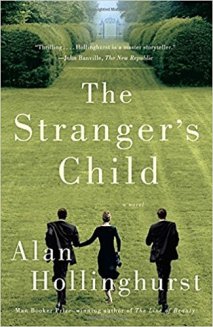
Cover for The Stranger's ChildI had the oddest experience with The Stranger’s Child. Although it was well written and sounded like something I would be interested in, for a while every time I started to read it, I fell asleep. There is very little movement to this novel, which isn’t necessarily a bad thing, but the end of it had me wondering what the point of it was.

The novel is multigenerational, beginning in 1913 and ending in 2008. In 1913, Daphne Sawle, who is 16, is attracted to her brother George’s friend, Cecil Valance, down for a visit from Cambridge. Cecil is an aristocrat and a poet. Unbeknownst to naive Daphne, he and George are having a wild affair.

The next section of the book takes place ten years after World War I. Cecil died in the war, and the family is dedicating a memorial to him. The family includes Daphne, as she has married Cecil’s younger brother, Dudley, and they have two children. However, she is in love with Revel Ralph, a set designer for the theater.

By far the bulk of the novel is set in the 1960’s and 70’s and is from the point of view of Paul Bryant. In the 1960’s, he is a shy bank clerk. He has become involved with the family through his boss, who has married into it, and through his affair with Peter Rowe, a schoolteacher at Corley House, which used to be the Valance home. Cecil is now regarded as one of England’s minor poets.

Ten years later, Paul is a biographer, determined to out Cecil as a gay man despite the claims of Daphne to have been his fianceé. It is unfortunate that I found this main character of the longest section to be so unappealing and completely focused on who was or was not gay, although I realize that the 1970’s was the time for that kind of revelation.

Part of my problem with the novel may have been the blurb, which really oversells aspects of the plot. For example, it says, “Over time, a tragic love story is spun . . . .” Well, there are several love stories that come out, but I wouldn’t call any of them tragic, and it’s actually difficult to tell which of them this comment refers to. One of the secrets is so understated during the novel that even though it is the last revelation, it seems anticlimactic. I suppose it’s supposed to be ironic that Paul is so focused on the possibility of one affair that he completely misses another.

Finally, this is a novel so focused on the sexuality of its characters that it gives the impression that the entire upper class male population of England is gay. We see a little into Daphne’s infatuations, but otherwise, only from the point of view of various gay men trolling for sex or obsessing about it. Those of you who know me will realize that I would have the same complaint if the sole focus was on heterosexual sex. So, not one of my favorites for my Walter Scott prize project.

Related Posts

Arctic Summer

A Place Called Winter

The Summer Before the War

Day 1099: The Moving Toyshop

Cover for The Moving ToyshopI am sure I previously read one of Edmund Crispin’s Gervase Fen mysteries and was not impressed, but lately several bloggers I enjoy have recommended The Moving Toyshop. So, I decided to try him again.

Richard Cadogen has decided to give himself a holiday in Oxford. When he ends up stranded partway because of the cancellation of a train, he decides to hitchhike the rest of the way. So, he arrives in the outskirts of Oxford at 1 AM.

Curiosity makes him investigate a toy shop that he finds unlocked. Upstairs in the living quarters, he discovers the dead body of an older woman, strangled. Then someone hits him on the head.

When he awakens, he is locked in a closet. He gets out by the window and reports the crime to the police. However, when they arrive at the store, it’s a grocery. The apartment is different than the one he remembers and there is no body. The police think he is crazy.

Cadogen turns to his friend, the eccentric Oxford don, Gervase Fen. Their inquiries begin to turn up a plot to defraud the victim of her inheritance. The problem is, first they have too many suspects and later too few.

This novel has a complicated, fairly unbelievable plot, but it is characterized by a wacky sense of humor, as Gervase and his pals chase bad guys all over town. At one point, he is assisted by a hoard of undergraduates, and the novel ends with an exciting chase on a fast-moving carousel, a la The Third Man. I found the novel fun to read and the characters engaging.

Related Posts

The Iron Clew

Silent Nights

4:50 from Paddington

Day 1098: Bella Poldark

Cover for Bella PoldarkI’ve finally finished the last of 12 books in the Poldark series with Bella Poldark. I enjoyed the first six books very much but was only mildly interested in the others and finally only continued because I wanted to finish the series.

This novel is not exactly what you might expect of the last of a series. It resolves some of the continuing subplots but not others. I was surprised to find it introducing some new characters while hardly mentioning some who featured strongly in the other books.

Set in 1818, Bella Poldark is principally concerned with the romances of the two Poldark daughters, Clowance and Bella. Clowance is now a widow, but she has two suitors, Captain Philip Prideaux, a former soldier, and Lord Edward Fitzmaurice, who has been in love with Clowance since she was a girl. But Clowance feels still half in love with Stephen and half hates him because of his lies.

Bella has been courted by Christopher Havergal for years, and he helps her find a voice teacher in London and begin her career as a singer. But a French empresario, Maurice Valéry, offers her a part in an opera in Rouen and himself.

Valentine Warleggan’s affairs are also a concern of the novel. They become entangled with another subplot, a murder mystery. Someone has been killing young women in the area. When Valentine’s latest mistress is a victim and he is questioned about it, his wife, Selina, has had enough and leaves with their son, George. Valentine at first leads a life of dissipation, but when he realizes that his putative father, George Warleggan, is interesting himself in his son, he decides he cannot leave young George to be raised by old George, as he was.

In all, although this novel was more interesting than some of the others, I felt sometimes as if Graham was trying to juggle too many balls. I am happy to have finished this series even though I only found the later books moderately interesting. So, I am happy in more ways than one.

Related Posts

The Twisted Sword

The Loving Cup

The Miller’s Dance

Day 1097: Alexander Hamilton

Cover for Alexander HamiltonBest Book of the Week!
I don’t think it’s ever taken me so long to read a book as it did Alexander Hamilton, despite it being a fascinating biography. Although it did not seem as if it went into too much detail, as some biographies do, it is certainly long.

Thanks to the Broadway show, which is based on this book, people have become a little more conscious of the accomplishments of Hamilton. Unfortunately, he was such a controversial figure that his enemies managed to blacken his legacy for many, many years.

A man of astounding intelligence, Alexander Hamilton sprang from a difficult heritage as an illegitimate son of a man who was a failure at business and deserted his common-law wife and their children. From this beginning, Hamilton expended his own formidable efforts, eventually to become one of the most powerful men in the new United States.

Hamilton was apparently not at all tactful and earned himself many enemies through speaking truth to power. He and Washington had a close and affectionate relationship that began when he was Washington’s aide during the Revolutionary War, but he counted among his enemies James Monroe, Thomas Jefferson, the New York Clinton family, Aaron Burr, and to a lesser extent, James Madison. John Adams hated him. None of these men emerge from this book looking well, although Hamilton certainly had his faults.

I think almost anyone interested in history will find this book fascinating, even if, like me, you are not particularly interested in the Revolutionary period. Alexander Hamilton was an amazing man who has been largely robbed of his proper legacy.

Related Posts

Valiant Ambition: George Washington, Benedict Arnold and the Fate of the American Revolution

Lafayette in the Somewhat United States

Seven Locks

Day 1096: Lockdown

Cover for LockdownAlthough King is best known for her Mary Russell/Sherlock Holmes mysteries, it is her stand-alone thrillers that have really appealed to me. I think her Folly is one of the best of its genre. However, if Lockdown hadn’t been written by Laurie R. King, I probably wouldn’t have chosen to read it. The subject, a violent incident at a middle school, wouldn’t normally appeal to me.

The staff and students of Guadalupe school are preparing for Career Day. They have had a tough year in which one student’s sister was murdered by a gang banger, another student is a witness against him, and another student, a young girl named Bee, disappeared without a trace.

Linda McDonald, the school principal, is most concerned about whether the day will come off. She is hoping to inspire some of her mostly impoverished students with career ambitions, and hope for the future.

Gordon Kendrick, Linda’s husband, has a past that may be coming back to haunt him after he is mentioned in the publicity for Career Day. Another adult who is hoping to stay under the radar is Tio, the school janitor.

link to NetgalleySeveral of the students are clearly troubled. But 8th grader Brendan Atchison, the son of a successful entrepreneur, is plotting something drastic that involves another person.

Although the novel employs a technique that I recently found irritating in Salt to the Sea, the rapid shifting of point of view between short sections, it works much better in Lockdown, building true suspense. At first, I was more interested in the story of what happened when Linda met Gordon in New Zealand than in the plot about the school, but I finally decided that this is another fine suspense novel by Laurie R. King.

Related Posts

The Bones of Paris

The Child Garden

Quiet Neighbors

Day 1095: Number9Dream

Cover for Number9DreamI usually enjoy, on one level or another, everything David Mitchell writes, and I consider a couple of his novels to be really excellent. I wasn’t as fond of Number9Dream, however.

Eiji Miyake has traveled from his home on a southern island of Japan to Tokyo to find his father. He and his twin sister were the product of an illicit relationship that their father abruptly broke off, and Eiji and Anju have never known his identity. They were raised by their grandmother with only infrequent visits from their mother.

When Eiji was eleven, his sister drowned. We are supposed to believe that he ran away on that day and lived in the mountains by himself.

The book begins with a series of unlikely daydreams that Eiji has about meeting his father as he sits in a cafe looking at the building where a lawyer representing his father has an office. When he finally meets the lawyer, she refuses to give him any information about his father or even to give his father a message.

Eiji begins a series of attempts to find his father, involving some unlikely and almost surrealistic adventures. He journeys to the city’s underworld, visits brothels, gets involved with the Yakuza, and has other adventures, all while working a series of low-wage jobs.

This novel is Mitchell’s second, and it seems more juvenile than the others. I don’t think I’m giving away too much, considering the quotes on the jacket cover, when I say that it’s difficult to tell at times whether the protagonist is dreaming or not or whether the entire novel is a dream. There are varying opinions about whether using dreams in novels is effective, or whether they simply stall the plot. I am usually bored by them.

Like some of Mitchell’s other novels, this one also involves several voices. One chapter interjects a series of children’s tales in between sections of the main story, and I found these frankly tedious and unlikely to amuse children. In another section, Eiji receives a diary of his uncle’s life during World War II. This manuscript is interesting inasmuch as it tells about a Japanese program to send manned torpedoes against the American fleet, a suicidal mission that proved more costly to the Japanese than it did to their enemies. This section had some appeal but didn’t seem to have anything to do with the rest of the novel.

So, this novel was not to my taste. I felt it was disjointed and occasionally uninteresting. Although it uses techniques that Mitchell employs in other books, it doesn’t use them as skillfully. It was shortlisted for the Booker prize, though, so I guess I’m in the minority.

Related Posts

Ghostwritten

The Thousand Autumns of Jacob de Zoet

Cloud Atlas