Day 1055: Benediction

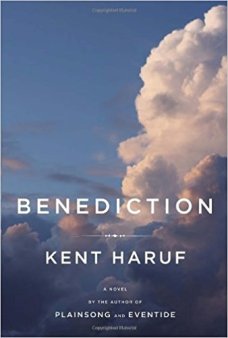
Cover for BenedictionBest Book of the Week!
Goodreads has Benediction listed as Plainsong #3, which makes me wonder what that means. The first two novels in the series, Plainsong and Eventide, were very closely related, but this one not so much. All three of them are set in Holt, an imaginary town in Eastern Colorado, but then again, all of his novels are set there. Yet, these three novels all have titles related to religious services and song.

Dad Lewis is dying. That’s the central focus of the novel. But this novel even more than the others provides a picture of small-town life by looking at the neighbors and others in touch with Dad during his last weeks.

Dad is loved by his wife Mary and daughter Lorraine, but his son Frank has long since disappeared from their lives. When Frank was a young man, Dad was not understanding at all about his homosexuality, and that conflict eventually resulted in a complete break.

Dad is also perhaps not being fair to his long-time employees. When he was 22, his boss gave him an opportunity to buy the hardware store, and he has owned it ever since. Now he wants a reluctant Lorraine to take it over instead of extending the same opportunity to his two employees.

There are other things Dad frets over and even hallucinates about, but the novel isn’t just about Dad. The Lewis’s next-door neighbor Berta May has taken in her granddaughter Alice after her daughter’s death. Lorraine lost her daughter years ago, and she and retired schoolteacher Alene take Alice under their wings.

Reverend Lyle has been sent to Holt after a problem in Denver. His wife and son John Wesley are unhappy in Holt, and soon Lyle begins expressing opinions that leave some of the town in an uproar.

This novel is written in Haruf’s lovely spare prose. In theme and plot, it seems more diffuse than his other novels, but it is profound and moving.

Related Posts

Our Souls at Night

Gilead

Pastoral

Literary Wives: Announcing Next Year’s Books!

Literary Wives logoWe have two more books to go in the list already selected for Literary Wives, taking us through June. So, a few weeks ago, the wives started discussing books for the upcoming schedule. We’re happy to announce that we have chosen the next seven books for 2017-18. Here are the new books we just added to our schedule:

August 2017: On Beauty by Zadie Smith
October 2017: Dept. of Speculation by Jenny Offill
December 2017: A Lady and Her Husband by Amber Reeves
February 2018: The Blazing World by Siri Hustvedt
April 2018: The Headmaster’s Wife by Thomas Christopher Green
June 2018: Stay With Me by Ayobami Adobayi
August 2018: First Love by Gwendolyn Riley

As usual, if you would like to participate in the discussion, just take a look at the schedule posted on any of our blogs and read along, then post your comments on our reviews, which usually go up the first Monday of the month. Please join us on Monday, April 3, for a discussion of Z: A Novel of Zelda Fitzgerald by Theresa Fowler.

Day 1054: Room

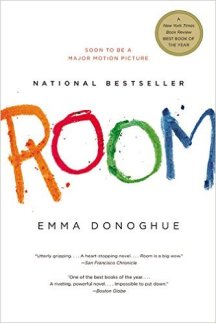
Cover for RoomReviews and even the book blurb have made no secret of a major plot point of Room, that it is about five-year-old Jack and his Ma, who has been kept captive in a small room for 10 years. Perhaps Donaghue meant this to be a surprise, simply presenting us at first with a strange situation that is difficult to understand, but there has been too much publicity about this novel to keep this plot point hidden.

Donaghue is clever to make the novel be from Jack’s point of view, because this is the only world he has known. His Ma has told him that the world presented in grainy black and white on their TV is all made up.

But an incident with Old Nick, their captor, makes Ma realize that they could be left locked in their shed to die. So, she begins making plans for their escape, plans that require Jack to leave Room by himself.

This novel is certainly compelling. I read it in one day last October despite spending a great deal of time preparing for our move. At times, though, I didn’t believe Jack’s voice. Yes, he is often childlishly naive, but sometimes Donaghue gives him insights that a five-year-old wouldn’t have. I’m not talking about his almost telepathic sense of what his Ma is feeling, but of other times when he has some rather sophisticated thoughts.

So, I think this novel has been a little over-rated, but it is still certainly worth reading.

Related Posts

Finders Keepers

Before I Go to Sleep

The Day She Died

Day 1053: The Loving Cup

Cover for The Loving CupI continue to feel less satisfied with the Poldark series as it comes to the end. The only reason I have kept reading at this point is because I have read 10 of the 12 books. Also, I would like to see what happens to Ross and Demelza.

Unfortunately, I am less interested in their children, and the last two books have been mostly about their oldest two. Neither Jeremy nor Clowance seems well defined to me, and both of them have poor judgment.

Early in this novel, Clowance, whose only good judgment of late has been to break off with Stephen Carrington, reconciles with him. They marry shortly after, and Stephen looks to be getting himself into George Warleggan’s clutches financially.

Jeremy is regretting the unlawful act he committed with Stephen and his friend Paul. It is 1813, and there is still war on the continent, so Jeremy has decided to enlist to get away, especially from thoughts of his unsuccessful pursuit of Cubey.

While Ross is away serving his last term in Parliament, Demelza makes a discovery that causes her to have doubts about Jeremy. She begins wondering if she and Ross have done a good job of raising their children.

I will read this series to the end in the hopes that Clowance and Jeremy will get some sense. Unfortunately, only the older characters who have been with the series from the beginning seem to have much depth.

Related Posts

The Miller’s Dance

The Stranger from the Sea

The Angry Tide

Day 1052: A Farm Dies Once a Year

Cover for A Farm Dies Once a YearA Farm Dies Once a Year is Arlo Crawford’s memoir of growing up on his parents’ organic vegetable farm in Pennsylvania. It focuses particularly on a summer and fall when Crawford returned to the farm as an adult.

Crawford had been living in New York and then Cambridge, Massachusetts, for years before he decided to return home to the farm for a few months before relocating with his girlfriend, Sarah, to San Francisco. Although he was never interested in farming, he found himself at a loss for what he wanted to do with his life.

In between descriptions of hard work and uncertainty on the farm and his father’s worry and fits of anger, Crawford tells the story of his parents’ decision to become farmers. He talks about the first years of difficult life in Appalachian Pennsylvania, his boyhood on the farm, and significant episodes, particularly the senseless murder of a family friend and neighbor when Arlo was 12.

This is a well-written account, evoking both the beauty of the countryside and the sheer hard work of farming a large operation and marketing the produce. It reflects Crawford’s ambivalent attitude toward his home and his parents’ legacy. I enjoyed it very much.

Related Posts

The Rural Life

The Omnivore’s Dilemma

A Mountain of Crumbs

Day 1051: The Bookman’s Tale

Cover for The Bookman's TaleIt was difficult for me to decide how much I liked The Bookman’s Tale. Parts of it were very interesting and just up my alley, while other parts of it struck me as unnecessary.

Peter Byerly is a young seller of antiquarian books. His beloved wife Amanda died unexpectedly, and since then, he has been taken over by grief. He has moved from the States to the cottage in the Cottswolds that they bought just before she died, because their previous home held too many memories.

Peter finally becomes interested in something when he finds a watercolor of a woman who looks like Amanda in a book in an antiquarian book shop. In trying to track down more information about the artist and his subject, he gets onto the track of a document that could be the holy grail for antiquarians—something that proves Shakespeare wrote his own plays. This document is in the form of the Pandosto, a play written by Robert Greene that formed the basis for Shakespeare’s The Winter’s Tale. This play seems to have Shakespeare’s annotations in it. Later, there is a murder.

Periodically, we go back in time to trace the course of this document. We know there was a real Pandosto, because we see that a man lends it to Shakespeare with some trick in mind.

We also periodically look back to Peter and Amanda’s romance. Peter trains as a book restorer, so we learn something about this field, which I found fascinating. However, although I was interested in Peter and Amanda’s relationship at first, after a while I started to wonder why we were getting so much detail about it, since it didn’t have that much to do with the rest of the book.

So, a mixed review on this one. It has a good mystery about two feuding families and a lot of interesting detail about books, but the romantic storyline slows it down after a while.

Related Books

The Secret Life of William Shakespeare

The School of Night

The Forgotten Garden


Day 1050: Golden Age

Cover for Golden AgeGolden Age is the last book in Jane Smiley’s Last Hundred Years trilogy. It begins in 1987 and finishes a couple of years into a slightly dystopian future.

The Langdon family tree has expanded since the first book. Now, the original Langdon children are in their 60’s and 70’s. One has died of cancer, and by the end of the novel, only one of them is still living.

By necessity, this novel concentrates more on some of the Langdon descendants than others. Frank and Andy’s sons Richard and Michael are continuing to clash. Richard forges a political career by being a compromiser, while Michael makes it big on Wall Street and subsequently misappropriates funds from several member of his family. Joe’s son Jesse continues to struggle with the farm while both of his sons go to war. Claire finally finds happiness with Carl. Felicity becomes an environmental activist, while Janet spends most of her time with horses. Henry and Andy are also important characters.

Like the other novels, Golden Age covers most of the important events in its time period, the past 30 years—recessions, wars, 9/11, climate change, and fiscal crimes. Guthrie goes to Iraq. A family member is killed on 9/11. Michael is a major criminal on Wall Street.

Although I still felt some distance from the characters because there were so many and because the narration skips around from one to another so often, I couldn’t help but be caught up by the sheer volume and breadth of the trilogy. I wasn’t sure what I thought about the projection into the future of a country largely devoid of rain and mounting in chaos. Smiley, of course, couldn’t predict our current peculiar election results, which shows up the problems with this type of predictive writing in a largely realistic novel. Some aspects of her last chapters remind me a bit of Margaret Atwood’s Maddaddam series.

Related Posts

Some Luck

Early Warning

Maddaddam

Day 1049: Lafayette in the Somewhat United States

Cover for Lafayette in the Somewhat United StatesIt was interesting to contrast Lafayette in the Somewhat United States with the other book about the American revolution I read recently, Nathaniel Philbrick’s Valiant Ambition. While Valiant Ambition concentrated on what made Benedict Arnold a traitor, this book focuses on the French contribution to the war, embodied particularly by the Marquis de Lafayette.

The Marquis himself
The Marquis himself

In some ways, both books cover the same ground, particularly the woeful state of the Continental army. Several times, infusions of cash from the French saved it from utter ruin. But the writing style and the intent of these books are different. Vowell’s book is written in an informal, sprightly style with many references to current popular culture. Also, Lafayette’s impetuous, affectionate character comes through strongly.

This book is a slightly quirky homage to Lafayette’s contribution to our country, featuring side-trips to various battlefields and landmarks as well as a cogent, irreverent discussion of the events. It is a fun read.

Related Posts

Valiant Ambition: George Washington, Benedict Arnold, and the Fate of the American Revolution

Abigail Adams

Ross Poldark

Day 1048: Hide and Seek

Cover for Hide and SeekHide and Seek is Wilkie Collins’s third novel. It acknowledges inspiration from Charles Dickens and shows his influence in plot and characterization. It is getting closer to the works he is most famous for but is certainly not his best.

The novel begins in the household of Valentine Blyth, an artist. Valentine is a breezy, accepting person with an invalid wife. The one thing he fears to lose is his adopted daughter, Madonna, whose parentage is unknown. He is afraid that someone will come and take her away sometime.

Valentine himself took Madonna from the circus. She had been taken in at birth by Mrs. Peckover, a clown’s wife. Her mother died having her, refusing to speak of her people and leaving behind only a bracelet made from two people’s hair. Madonna later became a deaf/mute after an circus accident, and Valentine saved her from harsh treatment by the circus master.

Valentine has befriended a careless young man named Zach, with whom Madonna is in love. Zach in his turn befriends a rough man named Mat, who has just returned from adventures in the Americas. Here Collins’s geography breaks down a bit, for Mat speaks mostly of adventures in South America and claims to have been scalped in the Amazon, when scalping and some of the other things he mentions are definitely North American. It is through the identity of Mat that the plot thickens.

In this novel, Collins’s characters tend to be one-dimensional, and his plot is often easy to predict. Several times I was ready to quit because I felt the novel dragging. This was probably because, although most of the characters are likable, I wasn’t particularly interested in them. I think Collins is at his best in mystery plots (although this one has its mysteries), and his characterization eventually becomes much richer.

Related Posts

Basil

Oliver Twist

Great Expectations