Day 949: Traitor’s Purse

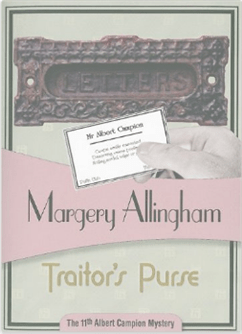
Cover for Traitor's PurseA man awakens in a hospital to realize that he remembers nothing about who he is or what has happened to him. Then he overhears a nurse and policeman talking. Someone has killed a policeman. Thinking they are talking about him, he escapes in the outfit of a fireman.

We soon learn that the escaping man is Albert Campion. Although he is picked up outside the hospital by his fiancée Amanda, he soon realizes that something important is happening and everyone is looking to him for instruction. He must stop something from happening, but he doesn’t know what.

This mystery, which is set during World War II, has to do with a plot to destroy the foundations of the country. All Campion knows is that it involves the mysterious Institute of Bridge, an organization called the Masters, and the number 15.

In this novel, we understand a little more about Campion’s thinking, precisely because he’s not behaving in character. I believe he is normally supposed to be somewhat inscrutable, because he’s frequently described as “wooden-faced.” Because of the unique situation of the novel, it is truly suspenseful.

Related Posts

The Tiger in the Smoke

The Singing Sands

At Bertram’s Hotel

Day 948: Sacred Hearts

Cover for Sacred HeartsBest Book of the Week!
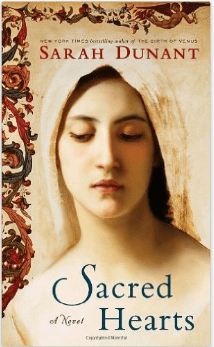
Sacred Hearts is another book I read for my Walter Scott Prize project. Although Sarah Dunant is an author I’ve read in the past with moderate enjoyment, I very much enjoyed her novel about the Borgias, Blood & Beauty.

This novel is also set in Renaissance Italy, in 1570 Ferrara. Dunant begins the book by telling us that in the second half of the 16th century, dowries had become so expensive that roughly half the daughters of noble families were consigned to convents, whether willingly or unwillingly.

Suora Zuana is one of that number. When her professor father died years before, she had nowhere to go and her dowry was small. Yes, dowries had to be paid to convents as well, but they were much smaller than those paid with brides.

Her small dowry has not earned Zuana very many comforts in the convent of Santa Caterina, but she has created a valuable role for herself as a healer and dispenser of remedies. She has managed to bring along many of her father’s books, although some of the most valuable were stolen at his death by his students and peers, and she has greatly expanded the convent’s herb garden. Aside from caring for the convent’s ill, she makes medicines for the bishop and others.

At the opening of the novel, she is on her way to drug Serafina, a novice who has been screaming for days, ever since she was forcibly ensconced in the convent by her family. She is a girl from Milan, so no one in the convent is familiar with her family. Suora Zuana is able to calm her, and later they find she has an angelic voice, which delights the convent choir director.

For the sake of everyone’s peace, the abbess, Madonna Chiara, asks Suora Zuana to take Serafina under her wing rather than handing her over to the novice mistress, Suora Umiliana. So, Zuana begins teach Serafina how to prepare medications. None of the sisters know that Serafina has hatched a plot to escape from the convent with her lover, the musician Jacopo.

What Serafina doesn’t understand, although she probably wouldn’t care, is that this is a politically delicate time for Santa Caterina and for all convents in general. Reforms on the heels of the Counter-Reformation have resulted in a cracking down on convents in some cities. Madonna Chiara fears that the convent’s few liberties will be lost, especially if they have a scandal. Their means of making a living will be removed, their orchestras disbanded and performances disallowed, their books will be confiscated, and they will no longer be allowed outside in the garden. Visitors will only be able to see them behind a grating. This is what has been happening throughout Italy.

On the local front, some of the sisters, led by Suora Umiliana, would like the convent to become stricter in its observances, even though it is already strict. Suora Umiliana is a religious zealot who is fascinated by Suora Magdalena, the convent’s “living saint.” Although Suora Magdalena has long been close to death, when she was younger she had fits of ecstasy and suffered from stigmata. Shortly after Serafina arrives at the convent, Magdalena has the first of her fits in years and speaks to Serafina. Later, when Serafina becomes ill, Umiliana thinks she can use her condition to take over control of the convent from Chiara.

Although I was interested in this novel, it took me some time to become really involved in it. I am revealing more about the plot than I usually would, because the description of the book from the blurb about how Suora Zuana comes to care for Serafina does little to convey the depths and power of this novel. For quite a while I had no idea where it was going and wondered how interested I was, but the novel turned out to be very much worth reading. This is one that really sneaks up on you.

Related Posts

Blood & Beauty

The Malice of Fortune

The Chalice


Day 947: Owl Song at Dawn

Cover for Owl Song at DawnWhen I first started reading Owl Song at Dawn, I was afraid it was going to be one of those quirky, feel-good novels that I’m coming to dislike. Fortunately, it turned out to have more depth than that.

Maeve is a woman in her eighties who owns the Sea View Lodge, a lodging house in a small seaside town in the south of England. Her policy has been to welcome guests with disabilities, and she provides a full-time residence for Stephanie, a young woman with Down Syndrome. Dot, the mother of Steph’s best friend Len, who also has Down Syndrome, is working with a social worker to arrange a home there for Len, because Dot is dying. A potential problem, at least for the authorities, is caused because Steph and Len consider themselves boyfriend and girlfriend.

Maeve’s memories are sent back to her adolescence and young adulthood by the arrival of Vince Roper, who has come to patch up their differences. Vince was her good friend when she was young. With her twin sister, Edie, who had severe disabilities, they made a threesome until Maeve began dating Frank. Then a series of tragedies culminated in Frank leaving Maeve at the altar. Maeve has always blamed this on Vince and has never understood why Frank left her.

This story is told nonsequentially with interjections by Edie, who is always with Maeve in spirit.

link to NetgalleyAlthough I felt there were some points where Maeve was inordinately obtuse and on the other hand where problems were cleared up too easily, I ultimately found this novel touching. The reasons that Maeve was angry with Vince for so long are flimsy, though, and she has brooded over them for so long that you’d think she would have figured out the truth, which is obvious, long ago. Her own perception that she has been shutting herself off from others for years is laughable, given her living situation.

These are small, niggling faults, though. Overall, I enjoyed this novel. It is touching without going too far, and it does a great job of showing us the loving personalities of its disabled characters. On the other hand, I see that it is on the long list for the Not the Booker Prize (for which you can vote this week from this link). I’m not sure how books get on this list, but I don’t really think this is a prize-winning novel. My favorite book on that list (although I have not read many of them) is Rush, Oh! by Shirley Barrett, which I will be reviewing in the next couple of weeks.

Related Posts

Relativity

The House We Grew Up In

We Are Not Ourselves

Day 946: The Story of the Treasure Seekers

Cover for The Story of the Treasure SeekersA while back, I read E. Nesbit’s The Railway Children. Although I liked it well enough, I did not find it as delightful as the book I’m reviewing today, The Story of the Treasure Seekers. This first novel of Nesbit’s is about the Bastable children, Alice, Dicky, Dora, Horace Octavius (known as H. O.), and Oswald. The narrator keeps his identity secret, but we can tell fairly soon that it’s Oswald.

The Bastable’s mother died not long ago, and the children are vaguely aware that their father is having financial problems. He has removed them from school, and the house isn’t nicely kept up. So, the children have a council, and they each come up with a plan for finding treasure.

The novel is about what happens as the children try to raise money, their plans ranging from holding up people on the common to dowsing for gold. The novel is very funny, I think even more for adults than for children. Children will enjoy the kid’s adventures, but adults can understand an entire additional layer of information that the children in the book don’t, for example, that the Robber they find in their father’s study is probably not a Robber.

The naivety of the narration lends this novel a charm and humor that a straightforward third-person narrative would not. This is a lovely, funny book.

Related Posts

The Railway Children

Ballet Shoes

Anne of Green Gables

Day 945: Literary Wives! How to Be a Good Wife

Cover for How to Be a Good WifeToday is another review for the Literary Wives blogging club, in which we discuss the depiction of wives in modern fiction. If you have read the book, please participate by leaving comments on any of our blogs. Be sure to read the reviews and comments of the other wives!

Ariel of One Little Library
Emily of The Bookshelf of Emily J.
Kate of Kate Rae Davis
Lynn of Smoke and Mirrors
Naomi of Consumed By Ink

My Review

Marta has stopped taking her medication. She has been on it for years, and the only other time she stopped, she suffered symptoms of severe depression. This time she keeps glimpsing a young blond girl. Although the girl doesn’t speak to her, she seems to be trying to tell her something.

Marta has been married to Hector for many years, and they have a grown son. Marta seems inordinately upset because their son has left home to go to college. Her marriage to Hector seems almost cartoonishly old-fashioned. Her mother-in-law gave her a book about being a good wife when she married Hector, a book that was out of date when she got it. But she has tried to follow it. Aside from behaving like a 50’s housewife, she has been set limits by Hector beyond which she is not allowed to drive. It is not safe, he claims.

The more we learn about Marta’s life, the more disturbing this novel seems. Are we to believe that Marta is descending into madness, or does it seem as if her memories of her past life are oddly murky and she’s finally remembering?

I’m not sure if we’re to believe that Marta is an unreliable narrator or not. Certainly, no one in the novel ultimately believes her, but I do. I found this novel chilling and completely compelling.

What does the book say about wives or the experience of being a wife?

Caution: My answer to this question involves spoilers, so if you don’t want to know, stop reading now.

I don’t believe we can generalize at all from this novel, because Marta’s is a peculiar circumstance. If we believe her, then she was captured as a young girl and held captive by Hector for two years under the house. She eventually escaped, but he recaptured her, kept her drugged, and created false memories for her to convince her she was a different person. She has lived as a drugged captive, trying to please her husband and feeling love only for her son.

Again, this is a novel about power, and Hector holds all the power in this relationship. The only power Marta has is in subversive minor disobedience, like smoking and pretending to take her pills. Although Marta finally escapes, it is at a terrible cost, since no one believes her. Are we to believe there is really no record of her kidnapping or that they either didn’t look hard enough or she is delusional? I know what I believe, but you may not agree.

Related Posts

Before I Go to Sleep

The Happy Marriage

Finders Keepers

Day 944: Checkmate

Cover for CheckmateBest Book of the Week!
I thought I finished reviewing Dorothy Dunnett’s Lymond Chronicles series ages ago, so it was with some surprise that I discovered I never reviewed the last book. Here it is!

* * *

In this last book of the Lymond Chronicles, Francis Crawford of Lymond has returned from Russia to France. Although I have concentrated in my previous reviews on the swashbuckling and intrigue of the novels, I have not mentioned the shadows that haunt Lymond, particularly the question of his parentage. This question was brought forward in an earlier book by the appearance of the mysterious Marthé, who looks exactly like him. These shadows have put him under tremendous pressure in the last couple of novels, culminating in horrendous migraines and even temporary blindness.

Another problem is his marriage to Philippa Somerville in a previous novel. He married her to save her reputation when they were travelling together, but both of them have since found that they are in love with the other. However, he considers his reputation and lineage to be too besmirched to keep her as his wife, so he has not told her of his feelings, and they have been trying to get an annulment. Their marriage has been in name only.

In any case, Lymond is now fighting the English for France in the Hapsburg-Valois war, a position he has taken on to hurry along his annulment from Philippa. As the wife of a Scottish nobleman, Philippa has been ordered to attend Mary Queen of Scots in France as Mary prepares for her marriage to the French Dauphin.

In trying to help Lymond find out the truth about his past, Philippa places herself in horrible danger and subsequently has a breakdown. Lymond leaves his post to care for her, and they discover their feelings for each other. But the result of her trauma is that Philippa feels unable to be more intimate with him, so Lymond eventually asks leave to go back to battle and preferably his own death.

It is much more difficult to review this final book without giving away spoilers. Suffice it to say that Lymond’s questions about the Dame of Doubtance prophecies and his own heritage are answered, there is plenty of action, and a satisfying conclusion. All the tangled knots that appeared in the previous books are untied. In any case, if you’ve been reading the series, you are already hooked, and will be unhappy, like me, to see the series end.

Related Posts

The Disorderly Knights

Pawn in Frankincense

The Ringed Castle

Day 943: The True Heart

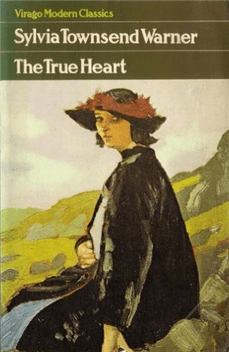
Cover for The True HeartThe True Heart is the book chosen for my Classics Club spin on Monday. I’m reviewing it this week because I have Literary Wives on the same day. It is the first book I’ve read by Sylvia Townsend Warner, and it is an interesting mix.

On the surface, it is a simple tale about the efforts of a naive young woman to win her love. But it has allegorical overtones and Warner admitted that it is her retelling of the myth of Cupid and Psyche. Let me just say that stories of women who labor long and hard to prove their love for men (and, actually, the other way around) have never been my favorite.

Sukey Bond, straight out of an orphanage school, is sent to work on a farm as a servant girl. Her escort part of the way is Mrs. Seabourn, a clergyman’s wife, and even though Sukey is afraid of the unknown, she is sure that Mrs. Seabourn would not take her anywhere bad.

On the Noman’s farm, she meets Eric, who appears to be another farm worker, but no one seems to mind if he doesn’t work. Sukey is very naive and inexperienced, and she is surprised when Eric seems to like her. She doesn’t notice how he is different than the other workers. They begin meeting each other away from the farm and decide they are in love.

But one day Eric has an epileptic fit after he sees Sukey kill a chicken. It is not until then that Sukey learns Eric is considered an “idiot.” (He is odd, certainly, but doesn’t really seem mentally lacking so much as on another plane of existence.) It is also not until then that Sukey learns Eric is Mrs. Seabourn’s son. This puts him well above her in social station, but she thinks Mrs. Seabourn would be happy that Eric has her to take care of him. So, when Mrs. Seabourn comes to take Eric away, Sukey quits her job and follows.

But Mrs. Seabourn is not the person Sukey thinks she is. She is ashamed of Eric and horrified and angry when Sukey presents herself. She sends Sukey away, and the girl is penniless and friendless until she finds work at another farm.

At the home of her new employer, she hears a garbled account of Mrs. Seabourn being snubbed by a “princess” at some event. She decides that if she were to go to Queen Victoria and get Mrs. Seabourn a bible from her, Mrs. Seabourn might be grateful and relent. So, she quits her job again and is off to London.

I hardly know what to think about this novel. On the one hand, it seems unlikely that events, which could go so horribly for Sukey, depend on her constantly receiving help from unexpected people. Too, it was difficult for me to imagine a person could be so simple-minded and naive. (Of course, I assumed she was a little older than she actually was until they told her age at the end.) On the other hand, I don’t think we’re supposed to take this apparently simple tale at face value.

Related Posts

The Vet’s Daughter

Rebecca

Tess of the D’Urbervilles

Day 942: Siracusa

Cover for SiracusaNews flash! The Man Booker long list was announced today, and I have actually reviewed one of the books!

* * *

Siracusa is a sometimes shocking story about a disastrous vacation in Italy. Two couples, linked by a friendship between the husband of one and the wife of the other, vacation together with one couple’s pre-teen daughter. The trip this year has been planned by Taylor except for a detour to Siracusa, Sicily, planned by Lizzie. The story alternates among the points of view of the four adults.

Lizzie’s voice seems the most reliable, but all of the adults are unreliable narrators for one reason or another. Lizzie, a writer, is deluded. She is in love with her husband Michael and does not know he is unfaithful. Michael, a formerly famous playwright who has been working on the same novel for years, is a liar who likes power games. He has been cheating on Lizzie with a waitress named Kathy.

Finn is a restaurant owner who smokes too much and is serially unfaithful. His wife Taylor is snobbish and shallow, and she is so overprotective of their 10-year-old daughter Snow that she talks for her. At some point, Taylor begins making a play for Michael, whom both she and Snow adore.

At Siracusa, a tragic chain of events begin when Kathy appears as a surprise for Michael and begins trying to maneuver him out of his marriage. It isn’t until then that Michael realizes he wants to stay with Lizzie.

link to NetgalleyThis novel is complex and interesting, with a shocking conclusion. I was rather freaked out by one of the characters from early in the novel, and my impressions turned out to be right. From starting out to be a fairly mundane story of relationships, this novel works up quite a bit of suspense.

Related Posts

Fates and Furies

The Happy Marriage

Gone Girl

Day 941: Let Me Tell You about a Man I Knew

Cover for Let Me Tell You About a Man I KnewLet me first get this over with. I have rarely encountered a book title that seems so inappropriate to the actual book. This title, which seems so similar to the opening of a 60’s Ray Charles song, is for a historical novel about a fictional relationship between an ordinary woman and Vincent Van Gogh.

That over with, the book itself is another matter. Susan Fletcher’s Corrag was one of my favorite books a few years ago. Even though I have missed some of her others, I was excited to hear about this one. It did not disappoint.

Jeanne Trabuc is the wife of Charles, who runs the mental asylum in Saint-Rémy. She finds herself in a lonely time of life. Her best friend has left town, and her boys have gone off to lead their own lives. She and her husband sleep separately, and she feels unloved. He has many rules about how the house should be run. She feels separate from the other women in the village, whom she feels gossip too much.

link to NetgalleyThere have been no arrivals at the asylum in years, so Jeanne’s interest is piqued when she hears a Dutch painter is coming. Charles does not allow her near the asylum, but she sees the man in the olive orchard painting and begins talking to him. Slowly, she finds herself wondering how she became what she is, instead of the adventurous girl she was.

This novel is more about Jeanne than Van Gogh, but it is touching and compelling. Jeanne Trabuc and her husband were actual people that Van Gogh painted, but Fletcher tells us that the lives she has created for them within the novel are entirely fictional. This novel is about the silences that can grow between people.

Related Posts

Corrag

Clara and Mr. Tiffany

Burning Bright