
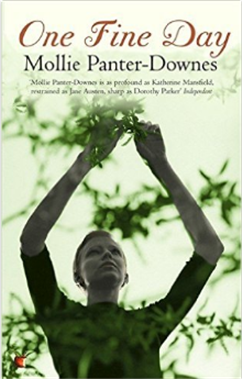
 This week’s Best Book is One Fine Day by Molly Panter-Downes!
Day 935: Acté
 Acté was Alexandre Dumas’ first novel and a partial inspiration for Henryk Sienkiewicz’s Quo Vadis. As with most of Dumas’ work, it is based on actual historical characters. That being said, my research tells me that it is unlikely that Acté was a Christian convert.
This novel begins in Corinth in the year 57 A.D. Corinth is preparing to hold a competition of wrestling, chariot racing, and singing. Acté, a beautiful Greek girl, is on shore when a bireme arrives containing one of the competitors. Acté falls in love with this man, Lucius, at first sight, and he appears to fall in love with her.
Lucius wins all three competitions but in a manner that seems to fill the audience with dread. He also behaves in an oddly commanding way. To the reader, things don’t look good for Acté, but she heedlessly runs off with Lucius, leaving her home and father behind.
It is not until their arrival in Naples that Acté learns with horror her lover’s true identity. He is the Emperor Nero. Acté is further horrified at the behavior of his court, especially the dissoluteness shown during feasts.
Nero’s formidable mother, Agrippina, actually approves of Acté and hopes that by her innocence, she will discourage Nero from his excesses. But in shock one night at the behavior during a feast, Acté runs to Agrippina for shelter. Unfortunately, that is the same night that Nero has decided to have his mother murdered by sinking her ship with her on it. Agrippina and Acté are almost drowned, but they get away, and Acté is rescued on the shore by the Apostle Paul. Agrippina, although briefly rescued by Acté, ends up dying.
There are lots of descriptions of races and fights and battles in this novel, but its focus is on the fall of Nero and the role Acté played. Acté herself is just a cardboard figure prone to fainting, which is interesting since she is strong enough to swim to shore from the middle of the Bay of Naples, supporting Agrippina, and is described in terms of an athlete and Diana the huntress.
 In addition, the many pages wherein St. Paul describes his conversion and in doing so recounts most of the life of Christ, are deadly dull and unnecessary. If his words are meant as the inspiration to convert Acté, I believe they would be more likely to put her to sleep.
All in all, this novel is interesting as the start of Dumas’ career but is not in itself the most compelling of historical novels. It is based on the most damaging of the accounts of the life of Nero, who has been rehabilitated to some extent in more recent scholarship.
Note that the cover at the top is for a French-language version. The only English-language version I could find had just a black cover. My own version is a Kindle collection of complete Dumas works, published by Delphi Classics, shown just above.
Related Posts
Day 934: One Fine Day
Best Book of the Week!
It is shortly after World War II, and Laura Marshall and her family are trying to return to normal life during the privations of post-war England. With only one part-time housekeeper, Laura is struggling with unaccustomed chores. The house and garden are beginning to look shabby, which bothers Laura’s husband Stephan, who struggles with the lawn every weekend.
The family is also having to accustom itself to living together again. Through the war, Laura and her daughter Victoria shared the house in a relaxed way of life with various female friends and children. Stephan is inclined to be more fastidious, while Laura is dreamy and untidy.
This novel takes place over the course of a fine summer’s day as Laura does her chores and thinks about a way of life that is disappearing. It is beautifully written, with evocative descriptions of nature. Barrow Down, which looms over the landscape, is an important feature of this novel.
This is a lovely short novel.
Related Posts
Day 933: The Night Stages
 While reading The Night Stages, I kept wondering when, if ever, the stories of the characters would link up. The answer is, one character’s story does not, except metaphorically. Still, I thought the novel was at times poetic, and engrossing and affecting enough to recommend it.
It is post-World War II, and Tam is fleeing her married lover. Upset by a confrontation she had with him, she drove from her cottage in Kerry to Shannon Airport and took a flight to Gander in Newfoundland. There, she has been stranded by fog for several days. While she waits in the lounge, she examines a cryptic mural, Flight and Its Allegories by Kenneth Lochhead. Tam’s relationship with Niall has been poisoned, not by his thoughts of his wife Susan but by his memories of his lost brother Kieran.
Kieran as a boy suffers from rages that overpower him. When he was young, his mother and her chemist, both addicted to pain killers, committed suicide. His father finds it impossible to handle Kieran, who hears his mother’s voice inside the house, but Kieran likes the housekeeper, Gerry-Annie. When Gerry-Annie announces she is taking Kieran home with her to live, no one objects.
Kieran develops a deep love of the Kerry countryside and travels all over it on his bicycle. While Niall is studying in college to be a meteorologist like his father, Kieran is an unskilled laborer who loves the stories and songs of the country people. Then Kieran falls in love with Susan, Niall’s fiancée. The story climaxes around the Rás, a bicycle race through the Irish countryside.
Making the novel seem more diffuse is the introduction of Kenneth Lochhead as a character. We see how episodes from his life have inspired characters in his mural. But the description of the mural is a difficult thing to grasp just through text, and the small pictures that come up in Googling it convey very little, although I would love to see it sometime. It seems to me as though the emphasis on the mural and this character take away some of the power of the novel.
Flight is a recurring theme of the novel. Tam used to be a pilot during World War II, flying planes from one location in the U.K. to another. She is on a flight from her earthbound life in Ireland, and of course Kieran has flown Ireland. Then there are the descriptions of biking down the steep mountains and through the valleys of Kerry.
Although I think the novel would have been more cohesive without Kenneth, and in retrospect, Tam’s past as a flyer seems irrelevant (although making me wonder why the person she was before would put up with the situation with Niall), I was deeply involved in the story of Kieran, Susan, and Niall. I think this is an ambitious novel that doesn’t quite accomplish its goals but is beautiful and definitely worth reading.
Related Posts
Day 932: Black Swan Green
 Jason Taylor is thirteen years old in 1982, the beginning of Black Swan Green. He is somewhat of a misfit, obviously bright and interested in poetry, a stutterer, but he spends most of his time hiding his true self to be more acceptable to his schoolmates. Still, acceptance is fleeting. One year he is on the margins of popularity; the next, he’s a pariah.
His parents have some problems he doesn’t understand. His older sister Julia can’t wait to leave home for university. The economic climate is grim in the wake of Thatcherism.
Black Swan Green seems to Jason to be the most boring village imaginable. Still, he manages to have some adventures, visiting a strange old lady in the depths of the woods, taking poetry lessons from Madame Eva von Outryve de Crommelynck, literally dropping in on Gypsies, all the while trying to avoid the popular bullies in his class.
Although I sometimes wondered where this novel was going (and for a while wondered if any time travelers were going to appear), it eventually got there. More importantly, it features a distinctive voice of a bright, funny, sometimes naive boy. It has a unique notion of character that to me makes the novel stand out.
Related Posts
Day 931: Horses of the Night
 Horses of the Night seemed like a good choice for me, because it’s about Christopher Marlowe, and I do enjoy novels about literary figures. I just never developed much interest in this novel, however, and gave it up after 100 pages or so.
The novel concentrates on Marlowe’s spying career, involving him right away in the Babington Plot. Although Marlowe is alleged to have been a spy, nothing is known of his activities. At least as Aggeler depicts it, Marlowe seems to have little role in the case, sent in at the end of the plot with only a few lessons in how to be a Catholic. He is involved long enough, however, to become sympathetic with one of the alleged plotters, Margaret Copley.
 Aggeler appears to be previously an academic writer. For this novel, he has adopted a pseudo-Elizabethan writing style throughout, even for descriptive passages. This is an interesting approach, and it is not inherently irritating, but I found the writing overblown at times.
I also felt as if I was seeing a Marlowe who was not the actual person I would expect from my admittedly limited reading, a man more conventionally likable than Marlowe probably was.
Related Posts
Best Book of the Week!
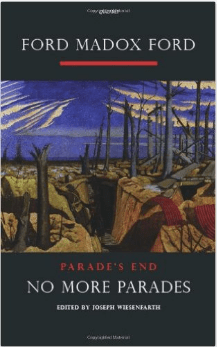 This week’s Best Book is No More Parades by Ford Madox Ford!
Day 930: Early Warning
 Early Warning is the second in Jane Smiley’s Last Hundred Years trilogy. It continues the story of the Langdon family, picking up in the 1950’s and ending in 1985.
The family, which began with a couple and their children and the occasional appearance of other relatives, expands during this period to grandchildren and eventually their children. As you can imagine, by 1985 we are dealing with many characters.
This is one of my criticisms of the novel. With so many characters, we don’t spend very much time with any, which creates distance from the novel. I already felt this with the first book, and this feeling increases for the second.
But is the purpose of this novel to follow the characters or the main events during these times? It seems to be the second, as we look at the ennui of suburban housewives in the 50’s, the Cold War, the Vietnam War and its associated protests, the counterculture and Jonestown, to name a few. Smiley manages to have at least one family member involved in each of these events or movements, which is quite an accomplishment for one family from Iowa.
Of the Langdon children whose families are the focus of this novel, Frank concentrates most of his attention on business and sexual escapades, while his wife Andie struggles with a feeling of pointlessness and self-absorption. Neither of them pays much attention to their children, except that Frank puposefully fosters competition between his two twin boys, Richie and Michael. All of his children suffer from this upbringing, and the boys are at times truly scary.
Joe is the only Langdon to stay on the farm, and although he was one of my favorite characters in the first book, we don’t see much of him in this one. He and Lois have had some lucky breaks, and the farm is in better financial shape than their neighbors’, but decisions of the Reagan administration make small farms a tough business.
Lillian and Arthur raise a rowdy and happy family in Washington, D.C. But Arthur’s job with the CIA brings him under terrific pressure, and a tragic loss creates ramifications for years. This family has more than its fair share of sorrows.
Claire eventually marries a doctor and settles down in Iowa. But she has selected her husband almost in competition with a friend and eventually regrets her choice.
The novel is saved somewhat at the very end by a touching event linked to the presence of a character who isn’t explained until the end, one who appears in the middle of the book and at intervals throughout. At first I found the introduction of this character confusing, but I figured he had to be a family member, so then it wasn’t too hard to guess who he is.
I will read the final book, but I fear that the distance I feel from the story will only increase.
Related Posts
The All-True Travels and Adventures of Lidie Newton
Day 929: The Railway Children
 The Railway Children is a classic British children’s story, written in 1906. At the beginning, Roberta (Bobbie), Peter, and Phyllis live a happy and comfortable life with their parents in a suburb of London. Then one evening two men come to see their father, and they hear angry voices. Their father goes away with the men, and shortly afterward they move with their mother to a cottage in the country.
Here things are a bit more primitive. They only have one servant, a housekeeper, and a pump in the yard for water. They have to help their mother more, and Peter can’t go to school. Their mother can’t play with them, because she is busy writing stories for money. They are poor and have to be careful how much coal they use and what they eat.
Near their house is the railway, and they find lots to entertain themselves watching the trains and getting to know the men at the station. They wave to an old gentleman on the morning train every day, and they have adventures related to the railway.
I can see why children would love this story. Although the children’s adventures are all realistic, they would be exciting reading for children. There is also the mystery about their father. Character development is not a strong suit of the novel, but the children and their mother are sympathetic and the children behave like actual children.
Perhaps the novel does not have as much to offer adults, especially those who didn’t read and love the book as children. Still, it’s easy to see why the book is still popular.
Related Posts
Day 928: The View from Castle Rock
 The View from Castle Rock is an earlier Munro collection of short stories than Family Furnishings, which I previously reviewed. Since Family Furnishings is an anthology of Munro’s stories over the course of her career, I had already read several of the stories in The View from Castle Rock.
All of these stories have to do with the history of Munro’s family. In “No Advantages,” she has traveled to the area of Scotland where the Laidlaws came from. This story incorporates excerpts from other writings and quotes the epitaphs of some of her ancestors. It explains their hard life and the kinds of people her 18th century ancestors were.
In “The View from Castle Rock” Munro relates a family legend about how their drunken great-great-great grandfather James Laidlaw took his son Andrew up onto Castle Rock in Edinburgh to view America, probably as a joke, since they were looking at Fife. Although he talks of emigration throughout his life, he is unhappy when some of his sons finally take him and their families to America. This story is about their voyage and the fates of some of the family on board.
Other stories are more recent. “Hired Girl” is about a summer when Munro worked as a hired girl at a beach house on an island. For that summer, she had to learn that her employers did not consider her an equal. This was a tough lesson, as her mother especially had always had some pretensions of superiority even though they were poor.
In “Home” she revisits home after living away for some years. Her father has remarried after her mother’s death, and her old house has changed almost completely.
 The stories in this collection are powerful, relating the hard life of her family farming and raising fur, their close-mouthed quality, pride, and stubbornness. She is courageous in her ability to look at everything with honesty, even her own foibles.
One comment I have to make is on the cover of my Vintage International edition, shown here. It has absolutely nothing to do with the contents of the book and gives an entirely misleading idea of the stories. The only story that even faintly is about a beach is “Hired Girl,” and the girl is not exactly lying around in the sand. Sometimes I wonder what publishers are thinking. The cover that I used at top is much better.
Related Posts
 What? Me Read?