Day 917: Neverwhere

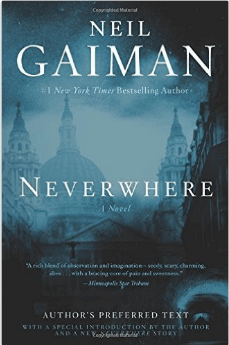
Cover for NeverwhereI haven’t read any Neil Gaiman except a book about a witch that he wrote with Terry Pratchett. That one was very silly, but I thought I should read some more Gaiman since he is so popular. I should maybe mention that fantasy is not usually my genre, with notable exceptions.

Richard Mayhew is happy with his life. He is a successful young investment counselor and is engaged to a beautiful but demanding woman. One night when they are on the way out for an important dinner with his fiancée’s boss, he finds an injured girl lying on the sidewalk. The girl is filthy, and Richard’s fiancée wants him to call an ambulance and leave her there. But Richard picks her up and takes her to his apartment.

We have already met the girl, being chased by two villains named Mr. Croup and Mr. Vandemar through dirty dark tunnels. When the two men come to Richard’s apartment looking for the girl, he says she is not there.

The girl’s name is Door, and she asks Richard if he will go somewhere for her and fetch the Marquis de Carabas. Doing this favor takes him to a strange world underneath London. Richard returns Door to the Marquis, but once she is gone, he realizes he can’t return to his own world. When he tries to, people can’t see him. He finds he has no job, no fiancée, and his flat is in the midst of being let to someone else. He returns to the other world to get help from Door.

Door is the daughter of Lord Portico, a family famous for opening things. Recently, her entire family was slaughtered by Croup and Vandemar, and she wants to find out who ordered it and why. When she returns home to find her father’s diary, it tells her to go to Islington, a legendary angel. Richard finds himself accompanying Door, the Marquis, and Door’s bodyguard Hunter on a dangerous quest through this alternate world that makes its home in the London underground, with characters whose names play on the names of underground stations.

At times this novel seems quite juvenile. In fact, partway through I started trying to figure out if it was intended for adults at all. This is because the humor often seems to be aimed at 14-year-old boys, for example, a villain who is constantly eating live slugs and pigeons. But the Introduction states that it is meant for adults, to do for them what books like the Chronicles of Narnia did for Gaiman as a child.

For this adult, anyway, it fails. I was mildly sympathetic to Richard’s plight, but the book doesn’t do enough with the characters to get us more interested in them. And I wasn’t enamored of Gaiman’s vision of a filthy, mud-filled underworld of strange beings.

Related Posts

Good Omens: The Nice and Accurate Prophecies of Agnes Nutter, Witch

The Night Circus

The Summer Tree

Day 916: The Unraveling of Mercy Louis

Cover for The Unraveling of Mercy LouisAt the beginning of this novel, it is 1999 and the last day of Mercy Louis’s sophomore year in high school. The novel is set in the downtrodden refinery city of Port Sabine, Texas. Mercy lives with Maw Maw, her grandmother, a woman who combines a background of Cajun superstition with strict fundamentalism. Maw Maw has visions and believes that the End of Days will arrive at the end of the year.

Mercy is focused on the thing she finds most important—basketball. She follows her coach’s rigid routines and diet, and she doesn’t drink or get involved with boys. Her best friend and teammate Annie isn’t so careful, though, about parties or boys.

Troubles for the town begin when an employee of a convenience store finds the body of a fetus in the dumpster. National attention falls on the town, fundamentalists demonstrate against the evils of baby killing, and attention soon turns on the town’s teenage girls. As one of them remarks, it’s as if suddenly it’s a sin to be a girl.

Mercy feels pressure from other sources, too. She has had a fit or a vision at church. She has received a letter from her mother, who left her when she was a baby. She also has a boyfriend for the first time, Travis, a boy from an artistic, liberal background. And she’s started having trouble controlling one of her arms.

The other major character is Illa Stark, a misfit girl who has only one friend, Lennox, who works with her on the school paper. She has a crush on Lennox, but he is dating the formidable Annie. Illa also has a fascination with Mercy, the star of the girls’ basketball team.

Illa’s mother is wheelchair bound after a huge refinery accident several years ago. Now she hardly ever goes out. Illa doesn’t get out much either except as manager of the basketball team and in pursuit of her interest in photography.

Although this novel is a coming of age story, it is more about the pressures of religious fundamentalism on girls. Mercy tries to cope with the natural desires of teenage years to date and have fun, both of which she has been brought up to believe are evil.

I did care about these characters, but I felt that in some ways, although the novel doesn’t tie up all the threads, it comes to some easy solutions of the characters’ problems. I also found the writing—which is overloaded with similes and metaphors—to be irritating at times. So, I had a mixed reaction to this novel.

Related Posts

Tell the Wolves I’m Home

Under the Lemon Trees

The Witches: Salem, 1692

Day 915: Come to Harm

Cover for Come to HarmKeiko is a Japanese exchange student working on her doctorate who has accepted a grant from an association in Painchton, Scotland, near Edinburgh University. Her grant comes with a free flat that has even been stocked with food. Keiko is overwhelmed by everyone’s hospitality, particularly with their propensity for stuffing her with food, much of which she finds unappetizing.

Not everyone is welcoming, though. Her landlady Mrs. Poole is the proprietor of the butcher shop below Keiko’s flat. She is a recent widow, but her unfriendly behavior seems to indicate more than grief. She has two sons, Malcolm and Murray, and she certainly isn’t encouraging them to befriend Keiko. She also spends every morning cleaning the seldom-used slaughterhouse in the yard.

Early on, Keiko finds a note behind the radiator in her flat. It is clearly from a blackmailer, perhaps to the previous occupant of the flat. She also notices that several women have vanished from town. As Keiko tries to figure out what is going on in town, she also has quite a few misunderstandings with people through not understanding exactly what they’ve said.

I had a few problems with this novel that I haven’t had with other McPherson thrillers. For one thing, the reasoning behind the Painchton Trading Association’s grant to Keiko seems so flimsy that I had a hard time imagining even a child would believe it, let alone the entire town. The town committee seems to be up to something illegal, which lends to the atmosphere of the novel.

And then there is the resolution of the plot. First, Keiko’s suppositions run so berserk that I started to think the novel was an elaborate joke and that maybe I was reading an updated version of Northanger Abbey. But I won’t say whether I was right or not.

So, I wasn’t as happy with this novel as with others by McPherson, particularly as compared to the wonderful Quiet Neighbors. I thought it was obvious fairly early on that one character was dangerous, but Keiko doesn’t realize this until very late in the novel. Still, the novel is atmospheric and the ending is suspenseful, and parts of it are funny, so all that will probably keep most readers happy.

Related Posts

Quiet Neighbors

The Child Garden

The Day She Died

Day 914: History of the Rain

Cover for History of the RainBest Book of the Week!
The distinctive voice of its narrator is what stands out to me about History of the Rain. But again, I feel as if I may not be able to convey just how wonderful I found this lovely novel.

Ruthie Swain is a young girl bedridden from an illness. In her attic bedroom under a watery skylight she is trying to read her father’s thousands of books. She is also writing a novel to try to understand him. During this effort, she writes about Ireland, her village, and the history of her family, especially about the Impossible Standard. Her story incorporates the mythological heritage of Ireland as well as references to countless literary authors and characters and the eccentric residents of her village.

Ruthie’s mother’s family, she says, evolved from salmon, and her mother first meets her father salmon fishing, and is hooked. But that gets way ahead of the story, which in unchronological order recites the history of her father’s family, the story of the Impossible Standard and his evolution into a poet.

To give a flavor of the novel, here is how Ruthie imagines the first time Ruthie’s father Virgil is invited to dinner at her mother’s house:

“So, how do you like it here?”
“Very much.”
“Good.”
That exhausts the dialog. She realizes she hasn’t folded the napkins and takes hers and begins to press it in halves. Virgil does the same. Both of them are useless at it. Maybe evenness is a thing intolerable to love. Maybe there’s some law, I don’t know. She lines up the halves of hers, runs her forefinger down the crease. When she picks it up the thing is crooked. So is his. She undoes the fold and goes at it again, but the napkin wants to fall into that same line again and does so to spite her, and does so to spite him, or to occupy both with conundrums or to say in the whimsical language of love that the way ahead will not be a straight line.

She doesn’t give up, and he doesn’t give up. And in that is the whole story, for those who read Napkin.

This novel is funny, heartbreaking, and lovely. It is about the loves of reading and poetry and Ireland and life. I loved this book.

Related Posts

Tell the Wolves I’m Home

The Fault in Our Stars

Nora Webster

Day 913: The Unforgotten

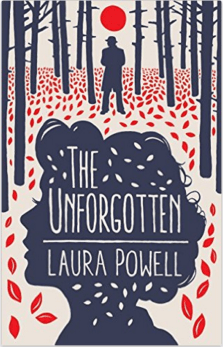
Cover for The UnforgottenA novel set in two time periods, The Unforgotten is a thriller and a mystery. But it is more than that—a story with deep-running themes offering its characters difficult choices.

In 1956 Cornwall, Betty Broadbent is an innocent, naive 15-year-old. She helps her unstable mother run a hotel and sometimes has to run it herself when her mother is in the throes of depression or alcoholism. The small fishing village has been invaded by reporters after the murders of several young women.

In 2006, Mary reads that the man who served time for the murders back in 1956 still insists he is innocent. Mary remembers him as the man her mother used to date and believes he is innocent. She thinks she knows who the actual killer is and is torn between telling what she knows and keeping a long-held secret. Although we don’t know why she is living under another name, we are soon sure that Mary is Betty.

This novel is about the painful choices two people must make under difficult circumstances. It is also about a sad and doomed love affair.

At first I thought that some of the dialogue and situations were unlikely, but I soon forgot those thoughts, driven forward by the sheer power of the story. It is one that has many more levels than first expected. This is a great first novel by Powell.

Full disclosure: I received a copy of this novel from the publisher in exchange for an honest review.

Related Posts

The Lace Reader

Sharp Objects

The Last Summer of the Camperdowns

Day 912: Literary Wives! The Disobedient Wife

Today is another review for the Literary Wives blogging club, in which we discuss the depiction of wives in modern fiction. If you have read the book, please participate by leaving comments on any of our blogs. Be sure to read the reviews and comments of the other wives!

Ariel of One Little Library
Emily of The Bookshelf of Emily J.
Lynn of Smoke and Mirrors
Naomi of Consumed By Ink

My Review

Cover for The Disobedient WifeA distinctive characteristic of The Disobedient Wife is its sense of place in an unusual setting, Tajikistan. The novel contrasts the lives of two women, Nargis, a nanny and maid who is struggling to support her family, and Harriet, her employer.

The novel begins during a bitterly cold winter, and Milisic-Stanley effectively conveys how difficult life is for the majority of Tajiks. Harriet, in contrast, lives a life of luxury as the wife of a foreign diplomat. At first, she is not a very sympathetic character, as opposed to Nargil. The novel makes it clear that Harriet is a trophy wife who angled to take her husband Henri from his previous wife.

Nargil, on the other hand, is separated from her second husband. She loved her first husband, who died, but was rushed into her second marriage by her parents. Her second husband has proved abusive to her and her son, so Nargil has left him, at the expense of leaving her youngest son Faisullo with her husband’s family. She has no legal right to her son if her husband doesn’t grant it.

By contrast to Nargil’s, Harriet’s life is one of idleness and boredom. Her husband is almost constantly working, frequently away traveling, and she has little purpose to her life.

The writing style of this novel was so florid at first that it bothered me. However, I quickly got involved in the women’s stories and in the details of life in Tajikistan, particularly in Nargil’s life.

What does this book say about wives or about the experience of being a wife?

Literary Wives logoAlthough the marriages are very different, I felt they were both stereotypical, and a bit of a weakness in the novel. For one thing, we see very little of any positive interactions between the wives and husbands. As Nargil is separated from Poulod, we don’t see day-to-day interactions but understand he was an abuser. The novel concentrates more on the difficulties Nargil faces with his continuing presence in her life and her lack of rights.

Henri expects Harriet to be a proper hostess to his guests. Otherwise, he doesn’t spend much time with her. He patronizes her and leaves her with the children most of the time. It’s difficult to imagine why they ever got married.

I guess the message we’re supposed to get about this topic is that both women have the courage to leave their marriages, no matter how different.

Related Posts

The Happy Marriage

The World’s Wife

A Thousand Splendid Suns

Day 911: A Place Called Winter

Cover for A Place Called WinterI read A Place Called Winter for my Walter Scott Prize project, the second book I’ve read for the 2016 list. Like one of the other books I read recently for that project, Arctic Summer, it has as a major theme the main character’s homosexuality. However, I found myself feeling much closer to the characters and more interested in the plot of this novel than I did for Arctic Summer.

At the beginning of the novel, Harry Cane is being treated, or rather mistreated, in an asylum in Canada. Shortly thereafter, he is transferred to an experimental center that treats the patients much more humanely. We understand that Harry has committed a crime, but we don’t know what it is. Between short chapters about his life at the center, we learn what brought him there.

The story of Harry’s life begins when his wealthy father dies. His brother Jack is still in school, and Harry undertakes his education and expenses. Harry is a man of no occupation who feels that he would like one, but he doesn’t know what to do about it. He feels vaguely that he would like to work an estate or a farm but thinks he has to be born to it. A shy man with an occasional stammer, he likes reading and horses. Eventually, he marries a shy woman, Winnie, who informs him on their wedding night that she loves someone else. Nevertheless, he cares for his wife and loves his daughter.

An investment recommendation by his brother-in-law takes a large part of Harry’s inheritance, and Harry and his family are forced to move in with his in-laws. He is an innocent-minded person, so it is not until he meets an actor named Browning that he realizes he is homosexual. He begins an affair with Browning, but then disaster strikes. His affair is exposed to his in-laws by a blackmailer and Harry is forced out of the family. Even his brother Jack, whom he loves, is pressured by his wife not to correspond with him.

Now totally alone, Harry emigrates to Canada and ends up in Saskatchewan, which is just being opened to settlement by the arrival of the Grand Trunk Railway. On shipboard, he meets Troels Munck, who finds him a position where he can learn farming and then helps him purchase a homestead. Munck, though, is a bully, and from the moment Harry meets him, we know that relationship will not end well.

link to NetgalleyHarry finds that a farmer’s life suits him. He settles in, works hard, and makes friends. But we know where he is at the beginning of the book, so the tension builds as we find out how he got there.

Although the time spent to get him to Canada, where the book really captured me, seems a little long, by the time he gets there, we know Harry very well. He is a kind and polite person, but he earns our respect when he finds his niche. Eventually, I became deeply involved in his story. It was also interesting in its details of early homesteading and treatment of mental illness.

Related Posts

Arctic Summer

This Godforsaken Place

Giants in the Earth


Classics Spin #13!

It’s time for another Classics Club Spin, for which I will post the rest of my Classics Club list, numbered. On Monday, the spin will select the number of the novel I must read and review by August 1. Since August 1 is a Literary Wives posting date, I will be posting my review the week before. And, since I have fewer than 20 books left on my list, I will have to repeat some of them. I have gotten my list down so that many of the remaining books are rereads. So, here goes:

  1. Cover for The MoonstoneThe Vicar of Wakefield
  2. Beloved
  3. Ada
  4. Henry VI, Part II
  5. The Idiot
  6. The Moonstone
  7. The True Heart
  8. Troy Chimneys
  9. Vanity Fair
  10. Bleak House
  11. Middlemarch
  12. The Beggar Maid
  13. The Moonstone
  14. Troy Chimneys
  15. The True Heart
  16. Vanity Fair
  17. Ada
  18. The Idiot
  19. Beloved
  20. Bleak House