Day 797: Dissolution

Cover for DissolutionIt is shortly after the death of Queen Jane in Henry VIII’s reign. Matthew Shardlake is a lawyer employed by Thomas Cromwell, Henry’s vicar general. Like Cromwell, Shardlake believes in reforming the Catholic church to abolish its abuses.

Cromwell has already dissolved the smaller abbeys and is now ready to start on the large ones. His commissioner Singleton has traveled out to investigate an abbey in southern England, Scarnsea, to find an excuse to dissolve it. Cromwell has received a letter from Singleton’s assistant saying that Singleton was murdered. Cromwell dispatches Shardlake to investigate the murder and find an excuse to close the abbey.

Shardlake has just returned from Sussex, and his disability as a hunchback makes him dread another journey in the winter cold. He takes along his own assistant, Mark Poer, who has recently been demoted for becoming involved with a lady in waiting.

When Shardlake arrives at the abbey, he finds that Singleton was decapitated, possibly with a sword. Sometime the same night that Singleton was murdered in the kitchen, someone sacrificed a chicken on the church altar and stole a holy relic.

Shardlake finds a complex environment with many possible suspects, particularly the five senior monks who have access to the keys. He also finds himself unfortunately attracted to Alice, a serving woman employed in the infirmary, as does his assistant Mark.

This is a complicated mystery not just set in a historical time but close to and involving the important events of the time. Shardlake is an interesting character whose faith in his master Cromwell is disturbed by what he learns in his investigation.

Although I picked up on key clues when they appeared and did guess the murderer of Singleton, a lot more happens in the novel that is harder to figure out. I’ve read good things about this series and think it is certainly worth continuing. This book is the first in the series, for those who are interested.

Related Posts

The Tudor Secret

Bring Up the Bodies

Wolf Hall

Day 796: Slade House

Cover for Slade HouseBest Book of the Week!
I haven’t read any ghost stories lately, so David Mitchell’s Slade House will have to do for a first nod to Halloween. Fans of Mitchell know to expect something unusual from his work, and Slade House is no exception. This novel features a series of characters over five decades all about to set foot in the mysterious Slade House.

Nathan Bishop, a nerdy teenager perhaps on the autism spectrum, is on his way with his mother down Slade Alley looking for Slade House. In the alley they meet a workman and ask him directions. He has never heard of it. They find the small iron gate leading into the gardens, and the workman is the last person ever to see them.

Nathan has taken a little of his mother’s Valium, so he thinks the drug is affecting his vision when the scenery in the Slade House garden fades. But something more sinister is happening while his mother is in the house attending a concert.

It’s difficult to say much more about this novel without revealing too much. Suffice it to say that people are in peril and the suspense builds accordingly. The book is divided into six sections, beginning in 1979, with each one set nine years further on. Each time a person is drawn into the house, never to be seen again.

link to NetgalleyReaders of Mitchell will pay attention in the last section when the name Marinus is mentioned, for they know that a few of the same characters appear in his books, sort of. Let us say that characters with the same names appear in his books. Slade House continues the complex story of horologists that came to the fore in The Bone Clocks.

As usual with Mitchell’s books, Slade House reflects exciting writing, a complex back story, a large creep factor, and a battle between good and evil. What more could you want?

Related Posts

The Bone Clocks

Ghostwritten

The Thousand Autumns of Jacob de Zoet

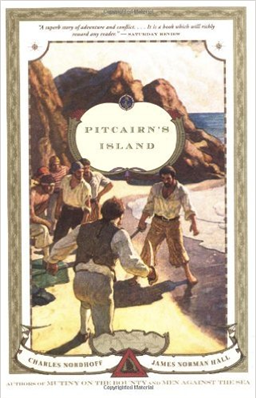
Day 795: Pitcairn’s Island

Cover for Pitcairn's IslandThis final novel in the Bounty Trilogy tells what happened to the mutineers from Mutiny on the Bounty. As explained in the introduction, the fate of the mutineers was not known until Pitcairn’s Island was rediscovered by an American ship in 1808. Although the mutineers arrived 18 years before, only one survived, surrounded by the wives and progeny of himself and others.

As the authors explain, the only information available about the fate of the mutineers was directly or indirectly from Alexander Smith, but those sources failed to agree and many accounts were improbable. So Nordhoff and Hall presented what they thought was the most likely version of events.

The mutineers and their companions arrive at Pitcairn’s Island in 1790. They have already tried to settle twice in Tahiti and once in the Friendly Islands (Tonga) but had to leave for fear of discovery or because of hostile natives. With the nine mutineers are six native men and twelve native women. Although all of the islanders get along well at the beginning while they are busy building their homes and planting their crops, the seeds of failure are already there, in the quality of some of the mutineers.

The first problems are caused by John Williams. He already has a woman named Fasto, but he lusts for Hutia, the wife of one of the native men, Tararu. When disputes over the woman reach the heights of disruption, Fletcher Christian allows Hutia to pick her husband. She picks John Williams, thus introducing the first tension between whites and native men.

But Christian’s biggest mistake is his egalitarian impulse to grant each man a vote on the future of their community. Although he wants to extend this vote to the native men, the whites do not agree, and it is this plus the votes extended to the less scrupulous whites that cause the problems. Eventually, some of the lowest of the men begin treating the native men as their slaves. The final break between whites and natives comes after a vote about ownership of the land, for the whites want to own the land and reduce the natives to servants.

Although most of the novel is peaceful, taking place in a tropical paradise, the worms in the apple are a few of the white men. A palpable tension brews throughout the novel.

If I have a criticism, it is that the final portion of the novel, presented as Alexander Smith’s story to the mate of the Topaz in 1808, goes on for a bit too long past the fate of the islanders into Smith’s discovery of God and the Bible. Other than that, the novel is gripping and a fine conclusion to the trilogy.

Related Posts

Mutiny on the Bounty

Men Against the Sea

Robinson Crusoe

Day 794: Classic Club Spin #10! Selected Poems of Robert Frost

Cover for Selected PoemsMy book for Classics Club Spin #10 is Selected Poems of Robert Frost. I have to confess to not having quite succeeded in finishing my selection this time, but more than 300 pages of poetry is a lot of poetry to read. I got about halfway through the book.

Poetry is just not my thing, I guess. I did enjoy many of the poems in this book, but they were the same ones I’ve enjoyed before, so it was like visiting old friends—“Mowing,” “Mending Wall,” “After Apple-Picking,” “The Road Not Taken,” “Acquainted with the Night,” “Stopping by Woods on a Snowy Evening.” Most of these, I notice, are devoted to observations about nature or are about rural work.

I do not so much enjoy what Robert Graves refers to in the introduction as his “poignant country dramas,” like “The Death of the Hired Man.” They seem more like prose to me, which is ironic, since I am generally more comfortable with prose. But they are not what I come to Frost for. I come to him for things like this:

My long two-pointed ladder’s sticking through a tree
Toward heaven still,
And there’s a barrel that I didn’t fill
Beside it, and there may be two or three
Apples I didn’t pick upon some bough.
But I am done with apple-picking now.

Related Posts

The Bees

The Selected Poetry of Edna St. Vincent Millay

Goodbye to All That


Day 793: The Lives of Others

Cover for The Lives of OthersI probably haven’t read enough contemporary Indian novels, or maybe I wouldn’t be surprised that two of them are partially about the Naxilite rebellion of the 60’s and 70’s. Apparently, a good deal has been written about it without my being aware of it before.

The Lives of Others deals with the rebellion on the one hand and the lives of an upper-class family, the Ghoshes, on the other. Prafullanath Ghosh is a member of the wealthy Ghosh family, owners of an expensive jewelry store in Calcutta. But Prafullanath was robbed of his inheritance by his older brother when he was a young man. So, he has worked his way up to become the owner of several paper factories.

His family, however, is not so much interested in the business as in the benefits that accrue from it. His two oldest sons are dilatorily employed by the business while the third son wastes money through a publishing concern. The poor economic climate and Prafullanath’s ill-advised business decisions as an old man threaten the business, and then a strike shuts down the most productive factory.

But the family’s floundering fortunes aren’t so much the focus of the novel as the decadence of the family itself. With nothing much to occupy themselves, some of the wives and the sister bicker endlessly. The four-floor house is occupied according to prestige, with the more important family members living higher, away from the noise and dust. Purba, the widow of the youngest son, and her two children have one room on the ground floor while each other family has a whole floor. Purba is treated worse than the servants.

Although Prafullanath has been ill since his youngest son’s death, his other sons have their vices. Adinath is alcoholic, Priyo is subject to sexual obsessions, and Bhola practically throws money away. At first, Adinath’s son Supratik seems to have escaped the family decadence. He has left home and school without warning to work among the poor farmers and instruct them in Mao’s teachings. He is a Naxilite.

About a third of the novel consists of Supratik’s letters, written to someone who for a long time is not identified. He writes about the plight of the farmers, who are being plundered by large landowners in league with the police. He also writes about the activities of his small cadre.

Even though his deeds eventually become savage, for a long time Supratik seems to be the only Ghosh with praiseworthy motives, but this account is more nuanced than to paint anyone as simply good or evil. Almost all the adults in the novel are in some way corrupt.

Although set mostly in the 60’s and early 70’s with flashbacks to earlier times, an epilogue shows that the same kind of corruption is going on today. The Lives of Others is a novel that is powerful but difficult to read. It is an indictment of class and caste divides, corruption, and the imbalance between the rich and the poor.

Related Posts

The Lowland

The Circle of Reason

An Atlas of Impossible Longing

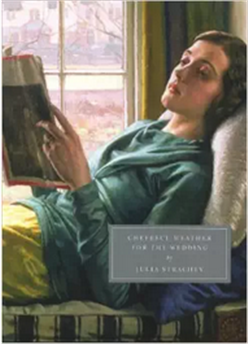
Day 792: Cheerful Weather for the Wedding

Cover for Cheerful WeatherBest Book of the Week!
The house is in chaos on this morning of the wedding of Mrs. Thatcham’s daughter Dolly. Her two sons are arguing about the socks Robert has on and Kitty, the younger daughter, is screaming at the top of her lungs for her maid to find her brooch.

Breakfast has not been served after Mrs. Thatcham’s contradictory commands, and Mrs. Thatcham has just come in from a bitterly cold gale. Still, she thinks the weather is cheerful, as we find that her only criterion for cheerful weather is visibility.

Upstairs, Dolly is putting on her bridal garb with a bottle of rum in her hand. Downstairs, one of the guests, Joseph, has been asking if he can see the bride before the wedding.

At a little more than 100 pages, this novel by Julia Strachey (Lytton Strachey’s niece) is astonishingly rich. Upon its publication in 1932, it was regarded as nearly perfect. And so I find it.

Related Posts

Greenbanks

Someone at a Distance

Mrs. Dalloway

Day 791: Moloka’i

Cover for Moloka'iIn late 19th century Honolulu, Rachel Kalama is only seven years old when she develops leprosy. It starts out as just a pink spot on her leg, but as soon as authorities spot it, she is examined and exiled to the leper colony on Moloka’i. Even though her beloved Uncle Pons is already on the island, she is not allowed to stay with him but must live in the girls’ dormitory at least until she is 16. The facilities on the island are primitive and the rules rigid. She is the youngest resident of the island. It’s tough for a little girl.

Although Rachel’s father Henry writes regularly to her from his travels as a seaman, she soon has her letters to her mother returned to her. She never sees her mother again. The novel tells the story of Rachel’s life from the time she is admitted to the colony until she is an older woman.

I have to admit that I hesitated to read a novel about lepers, thinking it might be too gruesome. But Rachel’s story isn’t depressing. Aside from lightly covering a great deal of the recent history of Hawaii, beginning with the deposing of the queen by the United States, the novel depicts a life in a tough environment that slowly becomes a community. If anything, at times the novel seems to depict a rosier environment than seems possible.

Owing to lack of characterization and the prevalence of description versus action and dialogue, I was not captured by this novel until almost the end. I was interested to see what would happen, but I didn’t find the characters very involving. Still, I found the end of the novel touching, and I enjoyed learning about the history and customs of Hawaii.

Related Posts

The Descendants

Shanghai Girls

The Known World

Day 790: Jade

Cover for JadeOf the Sally Watson books I rediscovered, Jade is one I haven’t read before. I’ve mentioned that Watson wrote several of her novels around a person from her own ancestry, but it is not clear to me if the outlines of each story are based on family legend or are just invented around the events of the time. This question becomes of special interest in regard to Jade, which is the least likely of Watson’s books to date, even if part of it is based on history.

Jade’s real name is Melanie Lennox, but she much prefers her old nickname. She is a rebellious girl completely taken up by her own ideas of right and wrong. She is especially incensed by slavery and women’s lack of rights, which makes early 18th century Williamburg an uncomfortable place for her and for her family, who doesn’t know what to do with her.

The last straw for Jade’s father is when he finds she has been sneaking off to meet Monsieur Maupin, an elderly Frenchman, for fencing lessons. Tired of beating her, her father ships her off to Jamaica to live with her aunt and uncle. With her goes her slave Joshua, whom she’s been trying to free since she was 10.

In Jamaica, she is disgusted by the slave market and the treatment of field slaves, so her aunt and uncle are surprised when she wants to buy a proud untamed African woman, whom she names Domino. But Jade sees something in Domino that reminds her of herself. In fact, Jade isn’t really getting along any better in Jamaica, but doesn’t stay there long.

Jade’s aunt and uncle hear of yellow fever on the island, so they dispatch Jade and her two slaves back to Virginia. They return on the same ship they came on, but this time it is loaded with slaves. Jade decides to try to free the slaves, in which effort she doesn’t realize she’s assisted by the sardonic second mate, Rory McDonald (whose grandmother was Kelpie from Witch of the Glen).

I wasn’t quite prepared for what happens next, but maybe I should have been. Their ship is attacked by pirates and she and Rory and some other crew members and the slaves decide to join the pirates. Well, Jade and Rory are taken on board unconscious, but like Elizabeth Swann of Pirates of the Caribbean, Jade at first decides it’s “a pirate’s life for me.” Only later does her view of the life become more nuanced.

The novel’s plot is unlikely, even though it is based on the life of the famous pirate, Anne Bonny (spelled Bonney in the novel), whose ship our characters end up on. And Jade is not strictly likable, her character being so full of self-righteousness and so unbending that she can’t tell a polite lie. Also, the novel tends much more to the preachy than those I’ve read so far of Watson’s.

Still, this novel is probably a good one for insights into the abuses of the time, while still providing plenty of adventure. Little feminists in the making will be sympathetic to the restrictions Jade struggles with, such as her dislike of what she must wear, her lack of rights as a woman, and the limits to what she’s allowed to do. I personally think she’s too much of a 20th century girl, but young girls won’t even think of that.

Related Posts

Witch of the Glens

Lark

Captain in Calico