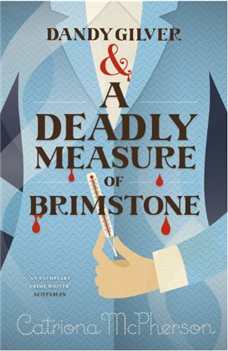
Day 781: Dandy Gilver and A Deadly Measure of Brimstone

Cover for A Deadly Measure of BrimstoneThings have been fairly stressful in the Gilver household. Dandy’s husband Hugh and both boys, Donald and Teddy, are recovering from a serious illness. Just as they begin to improve, Pallister, the butler, and Mrs. Tilling, the cook, are also felled. Dandy and her partner, Alec Osborne, haven’t had a case in months, and when Alec announces it’s time he looked for a wife, Dandy is afraid their detecting days will soon be over. Then, she has a letter from Mr. Addie and Mrs. Bowie, asking them to make an inquiry.

The job turns out to be helpful for all parties. Mr. Addie and Mrs. Bowie are upset about their mother, who died recently on a visit to a spa in Moffat. She reportedly died of a heart attack, but her children insist she had no heart trouble. Dandy thinks everyone will be served by renting a house in Moffat and enrolling the invalids at the spa. Alec goes early, pretending to have a bad back.

Once they begin investigating Mrs. Addie’s death, something seems suspicious. The police sergeant says she was scared by a ghost. He also says that although Dr. Laidlaw was there at the spa, they called in Dr. Ramsay from the village to sign the death certificate. That Dr. Laidlaw apparently refused to sign the death certificate seems suspicious to Dandy, and when she questions Dr. Ramsay, he proves to be an idiot who says that everyone dies of a heart attack. Dr. Laidlaw herself has a violent reaction to mentions of Mrs. Addie.

On her investigations of the spa, Dandy finds the attendant who prepared Mrs. Addie for burial. She says that Mrs. Addie was dirty, even under her fingernails, so Dandy begins to think she may have died outside. In the meantime Alec determines that Mrs. Addie did not believe in ghosts so would be unlikely to have been scared to death by one. Mr. Laidlaw, Dr. Laidlaw’s brother, also seems a shifty sort of person. Dandy is a little worried, because Alec seems protective of Dr. Laidlaw, a scattered young woman.

Dandy and Alec soon believe something odd is going on at the spa. For one thing, Hugh has stopped being grumpy! The arrival of a bunch of mediums makes everything even stranger.

Dandy Gilver mysteries, set in post-World War I Scotland, are light-hearted, funny, and entertaining. I am always happy to see another one coming out.

Related Posts

Dandy Gilver and a Bothersome Number of Corpses

The Child Garden

Sidney Chambers and the Shadow of Death


Day 780: A Place We Knew Well

Cover for A Place We Knew WellI was a kid during the Cuban Missile Crisis, and I don’t remember it as having much effect on our lives. I do remember the ridiculous duck-and-cover exercises and the display of model fall-out shelters, but I only remember one family that had one. I grew up in Michigan, not Florida, though, where things were apparently different.

Wes Avery realizes that something is up early on Friday, October 19, 1962. He is a former air force gunner, who took part in bombing raids over Japan during World War II. When the nearby McCoy Air Force Base begins a build-up, he notices right away.

The rest of his family is absorbed in other activities so at first doesn’t notice his concern. His wife Sarah is depressed and traumatized over a hysterectomy that was performed on her without her consent a couple of years before, after a miscarriage (sadly, all too common at that time). Her doctor is treating her with far too many pills. Charlotte, their daughter, has been picked for the Homecoming court. She is worried that she will be the only girl without a date until Wes’s employee and best friend Steve suggests that another employee, Emilio, a Cuban refugee from a good family, take her.

Emilio and Charlotte are happy about this solution, but Sarah tries to talk Charlotte into waiting, knowing that other boys whom Sarah considers more suitable will ask her. Wes has to field arguments from Sarah, who obviously thinks he tries too much to please everyone. Added to all this tension, as everyone’s awareness of the situation with Cuba grows, is a family member’s reappearance, which makes West feel disloyal to Sarah.

link to NetgalleyThis novel is effective at building tension and sympathy for Wes in the situation in which he finds himself. Despite what has happened to Sarah, it is not as good at evoking sympathy for her. Although her preoccupations turn out to have a deeper basis, if only in her own mind, they seem trivial compared to the possible immanence of war and the difficulties Wes finds himself in. I think we should feel more deeply for Sarah, but for some reason, we don’t, perhaps because her concern over Charlotte’s first date and her apparent snobbery seems so ridiculous. (Of course, there is a reason for that.)

However, overall I think this novel does a great job of evoking time and place. I think the closing chapter, a letter written in present time, is a little too didactic, though, and serves as an anticlimax even though we want to know what happened to the characters.

Related Posts

The House We Grew Up In

Amy and Isabelle

Once Upon a River

Day 779: The Quickening Maze

Cover for The Quickening MazeThe Quickening Maze is the first book I read purposefully because it’s one of the finalists for the Walter Scott Prize for Historical Fiction. By coincidence, I had already read half a dozen finalists and winners, and when I learned that Helen of She Reads Novels was trying to read them all, I decided to join her.

This novel is based on events in the life of the poet John Clare, known as the “peasant poet,” a man of rural background who was steeped in his natural surroundings. Unfortunately, Clare is having some mental problems and is staying in an asylum in Epping Forest. Nearby is Alfred Tennyson, whose brother Septimus also resides there.

John Clare seems to be doing well under the treatment of Dr. Matthew Allen. When we first meet him, his movements are relatively unrestrained and except for some confusion about a girl he knew named Mary, he seems sane enough. He is soon given a key to the gate so that he can walk in the forest.

Another patient important to the novel is Margaret, who is regularly transfixed by visions of angels and messages from god. At one point as Clare’s mental state deteriorates, he mistakes Margaret for his Mary.

Dr. Allen seems to have a gift for dealing with his patients during a time when mental health practices were deplorable. However, he also has a fascination with risk, and soon he is trying to talk his friends and the Tennysons into investing in his new invention, a machine for following the shape of furniture and carving additional pieces.

Hannah Allen at 17 has decided that Alfred Tennyson is the man she’d like to marry. She boldly begins seeking him out, not realizing that he is preoccupied with his brother and with grief over the death of a good friend.

Although this novel is more about the internal workings of some of the characters’ minds than its historical setting, it is beautifully written and atmospheric. I was interested in this narrow slice of history and curious to look at some of Clare’s poetry.

Related Posts

Under the Wide and Starry Sky

Parrot and Olivier in America

A Good Hard Look

Day 778: This Is Your Life, Harriet Chance!

Cover for This Is Your Life, Harriet ChanceA few years ago, I read Jonathan Evison’s West of Here. This Is Your Life, Harriet Chance! is nothing like it. It’s a somewhat whimsically told story of the whole of one woman’s difficult life.

Harriet Chance is a widow nearing 80 whose husband died a few months before from Alzheimer’s. She gets a call from a cruise company telling her that her husband booked a cruise to Alaska for two. At first, she has no intention of going, but then she decides to take her best friend, Mildred.

Her friends and family are a little concerned, because she claims she is being haunted by her husband, Bernard. Harriet is a little worried that they want her to enter the retirement community where Mildred lives. She loves her home and doesn’t want to leave. Besides, Bernard is haunting her.

When Mildred’s son arrives to pick Harriet up for the cruise, she learns that Mildred isn’t coming after all. Instead, Dwight gives her a letter to open on the ship. Harriet isn’t going to like what it says.

link to NetgalleyTold in a way that is supposed to remind us of the old TV show, “This Is Your Life,” the novel skips backward and forward to scenes from Harriet’s ordinary-seeming but painful life. This narrative technique is anchored by the story of the cruise, which is told linearly.

I found this novel touching, although in some ways the narrative style creates distance from the story. It’s a serious story told as if it’s a comedy, with bumbling, repentant Bernard as a chorus in ghost form.

Related Posts

West of Here

A Heartbreaking Work of Staggering Genius

Sweet Caress

Day 777: Barchester Towers

Cover for Barchester TowersBest Book of the Week!
As Trollope’s first book in his Chronicles of Barchester was about gentle Mr. Harding’s position as warden, it seems hardly possible that a good portion of Barchester Towers, the next in the series, would be about exactly the same subject. Yet, that is the case, and Trollope finds it to provide more food for satire and social commentary.

Several years have passed since the events of The Warden. The kindly old bishop, Dr. Grantly, is dying, attended by his son, the archdeacon, and his old friend Mr. Harding. Although the younger Dr. Grantly is certainly devoted to his father, he has hopes that he will be appointed to his father’s office, as he has been doing the work for years. However, just before his father dies, a new government comes in, and Dr. Proudie is appointed bishop.

The quarrels in this novel pit low church against high church, which is about all I understand about the religious issues. But all of the clergy in Barchester are high church, and Bishop Proudie is low. Bishop Proudie himself, a meek man, is not so much a problem, but he arrives with a wife who is determined to sit in on every meeting and meddle in diocese business, much to the shock of everyone else. In this she is assisted by Mr. Slope, the bishop’s own chaplain, selected by Mrs. Proudie. And an insinuating, unlikable Uriah Heepish character he is.

One of the first issues to come up for the bishop is the wardenship of the hospital for old men, which has sat vacant since Mr. Harding resigned. Bishop Proudie knows he must offer the position at its lowered salary to Mr. Harding, and Mr. Harding would enjoy returning to the house that was his home for so many years and taking up his old duties. But Mrs. Proudie wants anyone except the entrenched Barchester clergy, so she selects Mr. Quiverful, an impoverished curate with 14 children.

Under instruction from the bishop to offer the position to Mr. Harding, Mr. Slope does so by adding conditions to the position that he knows Mr. Harding will not accept and that Mr. Slope himself, or even the bishop, has no authority to request. Although Mr. Harding does not turn down the job outright, Mrs. Proudie then promises it to Mrs. Quiverful.

But Mr. Slope decides that he can run the bishopric himself if he can cut out Mrs. Proudie, so he and the bishop soon have a silent agreement to throw off the feminine yoke. They do so by offering the wardenship to Mr. Harding again. Mr. Slope has also found out that the beautiful widow, Mrs. Bold, is wealthy. He decides to marry her and feels that he won’t help his chances unless he assists her father, Mr. Harding, back into his position.

In the meantime, Mr. Slope is infatuated with Madeline Neroni, the crippled but beautiful married daughter of Dr. Stanhope. She herself is frankly toying with him and several other men, but she turns out to have some sympathy with Eleanor Bold. However, Madeline’s sister Charlotte Stanhope has decided that her impecunious brother Bertie must marry Eleanor for her money.

Barchester Towers affords another entertaining look at the political and social maneuvers underpinning this mostly religious community. It offers lifelike, engaging characters, plenty of humor, and an empathetic and perceptive view of Trollope’s own time. I enjoyed The Warden particularly because I sympathized with the upright Mr. Harding, but Barchester Towers offers more for our consideration and is an altogether more significant work.

Related Posts

The Warden

Happy Returns

Miss Bunting

Day 776: Patrick Leigh Fermor: An Adventure

Cover for Patrick Leigh FermorWhile reading Patrick Leigh Fermor’s retrospective trilogy about the journey he made in his teens, walking from Holland to Istanbul and then Greece, I was struck by the references to what seemed to be an exciting and unusual subsequent life. So, I soon looked for a biography and found this one, by British writer Artemis Cooper, the granddaughter of Leigh Fermor’s good friends and a woman who knew him from when she was a child.

Cooper goes into a little more detail than Leigh Fermor (known by his friends as Paddy) about his childhood, making clear there was a split between his parents and a good deal of neglect from both. Still, he had a happy childhood growing up in a rural setting, and his problems only began with the regimentation of school. Having failed in an academic setting and with the army, Paddy got the idea to go on his fabled walk.

Cooper summarizes the route of this walk, only she reveals the true names of the people he met (he used pseudonyms) and tells us when the stories are invented or conflated. When I read the trilogy I wasn’t aware that any events were invented or conflated, but I should have known that the level of scholarship reflected in the writing was not that of an eighteen-year-old. (Well, I did know, but he wrote the books much later in his life.)

picture of Princess Balasha
Princess Balasha

After his journey, Paddy settled in Athens and then Rumania with Princess Balasha Cantacuzene, a fascinating older woman separated from her husband. However, after World War II broke out, he hurried back to England, not realizing how long it would be until he saw her again.

Paddy spent most of the war in Crete working with the resistance. He is famous for kidnapping a German general and removing him to Egypt, an act meant to improve Cretan morale. (A movie, Ill Met by Moonlight starring Dirk Bogarde as Paddy, was made about this feat, but Paddy was unhappy with how far it drifted from the facts.) For the rest of his life, despite the unfortunate political differences that evolved between England and Greece after the war, Paddy was beloved in Crete.

picture of Joan Fermor
Joan

After the war, Paddy lived a gadabout life with many famous friends, only settling down in Greece with his wife Joan in his late middle age. He and Joan had been together 27 years before they married and for many of those years, had an open relationship.

Paddy chose the profession of writer and wrote several books about his travels and adventures. He was a raconteur who demonstrated an impressive range of knowledge and was interested in everything. Apparently very charming and loved by many people, he was not always sensitive to the feelings of others.

This biography is a well written, fascinating, and occasionally funny portrait of a remarkable man. At times, the sheer number of people mentioned made me unsure of who they all were, and there was certainly an assumption that readers would know who was meant. I didn’t always, which made the book a little more difficult to follow, but that was only on occasion.

Related Posts

A Time of Gifts: On Foot to Constantinople: From the Hook of Holland to the Middle Danube

Between the Woods and the Water: On Foot to Constantinople: From the Middle Danube to the Iron Gates

The Broken Road: From the Iron Gates to Mount Athos

Day 775: Mind of Winter

Cover for Mind of WinterSeveral times I thought I knew what was going on in Mind of Winter, but I have to give the novel credit for having completely fooled me. This chiller is set on Christmas Day during a blizzard.

Holly awakens late on Christmas morning. She vaguely remembers having awakened earlier and looked in on her daughter Tatiana, but then she fell back asleep and the family overslept. Her husband Eric rushes off to pick up his parents at the airport. Holly gets up to begin Christmas dinner for a full house, and then it begins to snow.

But Holly has awakened with a thought—something followed them home from Russia. Russia was where she and Eric adopted Tatiana (called Tatty) 13 years earlier as a baby. Throughout the day, Holly is obsessed with memories of the adoption and of incidents with her daughter as her interactions with Tatty become more bizarre.

The two of them are left alone because Eric’s parents have to be driven to the hospital and friends and family decide to stay home because of the blizzard. Oddly, some of them omit calling Holly to tell her these things directly, so she spends quite a bit of time unnecessarily preparing the dinner and has to call Eric to find out what is going on. But the oddest behavior is going on inside the house. As Holly obsesses about everything Tatty does, Tatty alternates between loving girl and rebellious teenager. This doesn’t sound that odd, but you have to read the novel to understand.

This tale is a carefully constructed psychological drama. The book blurb focuses on Tatty’s behavior, but it is really Holly’s that seems inexplicable at times. At first, she seems to be the most over-protective mother ever. Then, something else seems to be going on. The novel builds quite a bit of suspense as you try to figure out why these characters are behaving so oddly, and I didn’t see the ending coming at all.

Disclaimer: I received a free copy of this book from the publisher in exchange for an honest review.

Related Posts

The Darkest Room

The Sleep Room

Your Presence Is Requested at Suvanto

Day 774: Miss Emily

Cover for Miss EmilyLast year, I read the novel Amherst, which was mostly about Emily Dickinson’s brother Austin but depicted Emily hazily. The excellent biography White Heat, about Emily’s relationship with Thomas Wentworth Higginson, portrayed her more fully but she still seemed hard to grasp. The Irish poet Nuala O’Connor presents a more fully realized character—Emily in her middle age*—through her relationship to a (fictional) Irish maid.

Ada Concannon is a good worker but a bit too much of a free spirit for her Irish employer. She arrives at work one too many times smelling of the River Liffey, in which she has bathed on the way to work. She is demoted to scullery maid, and her mother decides there is nothing to be done but send her to America to find better opportunities.

Ada has good luck at first. She finds a pleasant home with her aunt and uncle in Amherst, and they soon learn that the Dickinsons need a new maid.

Emily Dickinson has insisted that her parents get a new maid after the old one left, because she is spending all her time on housework and none on writing. Although she loves baking, she is not really interested in most of the other chores. Other than poetry, her main interest is in her warm relationship with her sister-in-law, Sue, but Sue is busy with her family. When Ada arrives, Emily becomes fascinated by the small, neat maid.

Ada soon finds she is being courted. Daniel Byrne shows he likes her right away, and she is attracted to him. His boss’s son, Patrick Crohan, is also trying to get her attention, but she dislikes him.

When Ada finds she needs help, she has only Emily to turn to. Emily, in her turn, goes to her brother Austin.

link to NetgalleyThis novel is beautifully written, sometimes poetically, with delightfully old-fashioned chapter titles. It explores the relationship between two women across a class divide. The two main characters are interesting and convincingly developed. Austin is also developed more fully than the others, but is not as likable.

I enjoyed this novel, which made me feel as if I understood O’Connor’s fictional Dickinson as a person. Although Dickinson at 16 was just beginning to develop some of the quirks she becomes well known for, O’Conner her thinking believable.

*I originally said that Emily was 16, but Caroline of Rosemary and Reading Glasses pointed out that I was mistaken. I thought I saw a reference to her age, but perhaps I got the age reference mixed up with one about Ada. My e-copy is expired, so I couldn’t go back and look it up.

Related Posts

Amherst

White Heat: The Friendship of Emily Dickinson and Thomas Wentworth Higginson

The Invention of Wings