Day 757: Thirteen Guests

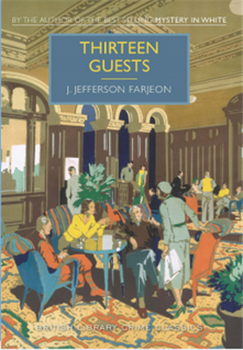
Cover for Thirteen GuestsJohn Foss is a young man running away from London at the end of a failed love affair when he injures his foot jumping off the train at a small station. Guests bound for the house of Lord Aveling take him to the doctor’s house only to find that the doctor is away treating Mrs. Morris, Lord Aveling’s mother-in-law. Nadine Leveridge, a beautiful widow, insists on bringing John along to Lord Aveling’s, the unwitting thirteenth guest at a house party.

Lord Aveling’s guests feature a cricket player, an actress, a member of Parliament, a society painter, a gossip columnist, and a novelist, but there are also some more unusual guests, a vulgar sausage king and his family and a shady couple, the Chaters. Some odd things happen almost immediately. Someone throws paint on Leicester Pratt’s painting of Lord Aveling’s daughter Anne, and an odd confrontation takes place between Zena Wilding, the actress, and a strange man at the train station. Mr. Chater seems to be around sticking his nose into everything.

After John’s foot is treated, he is parked on a sofa in an anteroom. Late that night, he hears a dog barking outside, several exchanges in the hallway, and some glass breaking. The next morning it is obvious that someone broke out of the studio that Pratt locked after he discovered his ruined painting, and the dog has been stabbed to death. Later, the strange man from the station is discovered dead at the bottom of a nearby quarry.

Of course, when Detective-Inspector Kendall arrives, he finds that many of the house’s inhabitants have something to hide. And the man no one seems to know is not the only one to die.

link to NetgalleyAlthough this Golden Age mystery involves time tables, the solution is fairly straightforward but hard to guess. Agatha Christie was a great admirer of Farjeon, who I think gives a good sense of his characters, enough to help me distinguish one from the other when there were so many of them.

Related Posts

Antidote to Venom

The Hog’s Back Mystery

Behold, Here’s Poison

Day 756: Z: A Novel of Zelda Fitzgerald

Cover for ZTo write a novel about Zelda Fitzgerald, Therese Anne Fowler had to make many decisions between competing sources. Historians and biographers are sharply divided between those who think Zelda ruined Scott’s life and those who think Scott ruined Zelda’s life. Fowler ends up coming in pretty firmly on Zelda’s side. Ernest Hemingway’s A Moveable Feast said nasty things about both of them, but many of those things have been found to be exaggerations or outright lies. In any case, I’ve always thought Hemingway was a jerk.

This novel begins when Zelda, fresh out of high school and a popular debutante, meets Fitzgerald, at that time in the army and due to ship out to Europe and World War I. It ends shortly after Fitzgerald’s death. It paints a vivid portrait of Zelda, a woman trying to find a purpose in her life beyond being a wife.

If Fowler has made the right choices, the novel creates a devastating idea of Fitzgerald, insecure, unfaithful, controlling, and alcoholic. He undercuts Zelda in every way possible, publishing her stories under his own name, taking control of her published novel in the editing stage and butchering it, being generally nasty, and threatening to take away her daughter Scottie when she wanted to accept a solo role in the ballet in Naples. His friendship with Hemingway especially drove them apart, as Hemingway was relentless in accusing her of being selfish and ruining Scott’s career, and Scott began to believe it. Note that Hemingway is the same person who did all he could to halt his own wife’s career as a war correspondent.

I was completely absorbed by the novel, which strongly characterizes Zelda and to a lesser extent, Scott. My only criticism, besides a few too many descriptions of clothes, is that most of the other characters are only sketchily drawn. A great many characters appear in these pages, and I can’t say that I had much of an impression about any of them, to the point where I couldn’t remember whether some were friends or relatives. With such vivid personalities as Cole Porter, Gertrude Stein, H. L. Mencken, and Hemingway appearing in the novel, more could have been done with them.

Related Posts

Circling the Sun

The Happy Foreigner

The Other Daughter

Day 755: The Woman Who Had Imagination

Cover for The Woman Who Had ImaginationFor some reason, I have always associated HE Bates with such comic writers as PG Wodehouse and EF Benson. This notion was without having read him, mind. But the stories in The Woman Who Had Imagination are not at all what I expected.

Most of the stories in this collection are set in rural localities and are about ordinary country people. Many of them are closer to character sketches than plotted stories. “The Lily,” for example, describes Great-Uncle Silas, a lively, vulgar old man who likes his jokes and his “mouthful of wine.” A later story describes the circumstances of his death.

Many of the stories depict characters caught in their environments, such as “The Story Without an End,” which describes the life of a boy working in a restaurant who is terrified of his boss, or the title story about a bored young man on a church choir expedition who meets a young woman unhappy in her marriage.

link to NetgalleyAlthough the descriptions of rural settings are beautifully written, many of the stories in this collection depict the lives of people who are depressed by the limitations of their lives. However, that is not always the case. In “Sally Go Round the Moon,” a man helps his niece by marriage escape the life she hates in London and then decides to leave himself.

To give you a flavor of the lushness of these stories, here is part of the description of great-uncle Silas’ house from “The Lily”:

On summer days after rain the air was sweetly saturated with the fragrance of the pines, which mingled subtly with the exquisite honeysuckle scent, the strange vanilla heaviness from the creamy elderflowers in the garden hedge and the perfume of old pink and white crimped-double roses of forgotten names. It was very quiet there except for the soft, water-whispering sound of leaves and boughs, and the squabbling and singing of birds in the house-thatch and the trees.

Related Posts

Collected Stories of Carson McCullers

Anderby Wold

Wise Blood

Day 754: The Night Sister

Cover for The Night SisterI have never read anything by Jennifer McMahon before, so I have no way of knowing whether The Night Sister is characteristic of her or not. Certainly I was captured by this creepy and original tale.

The novel is set in three different time periods and features two related sets of characters, but it begins chillingly in the present when Amy takes a shotgun up the stairs of her house in Vermont. Jason, her friend from childhood who just talked to her a week before, is shocked to be called as a policeman to her house, only to find Amy and her family dead. Only her 10-year-old daughter Lou is outside on the roof.

In California, Piper receives a call from her sister Margot. She is shocked to learn that her ex-best friend Amy and her family are dead. Even more shocking is that it appears Amy killed her family and shot herself. Piper leaves immediately for Vermont, but she is preoccupied with memories of the summer she and Amy were 11, the last summer they were friends.

Occasionally, the novel returns to the 1950’s and the story of sisters Rose and Sylvia. Sylvia is the beautiful, favored child, and Rose feels she is treated unfairly. She believes something is wrong with Sylvia and starts wondering about her grandmother’s stories about monsters. She catches Sylvia sneaking out at night to go to the tower near the family motel.

link to NetgalleyBack in the present, Piper rifles her memory about the discoveries the girls made when they were 11. By then, Amy’s mother Rose is seldom around, rumored to be in a mental hospital. Sylvia disappeared years ago, presumed to have left for Hollywood and never heard from again.

This novel is not only truly suspenseful, but it is hard to predict. Several times I was convinced I knew what was going on, but I never did. It’s a truly gothic thriller.

Related Posts

Wylding Hall

The Lace Reader

Broken Monsters

Day 753: Blood & Beauty

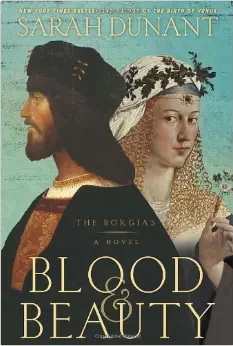
Cover for Blood & BeautyBest Book of the Week!
Blood & Beauty is a historical novel about the Borgia family that shows meticulous research, examining in light of modern findings the legends that have surrounded the family for centuries. It also powerfully evokes the period.

The novel begins with the election of Rodrigo Borgia as Pope Alexander VI. He is clever and ruthless but sentimental about his four illegitimate children. Although historically there is some debate about the birth order of the oldest two sons, Dunant firmly places Cesare as the oldest, followed by Juan, Lucrezia, and Jofrè.

Although the pope loves his children, especially Juan and Lucrezia, their value is largely in the alliances he can make through their marriages. Cesare’s value, on the other hand, is to back up his father on the religious front. He begins as a cardinal, although he is unsuited to his religious profession and eventually throws it off to become a commander of armies.

Juan’s marriage is first, but the novel is mostly concerned with the relationship among Pope Alexander, Cesare, and Lucrezia. It is much more complex than and different from what you may have heard. It is Lucrezia’s misfortune to be married into families that become enemies of the Borgias because of shifting alliances. This is particularly true of her second marriage to Alfonso of Aragon, whom she loves.

Dunant remarks in the afterward that the Borgias have not deserved their evil reputation. Certainly they were rapacious and ruthless—and more interested in the good of the Borgias than anything else—but so too were most of the great families of Italy at that time. In this novel, alliances are made and discarded at will by most of the great families.

This novel is historical fiction at its best. None of the characters are invented or romanticized, and we become immersed in the world of Renaissance Italy.

Related Posts

The Malice of Fortune

A Folly of Princes

Worldly Goods: A New History of the Renaissance

Day 752: The Ascent of Man

Cover for The Ascent of ManThe book The Ascent of Man is a companion piece to the 1970’s era TV series. The introduction to the book states that the series was an answer to Kenneth Clarke’s famous Civilisation, which left out the accomplishments of science. Author Jacob Bronowski was a well-known mathematician, biologist, and science historian.

Bronowski begins this book with our ape relatives and a discussion of evolution, but he really gets into his subject after man has moved from a nomadic to an agrarian lifestyle. His contention is that nomads do not have the time or energy to innovate.

The book takes us through a series of the most important discoveries for the improvement of human life and understanding. These include the combination of copper and tin to make bronze, mathematical discoveries, the Copernican system, the Scientific Revolution, and so on up to the double helix.

As the book is so obviously the script of a program, there are some frustrating times when it refers to an image that certainly appeared on TV but not in the book. On the other hand, the illustrations in the book are many and beautiful.

Of course, since the book was written in the 70’s, it is a little dated. One example is that Bronowski frequently comments on how slowly animals evolve, but I believe this idea has been reconsidered.

Because the discussion of the concepts is very brief, there were times when I felt Bronowski was implying a lot more than he described. That is, his greater understanding of the topic interferes a bit in his simple explanations. So, even though I watch a lot of science programs and usually have no trouble understanding them, I felt sometimes as if the explanations of the more difficult subjects have too much left out. Still, for someone who wants to learn basic information about important scientific discoveries up to the middle of the 20th century or is interested in the history of science, this is a good place to start.

Related Posts

Salt: A World History

Death by Black Hole and Other Quandaries

A History of the World in 12 Maps

Day 751: The Martian Chronicles

Cover for The Martian ChroniclesThe Martian Chronicles is an odd collection of stories about the colonization of Mars by Earth. The stories begin with an almost comic book feel, which continues with many of them, even though the message is ultimately serious, about the destructiveness of American culture. (Only Americans come to Mars.)

As with many futuristic stories, Bradbury doesn’t get it quite right, rendering them dated in these times. The stories take place beginning in 1999 and continuing for about 30 years, yet many features of the tales reflect the 50’s, when the stories were written. Of course, even the notion that Mars would be habitable for humans without space suits is a funny one for us today. Most shockingly, there is a story about all the black people leaving Southern towns for Mars, supposedly set in 2009, that is queasily stereotypical, both of the Southern whites and the African-Americans, even for the 50’s. And having shown the African-American people a modicum of sympathy in that story, Bradbury never mentions them again.

The stories begin with a series of expeditions to Mars, where the exploratory forces are killed by Martians, not because the Martians fear invasion but just sort of accidentally. The first human to Mars is murdered by a Martian in jealousy over his wife, whom the human hasn’t actually met. In fact, the Martians don’t even realize they’re being invaded. They are telepathic, but their telepathy doesn’t seem to extend to figuring out what’s going on and what a danger these people are. By the fourth story, most of the Martians have been wiped out by disease brought by the Americans. When they appear, though, the Martians seem to be residents of superior civilization to ours.

Overall, my impression of the stories is ambiguous. In many ways they seem childish, although all together they convey a powerful message. In one story that seems to be a frank indictment of McCarthyism, a wealthy man whose library on Earth was burned by government forces who have proscribed all works that aren’t realistic comes to Mars to build his own House of Usher. When government officials come to destroy it for the same reason they destroyed his library on Earth, he gets his revenge and honors Poe at the same time. It struck me that in the frontier environment Bradbury depicts, the government forces wouldn’t be that strong or present (or they would control everything, and there would be no frontier environment).

The stories are beautifully written, especially the descriptions of Martian cities and landscapes. I just think that Bradbury has more to offer us in other works, as classic as this one is. Try Fahrenheit 451 or Dandelion Wine instead.

Related Posts

Stranger in a Strange Land

Oryx and Crake

Aurorarama

Day 750: The Quarry

Cover for The QuarryThe Quarry is the third of Johan Theorin’s dark novels set on Öland, an island off the coast of Sweden. The Quarry is more of a traditional mystery than my favorite of these novels, The Darkest Room, but it does have uncanny overtones.

Gerlof is an old man who has talked his family into releasing him from a retirement home so that he can return to his cottage in Stenvik near the quarry. Nearby, in the house that belonged to his friend Ernst, is Per Mörner, who inherited the house from Ernst.

Per has just had a run-in with another neighbor, Max Larsson, who almost hit Per’s son Jesper with his car. But Per has much more to worry about. His 13-year-old daughter Nilla is in the hospital with an aggressive cancer.

Per is trying to visit the hospital, but his father Jerry keeps calling him. Although Per has kept his distance from his father, who is a notorious pornographer, he has had to help him sometimes lately since he had a stroke. Jerry has difficulty talking and no use of one arm. When Per finds his father at his studio, he has been stabbed. Upstairs the house is on fire, and he realizes there are people in the rooms that he can’t get to. He is just able to get his father and himself out and thinks he sees a man leave the property.

The police find two bodies in the house—that of Hans Bremer, Jerry’s partner, and a woman. When Per asks Jerry who stabbed him, he answers “Bremer,” which doesn’t seem possible as Bremer died upstairs in the fire. Soon, both Jerry and Per begin receiving anonymous phone calls.

As new neighbors, Max and Vendela Larsson decide to throw a party for the little enclave above the quarry. Vendela is actually a local girl whose family held some secrets, one to do with the quarry.

The mystery concerns why someone is going after people associated with Jerry’s old porn business, which Per begins to investigate. But the diaries Gerloff’s wife left behind also help solve a mystery about Vendela’s family.

If you decide to read any of Theorin’s novels, I think you’ll find them difficult to put down. He has a way of building atmosphere around the history and landscape of the island, and his characters are interesting. These novels are worth searching out.

Related Posts

Echoes from the Dead

The Darkest Room

Blacklands