Day 744: The Child Garden

Cover for The Child GardenI have long been a fan of Catriona McPherson’s light-hearted historical mysteries featuring Dandy Gilver, but I wasn’t aware that she had written some darker contemporary mysteries. For me, dark is always good.

At 40, Gloria is in a somewhat dowdy middle age, her life completely taken up by work and care for her severely handicapped son Nicky. Nicky will die soon, she knows, and her greatest fear is that her friend old Miss Drumm will die before he does, so that Gloria will lose her home in Miss Drumm’s cottage and have to move Nicky to care in a less expensive facility.

Gloria is driving home one stormy night from visiting Miss Drumm and Nicky in the care home when another car almost runs into her on the deserted roads near her remote cottage. She has just arrived home when the driver comes to the door and she finds he is an old friend from primary school, Stieg Tarrant.

Stieg  has a favor to ask. He says he has been stalked by a woman from his school days, April Cowan. Long ago, when he and April were in the school named Eden nearby in what is now the care facility, a boy died on an overnight camping trip on school grounds. Hinting that she knows something about the death, April has demanded Stieg meet her in a small building on the grounds, and Stieg wants Gloria to go with him. When they arrive there in the pouring rain, they find April’s dead body. Their first instinct is to tell the police, but Gloria panics, worried that a body in the grounds would result in the care facility being closed, just as Eden closed after Moped Best fell off the bridge years ago.

They go back to Gloria’s cottage, where Stieg admits that he had already found the body before he fetched Gloria. After some discussion of the circumstances of April’s death, Gloria thinks April for some reason tried to frame Stieg for her own suicide, so she has Stieg stay at her cottage while she goes back to the body. The body is gone.

When Gloria tracks down April’s address and goes to her house, she finds the police already there. Soon, it becomes clear that someone is trying to frame Stieg for April’s murder. Gloria can’t help but think there must be some connection to Moped’s death. Sure enough, when she begins trying to track down the other 11 people who were children on the camp-out, most of them have died.

link to NetgalleySet in the atmospheric countryside of Scotland, this novel is a real page-turner. As Gloria and Stieg investigate, the secrets start to come out, and Gloria even finds herself discovering the truth about her own marriage and ex-husband, who also attended the camp-out. I see there are some more McPherson books I haven’t read yet, and I’ll be looking for them.

Related Posts

The Map of True Places

Nightwoods

Echoes from the Dead

Day 743: Happy Returns

Cover for Happy ReturnsHappy Returns is one of Angela Thirkell’s books set in Barsetshire, the setting also of Anthony Trollope’s novels. Thirkell’s novels were written in the 1930’s-50’s and feature, in large part, pleasant and well-meaning characters, gentle romances, and problems bravely dealt with, particularly during and after the war.

Happy Returns is set in 1951 and 1952, just before and after Winston Churchill’s ascension to the office of Prime Minister. Much of the conversation at the beginning of the novel is about the government, called Them, the depredations its taxes have made to the neighborhood, and the characters’ hope that there will be an election that will bring Churchill into office.

The situation of Lady Lufton is one of the focuses of this novel. Her husband is recently dead at an early age, and she is struggling with grief and apathy. The family fortunes have suffered so from death taxes that she is forced to lease half her house to a tenant, Mr. MacFadyen of Amalgamated Vedge. She is concerned because her son, the young Lord Lufton, can’t afford to rent a better place when he goes up to London for Parliament and has to stay with a miserly relative, who does not feed him well in exchange for his ration card. Frankly, the gentle Lord Lufton fears he is too poor to marry.

Charles Belton is another important character. He has been engaged for a year to Clarissa Graham, but they show no sign of marrying. Clarissa has been behaving petulantly, so that Charles has begun to doubt that she wants to marry him. It takes his friend Eric Swan to notice that Clarissa is actually madly in love with Charles and fears he doesn’t love her back.

Swan, a schoolteacher, doesn’t seem very ambitious, but he is actually considering trying for a place at Oxford. But then he meets Grace Grantly and falls in love with her. At this time, fellows at Oxford couldn’t be married, so he decides to put his plans on hold and see what develops.

The whole neighborhood notices that Francis Brandon hasn’t been treating his nice wife Peggy very well lately. She, along with several other women in the novel, is very pregnant and despite her husband’s behavior keeps her good humor.

As an example of the flavor of this book, Lady Lufton and Lord Lufton are having a conversation when Mr. MacFadyen comes in. Mr. MacFadyen observes sympathetically that some of Lady Lufton’s comments are of the type to make a young man impatient, but Lord Lufton always replies gently and patiently.

Most of the characters in Happy Returns are nice people, except maybe the Bishop, who never actually appears. Throughout the entire novel, Mrs. Joram is planning a party but is waiting for the Bishop and his wife to depart for Madeira so she won’t have to invite them. The Bishop is apparently so disliked by many people that when he finally leaves for Madeira and his ship is overtaken by a storm, almost every character wishes for a shipwreck.

I enjoyed this novel with its depiction of the hardships of post-World War II Britain. My only problem with it was the plethora of characters, for I could not keep track of who they all were and what their relationships were. Probably someone following the series from the beginning would not have this problem. I have read several of the books, but that was a long time ago.

There are also quite a few cultural and literary references I didn’t get—and probably many jokes. For the tone of the novel, although it has touching moments, is one of humor, with many funny asides addressed directly to the reader about what will or will not be further explained. I think a fair comparison for someone who is not familiar with Thirkell’s work would be the novels of Nancy Mitford, although they are more obviously unrealistic and caricatured.

Related Posts

The Warden

The Pursuit of Love

Love in a Cold Climate

Day 742: Witch of the Glens

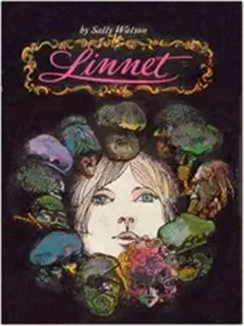
Cover for Witch of the GlensKelpie is about fourteen or fifteen and only remembers a gypsy life traveling with Mina and Bogle. They use her to steal and read the crystal, for she has second sight. Mina keeps promising to teach her witchcraft without actually showing her any. Still, they are often accused of being witches and hounded out of town.

Then one day she pretends to fall in front of a party of young men only to find she has actually injured herself. Although they catch her stealing from them, they are amused by her and take her home with them. The young men are Ian, Cameron, and Alex, returning from Oxford to their home north of Inverlochy.

Kelpie stays at Glenfern with Ian’s family, eventually as a servant, but they treat her kindly. She begins to feel affection for the children, especially little Mairie, and is dismayed when Mina and Bogle reappear. Mina threatens to curse the family if Kelpie refuses to come with them, and since Kelpie believes in Mina’s power, she goes.

The Highlands are in turmoil because Argyll has been commissioned to secure the area for the Calvinist Covenant against King Charles. Argyll’s troops are more prone to burn villages and murder innocents than to fight armies. But Montrose is trying to raise men to fight for the king. Mina sends Kelpie on a perilous task, to steal some hair or a personal possession from Argyll so he can be hexed.

Kelpie’s adventures take her all over the Highlands. When she joins the followers of Montrose’s army, she is happy to meet Ian and Alex again, but she has seen Alex strike Ian down in the crystal, so she is wary of him.

This is an enjoyable novel for tweens and teens full of likable characters and nasty villains, some history, lots of adventure, and another feisty Watson heroine. Kelpie begins re-evaluating her moral choices through the examples of others and the kindnesses she receives during her travels.

Related Posts

Lark

The Loon Feather

Treasure Island

Day 741: Seven for a Secret

Cover for Seven for a SecretSeven for a Secret is the second fantastic Timothy Wilde historical mystery by Lyndsay Faye. The series is set in 1840’s New York City. Wilde is a member of the newly formed copper stars, the city’s first police force.

It is Valentine’s Day, and Timothy and his colleague Jakob Priest are celebrating having solved an art theft when a beautiful woman of color comes looking for him at the station house. She is Lucy Adams, and she has just returned home from her job at a flower shop to find her son and sister missing. She knows exactly what happened to them. “Blackbirders” have snatched them to sell down south as escaped slaves, even though they are free.

Timothy asks his brother Valentine to go with him to get them back. Although Valentine is a corrupt Democratic party boss and a drug addict, he’s a good man in a fight. Timothy, his African-American friend Julius, and Valentine retrieve the three from the slavers, Varker and Coles, but not without a fight. The two women and little boy need somewhere safe to stay until Lucy’s husband returns, so Valentine offers them the use of his apartment.

Something is going on that is more complex than he understands, for when Timothy goes searching for Lucy’s husband, he finds that Lucy isn’t married to Charles Adams, a white salesman, as she thinks she is. She may or may not be married, but her “husband” is a Democratic senator for New York state.

Coming to see Lucy and her family a couple of days later, Timothy finds Lucy strangled and the room disrupted. Timothy is an honest police officer but he knows a frame job when he sees one. He has just finished removing the body and cleaning up when an enemy, Sean Mulquean, another copper star, arrives to investigate a reported disturbance. Timothy also soon learns that Varker and Coles have kidnapped Julius, so he must hurry to court to try to free him before he can look for Lucy’s sister Delia and son Jonas.

Faye’s historical setting of gritty 1846 New York is absolutely convincing. We like Timothy more the more we see him, and Faye is beginning to build a solid cast of supporting characters. This is a well-written, swift-moving, suspenseful series. At almost 500 pages, the novel is long for a mystery, but it didn’t seem like it for a second. Unfortunately, I have just learned that there is only to be one more in the series, and that one is waiting in my pile to be read.

Related Posts

The Gods of Gotham

Dust and Shadow

The Pale Blue Eye


Day 740: Richard III: England’s Black Legend

Cover for Richard IIIHistorian Desmond Seward explains in the introduction of Richard III that there are two views of Richard. He calls them the black legend—the traditional view—and the white legend—the notion that Richard’s reputation was blackened by the Tudors after Bosworth Field. This theory was first put forward by Horace Walpole in the 18th century and is famously supported by Josephine Tey’s The Daughter of Time. The Richard III Society has even claimed that Richard was not a hunchback, which claim was proved false by the recent discovery of his bones.

Seward’s view is that of the black legend, that Richard was a ruthless man who committed many dark deeds, including killing the princes in the Tower. Richard III is an interesting biography of Richard, based on what is known of his life. There are few of his own writings to base it on, unfortunately, because Richard was not much of a writer, a situation common to nobility of his time.

Of course, Richard’s entire life was lived during the turbulent period of the Wars of the Roses. England experienced little peace during this period, and what little there was occurred during the reign of Edward IV, Richard’s older brother. This peace was marred mostly by the rapacious behavior of the Woodvilles, Edward’s in-laws, and that of the Duke of Clarence, his erratic brother. However, that peace was destroyed by Edward’s early death, which plunged the country into another succession crisis because the prince was only 12 or 13 years old. The last time a young prince had become king, Henry VI, was disastrous for the country.

My own impression from reading this book is that Seward invariably looks at the darkest interpretation of events. I guess you could call me of the dark gray school. Certainly, the murders of the princes in the Tower was a shocking event, viewed with horror during its time and since, and there seems little doubt that Richard ordered the murders. Still, the situation for Richard was difficult. In doing his duty by his nephew, he faced the prospect of at least six years of an unstable regime with continual battles for power with the Woodvilles. This is not to excuse his actions, but it is possible to view them as an attempt to maintain stability in the realm, and that’s probably how he explained them to himself. Instead, the result was to almost completely exterminate the Plantagenet family.

Related Posts

The Wars of the Roses

Mary Boleyn

A Folly of Princes

Day 739: Sisters by a River

Cover for Sisters by a RiverBest Book of the Week!
In trying to characterize the tone and atmosphere of the autobiographical Sisters by a River, I have to say that it reminds me a bit of Shirley Jackson’s We Have Always Lived in the Castle, minus the murder. As reported in the introduction by Barbara Trapido, this novel did not fit the 40’s vogue for fond and touching memories of childhood, so it was not published for six years after Comyns began looking for a publisher. Comyns wrote it as a private recollection.

It is difficult to explain just how gripping this novel is. It is an unordered collection of fictionalized memories written by Barbara about the life of her family. Barbara and her sisters suffer a combination of abuse and neglect. Her father, known as Daddy, met her mother, called Mammy, when Mammy was a young child and arranged with her mother to marry her. She began having children when she was eighteen and only stopped after her sixth childbirth made her deaf. She also seems to be insane, periodically rampaging around or talking to invented lovers. Aside from cooking delicious meals, she completely neglects her children.

Granny is a dark and unpleasant presence. She does not allow anyone to clean her room, which is filthy, the floor caked with spilled substances. There she spends most of her time brewing up potions. When Daddy leaves the house, he has to lock up the billiard room to keep her out of the booze.

Daddy is prone to attacks of rage and cruelty. He throws Beatrix downstairs when she is a baby because she is crying. He blackens Mammy’s eye right before they are to host a big party. Yes, both of them are conscious of their social position. Mammy tells her semi-illiterate, poorly dressed, neglected daughters how cultured they are while Daddy takes pride in his hundreds of pairs of polished boots and shoes and takes three hours to prepare for a monthly meeting in town. Meanwhile, the girls’ teeth go bad and one governess after another is fired for some silly infringement or because her feet smell.

The oldest sister Mary has learned bullying from her father. She won’t allow the younger girls to read any of the books she likes, and she chooses what color clothes they may wear. Barbara must always wear brown, which she hates.

I could go on and on about this violent and eccentric family. But what really stands out about the book is its style. All of these events, and many that are worse, are related in a completely matter-of-fact way, no pathos or complaining. The writing style is that of a very young person, including many spelling errors, and this air of innocence and matter-of-face quality give the novel its charm. It’s hard to figure out how old the narrator is. The novel moves back and forth in time, and it seems that at her oldest, she is about sixteen. But there are references to her husband, so it’s hard to tell. My guess is the book was written at different ages.

If you care to try this novel, prepare yourself for something truly unconventional. It sounds dreadfully harrowing, I know, but it actually is not.

Related Posts

The Pursuit of Love

Brother of the More Famous Jack

The Death of Bees

Day 738: The House Gun

Cover for The House GunWhen Nadine Gordimer died last year, I thought it was about time I read something by her. I’ll say right up front that I did not find The House Gun easy to get into.

Almost the only characters of any depth are Claudia and Harald Lindgard, an older upper-middle-class liberal white couple living, I assume, in Johannesburg, although the city is never mentioned by name. The novel is set in the 1990’s, just after De Clerc has left office and the nation is stumbling to find its way in a new order.

Claudia and Harald are disturbed in their gated complex one night by a friend of their son Duncan who comes to report a horrible event. Duncan has been living in a compound in a separate house from three gay men. One of them has been murdered, and Duncan has been arrested for it.

The story is mostly about the effect this event has on the couple’s marriage. At first very close, they are driven apart almost immediately. They know nothing about what happened, and Duncan isn’t talking. Eventually they learn from Duncan’s advocate, Hamilton Motsamai, that Duncan did indeed shoot Carl Jesperson after finding him having sex with Duncan’s girlfriend Natalie.

There is much more to the story, but it comes out slowly. And Gordimer’s writing style is so abrupt and choppy, her viewpoint so removed and analytical, that the novel seems chilling. This impression is heightened by the tendency to use pronouns or other nouns instead of names for the other characters, especially for Natalie, who is referred to as “the girl,” and the victim, who is referred to as “he” or “him.” Obviously, since the novel is from the point of view of the couple, this naming is a distancing technique to separate the parents from the victim and the person they consider the instigator, but the overall effect is to also distance the reader. I have no frame of reference to know if this writing style is typical of Gordimer or not.

Of course, there are other, more political points to the novel. Although viewing themselves as liberals, Claudia and Harald are shaken to find how biased they are. For example, they wonder at first about the competency of Duncan’s advocate just because of Motsamai’s color. Racial and stereotypical comments permeate the book. It is clearly an issue that is on everyone’s mind.

Then again, the presence of the gun is an important issue. In an article about the novel in The New York Times, a statistic was quoted that after the violent and abusive regime of De Clerc ended and Mandela came into power, official statistics of violence in South Africa increased tenfold. The young men in the compound had bought the gun to protect themselves in case someone broke in. If it hadn’t been sitting there on the table, no one would have been killed. That’s a point that we in the states, with our own issues, should pay attention to.

Related Posts

The Sun is God

Conversations with Myself

I Know Why the Caged Bird Sings


Day 737: The Hog’s Back Mystery

Cover for The Hogs Back MysteryThe Hog’s Back Mystery is another Golden Age mystery featuring Inspector French. This mystery is much more elaborate than Antidote to Venom, the other Crofts mystery I read, featuring four murders, and is set in rural Surrey.

Ursula Stone has arrived at the railroad station in Ash to visit Julia Earle and her sister Marjorie Lawes, her schoolmates from long ago. The first part of the novel is from Ursula’s point of view, and she is surprised to see how distantly Julia treats her husband James, a retired doctor. She is also a little shocked to see how casually Julia behaves with an infatuated neighbor, Reggie Slade.

Ursula is off visiting her friend Alice Campion when James Earle disappears. Both sisters testify that he was settled down in his den for the evening when they last saw him. He was dressed only in thin shoes suitable for inside and did not take his overcoat.

Inspector French is called in when James doesn’t reappear and no one can discover a trace of him. Soon afterwards, French finds that a nurse also went missing around the same time. Her name is Helen Nankivel, and French at first supposes Earle and the nurse have run off together. But the people who know Helen Nankivel insist that she wouldn’t do such a thing. However, she did meet Dr. Earle when they both attended the last illness of Mr. Frazer, a wealthy old man.

French explores many theories, but he is just about to decide that Earle ran off with Nurse Nankivel when Ursula Stone disappears, under remarkably similar circumstances. She was upstairs in her room at the Earles’ while Julia and Marjorie entertained the Campions downstairs. Later, when summoned for dinner, she was nowhere to be found. But Mr. French finds evidence that someone was standing behind a bush outside the den and finds blood in Earle’s den.

link to NetgalleyLike many Golden Age mysteries, The Hog’s Back Mystery a complicated solution. In fact, it is so complicated that it must be explained in a 20-page last chapter, which makes the novel lose quite a bit of impetus. Still, I was able to guess the broad strokes of the solution very early on by simply paying attention to what her friends said about the nurse. It took French a good hundred pages to catch up with me. So, not the best of these reprinted mysteries by Poison Pen Press, but I love the cover.

Related Posts

Antidote to Venom

The Tiger in the Smoke

Brat Farrar

Day 736: Circling the Sun

Cover for Circling the SunPaula McClain’s novel about Beryl Markham begins with her historic flight over the Atlantic from east to west—and then flashes back to cover her life until then. Of course, the story of her life is interesting because she was a fascinating person.

Beryl is raised in Kenya, and after her mother leaves the family to return to England when Beryl is four, Beryl is allowed to run around freely for years. She befriends the local natives and plays with the boys until she is almost a teenager. At that point, her father hires a series of governesses in an attempt to civilize her, an effort not entirely successful.

Beryl’s father is a horse trainer, and she works with him up to the point where her last governess, by then her father’s mistress, decides she should prepare for husband-hunting. She makes a marriage of convenience when her father is forced to sell their farm and take a job in Capetown, but soon she is separated from her husband and seeking a job as a horse trainer. She becomes the first woman licensed horse trainer.

The novel follows Beryl through her introduction to the Happy Valley set, her friendships with Karen Blixen (Isak Dinesen) and Denys Finch-Hatton, and her second marriage to Mansfield Markham.

Although this material is certainly interesting, I was never convinced that the character McLain presents us with is the true Beryl. This interpretation of Beryl’s character doesn’t match the one presented by other sources. My feelings made me wish I had read a biography of Markham before reading this novel, so I could be surer of these statements.

link to NetgalleyI feel as if Beryl’s character and other facts are somehow sanitized for our easier acceptance. Although some expression is given to her impatience of convention and yearning for freedom, McLean still portrays her as a woman who wants acceptance and love. I’m guessing, for example, that her abandonment by her mother at a young age left her with few mothering skills and her lifestyle left her with little desire to be a mother. Some sources I consulted said she willingly abandoned her son to her mother-in-law, but in McLain’s book, she is grief-stricken when the child is taken away from her. That tells me that McLain can’t imagine a different reaction to motherhood than the typical one. I think McLean mentions the qualities that made Markham different without really understanding them.

As another example of what I called sanitization, let’s not forget Karen Blixen’s illness, referred to briefly a couple of times, but never explained as syphilis, given to her by her husband Bror.

Related Posts

Love in a Cold Climate

The Signature of All Things

Savage Beauty: The Life of Edna St. Vincent Millay