
 This week’s Best Book is Lila by Marilynne Robinson!
Day 675: Amsterdam
 The Booker Prize people liked Amsterdam a bit more than I did. Although the shattering last page of McEwan’s Atonement absolutely upended that novel, the same technique did not work as well for this one. Perhaps the problem lies with my having seen McEwan do this several times already.
The novel begins with the death of Molly Lane. Two old friends, both former lovers of Molly, meet at the funeral. Clive Linley is a world-famous composer, and Vernon Halliday is an editor trying to save a floundering newspaper. At the funeral is another of Molly’s former lovers, foreign secretary Julian Garmony, a right-wing bigot whom both men dislike. They all pay stiff respects to Molly’s possessive husband George.
The brush with mortality makes both Clive and Vernon a tad hypochondriac, and they end up exchanging a pledge. But various stresses will soon interfere with their friendship. Clive is struggling to complete what he thinks will be his masterpiece in time for a performance in Amsterdam. And George has offered to sell Vernon some compromising photos of Julian that he found in Molly’s papers. Vernon has to decide whether publication of these photos will result in increased sales or backlash.
This novel is darkly humorous. None of these men is a sterling individual. In fact, they are all morally bankrupt. Clive seems the least at fault for quite some time, but then he does something unforgivable and justifies it as being for his art.
It’s difficult to explain my main criticism without revealing the ending. I can only say that the implications of the final page do not make sense, that there is no way that the character could have known how things would work out. So, I do not think the surprise ending works as well in this case as in other McEwan novels.
Related Posts
Day 674: In a Lonely Place
 What makes this post-World War II noir crime novel stand out is that it was written by a woman and the crime is solved by two sharp women. Although there are plenty of women mystery writers, it is less common to find women writing noir mysteries at that time. Reminiscent of The Killer Inside Me, In a Lonely Place tells the story of a serial killer of women from the point of view of the killer.
Dix Steele is an ex-pilot being supported by his uncle in Los Angeles while he pretends to write a novel. He is living in a posh apartment of an old Princeton friend, wearing his clothes and driving his car and telling everyone his friend is in Rio. About once a month he picks up a girl at a bus stop or some other lonely place and strangles her.
Dix decides to get in touch with an old friend from the military, Brub Nicholai, but is taken aback to find Brub is now a police detective. Brub has also married, and his wife Sylvia doesn’t like Dix.
Dix meets an attractive redhead, Laurel Gray, who lives in the apartment complex and is divorcing her wealthy husband. Soon they begin a torrid romance.
This novel was convincing in its depiction of a serial killer. Although we see things from Dix’s point of view, we are not drawn into his dilemmas as we are, say, for The Talented Mr. Ripley. We want him to be caught and worry about Laurel or about the next time he is going to find the need to kill.
Related Posts
Day 673: The Illuminator
 It is the 14th century, and Lady Kathryn finds herself in a precarious position. She is a widow and owner of Blackingham Manor, the mother of 15-year-old twin sons. The church has been incessant in its demands for tithes, and there are also the king’s taxes. She suspects her overseer of being dishonest, and he is certainly disrespectful, but she has no one who could replace him.
When Father Ignatius makes yet another demand of her, she has nothing to give him but her mother’s pearls. Still, the church could make trouble for her, so she gives them up. Later Brother Joseph arrives with a message from the Abbott. If Lady Kathryn will house an illuminator who is working for the abbey, along with his daughter, the abbey will let up on its demands for tithes. For the price of food, Kathryn thinks this is a bargain.
Soon the artist Finn arrives, along with his beautiful daughter Rose. Lady Kathryn is immediately worried about her son Alfred, who likes to dally with the serving maids. Finn’s arrival is made more chaotic because of the news that Father Ignatius was murdered. Although this happened after he left her house, Kathryn doesn’t want to draw attention to herself, so she lies to the sheriff, Sir Guy, and tells him she hasn’t seen the Father recently. This of course turns out to be a lie she regrets.
Sir Guy, being the rapacious type, has his eye on Lady Kathryn and her estate, which is her own and does not go to her son. But Kathryn and Finn are soon drawn to each other. To get Alfred away from Rose, Kathryn asks him to supervise the overseer. Soon involved with Finn herself, she does not notice the depth of Rose’s friendship with Colin, the younger twin.
Other important characters in the novel are Half-Tom, a dwarf who befriends Finn, and the anchorite Julian of Norwich, a real woman famous for her writings about religion, reflecting unusual views.
I wanted to like this novel more than I did. Overall, my impression could be summed up as meh. At first I was worried that it was going to be a historical romance, which I usually do not enjoy, but it was not. It shows a solid grounding in the time period, with convincing detail. I think I was turned off by the depiction of the church. This was a violent time in history, and the Catholic Church was in a period of corruption, but I don’t think that is a good reason for depicting every representative of the church (except Julian of Norwich) as a cartoonish villain. It is clear that the author’s sympathies lay with the Reformation, but that movement had its own abuses. In fact, in the 14th century, it is doubtful that many people in England would have even envisioned a Reformation. Martin Luther didn’t put up his theses until 1517.
I think that my biggest problem with the novel is that only a few characters were at all developed. The others were simply villains. I also had problems with the situations created in the novel simply by both Kathryn’s sons departing without notice. Alfred pulls a nasty trick on Finn before leaving—one that endanger’s Finn’s life and leaves Kathryn open to blackmail. Both sons behave like spoiled adolescents instead of the young men they would have been considered at the time, and Kathryn makes several poor or dishonest decisions regarding them.
There is also a theme of Kathryn’s changing religious beliefs, but I found this decision sudden and unlikely. I would have liked to see more about Finn’s art, but there was very little.
Related Posts
Day 672: The Etymologicon
 The Etymologicon is an amusing look at the etymology of words and phrases, explaining connections between those that don’t always seem connected. It is written by Mark Forsyth, the author of a blog called The Inky Fool, and it does a rather clever thing. It starts with an explanation of “turn-up for the books,” a phrase I wasn’t actually familiar with. From that, it moves to a subject related to something he discussed in the first article, so that each article is linked to the next. The last one leads, you guessed it, right back to “a turn-up for the books.”
The book is amusingly written in a zippy style and is crammed full of facts, not just about the meaning of words. In style, it reminds me very much of the rapid fact-based videos done by John Green for Mental Floss. At the end, it even has some quizzes. It’s a good gift for someone interested in language or trivia.
I only have two critiques, and one I’m not sure of. First, the text is taken straight from the blog, it appears, with no attempt to remove the references to the next link. I call that lazy.
The second occurs in a section about butterflies. Forsyth says that the word for butterfly in Russian is the same as the word for little lady, bow tie, and girl, and that word, he says, is “babochkas (like babushkas).” (The s is of course the English plural, not the Russian. In context, he is talking in plurals.) Actually, “babochka” is the word for moth. I can let that go, because lots of people, including me, can’t tell a moth from a butterfly. But “dyevushka” is the Russian word for girl, unless there is some usage I’m not aware of. And “bábushka” means grandmother (whereas babúshka means kerchief). I have no idea what the word for bow tie is. The words for moth and grandmother are similar but they are certainly not the same. The word for girl is quite a bit different. This makes me wonder about the accuracy of other information, but maybe someone who is more familiar with Russian will correct me. Perhaps he’s trying to convey that the etymology of the words is the same, but what he actually says is that they’re the same word.
If so, I’ll be happy to be corrected, for I found this book an entertaining way to while away an afternoon.
Related Posts
White Heat: The Friendship of Emily Dickinson and Thomas Wentworth Higgins
Day 671: Lila
Best Book of the Week!
In Lila, wonderful writer Marilynne Robinson returns to the small Iowa town of Gilead, the setting of her previous novels Gilead and Home. In these novels Lila Ames is not much of a presence. She is referred to as the surprising choice of a wife for the elderly, gentle, and educated pastor John Ames—much younger, rough, and uneducated.
Lila has lived almost her entire life on the tramp, ever since Doll stole her away, a neglected, starving, feverish little mite who lived mostly under the table or was locked out of the house. Doll and Lila joined up with a group of travelers lead by Doane, wandering from job to job, and life was just fine until the long, dark days of the Depression and the Dust Bowl. Years later, Lila has stopped outside Gilead and is living in a shack, walking to nearby farms and houses and asking for work.
Lila knows nothing about religion, but on occasion she has been curious about it and was warned away by Doane, who claims all preachers are charlatans. So, one day she ventures into the church. There she sees and is drawn to John Ames, and he to her. Eventually, they marry.
The action of this novel is mostly interior. Lila is tormented by some of the memories of her previous life and feels unworthy of Ames. She is afraid that he may ask her to leave at any minute. All the same, she occasionally wants to return to the freedom of her old life.
Ames, on the other hand, is happy to have Lila’s company, for he has lived alone ever since the death of his wife in childbirth, years ago. He is afraid she will decide to leave him one day.
As with Gilead and Home, this is a quiet novel, characterized by religious discussions as Lila tries to read and understand the Bible. She has no prior relationship to religion, but she has vowed that John Ames’s son will be brought up praying, as his father does. The discussions in Gilead between the two pastors were way over my head, but these are more fundamental.
I am not particularly interested in religion, but what I like about Robinson’s books is that they are about good people trying to be good. That is a refreshing theme these days. And the writing is superb, the subject matter approached with delicacy. I can’t recommend any book by Marilynne Robinson strongly enough.
Related Posts
Best Book of the Week!
 This week’s Best Book is Alias Grace by Margaret Atwood!
Day 670: The Jewels of Paradise
 I have read a few of Donna Leon’s Commisario Brunetti mysteries and liked them well enough. I was intrigued, though, to find The Jewels of Paradise, a recent one-off or perhaps the start of a new series by Leon.
Caterina Pelligrini is an Italian musicologist who has been working as an assistant professor for a university in Manchester. With a doctorate specializing in Baroque opera, she has found employment opportunities hard to come by. She also has not foreseen how much she would miss her home. So, when she hears of an opportunity for a research position in Venice that is to last a few months with the possibility of being extended, she jumps at it.
The position is an unusual one, though, for she knows only that she has been hired to go through some trunks containing recently discovered papers belonging to an unnamed composer. Hired by an impeccable lawyer, Dottor Andrea Moretti, Caterina is employed by two thugs, Scapinella and Stievani. They hope she will find papers showing that one of them has a better claim to the trunks than the other, for they have family legends that this man, a supposedly rich relative, died with a fortune of jewels.
Caterina is to conduct her research at a foundation that is almost bare of resources. There she finds that the papers belong to Agostino Steffani, a once famous Baroque composer of operas who gave up his career to become a church diplomat. As Caterina investigates, she finds he may have been implicated in the Königsmarck Affair, in which the lover of the wife of the future King George I of England disappeared and was believed to have been murdered.
A faint air of menace haunts the entire project, as Caterina is followed and finds someone has been reading her email. Soon she learns that the position, for which she has moved from England, is only to last a month.
I really enjoyed this tale of mystery in the realm of academic research, although I thought that the physical setting of Venice got short shrift. Still, I find I am drawn to this kind of novel and hope to see more of them from Leon.
Related Posts
Day 669: Death by Black Hole and Other Cosmic Quandaries
 A Quick Note: I just now published a new feature for my blog, an additional link called “List of Authors,” which lists all of the authors reviewed on this site and all their books. This new page will make it easier for people to find more books by authors they enjoy. Look for it at the top of the page!
* * *
Death by Black Hole is a collection of astrophysicist Neil deGrasse Tyson’s essays from Natural History magazine. In general, I’m not that fond of essay collections because just when I want an author to build on a point, the essay is over.
Tyson is always good, though, at explaining complex ideas in a way that a science novice like me can understand. He is also frequently amusing, funny enough for me to occasionally read passages out loud to my husband. Some of the pieces are probably written solely to provide amusement, like the one about the scientific errors in sci-fi movies. But he also includes essays about the creation of the universe, climate change, particle physics, cosmic curiosities, and the interface between science and the public.
If I can repeat a point, though, I think I would have appreciated even more a book that explained principles and then took me farther with them. Instead, by the nature of the beast, the essays are sometimes a bit repetitive, although none of them cover exactly the same ground.
I was really looking forward to the chapter on “intelligent design,” which is a sore point with me. But even though Tyson is clear that this is not a scientific viewpoint, his essay is a bit too tactful for my taste. At this point I would have appreciated some zingers.
Related Posts
Day 668: The Sea
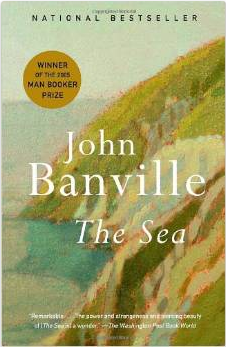 In this contemplative novel, recently widowed Max Morden returns to the small Irish seaside resort where his family used to live when he was a boy. It was there he met and became fascinated by the Grace family, much above his own in social strata.
Max’s memories are assisted by his residence as a boarder at The Cedars, the house where the Graces stayed that summer. The Cedars has become a boarding house that is now managed by Miss Vavasour.
The young Max became the companion of the Grace’s oddly feral twins, Chloe and Myles. They are two very unpleasant children who torment their teenage nanny Rose. At first infatuated with the voluptuous Mrs. Grace, Max eventually turns his attentions to the spiky Chloe.
Through his memories of the extraordinary events of that summer and his feelings about his wife’s death, Max eventually gains some self-knowledge. Looking back, he also gains some understanding of the dynamics between people that he did not grasp as a child.
The Sea is stylistically exquisite, with its sussurating and rhythmic prose a striking meditation on death, grief, and memory. Although I guessed one of its revelations much earlier than intended, that did not take away from the power of the prose.
Related Posts
 What? Me Read?