Day 660: Straight Man

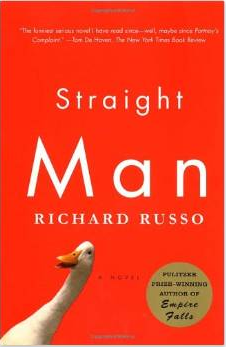
Cover for Straight ManSo far, I have enjoyed Empire Falls the most of Richard Russo’s novels, and Straight Man is at least also set in the rust belt, which he depicts so well. However, rather than being a depiction of small-town life, it is a rich spoof of academia. My husband, formerly the spouse of an academic, tells a joke, probably an old one, that the reason politics in academia is so vicious is that the stakes are so low. That these battles are being fought not on the campus of a great university but of an obscure college in a small Pennsylvania industrial town makes it more ironic.

William Henry Devereux, Jr., (Hank) sees himself as a bit of a rebel, although his rebelliousness mostly confines itself to snarky comments in faculty meetings and satiric opinion pieces on academic life in the local paper. He was once the author of a decently reviewed novel, but now he finds himself the interim head of the English department at a small Pennsylvania college.

Hank has been ignoring rumors that the college is to undergo stringent cuts on the grounds that the same rumors make the rounds every April. The faculty members in his department are constantly embattled, most recently over the job search for a new department head. Hank is better at enraging them than smoothing things over, and at the beginning of the novel suffers a wound to his nose when a professor hits him with her spiral notebook.

Maybe Hank wouldn’t have gotten himself into quite so much trouble, but his wife Lily is out of town on a job interview, and he is preoccupied by a possible kidney stone when he begins taking the rumors seriously. One of the reasons he has discounted them is that the college is breaking ground on an expensive new technology center and he can hardly believe they could claim financial problems requiring layoffs at the same time.

Such is the case, he finds, and with his department members all worried about their jobs, he chooses the groundbreaking ceremony to stage a protest, claiming he will kill a duck (which is in reality a goose) from the campus pond for every day he doesn’t get his budget. Soon he finds himself a minor media celebrity and a suspect of campus security when someone actually does kill a goose. In the meantime, his daughter’s marriage is imploding, he keeps imagining his wife is having an affair with the dean, his scholar father who years before deserted him and his mother for a graduate student is returning, and an attractive daughter of a colleague might be trying to seduce him. The events of this week force him to examine his relationship to his own life.

I found this novel both a bit over the top and amusing, as well as true. If I have a criticism, it is to wonder about some modern male authors’ fascination with bodily functions, and why they seem to think they’re funny. But I guess I can’t constrain this complaint to just novelists, because I’ve been staying away from comic movies for years for the same reason.

Related Posts

That Old Cape Cod Magic

Lucky Jim

The Bridge of Sighs

Day 659: The Prague Cemetery

Cover for The Prague CemeteryThe Prague Cemetery opens in 1897 with a monologue that is so vile and bigoted against just about everyone—the French, the Germans, the Italians, Jesuits, Masons, women, and especially Jews—that I almost put it down at that point. That monologue is the ranting of the main character, Simonini, as learned at his grandfather’s knee. Simonini is an absolutely repellent person who makes his living forging wills and other documents but who also works for the French secret police, and the German secret police, and the Okhrana, making up lies and creating international incidents.

Simonini has a problem. He has gaps in his memory. Further, when he explores a passage in his house, it leads to the rooms of someone who wears a cassock. Following the advice of an Austrian Jew (whom he calls Froïde), he begins writing down what he can remember of his life. The next time he awakens, he finds his diary annotated by the Abbe Della Piccola, who seems to remember the time periods he cannot but doesn’t remember the others. It is soon obvious that these are two personas of the same man.

Simonini is already a forger when he begins his first employment in espionage, spying on the leadership of Garibaldi’s army for the Piedmontese secret police. He always ends up exceeding his orders, though, so when he blows up the ship containing Ippolito Nievo, who is in charge of Garibaldi’s finances, instead of simply assuring the books go to the government and nowhere else, he is shipped off to Paris.

Simonini is most concerned with the fate of what he considers his life work, a document that is supposed to be a true account of a meeting of eminent rabbis—and one Jesuit—in the Prague cemetery, where they plot against the Gentiles and scheme for world domination. Although Simonini has plagiarized some of this document from other sources, he has fabricated most of it, including the setting. Over the course of 40 years, he perfects this document, eliminating the Jesuit and changing it to a series of protocols, all the while trying to sell it to different governments. It is this document that becomes the infamous Protocols of the Elders of Zion, used by the Nazis and other hate-mongers through the years to justify anti-Semitism, even though everyone involved in its creation knew the document was apocryphal.

Although this tale is supposed to be some sort of answer to Dan Brown’s The Da Vinci Code, being based on actual instead of made-up events, and though it is told with proper postmodern irony, it left a bad taste in my mouth. As Simonini and his abettors make up more and more ridiculous stories linking, say, the Masons to Satanic rites, with the public gleefully believing everything, I felt disgusted. Almost every character in the novel except Simonini was an actual person, and all the events the novel is based on are true, which makes it even more disturbing. Eco even has Simonini responsible for framing Dreyfus. Simonini also murders people and dumps their bodies in the sewer beneath his house.

Maybe I agree with one reviewer that some readers may not understand irony. I’m not sure. The construction of a truly dark and repellent protagonist reminded me of the novel Perfume, except that I enjoyed Perfume. I just know that although I have a dark sense of humor myself, this novel made me want to take a bath.

Related Posts

Great House

In the Garden of the Beasts

The Bones of Paris

Day 658: Euphoria

Cover for EuphoriaI switched around my book for today so that I could review a book that is about love rather than about hate (my original selection). I wasn’t thinking about Valentine’s Day coming up tomorrow when I originally selected the review. Happy Valentine’s Day!

***

Best Book of the Week!
Lily King based many of the events in her novel Euphoria on the life of anthropologist Margaret Mead. The result is a fascinating examination of another culture and Mead’s work methods as well as a love story.

When Nell Stone and her husband Schyler Fenwick (Fen) crawl out of the New Guinea jungle after grueling months spent studying the Mumbanyo, they don’t even know it is Christmas Eve. Nell has found the Mumbanyo people too militant and unsympathetic to work with, so she has insisted they leave against Fen’s wishes. We see almost immediately that Fen is jealous of Nell’s fame from the publication of her book on the Solomon Islands and that he can be brutal. Since the anthropologists consider the territory around the Sepik River to be already claimed by Andrew Bankson, their plan is to study the Aborigines in Australia.

At a Christmas party in their hotel, they meet Bankson. He has been working alone for two years and is dreadfully lonely, has even recently attempted suicide. He also feels stymied in his approach to research, wanting someone to bounce ideas off of. He has been begging for a partner to no avail.

Feeling an instant connection to Nell and Fen, Bankson urges them to pick a tribe to study near him on the river, and he takes them along it to choose. He hopes they choose the people in a village that is close to him, but they choose the Tam, seven hours away.

Here, Nell settles down to work hard, learning about the women and children. She is not allowed in the men’s street, so Fen’s job is to collect information about them. But Fen seems to be more interested in doing things with the men than in actually working on his research.

In the meantime, Bankson has been resisting his terrible loneliness and his attraction to Nell. But finally he comes to visit.

This brief novel is really wonderful in its characterizations, its descriptions of life in a New Guinea village, in its sheer richness. It reminded me a lot of another wonderful book, State of Wonder by Ann Patchett.

Related Posts

State of Wonder

The Bone People

The Cruelest Journey


Day 657: The Fish Can Sing

Cover for The Fish Can SingÁlfgrímur is an orphan boy who has always known life in a simple turf cottage with his foster parents, Björn of Brekkukot, whom he calls Grandfather, and Grandmother. His grandfather lives a life of integrity, with no interest in ambition. Words are so important in their household, Álfgrímur explains, that they are only spoken to hide things.

Álfgrímur grows up with his only ambition to live in his grandparents’ cottage and fish for lumpfish with his grandfather. But his grandmother has other ideas, so when he is old enough, he goes reluctantly off to school.

Most of this novel is an account of everyday life at Brekkukot, peopled by the peculiar residents of the grandparents’ loft, some permanently there and others passing through. These people are all good but eccentric. For example, there is the Superintendent, whom Álfgrímur as a boy thinks is the superintendent of the entire city of Reykjavic but turns out to be in charge of the public toilets at the harbor.

Hanging on the wall of their neighbor Kristín’s cottage is the picture of a young man. When Álfgrímur asks about him, his grandparents answer “He was a nice little boy, that Georg,” Kristín’s son. But Georg is now Garðar Holm, a famous Icelandic opera singer. Garðar Holm seldom comes home. When he does and his patron schedules a concert, he never appears, but he does take an interest in Álfgrímur. Álfgrímur can sing and he wants to learn to sing “one true note.”

In this novel, Laxness is interested in exploring the tension between fame and obscurity, but he is also interested in the importance of morality and honest dealing. Serious as its intent is and primitive as are the characters’ surroundings, this is not at all a grim novel. It is told with a wry and ironic sense of humor and is full of colorful characters. With Laxness, you can be sure that there is plenty going on beneath the surface of things.

Related Posts

Independent People

Cod: A Biography of the Fish That Changed the World

The Beautiful Mystery

Day 656: The Mysteries of Udolpho

Cover for The Mysteries of UdolphoI valiantly strove to finish The Mysteries of Udolpho, but with about 80% of it read (frustratingly hard to tell with a collection on Kindle), I just couldn’t take it anymore. Although the book is a classic gothic novel, it is extremely long and slow moving, and my mild curiosity about the secrets of the castle could not overcome my feeling that the novel was never-ending.

Radcliffe was known for writing novels that were more realistic than those that had come before in the gothic genre. That is, the events, however unlikely, might actually happen. Heroines are kidnapped, not squashed to death by a giant foot.

Emily St. Aubert’s troubles begin with her father’s death, but not before the two of them take a leisurely several-hundred-page trip through Provence. There she and her father meet the handsome Valancourt, alas only a younger son.

After her father dies, Emily finds she is left destitute except for her estate and goes to live with her fashionable and shallow aunt Madame Cheron. Madame Cheron eventually marries an Italian lout, Count Montoni. Once Emily and her aunt are in his power, he expends all his energy first in trying to force Emily to marry one of his dupes and then in trying to get both women to hand over all their property in France.

About halfway through the nearly 800-page book, Montoni takes them to his castle, Udolpho, in the Italian alps. Here I was expecting things to heat up, and they do a little, with a disappearing previous owner, secret passageways, unnamed but horrible sights, and odd lights on the battlements. On the other hand, Emily spends most of her time looking at the scenery—described in excruciating detail and admired while she is in peril of her life—and painting watercolors. Oh, also writing poems at the drop of a hat that we get to read.

To modern audiences, Emily seems a bit insipid, but her role is to demonstrate the feminine virtues under duress. So, instead of investigating where the secret passage from her bedroom goes or looking at the contents of the heavy chest or trying to escape, she faints and runs away. She does, however, do what she thinks is right most of the time.

So far, although the most famous, The Mysteries of Udolpho is not my favorite of the “horrid mysteries” mentioned in Northanger Abbey that I reported I was reading in a collection. (This novel wasn’t mentioned but is included in the Horrid Novels collection for completeness.)

Related Posts

The Castle of Wolfenbach

Northanger Abbey

Dracula

Day 655: The Night Inspector

Cover for The Night InspectorWilliam Bartholomew is a survivor of the American Civil War, but in many ways he is also a casualty. His face was destroyed, so he wears a mask, but he also bears less discernible scars from his work as a sniper for the Union army.

Bartholomew is working as a commodities trader when he meets the writer Herman Melville. He has read and admired Moby Dick, but the novel was mostly met with mockery by the critics and ignored by the public. Unable to take care of his family with his earnings as a writer, Melville takes a job as a deputy customs inspector.

Bartholomew has a relationship with a Creole prostitute that he considers deeper than the usual one of client. She asks for his help in a venture that seems laudable but is illegal. To pull it off, he must involve Melville.

At first, I wasn’t sure where this novel was going. It is dark and sometimes disturbing, and I even thought it might become a mystery. It does not, but it fully captures the consciousness of a man who is tough but has had to fight to keep from being shattered by circumstances, his own actions, and his conscience.

It is also a vehicle for depicting Melville. There, I was not so sure it was going to be successful in making Melville interesting until the denouement of the novel.

Related Posts

Moby Dick

Ahab’s Wife, or The Star-Gazer

The Invention of Wings

Day 654: Longbourn

Cover for LongbournBest Book of the Week!
There has been a plethora of Pride and Prejudice reinterpretations and sequels in the past few years, and I haven’t found the ones I’ve read to be very interesting. Longbourn, however, looks at the novel from a completely different angle, from the point of view of the servants in the Bennet household.

Sarah has been a housemaid for the Bennets since she was a child. Although she is grateful for the kindness shown to her by the housekeeper, Mrs. Hill, she chafes against the limits of her existence and the sheer hard work. She has begun to wish for more.

Mr. Bennet unexpectedly hires a servant named James Smith. There is some mystery about him, for Sarah overhears Mrs. Hill having a heated discussion with Mr. Bennet about him. At first excited to have a new member in the household, Sarah is disappointed by his unkempt appearance and the fact that he never looks at her. Besides, she soon meets the handsome and exotic Ptolemy Bingham, Mr. Bingham’s mulatto coachman.

Aside from presenting fully realized characters and an interesting story, Longbourn imagines a completely different view of the Bennet household and the action of the original novel, which here is only peripheral. We find unexpected sympathy for Mrs. Bennet through Mrs. Hill’s knowledge of her history. Mr. Bennet turns out to have a secret. Lizzie and Jane are still the most likable Bennet girls, but they think nothing of sending Sarah to walk to Meryton in the pouring rain to buy roses for the girls’ dancing shoes. The viewpoint from the kitchen is certain to be an unexpected one.

This novel is fascinating, providing its own rich story while carefully observing the events of Austen’s novel in the background. I loved this truly original re-imagining.

Related Posts

Persuasion

Jane Austen: A Life

Jack Maggs

Day 653: Viper Wine

Cover for Viper WineTo say that Viper Wine is an unusual novel is to make an understatement. The novel is based on events in the lives of historical characters, but its narrative style is wildly creative, including many anachronisms and quotes from both modern and historical sources, even computer code. It seems occasionally to blur the time between centuries.

In 17th century England, Venetia Digby was once the renowned beauty Venetia Stanley, but she is getting older. She is not exactly vain so much as humiliated by her loss of distinction and the pitying glances she thinks she detects. Her husband Sir Kenelm loves her as much as ever and thinks she looks fine, but she believes he doesn’t actually see her.

Kenelm is a sort of Renaissance man, a scholar, soldier, and adventurer. It is true that he spends a lot of time on his experiments and books. He has some other occupations he must be more careful of. He is an alchemist, and even though the Queen, Henrietta Maria, is Catholic, the Digbys’ Catholic religion must be observed with discretion.

Venetia has begged Kenelm to make her a preparation to restore her youth, but Kenelm doesn’t think she needs one and refuses without explaining to her how harmful such a preparation could be. Venetia finally sneaks off to try an apothecary’s concoction named Viper Wine that is made from snakes, and apparently some kind of opiate. Whether it really improves her looks or she just thinks it does is not clear, but soon, many of the ladies at court are sneaking off to find the same apothecary. Later she starts using something similar to Botox.

http://www.netgalley.comAs Venetia exuberantly pursues a renewed career at court and Kenelm continues his studies and adventures, Eyre reminds us by little digs and a sort of melding of time periods that people haven’t changed in their extreme remedies for aging. This novel is written with a zippy postmodern irony that adds energy and liveliness to the story of how the famous beauty’s autopsy after her death showed she had “very little brain” (not a spoiler, as her death is mentioned in the book blurb).

Related Posts

The Nature of Monsters

Queen Anne: The Politics of Passion

Look at Me

Day 652: Amy and Isabelle

Cover for Amy and IsabelleIn 60’s small-town New England, Isabelle Goodrow and her 16-year-old daughter Amy are having a tough summer. They are together all the time because Amy has a job in the mill office where Isabelle has worked for years, but they are presently resentful of each other and barely speak.

Although Amy has been harboring typical teenage feelings toward her mother, their problems go back a lot farther. Some of them have roots in how Isabelle has represented herself in town since she moved there. She has some social ambitions and thinks she is more refined than the other women who work in the office. Quietly in love with her married boss for years, she is concerned about how she and her daughter are perceived. She also has secrets.

But their immediate problems begin earlier that school year, when insecure Amy thinks she is in love.

This is my third Strout novel, and I like how observant she is of life in these small, conservative New England towns. She presents us with situations that are dramatic but common and has us examine the lives of ordinary people. Amy and Isabelle are hard on each other, as mothers and daughters can be, but they are also able to learn from their mistakes, even if the lessons are painful.

Related Posts

Olive Kitteridge

Giving Up the Ghost

Empire Falls