Day 644: The Wives of Los Alamos

Cover for The Wives of Los AlamosA little note from me: I noticed that for awhile WordPress applied a feature to my blog that showed related posts at the bottom of the page. Then yesterday I noticed that the feature disappeared at some time. I couldn’t figure out a way to implement it on my blog automatically, but I was amused at its choices sometimes. So, a new feature of my blog is that every time I review a book, I’ll try to find three other reviews that share something in common with it, whether it’s the subject matter, the setting, the author. The reviews are links at the bottom of the page. Let me know how you like it!

* * *

The Wives of Los Alamos takes an unusual approach to historical fiction. It is narrated collectively, in first person plural, by all the wives of the scientists at Los Alamos during World War II. Of course, this approach has its disadvantages, as there are no characters who stand out from one another. Still, it is a fascinating way to point out what these people shared—and did not share.

The novel begins as the wives depart their former lives. They know nothing about where they are going or what their husbands are going to do when they get there. What little they know, they are not allowed to say. The novel tells their story throughout the war and their reactions when they finally learn what their husbands have created.

At times we see these women as selfish and privileged, especially when they become bored with the restrictions and begin gossiping and complaining about the “help.” But other times we realize how difficult their situation is, shipped off to a primitive environment where their housing is not even ready when they arrive, unable to learn what is going on, subject to restricted movements and stringent security even though they know very little.

http://www.netgalley.comThis is an interesting book that touches on topics that emerged during the war and after—like equal pay for equal work, the ethics of creating this powerful weapon, and family relationships and roles.

Related Posts

Lucky Us

The Zookeeper’s Wife

Shanghai Girls

Day 643: The Orenda

Cover for The OrendaBest Book of the Week!
The Orenda is a powerful novel about the death of a people. At times it is difficult to read, but do not let that stop you from experiencing this novel.

Father Christophe, one of the first French priests to evangelize the Indians of Canada west of Kebec, finds himself at the beginning of the novel captive to a group of Huron warriors. The group is returning from a trading expedition, but they recently attacked a family of Ojibway, their enemies. Bird, the leader of the party, is seeking revenge for the killing of his wife and daughters by the same group. He keeps one young girl, Snow Falls, to be his daughter but kills the rest of the family.

The novel is narrated in turn by Bird, Father Christophe, and Snow Falls. Father Christophe, whom the Hurons call the Crow, finds life in the village brutal and the customs of the people barbaric, but he is determined to learn the people’s language and convert them.

Bird continues to grieve for his wife and addresses his sections of the book to her. He is concerned about the problems of the village and his people, and not least with his difficult new daughter.

Snow Falls is determined to escape and to at all times demonstrate her defiance.

The novel covers about ten years, during which things go well and then badly for this group of Huron people. A combination of disease from contact with the French and the hostilities between the Hurons and their enemies eventually have results that presage what will happen on a larger scale throughout North America.

The novel paints a fascinating picture of the daily life among the Huron and of the misconceptions and misunderstandings between the native people and the Europeans. It is a wonderfully involving book.

Day 642: The Silkworm

Cover for The SilkwormThe Silkworm is Robert Galbraith’s second Cormoran Strike mystery. It picks up about a year after private investigator Strike solved the murder of the famous supermodel Lula Landry. Since then, he has gained a lot of business, mostly from wealthy or famous clients. So, he does something unexpected when he kicks an entitled client out of his office to take on an apparently simple job of finding the wandering husband of the downtrodden Leonora Quine.

Owen Quine, Cormoran learns quickly, is prone to drama and disputes and is not very likable. He long ago wrote one notable novel but since then has been considered second rate. He is known for his attention-seeking disappearances, but this time Leonora thinks he’s been gone too long, ten days.

Strike finds that Quine disappeared after a loud, public fight with his agent, Elisabeth Tassel. Quine has just finished a book that he considers his masterpiece, Bombyx Mori, named after the silkworm. Leonora reports that Tassel was encouraging Owen and telling him it was his best. But Tassel says that when she read it, she was appalled. It grotesquely defames almost everyone Quine knows in the publishing world, including Tassel herself, Quine’s editor Jerry Waldgreave, a famous writer and ex-friend Michael Fancourt, Quine’s publisher Daniel Chard, Quine’s girlfriend and writer of erotic romances Kathryn Kent, and Quine’s student from a creating writing class, a transgender woman named Pippa Midgely. Although Quine’s manuscript was suppressed, all of these people had an opportunity to read it. Leonora, also ridiculed in the book, is the only one who claims not to have read it.

Cormoran is unable to find a trace of Quine, and he begins to feel odd about the situation. When he learns that Quine co-owns a house with Michael Fancourt that neither of them ever visit, he goes there immediately. He finds the house marred by acid and Quine’s body, tied up and disemboweled.

Strike’s old friend Richard Anstis is head of the investigation, but the police are not happy to have Strike involved since he made them look bad when he solved Lula Landry’s death as a homicide after they declared it a suicide. In any case, Anstis is inclined to suspect Leonora.

Meanwhile, the date of Strike’s assistant Robin Ellacot’s wedding is approaching, and she has still not managed to reconcile her fiancé’s dislike of her job with Strike. She is hoping Strike will train her to be a detective, but she is worried he has relegated her to being a secretary.

In my review of Galbraith’s first novel I complained of a dirty trick. I’m happy to report that there were none in this novel and the murderer was difficult to guess. I haven’t figured out yet how much I like Cormoran Strike, though, and I hope that his yearning after his bitch of an ex-fiancée is not going to continue in every novel. Whether she would follow through with her own wedding was a minor plot point of this novel, but I’m already tired of her and wish she would go away. Ditto with Robin’s tiresomely jealous fiancé.

Rowling as Galbraith continues to be a very good writer who keeps the story moving, but she has not quite engaged me on Strike’s behalf as yet.

Day 641: Remarkable Creatures

Cover for Remarkable CreaturesRemarkable Creatures is based on the true stories of Elizabeth Philpot and Mary Anning. These were two women of the early 19th century who collected fossils along the sea near Lyme Regis, beginning before fossil collections became wildly popular. Some of their finds resulted in discoveries about evolution and extinction. The novel is told in alternating chapters from the point of view of the educated upper-class Elizabeth and the uneducated working-class Mary.

Elizabeth Philpot already realizes she will be a spinster when her newly married older brother nudges her and her two sisters to look for a less expensive place to live away from the family home in London, perhaps in some genteel seaside resort. The women choose Lyme Regis, and their brother soon finds them a comfortable but small stone cottage.

Louise Philpot becomes interested in gardening and Margaret busies herself with the town’s social scene, but Elizabeth realizes she must find something to occupy herself. When visiting a carpenter’s shop, she meets Mary Anning, at the time a child, and sees the fossils Mary has collected and is trying to sell. She is fascinated particularly by the fish and decides to look for fossils herself, doing much to help label herself and her sisters as eccentric.

Mary Anning finds and sells fossils to support her family, but she is also fascinated by them. After she begins her acquaintance with Elizabeth, she starts learning more about the scientific theories behind her work. When she discovers the fossil of a previously unknown animal, she does not know that her discovery challenges the beliefs of conventional religion that every animal created by God is currently alive on Earth.

Philpot and Anning, who made significant contributions to the science, both eventually find themselves frustrated by the lack of recognition for their contributions. It is worse for Mary, for she is not only a woman and uneducated, she is considered just a fossil hunter.

I found the subject matter of this novel interesting but feel Chevalier was probably struggling with the difficulties of depicting real people in fiction. Although she depicts two distinct women, they do not seem fully formed to me. I couldn’t help contrasting this novel with the wonderful The Signature of All Things, which is a similar story although completely fictional. There I got a sense of a strong, fully realized individual. To contrast, Chevalier gives each of her main characters a few signature traits—for example, Elizabeth judges people by what part of their physique they “lead with”—and we don’t get a sense of fully formed individuals.


Day 640: The Enchantment of Lily Dahl

Cover for The Enchantment of Lily DahlBest Book of the Week!
Lily Dahl is a 19-year-old making a living as a waitress in a small-town cafe and living in an apartment above it. Although she is saving for college, what she really wants to be is an actress.

Lately she has been fascinated by Ed Shapiro, an artist living in a room across the street. He is in his thirties, recently deserted by his wife. At night she can’t keep herself from watching as he paints in his underwear.

Lily’s next-door neighbor, an old lady named Mabel, is helping Lily with her part of Hermia in a local production of A Midsummer Night’s Dream. Lily has also made friendly overtures to Martin Petersen, even though he seems very odd, because she remembers they used to play together as children. Martin stares at her and stutters, but he becomes a different person when acting his part of Cobweb in the play.

As Lily gets to know Ed Shapiro, she becomes aware that someone is watching her apartment and has even entered it when she wasn’t home. She suspects Hank, the boyfriend she broke up with when she realized she liked Ed.

Odd things begin to happen around town. Martin has left her some bewildering gifts and told her things that don’t make sense. She has heard rumors of someone seen near the river carrying a body and people seeing something that looks like an angel. Lily begins to fear that someone may have been killed.

This novel is an eerie one, and Lily, although at times naive, makes a strong and daring heroine. Occasionally, the novel seem almost dreamlike as it explores the differences between appearance and reality. You may find it hard to put down the novel, which in its look at the underbelly of a small town in Minnesota, reminded me a bit of the movie Blue Velvet, although the novel is gentler.

Day 639: The Children’s Crusade

Cover for The Children's CrusadeIt took me awhile to figure out the focus of The Children’s Crusade, which for some time just seems to wander backward and forward in time telling the story of a family. This is not really a criticism, though, as I was interested in the story.

It begins when Bill Blair discovers a piece of land outside San Francisco after his time serving in the Korean War. He envisions children playing there, so he buys the property, and eventually he marries and builds a house. He is a pediatrician, and he and his wife Penny have four children: Robert, Rebecca, Ryan, and James.

By the time the older children are nearing their teens, all of the children begin planning a Children’s Crusade. The purpose of the crusade is to try to think of activities that their mother will want to do with them. Although their father is warm and nurturing, their mother is distant and passive-aggressive, wanting, for example, her family to explicitly invite her on outings even though she knows they want her to come and will be disappointed if she doesn’t. When they don’t think to ask her, she stays home. She begins spending more and more time in a shed on the property working on art projects.

It is a usually unacknowledged fact within the family that the addition of James, large, obstreperous, and destructive, proved overwhelming for their mother. He feels this deeply, and it makes him more unruly. Affectionate and caring Ryan, closest to him in age, tries to make up for their mother’s neglect, but he is only three years older than James. Robert and Rebecca spend a lot of time keeping James out of their mother’s hair.

http://www.netgalley.comAs adults after their father’s death, the four siblings are forced to consider selling the house. No one originally wanted to sell, so they have it rented out, but then James forces the issue when he needs the money to make a home for his married girlfriend and her children. Even though Bill and Penny Blair were separated for years before Bill died, Penny must agree to the sale of the house. This arrangement forces James to talk to his mother for the first time in years after one of her art projects proved difficult to forgive.

The novel moves between the points of view of each of the siblings, only briefly touching on that of the parents. It is absorbing and well written and struck some chords with me. Its examination of the complexities of human relationships is thought-provoking.

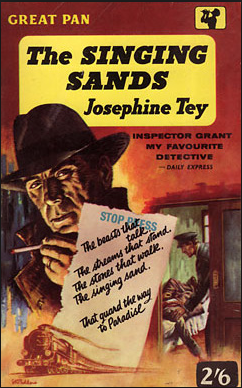
Day 638: The Singing Sands

Cover for The Singing SandsEvery once in awhile, I like to read a classic mystery, and I have only read a few by Josephine Tey. Tey’s novels acted as a bridge between the Golden Age of mysteries and the modern mystery, when the genre moved toward more realism.

The overworked Inspector Grant is on his way to a holiday in Scotland and is concerned because he has developed a debilitating claustrophobia. Upon leaving the train at Euston station, he comes across a porter trying to rouse an apparently inebriated passenger. Grant sees right away that the man is dead. When he examines the body, he drops some of his own papers, and while picking them up, accidentally removes the dead man’s newspaper.

Relaxing at his cousin’s house in the Highlands and preparing to go fishing, Grant checks the paper the next day to see what it says about the dead man. His face has stuck in Grant’s mind. He finds that the man has been identified as a Frenchman named Charles Martin. He has already discovered the man’s newspaper, with some verse scratched on it referring to animals that talk, streams that stand, stones that walk, and singing sand. He recognizes the man’s handwriting as the unformed style learned by British schoolboys, and he can’t imagine that the dead man was French. So, he decides to look into the death a bit more.

Except for The Daughter of Time, Tey’s most well-known book, I have only read a couple of Tey’s one-off novels, not her Inspector Grant mysteries. After reading this one, I think I’ll look for more. Inspector Grant is interesting and likable, as are the relatives he visits. The mystery is involving without being so overcomplicated as to be unlikely, as Golden Age mysteries often are. When Grant travels to the island of Claddagh (referred to as Cladda in the novel) in search of the singing sands, we also get to explore a new landscape.

Day 637: The Quick

Cover for The QuickAt first, The Quick seems like a straightforward historical novel about a young writer in 19th century London. But it has a twist. To be honest, if I’d known what the twist was beforehand, I probably wouldn’t have chosen this novel to read, because frankly, I’m tired of this subject. That said, I’m glad I read the book, because it is absorbing, well written, and quite suspenseful.

James and Charlotte Norbury grow up neglected in a rambling house in Yorkshire. Their father rarely comes near them after their mother dies and seems to forget they might need attention or tutors or governesses. So, while the two children run wild, it is the older Charlotte who takes care of James and teaches him to read.

After their father’s death, James goes away to school while Charlotte stays in the care of Mrs. Chickering, an elderly relative. James eventually moves to London to try being a writer, but he is not wealthy and has difficulties finding acceptable lodgings he can afford. An acquaintance introduces him to Christopher Paige, a young aristocrat looking for someone to share his rooms. Although the more austere and shy James does not envy Paige’s life of frivolity, he slowly begins to realize that Paige is his first friend—then that he is more than a friend.

One night, though, a terrible event takes place. Christopher Paige is killed and James disappears. When James does not appear at Mrs. Chickering’s funeral, Charlotte travels to London to find him.

In London, Charlotte’s inquiries attract the attention of the members of a powerful and mysterious club, the Aegolius. There has been an unexpected event at the club, and other people are looking for James. Soon, Charlotte finds herself involved with a secret substrata of the city.

Owen depicts a wonderfully atmospheric London. Although I was at first disappointed with the direction the story took, I still was unable to put this book down.

Day 636: Their Eyes Were Watching God

their-eyes-were-watching-godTheir Eyes Were Watching God was my selection for Classics Spin #8 for the Classics Club! Here is my review.

I had a complex reaction to this novel. On the one hand, I liked its protagonist, Janie Crawford, and was interested in her struggle to define her own identity. On the other hand, I didn’t much like any other characters in the novel. On the one hand, Janie’s struggles to define herself make the novel a landmark feminist book; on the other hand, Janie defines herself through her choice of husbands and her relationships to them. On the one hand, I don’t usually like tales in the vernacular; on the other hand, both the educated omniscient narrator and Janie’s vernacular third/first-person narration have moments of entrancing imagery. And speaking of that imagery, for a book written in 1937, the novel is occasionally startling in its sexuality.

A woman in her 40’s, Janie has recently returned home without Tea Cake, the man she left with. Having departed in some scandal, a well-off widow with a much younger, penniless man, she is figuring in a lot of talk. So, when her friend Pheoby comes to see her, Janie decides to tell her the story of her life.

Janie was raised by her grandmother in West Florida after her mother had her as a result of rape and then disappeared. Janie is a light-skinned black woman with long beautiful hair, and her appearance features in much of her story. When she is still an extremely innocent 16-year-old, her grandmother marries her off to a much older man, trying to give her stability. Janie thinks that marrying will make them love each other, but she is soon disillusioned and finds he is inclined to treat her like a work horse.

Then she meets Joe Stark, a flashy well-dressed man who seems to be going somewhere, and is. She leaves with him and they settle in an all-black town in “the new part of Florida,” where Joe soon becomes the mayor and store owner. But he defines his marriage by what he gives her and expects her to maintain a certain decorum as his wife, not allowing her to participate in many of the small town amusements. Also, he treats her with disrespect, publicly ridiculing her.

After Joe dies, under circumstances that have already started talk, Janie meets Tea Cake and eventually leaves with him to work in the Everglades. Although Tea Cake is in some ways an improvement over her other two husbands, there are some events that disturbed me. First, he steals her $200 and comes back with $12, but she is only upset when she thinks he has left her. Next, he earns it back but makes her put it in the bank and promise to live off what he can provide, a classic play for dominance that ignores the fact that she soon has to go to work next to him, manually in the fields. Finally, he beats her up once, not because of anything she does but because he wants to show everyone that she belongs to him.

Hurston was a trained ethnographer, and her fiction details a way of life in small-town Florida of her time. I found many of the details interesting. A fascination with skin color and Caucasian features is one theme that comes up several times. In fact, when Tea Cake beats Janie, instead of provoking a discussion of the fairness of the beating, the people are more fascinated by Janie’s skin being fair enough that they can see the bruises, which makes the other men envious.

Janie is often viewed harshly and unfairly by others. But it is part of her growing self-awareness that she doesn’t care. Although to me she sometimes seems too passive in her relationship to men—her gentle response to Tea Cake’s beating is seen as a good thing—she is otherwise a strong and resourceful heroine.