A Little Blogging Fun

Inspired by the yearly summary by Alina of Literary Vittles, I decided to take a look at my blog’s search terms for the past year. The search terms are what people entered into search engines that brought them to my site. Although most of them made sense, I found a few things of interest or amusement.

Information No One Will Find on My Blog

Cover for Still LifeA few search terms fell into the category of things you won’t find on my blog, sometimes just because of spelling errors but also because I don’t give away key plot points or they’re about subjects I don’t cover on my blog:

  • “Desmond Seward wife”: okay, I have one book by Desmond Seward, but I have no idea who he’s married to.
  • “Villan in Peaches for Father Francis”: do they mean “villain”?
  • “How is Mary Stewart’s life reflect in her books”: good question
  • “What happens to Peter and Clara in Louise Penny’s Still Life” or “In the Louise Penny series are Clara and Peter reunited”: I’ll never tell.
  • “Nonfiction: a biography of Daphine du Morea”: I DO have one of Daphne Du Maurier.
  • “The secret life of the renowned storyteller”: this is mysterious, isn’t it? Does anyone understand this one?
  • “The Orphan Choir ending. I don’t get it”: I’m not going to explain it to you.
  • “Why are Rose’s fingerprints switched in the Pinkie Brown murder in The Red Road”: not telling
  • “Unbelievable happy ending in Lisette’s List”: I don’t think I found it unbelievable.
  • “All the Light We Cannot See hard ships”: okay, maybe I’m not being nice to point this one out, but I don’t think there are very many ships in this book. A few.

Terms That Don’t Seem Like They Should Lead to My Blog

These are terms that make me wonder how the people ended up at my blog:

  • to.a.daytrader
  • history of sexual orgy in Istanbul
  • cascade asa dez deal: when I translated this, I was even more confused

Cover for SaltMost Common Search Terms

This is an interesting list to me because with a couple of exceptions it does not reflect which books are being heavily read on my blog:

  • Dunnett “The Game of Kings” Druon “The Iron King” (yes, quite a few searches worded exactly the same way)
  • Walt Longmire and Vic Moretti relationship or Walt Longmire and Vic Moretti or Longmire
  • Erlandur
  • List of historical fiction novels
  • Saint Gilbert Entre les Loups
  • Charlie Zailer or Charlie Zailer Simon Waterhouse
  • All the Light We Cannot See ending
  • Candlemass Road
  • The Cruelest Journey
  • Luloecen
  • Abigail Adams
  • Is Salt: A World History a microhistory
  • Melisites
  • Burning heretics England Chaucer

Top Fifteen for This Year

Cover for This Rough MagicHere are the 15 most viewed books this year:

  • This Rough Magic (This has been the top book since I reviewed it, which I find really odd, although it is a good book.)
  • The Loon Feather
  • The Bones of Paris
  • I Know Why the Caged Bird Sings
  • All the Light We Cannot See
  • King Hereafter
  • The Leaf Men
  • The World’s Wife
  • The Invisible Woman: The Story of Charles Dickens and Nelly Ternan
  • The Invention of Wings
  • Turn of the Tide
  • Wife 22
  • Anne of Green Gables
  • My Life in Middlemarch
  • Neverland: J. M. Barrie, the du Mauriers, and the Dark Side of Peter Pan
Day 635: The Secret Life of William Shakespeare

Cover for The Secret Life of William ShakespeareAs I am interested in Shakespeare and recently enjoyed a Regency romance by Jude Morgan, I wanted to enjoy this novel a lot more than I did. There is of course a risk in making a historical figure a main character in a novel, and that is that no author truly knows the mind of the real person. The truly successful novel of this type bravely forges a persona. Morgan’s solution, however, is to make Shakespeare, about whom little is known, truly amorphous in character.

The novel centers mostly on the relationship between Shakespeare and his wife, Anne Hathaway, an interesting choice, since we know they lived apart for much of their marriage. Morgan explains the marriage between Shakespeare and his bride, almost ten years older, as a love match, which is perhaps more unlikely than many different explanations for it (although of course not impossible). He has Anne reluctantly agree to Will’s eventual decision to join a group of players only on the condition that he is never unfaithful to her. Anne does not understand Will’s fascination with the theatre and views it with jealousy.

To go along with the amorphous nature of Will’s character, the details of his London life are murky. Morgan hardly ever shows him at his work or refers to any of the events of his life. Instead, he has him in conversation with various players and writers, particularly Christopher Marlowe and Ben Jonson. The introduction of Jonson into the novel is particularly confusing, as often we side track to examine his life and career as a playwright. In fact, he is a much more definite character than Shakespeare is.

It felt to me as though, in being perhaps reluctant to misinterpret Shakespeare’s personality, Morgan just doesn’t interpret it at all. Wife and friends find him equally unknowable. I had a hard time reconciling my knowledge of the plays with this reticent character. In particular, it seemed as though a man who was so fascinated with language would play with it more in his speech, as he does in Anthony Burgess’s much more adventuresome book Nothing Like the Sun. I did not buy Morgan’s idea of Shakespeare’s personality at all.

Day 634: The Never List

Cover for The Never ListThe Never List is one of several books that were published last year to capitalize on the huge popularity of Gone Girl. Unfortunately, The Never List never comes close to reaching the tension and suspense of Gillian Flynn’s work.

Caroline has managed to arrange her life so that she has not left her New York apartment for years. She was once Sarah, held captive with three other women for years and subjected to torture by a crazed psychology professor named Jack Derber. Derber’s parole hearing is coming up, and Agent McCordy is trying to prepare her to testify. That would mean she would have to leave her apartment.

Of course, Sarah doesn’t want Derber out of jail, but she is more concerned about whatever happened to her best friend Jennifer, with whom she was kidnapped. After a car accident in their teens in which Jennifer’s mother was killed, Sarah and Jennifer constructed the Never List, things they would not do that would put them in danger. One of those things was to never walk back to their college dormitory at night after a party. It was after they got into the car they thought was their cab that they were kidnapped. The last time Sarah saw Jennifer alive was in that car. After that, Jennifer was kept in a box in Derber’s basement.

Sarah begins to believe that letters she receives from Derber hold coded clues for her fellow victims Tracy and Christine, and that theirs may hold clues for her. In hopes of finding Jennifer’s body, she tries to get them to help. She believes that Jack’s wife Amelia, the member of a religious cult, might know something. But when she travels to Oregon to see her, she can’t find her.

Eventually, Sarah begins traipsing all over the country looking for clues, later helped by Tracy.

The first thing that struck me was the novel’s narrative style, a certain flavor of first person that reminds me of the style adopted for many young adult novels. I find it irritating, used to provoke a false intimacy.

I also found it completely unlikely that an agoraphobic who hasn’t left her apartment in years and is full of terror could put it aside and suddenly begin flying and driving all over the country. I had this same complaint about Louise Millar’s Accidents Happen, and that character was only traveling around the city.

Zan doesn’t successfully build suspense in this novel. At one point, Tracy and Sarah are captive in a van with a bunch of women and you wonder how they are ever going to get out, when before it can get too scary, they are miraculously released. Not only does she make this happen too quickly to build the suspense, but the character who releases the women has somehow managed to fly straight across the country from New York to Oregon in a few hours, just in time to witness them being kidnapped. (I only have to travel halfway across the country to Oregon, and it takes me almost all day.) Other scenes that could be terrifying are not.

I won’t go into much more detail about the plot, which mixes serial killing and torture, S & M clubs, human trafficking, and cults. Did I miss the kitchen sink? Suffice it to say, I did not believe this book for a minute.

Day 633: Kim

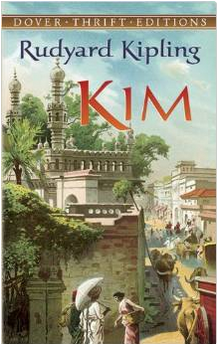
Cover for KimBest Book of the Week!
Up until now, the only book I read by Rudyard Kipling was Puck of Pook’s Hill, which is definitely a children’s book. I always assumed that Kim was a children’s book, too, or at most a boy’s adventure story, but I don’t think I would describe it that way.

Kim is the son of an Irish soldier in India, but both of his parents died impoverished when he was young. He has been brought up by a Eurasian woman who leaves him to himself most of the time, only insisting that he wear European clothing. But he keeps some native clothing hidden away, and when he is wearing it, he cannot be discerned from any other street urchin. He knows everyone in Lahore, and they call him Friend of All the World.

One day he is playing outside the Lahore museum when a holy old lama comes to look at the wonders inside. Kim sees that he is a truly guileless man with no one to help him in a foreign country. The lama explains that he is searching for a holy river that will wash clean all his sins. Kim decides that he will go with the lama as his chela, his disciple who begs for him and takes care of him. Before leaving Lahore, though, Kim goes to see Mahbub Ali, an Afghani horse dealer for whom he has run some errands. Mahbub gives him a dispatch to take to a British Colonel Creighton.

The description of the journey of Kim and the lama is very colorful and interesting, reflecting Kim’s joy in the bustle of the road and a love of the country on the part of the author. But Kim’s father told him long ago that he would be saved by a red bull on a green field, so when he sees a regimental flag flying the device, he goes nearer to look and is suspected of being a thief.

He has always carried his papers in an amulet, and when he is captured, his identity as Kimball O’Hara is established. The priests in the regiment, of which Kim’s father was a member, plan to send him away to a Masonic orphanage. Kept a watch on and forbidden to see his lama, Kim writes to Mahbub for help. Mahbub makes sure that Colonel Creighton understands how valuable a boy like Kim would be as part of the Great Game, of spies and explorers in the far regions of the area.

So, Kim’s fate is taken out of his own hands and he is sent to school to learn to take his part in the Raj. But the lama pays for his schooling and makes sure he goes to a better school than originally intended.

This is really a great novel. I came to it prepared for perhaps some outmoded racism or hints of British superiority but found a novel that reflects a deep love of India and of all its peoples. Of course, there is an implicit assumption that the Raj is a good thing, but the British characters in the novel are as varied as any, and there are comments about mismanagement and misplaced airs of superiority on the part of the British. Kim is rich in colors and smells, in the flavors of language and the stories of the orient, and in this complex tale of a boy with loyalties both to the soldiers who raised him and to his beloved lama.


Day 632: The All-True Travels and Adventures of Lidie Newton

Cover for The All-True Travels and Adventures of Lidie NewtonBest Book of the Week!
Just by coincidence, it seems, I have read several books in the last few years dealing with the wars in Kansas over whether it would be a free state or not. Bleeding Kansas by Sara Paretsky was the first book I read on the subject and the least well done, not providing much background for readers who don’t know a lot about the subject. The next book I read was Gilead by Marilynne Robinson, much more poetic but concerned mostly with a son’s reaction to his minister father’s participation in the bloodshed. The Good Lord Bird provides more of a comic flavor to the time, but it concentrates on a portrait of John Brown. I just finished Jane Smiley’s The All-True Travels and Adventures of Lidie Newton, which provides the most background to the issues and a more vivid picture of the times.

Lidie Harkness is a tall, plain young woman who has spent most of her time avoiding her traditional duties and instead rides, hunts, and swims with her 12-year-old cousin Frank near their home in Quincy, Illinois. She is the only child of her very old father’s second wife, and her sisters are much older. When her father dies, she knows her sisters are at a loss for what to do with her and eager to get her off their hands.

She meets Thomas Newton, a New England abolitionist on his way to join friends in Lawrence, Kansas. He seems struck by the stories Frank tells him of Lidie’s outdoor abilities, and it is not long before they are married and on their way down the Mississippi.

Flyers are plastered all over Lidie’s brother-in-law’s store promising a settled paradise in Kansas, but the reality is much more frantic and primitive. Lidie and Thomas find themselvs in a bustling but rustic town and are soon trying to build a homestead from a rough 12 x 12 cabin. Of concern, though, are all the rumors about the political situation and the outbursts of violence against the mostly free-state settlers by groups of pro-slavery Missourians who are trying to force them out.

In this tempestuous climate, Lidie tries to get to know her husband and also to understand just how committed she is to the fight against slavery. The novel depicts its time and location vividly. Lidie’s is an interesting portrait of a young woman attempting to find her own place in the world and decide what she believes about marriage and the issues of her time.

Day 631: Two Christmas Novels by Dickens

Cover for A Christmas CarolIn the spirit of the season, I thought I’d take a look at a collection I have of Charles Dickens Christmas books. As you may know, Dickens wrote a short Christmas book every year for years. A Christmas Carol was the first one, and it did much to revive Dickens’ career, which was flagging after Martin Chuzzlewit. My book contains the Christmas stories in order, and this Christmas I have read the first two.

Dickens is closely associated with Christmas. He didn’t invent our current traditions, but through his glimpses of how happy families celebrated it, some traditions were probably set and promulgated.

The introduction to this collection admits that A Christmas Carol is the best of the Christmas books, which is probably why it is most well known and adapted. Still, it has been a long time since I read it, and I found it interesting to compare it with the screen renditions, with which I am more familiar. (In my opinion, the best one because of its atmosphere is the 1951 version with Alistair Sim—but only in black and white, mind.) What stood out the most is that in one of the movies, Scrooge actually fires Bob Cratchit, a cruel joke even if only momentary, but he does not in the book. The movies also seem to put more or less of Scrooge’s nephew Fred in them, depending.

Of course, A Christmas Carol is the story of the miserly Ebenezer Scrooge, who has grown so obsessed with the accumulation of wealth that he has given up all pleasure and human companionship, and even worse, from Dickens’ point of view, all charity. Through the intercession of his dead partner Jacob Marley and the visits of three ghosts, he gets a second chance to be a better person.

chimesI haven’t read any of the others before, but I found The Chimes to be a similar story. Trotty Veck is a poor porter. He lives nearby a church that has a set of bells considered to be haunted. But Trotty likes the bells and in his simple way is always praising them.

One day an overbearing alderman makes some comments to Richard, who is the fiancé of Trotty’s beloved daughter Margaret, about how foolish he is as a young man to be getting married. Richard and Margaret are to be married New Years’ Day, and when Trotty sees Margaret in tears later, he thinks the alderman’s comments have caused Richard to break it off. This and other encounters cause Trotty to have doubts about the goodness of humankind. Later, the bells lure Trotty up to the bell tower and teach him a lesson.

The lesson of this story is much more garbled than that of A Christmas Carol. Since Trotty’s thinking processes are a bit murky at times, I wasn’t even sure exactly how Trotty supposedly transgressed the bells. Still, Dickens always manages to bring a tear to your eyes when he tries.


Day 630: Amherst

Cover for AmherstAmherst combines the tale of two love stories, one actual and one fictional. The historical actual affair was between Emily Dickinson’s brother Austin and the much younger Mabel Loomis Todd. The modern fictional affair is between Alice Dickinson, working on a screenplay about the affair, and Nick Crocker, an older academic who gives her a place to stay in Amherst while she does her research. All of these people are married to others except Alice.

Emily Dickinson herself is a minor character in the 19th century story. Her brother and Todd used her house for their trysts—a known fact—and there is some debate about how much exposure Emily herself had to sex. Nicholson theorizes a woman listening at doors and a sort of free love attitude by everyone except Sue, Austin’s wife. I found it all a little sordid and probably unlikely.

All of this might be interesting to a reader of literature if Nicholson had spent any time with these characters before thrusting them into their love affairs. We don’t know any of them, so we don’t care about them (alas, too often my complaint lately).

Worse, to me, are the liberties or omissions at the end of the novel. Nicholson gives Todd full credit for her efforts to publish Dickinson’s poetry after her death, even having her spend hours convincing Thomas Wentworth Higginson of the value of Emily’s work. He doesn’t mention that Higginson was already very familiar with Dickinson’s poetry, having been in correspondence with her for 20 years before her death, as related in the excellent biography White Heat. (Although on the surface Nicholson seems unfamiliar with or ignores some of the content of the biography, he interestingly uses the phrase “white heat” to refer to the affair between Todd and Austin Dickinson.) Higginson was already convinced of the worth of Dickinson’s poetry—he just had doubts about how publishable it was. In fact, he almost certainly met Dickinson, which Todd never did.

The other historical fact Nicholson completely glosses over is the one the world of literature finds most shocking—that Todd and Higginson edited Dickinson’s poetry, changing capitalization and spelling but even rewriting some of the passages.

http://www.netgalley.comThe lovers are not really likable, in fact or fiction. Austin Dickinson actually consummated his affair with Todd while his wife was grieving the recent death of their young son. Mabel comes off everywhere as self-centered, and she fought with the Dickinson’s over Emily’s legacy as much as she ensured it.

The two modern lovers are just not interesting, really more of a footnote to the historical section, and I found Nick to be extremely manipulative. The novel also employs that overused trope of having Alice find out immediately in a way that is too crass to be believable that Nick has a reputation as a seducer. Note to minor characters: these warnings never work.

It’s hard to tell whether Nicholson meant these stories to be romantic, although he states in an interview that he is interested in exploring love. I did not find the stories romantic, either one of them. I also did not feel they particularly explored the theme of love. I was not at all drawn in by this novel, neither by the historical nor by the modern story.

Day 629: Giving Up the Ghost

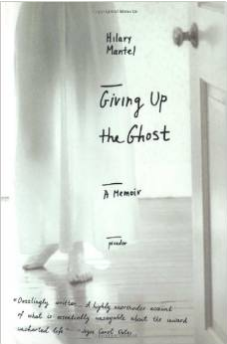
Cover for Giving Up the GhostBest Book of the Week!
In this gripping memoir, ghosts haunt author Hilary Mantel—the spectres of her past, her stepfather’s shade stumbling around the upper reaches of her holiday cottage, the spirit of her unborn daughter, the wisps of her yet unwritten books, and most confoundingly, the black smudge of an apparition that invaded her body when she was seven. Mantel’s is a memoir of wit, anger, and poetic truth.

It also meanders. It begins with the sale of Owl Cottage—where Hilary senses the ghost of her stepfather even though he never lived there—but then returns to the earliest memories of her childhood.

Of Irish Catholic parents, she grew up in the grim north England town of Hadfield, near Manchester. Although her family was poor, her earliest memories are the rich ones of her grandparents and aunts, who lived all along the lane, indulging the imagination of a child who was a knight of the round table, a red Indian, a priest, and was due to turn into a boy when she was four. To me, this last detail is one of the most charming. I can see this little girl.

Then a serious illness struck, changing her from a sturdy tough child with long black hair to a wispy, frail blonde girl, no longer due to change to a boy. From then on it seemed she was robbed of her true self.

The memoir details her rigid Catholic school education, where she developed an intolerance for ridiculous questions, from those asked by her teachers. It also tells of the more profound loss of her childhood, when her mother moved the family out of that lane of relatives so that she could take up life with her lover, Jack. Hilary’s father Henry was relegated to the status of a lodger and then left behind when Hilary won a place at a better school, never to be seen again.

The most debilitating events of her life began when she was a young married woman studying law. The extreme pains in her legs were diagnosed by patronizing and sexist doctors as mental rather than physical problems, caused by the stress of her studies on her feeble female brain, and she was treated first with Valium and later with anti-psychotics. What she actually had was endometriosis, which she finally diagnosed herself. It was left untreated so long that she ended up having a hysterectomy at age 29. She had put off having a child, and it was too late. The effects on her health continue to this day.

Mantel’s memoir is vividly and beautifully written. She strips herself bare, and it is unforgettable.