Day 628: Anne of Green Gables

Cover for Anne of Green GablesI have not read Anne of Green Gables since I was about ten, and I’m delighted to report that it is a book that offers as much enjoyment to an adult reader as to a child. As a child, I threw myself wholeheartedly into Anne’s delights and misfortunes, but as an adult, I am more able to appreciate the abundant humor of the novel.

Matthew and Marilla Cuthbert are an elderly brother and sister with a farm in Avonlea on Prince Edward Island. They have taken a momentous decision to adopt an orphan boy to help Matthew on the farm. They sent word to an acquaintance who went to adopt a girl, and she has brought an orphan back for them on the train.

But when Matthew arrives at the station, he finds not an orphan boy but a girl, a funny looking, skinny, red-headed girl. Matthew is a shy and reticent man, and he sees nothing to do but take the girl home and let Marilla break the news that there’s been a mistake. So, they set off home for Green Gables, the excitable Anne Shirley prattling all the way back.

When Anne learns she isn’t wanted after all, she is devastated. But when Marilla takes her to see another woman who might want an orphan girl, she can’t quite bring herself to leave Anne with the mean-mouthed woman with a reputation for mistreating the help (as an orphan would often be regarded at that time, not as a member of the family). Despite her better judgment, Marilla decides to keep Anne.

Thus begins this delightful novel about a young, imaginative girl who is always running into trouble. For Anne is romantic and dreamy and full of big ideas that often go wrong. The delight for me as an adult in reading this sentimental tale is the dry humor of Marilla, as she learns to love Anne and all her mischief. This is a lovely and fun book to read, particularly if you love any other volatile little red-headed girls.

Day 627: Mercy Snow

Cover for Mercy SnowBest Book of the Week!
On an icy Thanksgiving eve outside Titan Falls, New Hampshire, a school bus with children who had been to the movies in the nearby town plummets off the road, killing one girl and incapacitating the bus driver. Readers know that a car passed the bus at a dangerous place, causing the driver to lose control. Up the road from the bus, the sheriff finds the wrecked truck of Zeke Snow, a young man from a backwoods family of ill repute. No one knows exactly what happened, but the sheriff decides it must have been Zeke’s fault.

June McAllister, the mill owner’s wife, soon finds evidence that her husband Cal may know more about the accident than he’s admitting. Her reaction is to close family ranks. After all, the Snows have never been anything but trouble.

Zeke is hiding in the woods, but he has told his sister Mercy that he did not see the bus the night that he wrecked his truck. He ran when the police arrived because he’s known nothing but trouble from them.

Mercy knows that her brother occasionally shows poor judgment, but his main instinct has always been to protect her and their little sister Hannah. While eking out an existence for herself and Hannah and living in a battered old trailer, she decides she must somehow prove Zeke innocent. For her part, June is trying to drive the Snows out of the area, where they have returned to their grandmother’s property after years of a rough and nomadic existence.

This novel may sound like a mystery, but it is not. We know fairly early on what happened to the bus. Instead, the novel is an examination of themes like discrimination against the poor, the exercise of power, the complexity of people’s reactions to tragedy, and the close-mindedness of small, closely knit communities. It also includes a hint of the supernatural. The novel is disturbing and well written. Although I thought I knew where it was going, the novel turned out to be unpredictable.

Day 626: River Thieves

Cover for River ThievesReading River Thieves did not leave me with the same impression of wild originality as did Galore, the other Michael Crummey novel I read. Still, it is an interesting historical novel about the interactions between Europeans and the Beothuk Indians in early 19th century Newfoundland.

This novel is based on a true incident. It concerns an investigation into the killing of a Beothuk man by trappers after they went looking for redress for some thefts. This expedition brought back a Beothuk woman, later called Mary, who is captured at the beginning of the novel. But the narration of this story is far from straightforward, and we do not learn exactly what happened until the end of the novel.

Further, the characters’ actions are affected by a long history of their personal interactions. John Peyton is a young man at the beginning of the novel. He is in love with Cassie, his tutor and his father’s housekeeper, but she is somewhat mysterious and keeps aloof from him. John Sr. hired Cassie thinking that she and John Peyton might marry, but a misunderstanding interferes.

Lieutenant David Buchan encounters most of those figuring in the incident when he makes an earlier attempt to establish more cordial relations with the Beothuk than the violent ones currently existing. This expedition, which includes John Peyton, John Sr., and some of John Sr.’s employees, ends in disaster. It is the seemingly upright Buchan, later a captain, who is put in charge of the subsequent investigation.

This story is told at a remove from the characters. Although we learn the thoughts of several of them, Crummey never reveals everything, forcing us to view his characters more as an ensemble rather than to consider one a central character. In Galore, Crummey used this technique to depict the occupants of an entire village. Here, it is not quite as satisfying.

Day 625: Another Time, Another Life

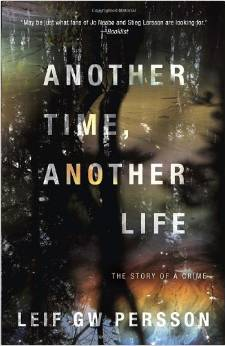
Cover for Another Time, Another LifeAnother Time, Another Life is the second book in a trilogy of complex political police procedurals by Leif GW Persson. I reviewed the first book last spring.

At first, it is difficult to see the connection between the two books, but eventually some of the names and events from the previous book re-emerge. Another Time, Another Life begins with two crimes 14 years apart. Like Between Summer’s Longing and Winter’s End, one of the crimes is based on an actual event, in this case the bombing of the West German embassy in Stockholm in 1975 by German terrorists. Although the Swedish authorities are certain that the Germans must have had help from Swedish citizens, the case is wound up fairly quickly without any indication of who those Swedes might be.

Inspector Bo Jarnebring was on the scene right after the bombing, and 14 years later he is the first to respond to a call for help. A little old lady has overheard an argument in a neighboring apartment and called to report that someone is attacking her neighbor. When Jarnebring and his partner Anna Holt arrive, they find Kjell Göran Eriksson stabbed to death in his living room.

Eriksson turns out to be an unpopular man—no one at his workplace liked him and he had only two friends, both of whom have not seen him in awhile and have alibis. Bäckström, the inspector in charge of the investigation, gets it into his head that the crime involves homosexuality, based solely on there being no evidence that Eriksson had a girlfriend. He has no compunction in using illegal means to make the facts fit his idea of the crime. Jarnebring and Holt are suspicious of the amount of money in Eriksson’s bank account, not justified by his salary or his background. But Bäckström won’t let them pursue their leads, and no suspect is ever identified.

Ten years later, Lars Johansson has just taken a job as head of the Swedish Security Police when he finds some puzzling information in his files. The names of four Swedes suspected of helping the German terrorists in 1975 were redacted from a file, but then two were reinstated. Both men are dead, and one of them was Kjell Göran Eriksson. The other was one of his two friends. This discovery leads Johansson back to his friend Jarnebring and to an official reopening of the Eriksson case and an unofficial reopening of the embassy bombing case.

Having read the first book in this series, I was not surprised to find the case becoming very complex, with important political ramifications. Persson’s work is reminiscent of some of John Le Carré’s political thrillers, although not as exciting and probably not as well written (hard to tell with a translation). The novels are intended more as complex procedurals, though, than thrillers, and they succeed in keeping my attention. As with the first book, Persson seems to delight in depicting incompetence and idiocy in the police and government. Jarnebring and Johansson’s teams are capable and intelligent, though, and for once we meet detectives who are happy with their wives.

Day 624: Men Against the Sea

Cover for Men Against the SeaMen Against the Sea is the sequel to Mutiny on the Bounty, and it accomplishes an interesting feat. While Mutiny on the Bounty depicts Captain Bligh as an enraged and irrational task-master, Men Against the Sea shows him as a consummate navigator and an able leader.

The novel takes up where the mutineers put the more loyal men adrift in a small boat. They have very little food and water and only a small tool box and a few weapons. Nineteen men are crowded into the 23-foot-long open launch.

Although the men make their way at first to one of the nearby Friendly Islands (present-day Tonga), they come close to being killed there by hostile natives. In fact, one of their number is murdered while they make their escape. They realize they will have to travel 3600 miles to the nearest European-occupied territory, in the Dutch East Indies (Indonesia).

Narrated by Thomas Ledward, the ship’s surgeon, the novel tells the story of this incredible journey. The men fend off hostile natives, battle storms, and survive on scanty rations and little fresh water, lead on by Captain Bligh.

This novel is well written and engrossing, although it lacks the suspense of the trial in Mutiny on the Bounty. I am looking forward to the final book in the series.


Day 623: The Goblin Market and Selected Poems

Cover for The Goblin MarketI don’t know much about the life of Christina Rosetti. I know a little more about her brother, the artist Dante Gabriel Rosetti. The introduction to this book of her poems says that something happened to her when she was 15 that changed her from a mercurial child into a controlled, careful young woman. Certainly, her poetry shows a preoccupation with religion and death. It is also brimming with life, full of nature and love.

In “The Goblin Market,” for example, her descriptions of the goblin’s fruit are luscious. But though I understand the introductory comments about the poems being too sexually explicit for Victorian tastes, I see this poem as more about the pleasures and temptations of life versus spiritual values.

Some of the poetry in this collection dwells on themes I am not that fond of, but there is no doubt that the language is vivid and gorgeous. I don’t know if the poems are arranged sequentially, but some of the earlier ones remind me somewhat of traditional folk songs. Her sonnets employ an unusual rhyme scheme, close to Petrarchian, but with the last six lines using a different scheme.

One of my favorite poems was “In an Artist’s Studio,” about how the artist paints and repaints his model:

Lizzie Siddal
Dante Gabriel Rosetti portrait of Lizzie Siddal

He feeds upon her face by day and night,
And she with true kind eyes looks back on him
Fair as the moon and joyfull as the light:
Not wan with waiting, not with sorrow dim;
Not as she is, but was when hope shone bright;
Not as she is, but as she fills his dream.

I know that Dante Gabriel occasionally painted Christina when she was young, but this poem made me think of how he obsessively painted his mistress, Lizzie Siddal.

Day 622: Under the Harrow

Cover for Under the HarrowBest Book of the Week!
Under the Harrow is an unusual and imaginative novel. It is described in some write-ups as if Charles Dickens had written a modern thriller, and that description does give a sense of the novel.

Dingley Dell is a hidden valley occupied by about 11,000 people who have never been out of it. Their history relates that their ancestors were deserted as children in an orphanage during a terrible plague in 1890. With the only books available to them an old encyclopedia, the Bible, and the complete works of Charles Dickens, they have invented for themselves a very Dickensian environment, not omitting some of its evils, like a workhouse, a huge separation between classes, and a government by a privileged few. Only a few people have ever left the valley to see what is outside, and only a very few of them ever returned. Those few were promptly clapped into the madhouse, victims of a terrible mental illness.

Frederick Trimmers has lately suffered from some misgivings about the state of the dell. He is a writer for a muck-raking newspaper who sees much to improve in the dell. Lately, though, he has more personal problems. His troublesome nephew Newton, sent off by his parents to school, has run off from the dell. Newton’s father Gus soon goes after him. While they are having unexpected adventures outside, Frederick is learning disturbing things about the existence and history of the dell. Soon he begins to believe that the entire valley is in danger.

Dunn is having some fun with us while building up a fair amount of suspense. The novel is narrated in a sort of über-Victorian English. The inhabitants of the dell have almost all taken some of the silliest names from Dickens, and many of them remind us of his oddest characters. And in a moment of major action, he offhandedly remarks that the farmer in the dell purposefully left the cheese standing alone. That will give you a little idea of what you have in store, although he doesn’t overdo it. It’s about what you must expect from an author known for a novel where letters disappear one at a time from the text or another written entirely in footnotes.

There is a conspiracy, of course, and if I have a complaint, it’s about the unbelievable extent of the conspiracy and the unlikelihood, given how big Dunn makes it, that everything would come out okay. Still, I give this novel high marks for its originality and its ability to capture and hold my attention.

Day 621: Smith, The Story of a Pickpocket

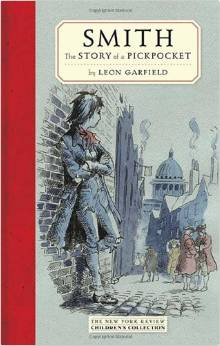
Cover for SmithI did not understand from the reviews I read for this book that it was a children’s book until I noticed its sprightly and simple tone. (My copy did not have this cover.) However, it is not suitable for just any child, because it begins with a murder and includes other violent acts. When I read in the introduction that Garfield wanted to write books full of adventure, like those by Robert Louis Stevenson, that made sense to me. The book is also described as Dickensian, but whereas some of Dickens’ and Stevenson’s books appeal to both adults and children, Smith does not have as much to offer adults.

Smith shares some plot elements with Oliver Twist, if the hero of the latter had been the Artful Dodger instead of the more innocent Oliver. For Smith is a twelve-year-old pickpocket. His adventures start when he picks the pocket of an old gentleman. Right after he does that, he sees the man murdered by two men dressed in brown. These men chase after Smith, but he eludes them.

Smith finds that all he has stolen is a paper that he can’t read. He is smart enough, though, to figure out that the paper must be important, since the men in brown are looking for him. Soon he finds he must leave the cellar where he lives with his two sisters and flee for his life. He goes looking for someone to teach him to read.

Smith’s adventures lead him to meet lots of characters who are vaguely Dickensian but somehow not as fully drawn as Dickens’ own. He finds shelter with a kindly blind man and his gruff daughter, is friends with a boastful highwayman, and meets an untrustworthy lawyer.

I found Smith only mildly entertaining but think that a child of the right age could be fascinated with this book—both by the life of a Victorian street urchin and by Smith’s adventures.