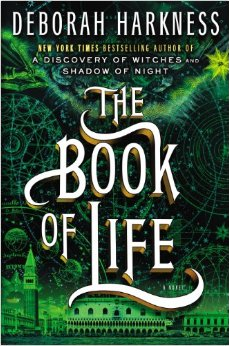
Day 611: The Book of Life

Cover for The Book of LifePerhaps I’m the last woman left in the country who doesn’t think it would be romantic to be in love with a tall, dark man who could suck my blood at any moment. In any case, although I first thought that Deborah Harkness’ All Souls Trilogy was refreshingly original, by the third book I was not as charmed by this complicated series.

In The Book of Life, Diana Bishop, a timewalker and special kind of witch called a weaver, and her vampire husband Matthew Clairmont have returned from the past where Diana was learning her skills. They have one of three missing pages from a manuscript called Ashmole 782, or The Book of Life, and they are trying to find the others to reunite them with the book. It was Diana’s accidental retrieval of this book from the Bodleian Library that started all the action. Diana is also pregnant with Matthew’s children.

Matthew and Diana are in violation of the Covenant, an old agreement among witches, vampires, and daemons that they will not associate with each other. They think the Book of Life may provide information about the origins of the three creature races and even help Matthew with his research into a deadly vampire disease called blood rage.

In addition, they are being pursued by Benjamin Clairmont, a crazed child of Matthew who wants Diana and her daughter.

Like the second book of the trilogy, The Book of Life seems rather scattered to me, with Diana and Matthew running here and there on their various quests. The spots in the plot that could be climactic can be a bit of a let-down, as, for example, we don’t even get to hear what Diana has to say to the Congregation when she finally presents the evidence she and Matthew have collected.

After reading the first two books, I wanted to see what happened, and I was fond of several of the characters. But I didn’t think the novel was romantic, nor do I have much use in general for the overprotective male partner.

Day 610: How the Light Gets In

Cover for How the Light Gets InI didn’t realize I had never reviewed this book, even though I finished it almost exactly a year ago, until I started to post a review of its sequel. So, you’ll have to forgive me. I’m working from memory.

This novel serves as a culmination of an ongoing plot from the very first of the series. Inspector Gamache’s enemies in law enforcement have gutted his department and alienated the loyalty of his friend and lieutenant Jean-Guy Beauvoir through encouraging his drug addiction. Now they are planning to destroy Gamache.

In the meantime, Myrna Landers has summoned him to the picturesque village of Three Pines to look for a friend who has disappeared, Constance Pineault. Myrna is cagey about the true identity of the friend, but eventually Gamache finds out that she is very famous, the last surviving sister of a set of quintuplets. Gamache and his department are also dealing with a possible terrorist threat. All of this action takes place over a snowy Christmas.

The end of How the Light Gets In is extremely dramatic, but it left me wondering if the novel was intended as the end of the series. (Hint: I wondered this at the time, but notice that I referred to a sequel.) As always, it is complexly plotted and colorful in detail.

Every time Penny describes Three Pines, I want to go see it. Also, Penny’s books continue to win my award for the most beautiful covers, ever.

Day 609: Good Behaviour

Cover for Good BehaviourMolly Keane was a successful author and playwright in the first half of the 20th century. Although she was known mostly for romantic frolics, Good Behaviour is certainly not in that category. In fact, at the time that she wrote it, it was rejected as being too dark. It was not published until years later, when Keane’s friend Peggy Ashcroft encouraged her to try again.

Good Behaviour is a comedy of manners and a satirical look at the life of a certain type of the Irish upper class. It startlingly begins with a murder, but I’ll leave it to readers to find out who the victim and murderer are.

After the murder, the book returns in time to recount the childhood and upbringing of Aroon St. Charles. But first it oddly shoots off to explain how Mrs. Brock, Aroon’s governess, came to them. It is telling to learn that the proper and kindly Mrs. Brock was “let go” by a friend of St. Charles, notwithstanding a good reference, because she committed the crimes of encouraging one of the boys to read poetry and comforting him after he was whipped by his father. The boy, Richard Massingham, becomes important to Aroon in later years.

Aroon is a large, unattractive girl who is desperate for affection and some acknowledgment of her own importance. She is not stupid, but she sees only what she wants to see and is incredibly naive. Although she loves Mrs. Brock, it is indicative of her character that she nevertheless makes fun of her later in life as a way to fit in with Richard and her brother Hubert. She loves her father, who treats her with casual affection, but expressiveness is considered bad form in their set.

Her relationship with her mother is more complex. Although Aroon steadfastly maintains the fiction that her parents are devoted to each other, it is clear that they are not. Mrs. St. Charles is cold and removed from her family. She has no interests in common with her husband, who spends most of his time pursuing outdoor sports and philandering. Aroon knows that, but does not seem to notice what is going on in her own house.

The events in this novel are largely trivial except for some deaths. The novel is not plot-driven but centers around the behavior of Aroon and her horsey upper-class friends, who maintain their snobbishness despite a consistent lack of funds. We see the irony when Aroon throws away her opportunity to escape her unhappy household through a combination of willful blindness and snobbery. Aroon finds her place eventually and it is a deserved one.

Although we can find some sympathy for Aroon, she is definitely an anti-heroine. If you appreciate a sly, dark, understated humor and a masterly characterization, you should look for a copy of this novel.

Classics Club Spin #8!

Cover for The MoonstoneIt’s time for another Classics Spin! I have put together a list of 20 books from my Classics Club List. On Monday, the Classics Club will pick a number between 1 and 20, and the number they pick determines the book that I will read from the list below. I’ll read that book and review it on January 5!

  1. Don Quixote by Miguel Cervantes
  2. The Vicar of Wakefield by Oliver Goldsmith
  3. Henry VI, Pt. I by William Shakespeare
  4. A Wreath of Roses by Elizabeth Taylor
  5. Beloved by Toni Morrison
  6. Red Pottage by Mary Cholmondeley
  7. Sisters by a River by Barbara Comyns Carr
  8. That Lady by Kate O’Brien
  9. Greenbanks by Dorothy Whipple
  10. The Remains of the Day by Kazuo Ishiguro
  11. Ada by Vladimir Nabokov
  12. Selected Poems by Robert Frost
  13. Their Eyes Were Watching God by Zora Neale Hurston
  14. The Call of the Wild by Jack London
  15. Night by Elie Wiesel
  16. Rebecca by Daphne Du Maurier
  17. The Moonstone by Wilkie Collins
  18. The Idiot by Fyodor Dostoevsky
  19. Troy Chimneys by Margaret Kennedy
  20. Vanity Fair by William Makepeace Thackeray

Day 608: The Convenient Marriage

Cover for The Convenient MarriageThe Winwood sisters are in turmoil. Miss Winwood has gained a spectacular suitor in the Earl of Rule, who has finally decided to marry. He is wealthy, and his generous settlement will save the family from ruin. The only problem is that Miss Winwood is in love with Edward Heron, a mere army lieutenant and a second son with no fortune.

Young Horatia Winwood, not yet out of the schoolroom, thinks she has the solution. Rule wants to marry a Winwood, and it should not matter to him which one. So, she goes to his house and proposes herself as an alternative. She forthrightly points out her unfortunate eyebrows and her stammer and hopes that Rule won’t mind them. Rule is enchanted.

So, Horry gets married without realizing she has made a love match. Since Rule is afraid he may be too old for her, he treats her with a little too much care. She has told him she won’t interfere with him, so she says nothing when she learns about his mistress, Caroline Massey.

Rule has broken with Massey, though, who is jealous and angry. Crosby Drelincourt, Rule’s foppish heir, is eager to make trouble, as is Rule’s enemy, Robert Lethbridge.

Horry soon finds herself very popular. But her efforts to make Rule jealous and the plots of Rule’s enemies land her in trouble, and her scapegrace brother Pelham’s schemes to get her out of it only make things worse.

In Horry, Heyer has created another engaging and feisty heroine. Heyer is an expert on the Regency period, as well as the master of warm and funny romantic escapades, and The Convenient Marriage is one of her best.

Day 607: The Bone Clocks

Cover for The Bone ClocksBefore I get started on my review of The Bone Clocks, my friend Ariel of One Little Library has put together a survey on reader’s interests. If you would like to participate, please do.

* * *

Best Book of the Week!
David Mitchell’s most recent book is another fascinating novel that reminds me a bit of his Cloud Atlas. It explores themes of temporality, life after death, and the human soul and ends in a near-future dystopian vision. Unlike Cloud Atlas, though, The Bone Clocks takes place completely within the course of one woman’s life.

The novel begins in 1984. Fifteen-year-old Holly Sykes has had a fight with her mom after staying out late with her 24-year-old boyfriend Vince. Determined to leave school and move in with Vince, she packs her things and goes, but not before being spotted by her seven-year-old brother Jacko.

She marches over to Vince’s, only to find him in bed with her best friend. Devastated, she flees her home town of Gravesend, not knowing where to go. Later that day, she meets Ed Brubeck, a boy from her school, who helps her find shelter for the night in a church. Taking the idea from a story he tells her, she decides to travel to a nearby island where he worked the summer before picking strawberries.

Holly heard voices when she was a child, and she called them the Radio People. But after her mother became worried about her, a Dr. Marinus stopped them simply by touching her forehead. Since then, her life has been perfectly normal.

But that afternoon several odd things happen. First, she thinks she sees Jacko go into a pedestrian tunnel ahead of her, but when she gets there, she can’t find him. Then a couple pick her up hitch-hiking and take her to their home for a meal. There some events occur that make it clear to readers that some kind of supernatural war is going on involving her. But Holly remembers nothing of this.

Holly goes on to work at the strawberry farm. But the second day, Ed arrives to tell her that Jacko has disappeared.

The narration continues in stories told by other characters, but Holly appears in all of them. In one, Hugo Lamb is a college student who seems to be genial and caring but is actually a sociopath who tries to lure his more wealthy friends into deals he will profit by and steals rare stamps from a senile old man. He meets Holly on a skiing trip in Switzerland and honestly falls in love with her. But fate and a mysterious group called the Anchorites have other plans for him.

We follow Holly through her life as she marries Ed, writes a book called The Radio People, and gets old. At each encounter, inexplicable things happen until Holly is pulled into a battle between the Anchorites and the Horologists.

David Mitchell is a master storyteller. Although I do not consider The Bone Clocks a masterpiece, as I do Cloud Atlas, it is almost as rewarding—at times comic, at times suspenseful. Mitchell likes to tease us, too, by repeating characters from book to book. In this case, Dr. Marinus also appears in his wonderful historical novel, The Thousand Autumns of Jacob De Zoet. Time spent with Mitchell is well spent.

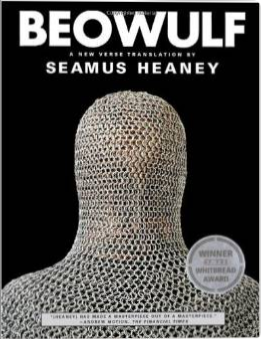
Day 606: Beowulf

Cover for BeowulfI’m planning this post for Halloween, so I decided to write about the quintessential monster tale. I’m not enough of a poetry reader to easily read an extended poem. Still, Beowulf is considerably more accessible than I expected.

The poem is, of course, the oldest known work in Old English, or Anglo-Saxon, written sometime between the seventh to early eleventh centuries. It is the story of the feats of Beowulf, a Scandinavian hero. It is also a poem written by a Christian poet looking back to a time of paganism. I read the award-winning translation by the Irish poet Seamus Heaney.

For me, the interest in the story is not the tale of battling monsters but the glimpses into a different past and mindset. For this poem is about right and proper behavior. The hero honors his lord and behaves rightly to him. When Beowulf is rewarded for killing Grendal and his mother, he rightfully takes his treasure back to his own chief. Later in the story, when all of Beowulf’s guard except Wiglaf desert him in the face of the dragon, Wiglaf is steadfast by his chief’s side to the end.

The poem is melancholy, for it tells of the end of the Geats, Beowulf’s people, when they are left leaderless after his death. It also stops several times to relate tales of revenge and blood money.

I barely remember a semester of Old English classes in graduate school, but it was enough to occasionally pass my eyes over the Old English side of this bilingual edition and recognize some similarity to modern English, an interesting pastime in itself.

Day 605: The Watch Tower

Cover for The Watch TowerBest Book of the Week!
The Watch Tower opens when Laura and Clare Vaizey are abruptly pulled out of school after their father dies. They move with their mother Stella to an apartment in the Sydney suburbs. While Stella lounges around in bed, she has the girls do all the housework. Laura, who thought she might become a doctor or an opera singer, is made to leave school and take a secretarial course. Later, to keep Clare in a decent school, Laura has to turn over all her earnings from a secretarial job in a factory, for her mother would as soon see Clare in the local high school, which only teaches girls home economics.

When World War II breaks out, Stella decides to return to England, leaving her girls to fend for themselves. By then, Laura is in her early 20’s and Clare in high school. When Laura wonders what she can do to keep Clare in high school, her mother suggests she get her a job in the factory.

Laura confides her problems to her boss, Felix Shaw, whom she thinks of as a good man. Felix has an idea that will keep Clare out of the factory. Laura should marry him, and he will support both girls. Stella refuses to give her advice, but she obviously prefers any solution that will be less trouble for herself. Seeing Felix’s offer as a sort of business deal, Laura accepts.

Laura and Clare do not know it, but they have put themselves into the hands of an emotionally and sometimes physically abusive man. The resulting story is one of great psychological depth. While Laura becomes a woman who will do anything to keep peace in the house, Clare finds herself attempting to stay in some way true to herself.

The novel is an absorbing account of the need of one person for escape from an abusive and emotionally stifling situation while another attempts to close every avenue of escape. Felix is continually involved in shady business deals with proteges who disappear as soon as they’ve managed to cheat him. Felix then takes everything out on his wife, showing her contempt so that others treat her contemptuously, too. Laura will do anything to appease him, including preventing her sister from attempting to leave.

This story is a dark and compelling one.