
 This week’s Best Book is Maddaddam by Margaret Atwood!
Day 595: Turn of the Tide
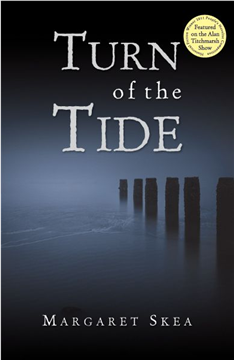 Turn of the Tide is a historical novel set in the 16th century that centers around a long-running feud between two Scottish families, the Cunninghames and the Montgomeries. The feud and some of the events are factual, although the main character and his family are not.
The novel begins when the Cunninghames summon Munro. Not a Cunninghame himself, he is a minor laird who owes them allegiance. But he is not happy when he finds the plan is to massacre a bunch of Montgomeries on their way to meet with the king.
Although Munro’s wife Kate is angry when she finds he took part, she is even more angry when she finds out later that he has befriended some of the Montgomeries. This apparent change of loyalties could cause even more problems for their small family. King James has forced the two families to make peace, but it is an awkward one, with both families jockeying for position in court.
Munro is most wary of his uneasy relationship with William Cunninghame, the Earl of Glencairn’s heir and a brute. As Munro becomes closer to the Montgomeries and William’s eye alights on Sybilla Boyd, the fiancée of Munro’s brother Archie, the relationship between Munro and William becomes dangerous.
This novel never quite gets off the ground for me. Although I don’t demand action from every book, this one has very little going on for much of the time. Skea does so little to differentiate some of the characters that I kept getting confused about who they were. The novel begins with the massacre and ends with some action that is not really satisfactory. In between it concerns itself with grown men literally jostling for position with King James, the form of which seems silly, although probably exactly what went on.
The novel is also about Munro’s family life, mildly interesting but not compelling. It is nicely written with some Scots dialect. It just isn’t very tightly plotted.
Day 594: The House We Grew Up In
 In some ways The House We Grew Up In hit home for me, but ultimately I felt it both was a bit unlikely and found too easy a solution for large problems. It is about a family trying to cope with a terrible event and with their mother’s mental illness.
We meet the Bird family at various stages of their lives, beginning when the oldest daughter Meg is about ten. As Easter is mother Lorelei’s favorite holiday, many of the events in the novel are set at that time.
In her mid-thirties, Lorelei Bird is a vibrant, beautiful woman, but there are already signs of what will become her obsession. Her kitchen is cheerfully cluttered and serves as the gathering spot for friends and neighbors. Lorelei’s husband Colin is a gentle, loving man, but when the wading pool gets punctured and Lorelei argues for keeping it anyway, he remarks mildly that they already have several punctured pools in storage. The kitchen wall is gay with children’s drawings, but when any of the children draw something new, Colin hastily claims it to put in his files.
When Lorelei’s youngest children are sixteen, tragedy strikes. From a seemingly happy family, the Birds disintegrate into unhappy adults. Meg, apparently the most well-adjusted and practical, is rigid and judgmental and fanatical about neatness. Bethany, slightly younger, is afraid to leave home and carries on an inappropriate affair for years. Rory simply leaves, seldom to be seen again.
Lorelei dumps Colin for a relationship with Vicky, the next-door neighbor. By the time of her death, twenty years later, she has accumulated so much junk in the house that only narrow pathways are open and she lives in one soft chair. All her loved ones have left her because they can’t live in the environment she has created.
With her death, the scattered family reassembles to try to clean out the house. As they exchange information, they slowly begin to understand some family secrets.
In some ways, the novel affected me because I have a family member who is a hoarder, although not yet on the scale of Lorelei. Still, we have an unusable room and some junk piled up even in the public rooms. It is very difficult to deal with.
 Yet, I felt that the novel was too easy. First, it gives every member of the immediate family severe emotional problems, which I actually found unlikely. Then it clears them up magically at the end after a few conversations. Not happening. The ending moves the novel in my mind from a thoughtful examination of the problems caused by unresolved tragedies and mental illness to something more closely resembling a sitcom ending.
Day 593: Maddaddam
Best Book of the Week!
Maddaddam is the final book in Margaret Atwood’s funny, cruel, and profound Maddaddam trilogy. At the beginning of the novel, all of the remnants of the Gardeners cult and the Maddaddam hackers have teamed up to try to survive the horrendous conditions post-Waterless Flood together. Ren and Toby, the main characters of The Year of the Flood, have managed to rescue Amanda from the vicious Painballers. They have also found Jimmy and the Crakers, from Oryx and Crake. The two groups of survivors are worried about the two remaining Painballers and incursions from the pigoons on their garden. They are also searching for Adam One, the leader of the Gardeners.
This novel again returns to the time of the other two, providing a look at events from the point of view of Zeb. Zeb has been a mysterious presence in both books, returning periodically to the Gardeners and going off again. Toby is so happy to see him after the long isolation following the Waterless Flood that she uncharacteristically bursts into tears. The story moves forward as Zeb, now Toby’s lover, tells her about his life with his brother Adam.
The novel is humorously punctuated with the stories Toby is telling to the Crakers. As Snowman-the-Jimmy is sick for the first part of the novel, Toby reluctantly takes up his role as the interpreter of the Crakers’ origins. She also befriends a young Craker boy named Blackbeard.
Maddaddam is touching and exciting, building to a battle between the surviving decent humans and the Painballers, with one side making an unlikely alliance with the clever pigoons, pigs with human DNA that were created during the manic gene-splicing days of the large drug companies. The aftermath of the battle is touchingly related by Blackbeard.
This trilogy is a profound one, about the evils of greed and rampant corruption, the perils of climate change, and the madness of one man who felt that the only solution was to wipe humans from the face of the earth and replace them with a gentler species. The third book is also about a group who understood where everything was going and did their best to save some of the people.
This series is great.
Day 592: Literary Wives! Wife 22
 Today is another meeting of Literary Wives, where a group of bloggers read and discuss depictions of wives in fiction.
* * *
I guess by definition chick lit is predictable, so perhaps it is unfair to criticize Wife 22 because I could tell where it was going before it got there. Still, I do criticize it for that, although it is well written, has funny, believable dialogue, and is quite enjoyable to read.
Alice Buckle is feeling a little dissatisfied with life. She has a handsome husband, but he has seemed withdrawn of late. She is often at loggerheads with her fifteen-year-old daughter, although she is very close with her younger son. She enjoys her work as a drama teacher at an elementary school. Still, the spark is gone between her and her husband.
She is invited by email to take part in a survey about marriage. To maintain anonymity, she is assigned a login of Wife 22 and a caseworker, Researcher 101. She finds it exciting to have a harmless secret and cathartic to answer the questions.
But it isn’t too long before the two are emailing each other outside the survey. Alice feels as if Researcher 101 really listens to her and understands her. Soon, she is fighting to keep herself out of an emotional affair. The situation is made more difficult because her husband William has abruptly lost his job.
I liked all the characters in this novel except the one I wasn’t supposed to like. However, I seldom read chick lit and again, I felt that this novel was predictable.
 What does the book say about wives or about the experience of being a wife? In what way does this woman define “wife”—or in what way is she defined by “wife”?
I have to admit this portrait of a modern wife is more well rounded than we have seen in some other books. Alice is a failed playwright—her one produced play was a flop—but she really enjoys her job working with children. As a mother, she is actively engaged with her children, although inclined to worry unnecessarily and feel inadequate. Her relationship with her husband is friendly but a bit distant. When she tries to feel him out about emotional issues, he is abrupt and dismissive. In this regard, she is needy, letting a feeling of being unloved and inadequate prevent her from dealing honestly with her husband. I’m not sure, though, that any of this says something about being a wife. I feel as if this novel comments more on marriage itself and what can happen to it if it’s allowed to grow stale. There are problems between Alice and her husband, but her husband also has his own troubles that Alice is too preoccupied to pay attention to.
The Wives
Be sure to read the reviews and comments of the other wives!
- Ariel of One Little Library
- Carolyn of Rosemary and Reading Glasses
- Cecilia of Only You
- Emily of The Bookshelf of Emily J.
- Lynn of Smoke and Mirrors
Day 591: Goodbye to All That
 This is my book for the most recent Classics Club Spin! I originally announced that I would post my review a day late, on October 7, but I decided to post it early instead, so as to meet the spin deadline, since Monday, the deadline, is Literary Wives.
Goodbye to All That is the only memoir by Robert Graves, written in his 30’s about a dozen years after World War I. Nowadays, Graves may be best known as the author of I, Claudius, but the publication of Goodbye to All That was extremely controversial. It was one of the first memoirs about the war, and it was one of the most critical.
But before Graves turned a satiric eye on the war, he pointed it at the public school system. I did not always understand what was going on in his boy’s school, but the layers of hierarchy and the customs seem ridiculous. Not surprisingly, this same complexity extends to the different regiments in the military and their customs—where to wear their decorations, what to wear (for one regiment in France, the answer is shorts), and who may speak or drink in the officer’s mess.
Graves, who enlisted early in the war at the age of 21, was soon viewing it all skeptically. One scene of high satire takes place in a meeting of battalion officers, who are all called in to listen to the complaints of their colonel that the men aren’t buttoning their pocket flaps and so on—the worst offence being that he heard a soldier actually call a noncommissioned officer “Jack”! This meeting takes place at the same time that the division is issuing commands for the men to perform impossible missions that would have gotten them all killed had they not been cancelled at the last minute.
Graves also deals somewhat facetiously with the premature reports of his own death, sent by the military to his family after he was wounded, by putting a polite announcement in the Times.
This memoir is interesting enough, although at times I could not follow the nuances of the events, having no knowledge of British school or military terms. There is a short glossary of military terms at the beginning of the book, but it is insufficient. These days, news of incompetency and jingoism during the war is no surprise, but when this book was published, it was the cause of a storm of letters containing all kinds of accusations against Graves.
Best Book of the Week!
 This week’s Best Book is a tie between All the Birds, Singing by Evie Wyld and Harvest by Jim Crace!
Day 590: All the Birds, Singing
Best Book of the Week!
Jake Whyte is a tall, strong young woman doing a man’s job on an island in northern England. She is keeping a sheep farm, doing the best she can at a hard job all by herself. She is haunted, though, by terrifying memories and the feeling that someone is watching her and coming into her house. Her neighbor Don thinks she’s imagining things, but there is no doubt that something is killing her sheep.
Interleaved with her struggles in the present time are scenes from Jake’s past, from the most recent backward in time to when she was a teenager in Australia. So, we slowly learn why Jake finds herself alone, feeling like an outcast from society.
This novel is haunting and in many ways reminds me of the excellent, Tethered, which I just recently reviewed, in dealing with damaged people. I don’t want to say more about it for fear of giving too much away. Let me say that the novel is extremely atmospheric and that I was completely involved in discovering the secrets from Jake’s past as well as what is hanging around her farm. It is also beautifully and sparely written, evoking a distinct personality in Jake.
Day 589: Broken Monsters
 In the wreck of the city of Detroit, Detective Gabi Versado is investigating the bizarre murder of a young African-American boy. His torso is found glued to the body of a deer. Gabi is so involved in the case that she doesn’t realize her teenage daughter Layla and Layla’s best friend Cas are attempting to entrap a child molester.
Jonno is a failed writer who moves to Detroit and is soon posting video blogs about the wild art scene. He just happens to be on the scene to videotape the discovery of another weird murder.
Clayton is an artist whose work has recently shifted. A few people have been stunned by the strange beauty of his animal fusion statues. An art promoter wants him to exhibit at a massive art party where the artists are assembling themed shows in a group of abandoned houses.
Beukes steadily builds tension in a novel that juxtaposes the ruins of the city with themes about abuse of the Internet. Those who are fans of her stunning debut, The Shining Girls, will not be surprised by the additional twist the plot takes.
If I have any criticism, and it is a very small one, it is that the South African author, who has set both of her novels in the urban ruins of large cities in the U.S., occasionally gets her American idioms wrong.
Day 588: I Await the Devil’s Coming
 I had a strong reaction to I Await the Devil’s Coming, which I will explain in a moment. This book was written in 1901 and belongs in the category of confessional literature. It apparently was quite a sensation at the time and had a great following by young women.
Mary MacLane was a 19-year-old woman living in a Montana mining town. In the book she declares herself a genius and an egoist who is waiting for her life to start when the Devil takes her away to be his love. This book is claimed as an early feminist work, and in the introduction, there is a statement to the effect that if MacLane had been a young man, she could have gone off and made her mark.
I don’t see this book as a feminist work at all but more likely as an expression of mental illness. I have met a similar person in a relative, who complained that life was hell on earth and that the people of our town were all provincial philistines. MacLane wasn’t going to act, she was waiting for things to happen to her. You could reply that in her time and place there was nothing a respectable woman could do to change her life, but of course, MacLane didn’t care about being respectable, at least she said she didn’t.
MacLane was mentally ill not because she said she was waiting for the Devil, but because she showed signs of severe depression alternating with fervor and euphoria, and she heard voices. If she had been a young man, she would have been incapable of striking out on her own and making a success of herself.
In fact, she did not. Her book was published and she was kicked out of the house. We don’t really know how she led her life after that. She wrote another book years later that was not a success, and she died alone in her 40’s in a hotel room.
It is a sad story. The book is well written, visceral at times, but it is not a feminist masterpiece. Charlotte Perkins Gilman was a feminist. George Eliot was to some extent a feminist. Mary Wollstonecraft was a feminist. Mary MacLane was not.
Could the situation of women at the turn of the century make a woman ill? That is another question. Charlotte Perkins Gilman obviously thought so.
 What? Me Read?