Day 587: Harvest

Cover for HarvestBest Book of the Week!
Harvest seems to be concerned with exploring the dark side of human nature. Set in an unspecified time in the past, it focuses on unusual events in a small, remote village.

The villagers are celebrating the harvest. They are so busy drinking and eating that they forget to appoint their harvest queen. Groggily awakening the next morning, they spot two fires. One is green wood burning in the distance, a signal that some new family is establishing itself. The other is the master’s resented dovecote and the stables. Someone has set fire to the dovecote, and the fire has spread.

The novel’s narrator, Walter, noticed three young men return the night before with a load of hallucinogenic mushrooms and a dried puffball. He knows there is no use for the puffball except to spread a fire. Still, he decides to say nothing.

After the fire is out, Walter notices how the men he believes guilty behave over-helpfully to Master Kent and insist that the newcomers must have set it. So, the master and some of the villagers go off to see them.

Walter has injured his hand in the fire, so he stays home. But he soon hears how the villagers caved in the roof of the hovel so that it injured the young woman inside and how the master sentenced her two companions to a week in the stocks.

For some reason I felt dread from the onset of this novel, and this feeling was not wrong. Although the villagers have already started trouble by not confessing their actions, much worse is to come. For kind Master Kent has lost his property through an entailment to his wife’s cousin, a ruthless and cruel young man who is only interested in enclosing the common land and putting it to sheep. Now that he is master, it is up to him to mete out justice when the next incident happens.

Although Walt’s main fault is inaction, he soon finds himself being treated like a stranger again, for he came to the village long ago as a servant to Master Kent. Soon the village he loved is unrecognizable.

This novel is masterfully written, about how greed and ignorance can destroy a community. It is a dark and twisty tale.

Day 586: Wit’s End

Cover for Wit's EndRima Lansill finds herself suddenly without a family. Both her parents are dead: her mother when she was young and her father just recently of cancer. It is not so much her father’s death that has rocked her, though, but that of her younger brother Oliver in a drunk-driving accident. Rima is upset enough to want to get away from Cleveland for awhile, so she is happy to accept the invitation of her godmother to stay at her house of Wit’s End in Santa Cruz, California.

Rima’s godmother is the famous mystery writer A. B. Early—Addison—whose sleuth is Maxwell Lane. Rima has read all of Addison’s books but has never actually met her, as there was some sort of rift between Addison and Bim, Rima’s father. Rima wonders if it was caused by Addison having used Bim’s name for the murderer in one of her books.

Taking sleuthing tips from Maxwell Lane himself, Rima decides to try to find out what happened and just what her father’s relationship to Addison was. Addison herself is not very forthcoming, but some letters Rima finds in Maxwell’s fan mail show knowledge of the real Bim, not the fictional murderer. And these letters arrived from the home of what used to be a cult.

I have now read three Fowler novels, and they all construct an interesting tale full of well-meaning characters (although We Are All Completely Beside Ourselves leaves the others in its dust). There are some alarming moments in Wit’s End, but mostly what it offers is comfort and a new home for the main character. I have categorized it as a mystery, but the mystery is really only something to hang the characters and atmosphere on, as the book club is in The Jane Austen Book Club. Wit’s End is a fun bit of very light reading.


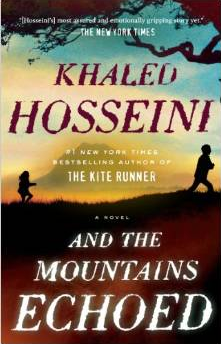
Day 585: And the Mountains Echoed

Cover for And the Mountains EchoedMaybe because it doesn’t have as focused a plot, I didn’t like And the Mountains Echoed as much as I have Hosseini’s other books. Still, its characters involved me in their dilemmas.

I don’t think the blurb helps, because it made me think that the novel centers around Abdullah and his younger sister Pari, who are separated early in the novel. It starts with them certainly, but then it goes on to examine a multitude of relationships between other characters—some relatives of Abdullah and Pari, some connected only peripherally.

The novel explores the difficulties of connections between people—loved ones who are separated, people who are displaced, siblings who don’t understand each other, children who feel their parents disapprove of them, and so on. Although each story is interesting on its own, I felt a certain amount of frustration when some of the characters never reappeared again.

Although the ending of the novel is touching, I feel that the plot is too diffuse to be entirely satisfying. Although Jennifer Egan used a similar approach in A Visit from the Goon Squad, the difference is that I came away from that book feeling thrilled at its cleverness rather than frustrated.

Day 584: The Shining Girls

Cover for The Shining GirlsBest Book of the Week!
The Shining Girls is a clever, clever novel, a hybrid of a fantasy novel and a crime thriller. I read rave reviews of it, and it deserves them.

Harper has just killed a man in a Chicago Hooverville in 1931. He is being pursued in the freezing cold when he murders a blind woman for her coat. Inside the pocket he finds a house key, and somehow he knows the way to the house. It is a boarded up old wreck on the outside, but inside it is warm and comfortable, even prosperous looking. When Harper goes into an upstairs room, he finds souvenirs and girls’ names written on the wall. He understands that the house wants him to kill these girls. When he goes back outside, he finds himself in another time.

In 1993, Kirby Mazrachi interviews for an internship at the Chicago Sun-Times. She has asked to work with Dan Velasquez, a former crime writer who now covers sports. Her goal is to find the man who attacked her and nearly killed her in 1989. She believes he is a serial killer, and she is planning to use the paper’s resources to find more of his murders.

As Kirby continues her investigation, finding evidence that doesn’t make sense, Harper tracks down his shining girls one by one, visiting them when they are young and then going back for them as adults, over a time period of 60 years. He takes something from each one and gives it to the next.

This novel is completely absorbing, well written, and suspenseful. It is also haunting and unusual, with everything cleverly linked up. In the larger context, it explores the issues of fate and free will, but as entertainment, it keeps you pinned to your seat.


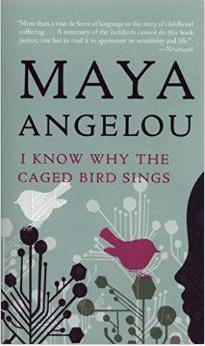
Day 583: I Know Why the Caged Bird Sings

Cover for I Know Why the Caged Bird SingsThe picture on the cover of my old copy of I Know Why the Caged Bird Sings shows an angry and dignified woman, and in some ways this is an angry memoir. Although I’m sure this anger helped sustain Maya Angelou during a difficult life and pushed her to make significant advances for herself and her people, I hope she became happier later. She earned it.

This book is the powerful story of the first 16 years of Maya Angelou’s life. She and her brother Bailey were raised by their grandmother in the small town of Stamps, Arkansas, after being sent there alone on a train from California at the ages of three and four by their parents. Much of the book deals with her upbringing by a strict and religious, somewhat reserved but caring grandmother in the racially segregated South.

Although life in Stamps was no picnic, her brief visit to her mother in St. Louis when she was eight was disastrous. There she was raped by her mother’s boyfriend. That was not the only event in her life that could have proved catastrophic.

Angelou speaks with raw transparency about the feelings of insecurity that she battled through her girlhood, a combination of her treatment by whites and her own feelings of unattractiveness. In her younger years she was saved by her love of reading, later by her own dignity and will to succeed.

This book is deeply involving and at the same time sometimes disturbing reading. I was brought to tears at the description of Angelou’s nearly ruined graduation, not when the pompous white guest speaker put the class in its place, but by how the valedictorian rescued the occasion. I was thrilled when Angelou’s perseverance won her a position, at the age of 15, as the first African-American cable car employee of San Francisco.

I think this story of pride and dignity against bigotry is inspiring for anyone.

Day 582: The Secret Place

Cover for The Secret PlaceDetective Stephen Moran has been stuck on the Cold Case squad ever since he made his move to claim responsibility for a solved case in Tana French’s last book, Broken Harbor. But when Holly Mackey comes to see him, he thinks he’s found his opportunity to join the Murder squad.

A witness in a previous case, Holly is now 16 and attending St. Kilda’s, a private girl’s school where Chris Harper, who attended a nearby boy’s school, was found dead the year before on the grounds. It is so far an unsolved case, and Holly has information about it.

Holly explains that the school has a bulletin board called the Secret Place, where the girls can post anonymous messages. The school thinks this board is preferable to allowing the girls to use a social media site. That morning Holly found a message that said, “I know who killed him.” As she is a cop’s daughter, she removed it carefully with gloves and put it in a plastic bag to bring to Moran.

Moran takes the note to Antoinette Conway, the lead on the Harper case, hoping she’ll allow him to work with her. She has not had a lead in the case for awhile and is eager to follow it up. Once the two detectives begin looking into it, they find their suspects for posting the note and for being the murderer limited to two groups of four girls—one Holly’s group of close friends and the other a bunch of mean girls lead by a girl named Joanne.

Although this is not my favorite of French’s novels, she writes a strong, atmospheric mystery. I believe she is the premier writer of contemporary Irish crime fiction, and her work in many ways reminds me of that of Gillian Flynn. I like that her books are not series, yet they are linked by a minor character in one novel being the major character of another.

http://www.netgalley.comIn The Secret Place, French evokes an eerie atmosphere in the grounds of this posh girl’s school. This novel creates a fascinating psychological portrait of these two groups of teenage girls.

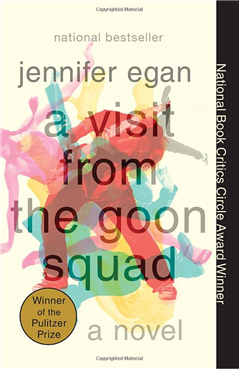
Day 581: Reread! A Visit from the Goon Squad

Cover for A Visit from the Goon SquadWhen I first read this quirky book last year, I said I wanted to reread it so that I could pay better attention to the minor characters in each story. I intended this because Egan’s clever technique to tie these stories together is to make a minor character in one story be the primary character in another.

So, this is my second review of this collection, which is really great. If you didn’t run right out and get it after my last review, I urge you to do so now. The stories are hip, aware, funny, and terrifically smart, centering around the music and public relations industries.

The stories in the first half of the book all touch on two characters—Benny Salazar, who is a music business executive when we first encounter him, and Lou, his mentor. The stories move backward and forward in time, so Benny is first at the height of his career but beginning to realize his taste is falling out of fashion. In a later story he is a teenager in a punk band called the Flaming Dildoes. He has several more appearances before making a comeback in his 60’s with a sensational concert starring his old friend Scotty from that first high school band.

Lou is at the height of his powers in one of the earlier stories, when he seduces one of the girls from the Dildoes, Jocelyn. Her friend Rhea watches their behavior in dismay. Later a dying old man, Lou is delighted to receive a visit from Rhea and Jocelyn, together again after years. But Jocelyn fights an urge to push him into the swimming pool as she considers her 30 years of wasted life as a drug addict, started on her way by Lou when she was 17.

The funniest stories skewer the public relations field. Dolly, once the premier public relations agent in New York (and the boss of Benny Salazar’s wife), has given up her career after a disastrous party she planned. Her brilliant idea to suspend translucent pans of colored oil from the ceiling near spotlights so that the oil would move as it heated was ruined when the plastic pans melted, sending hot oil down to burn all the celebrities. She sees an opportunity to revive her career in a job rehabilitating the reputation of a brutal third-world general. Even though this job almost ends in a murder, when her strategy actually works, she is contacted by a slew of dictators and assorted thugs wanting to hire her.

The has-been starlet Dolly used as the general’s “girlfriend” is the focus in her early career of a hilarious vituperative mock PR piece by the journalist who physically attacked her during an interview (Benny Salazar’s troubled brother-in-law). And finally, a short time in the future, Benny Salazar brings together his smash concert by appealing to the tastes of babies (“pointers,” as they are termed by the marketeers) and using the equivalent of likes on Facebook.

I understood a few things better on rereading the book. In an interview, Jennifer Egan said the stories were about pauses. One of them, a delightful Powerpoint presentation written by a preteen girl (the daughter of Benny Salazar’s ex-assistant Sasha, whose story is the first one in the book), talks about her little brother’s fascination with the pauses in rock music. In the book, we revisit the characters at different times in their lives, after pauses when we don’t see them. This approach leads us to consider the events of their life that we don’t see. Finally, there is the title, explained by the remark of a character. “Time is a goon.”


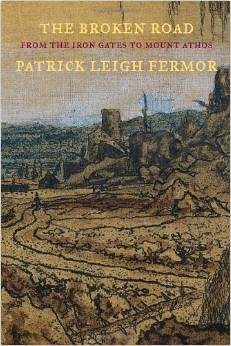
Day 580: The Broken Road: From the Iron Gates to Mount Athos

Cover for The Broken RoadIn December 1933, eighteen-year-old Patrick Leigh Fermor began a journey on foot from Holland to Istanbul. Last year I reviewed the two books that cover the first two legs of the journey, A Time of Gifts and Between the Woods and the Water, but had to wait until this third volume was published to finish the journey.

Unfortunately, Leigh Fermor never completed this book. He actually began writing it first, about ten years after his journey, but stalled. Many years later he wrote the other two books and finally returned to this one. The editors explain in the introduction that they had to piece bits of it together from the manuscript, one of his surviving diaries (others were lost), and other documents. They did a great job, for it only seems fragmentary for a few pages in the middle.

This travelogue picks up at the Iron Gates by the Danube in Rumania but almost immediately moves to Bulgaria. Leigh Fermor spends a great deal of the book traipsing around the Bulgarian countryside meeting colorful characters before abruptly deciding to go to Bucharest. As most of this section of the book is written from his memories of what happened because of his lost diaries, I can only say that his memory must have been remarkable. He writes in a vividly descriptive style, allowing you to imagine yourself along on his trip through a world that is long gone.

It is remarkable also that almost everywhere on this journey he meets with kindness and hospitality. Only one night as he miserably hobbled along in Bulgaria after his foot was rubbed all day by a boot nail were his requests for a ride on two different passing wagons met with demands for money. Since he was living on a pound a week, wired periodically by his parents, he chose to walk. That same night his appeal for shelter at one house met no response from inhabitants who were clearly home. But farther down the road some charcoal burners cheerfully took him in.

Only at all disappointing is his description, which is almost nonexistent, of Istanbul. (He persists in calling it Constantinople.) I can only suppose his visit was in some way spoiled, as it is clear from his comments on the way there that he had romantic notions of the East. A footnote repeats his remark that he never left Constantinople without a lightening of the heart.

Leigh Fermor’s book ends where his green diary picks up, with his travels all over Mount Athos, Greece’s Holy Mountain. There he visited one Eastern Orthodox monastery after another. This section is fascinating for its glimpses into this unusual mode of life. Fermor came to love Greece so much that he lived there much of his life, and this was his first experience of it.

I actually found this book easier to read than the other two more polished efforts, as enjoyable as they are. I think it is because it was written by his younger self. For although he was kicked out of prep school before this journey and never returned to a formal education, he plainly was frightfully well read and knowledgeable and constantly lost me in the earlier books with classical or poetic allusions that I was too lazy to look up.

Apparently Leigh Fermor, who was clearly adventurous, went on to live an exciting life. I have a biography of him waiting for me in my pile.

If you have read my reviews of Leigh Fermor’s other books, you may have noticed a discrepancy. In those I say he was nineteen at the beginning of his adventures. Well, that’s what he said, but since he celebrated his 20th birthday at a monastery in February 1935 and started his journey in December more than a year before, even I can do the math. I did notice him referring to himself as twenty before he actually turned it, so that’s probably what happened in the earlier books.