Day 579: The Daughters of Mars

Cover for The Daughters of MarsNaomi and Sally Durance are sisters and Australian nurses in 1914. They are divided by old grudges and a new crime. The older Naomi deserted their home in the bush for a career in Sydney, leaving Sally stuck there with their parents. More recently, their mother was struck down with cervical cancer and suffered terribly. Sally stole enough morphine from her own hospital to help her mother die, but one day after Naomi arrived, Sally found their mother dead and the drugs gone. Sally feels guilt at her part of the crime and resentment that Naomi could do what she could not.

There is a fervor in Australia for the war, so both women decide independently to volunteer as nurses. They set out by ship for Egypt, then to serve on a hospital ship off Gallipoli, and finally to France.

This novel shows extensive research into the conditions of World War I for nurses, and of their treatment. Although by and large they receive respect, that is not always the case. In an incident based on a true event, their hospital ship Archimedes is employed for one mission as a troop carrier, its red crosses blacked out. It is torpedoed and the survivors, including Sally and Naomi, wait in the water clinging to a raft for hours for rescue. During this traumatic wait, one soldier after another simply lets go.

After the nurses are rescued, they are put to work in a hospital on Lemnos, where the officer in charge sees no use for them and lets the orderlies treat them with disrespect. All their possessions lost, they are given local peasant dresses to wear instead of uniforms. Eventually, an orderly rapes one of the nurses and after a perfunctory investigation, gets off lightly.

The adventures of the sisters and their friends are indeed interesting and provide a different view of the war. With the few of Keneally’s books that I have read, Schindler’s List being the most well known, I have felt a certain distance from events and characters. This book is no exception, but at the same time I wanted to see what would happen.

Although told in a straightforward limited third-person narrative that moves between the point of view of the two women, Keneally offers up an alternate ending. It is not one we can choose between, but one where he tells us what might have happened and then tells us what did happen. The ending brought tears to my eyes but also seemed a little like a trick.


Day 578: Tethered

Cover for TetheredBest Book of the Week!
Clara Marsh has been wounded by life. She is a mortician who spends her days preparing bodies for burial, caring for them tenderly and tucking a symbolic bouquet of flowers into the coffin of each. But she herself is isolated, afraid to look people in the eye, unable to touch. Her frame is skeletal, her scalp scarred from pulling out her own hair. The only people who seem to care for her are her boss and his wife, Linus and Alma Bartholomew.

One day Clara finds a little girl in the funeral home named Trecie, who says she has been visiting Linus. When Clara asks Linus about the girl, he asks Clara to help her. Soon after, at the scene of a death, Clara finds evidence that Trecie is the victim of child pornographers. When she tells Detective Mike Sullivan that she knows Trecie, he asks her to call him when she sees Trecie again. But Trecie gets away from them.

Mike believes there is a connection between the pornographers and the death of Precious Doe, an unidentified child found murdered after being badly beaten three years before. Soon it begins to look as if he may be right. Unfortunately, a fragile friendship between Clara and Mike is threatened when Mike begins to believe that Trecie doesn’t exist.

Although this novel is framed within a mystery, its soul is within the persona of Clara and her story. Tethered is precisely and beautifully written and absolutely haunting. I was transfixed by it.

Day 577: Red Sorghum

Cover for Red SorghumRed Sorghum is absolutely brutal. It tells the story of a Chinese family during the time of the Second Sino-Japanese War. Most of the action of the book takes place in 1939 and a few years thereafter, although there are glimpses of years before and later. I say book, because it is described in some places as a series of novellas and in other places as a novel.

The two main characters are Yu Zhan’ao, the narrator’s grandfather, also known as Commander Yu, and Dai, his grandmother. The narrator’s father Douquan is a less important character. The narrator himself only makes an appearance in the last two pages.

The book begins with an ambush of the Japanese near Black Water River. But nothing here is related in a straightforward manner. The narration moves back and forth in time as Commander Yu’s preparations for the battle alternate with the story of Uncle Arhat’s kidnapping as slave labor for the Japanese and the story of how Yu Zhan’ao meets Dai. There is plenty of violence in all of these stories, and we are not spared any details of guts falling out, decapitated heads, or anything involving bodily functions.

The Chinese are at war through most of the book, of course, but various factions of Chinese fight and kill each other just as viciously. Although Commander Yu wins the battle of Black Water River, almost all of his men are killed when his ally, Detachment Leader Pocky Leng, fails to turn up at the ambush, then steals all of the captured armament.

Earlier in time but later in the book, Grandfather Yu meets Dai on her way to marry a rich man’s son. Her father’s greed has betrothed her to a leper. Yu seduces her on her way back to visit her parents after three days of marriage and then goes off to murder her husband and father-in-law, leaving her a rich widow.

Sometimes the violence in this book is so extreme it is almost funny. People behave grotesquely—they are crude, barbaric, disgusting, venal, and revengeful. Commander Yu is almost more eager to kill Pocky Leng than he is the vicious Japanese, who are nearly cartoonish in their evil.

In between scenes of almost unbelievable brutality are beautiful descriptions of nature, with a strong emphasis on color. Red is consistently a symbol of life and goodness while green is its opposite. Sometimes blood is green instead of red and too the sun can be green. This use of color comes to a focus in the last pages of the novel, where Mo Yan laments the disappearance of the wonderful red sorghum (a major presence in the novel) and excoriates its green hybrid replacement.

I found very little to like in this book. I read it all, but I basically had to force myself to finish it (and beautiful descriptions or not, I got tired of reading about sorghum). I know the book has received a lot of admiration, and I do not exactly agree with the criticism that it glorifies violence, but there is a lot of very graphic violence in the novel.

Day 576: Indiscretion

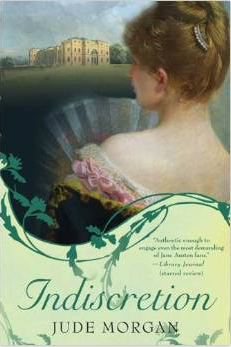
Cover for IndiscretionIn Regency London, Caroline Fortune and her ex-soldier father have been surviving at the edge of poverty for a long time. When her father reports that he has lost all his money in a bad investment, Caroline decides to look for work as a governess.

Soon, her father tells her he has found her a better situation, as companion to Mrs. Catling, the widow of her father’s former colonel. In his ebulliant way, he assumes Caroline could easily be left Mrs. Catling’s fortune. Caroline is not pleased with the situation, nor does she have any hopes of Mrs. Catling’s generosity, but seeing no other option, she takes the position. With no relatives other than her father to fall back on, as her mother’s relatives disowned her mother after her marriage, Caroline moves to Brighton to wait on Mrs. Catling.

Caroline soon learns that Mrs. Catling is demanding and petulant. She treats her servants harshly. When Mrs. Catling’s niece and nephew, the Downings, come to call, Caroline witnesses how her employer manipulates Matthew Downing with the promise of her fortune. Still, Caroline manages to get along with the Downings and Mrs. Catling fairly well, even receiving unwanted confidences from Matthew. However, her dependent position unexpectedly leaves her open to an insult from an unscrupulous man.

Re-opened contact with her relatives eventually removes her to an entirely new neighborhood and life, and she makes some new friends. After awhile, though, her experiences in Brighton return to haunt her.

I don’t often read romance novels and tend to stick to the older authors I love when I do. I have found no writer who can surpass Georgette Heyer in Regency romances. But a friend recommended this novel to me, and I found it quite entertaining. It does not seem simply a copy of Heyer as some other Regency novels have. The dialogue is witty. Once Caroline leaves Brighton she meets some endearing characters, and the plot is both complex and interesting. Caroline is an intelligent and engaging heroine. For some light, escapist reading, I recommend Indiscretion.

Day 575: All the Light We Cannot See

Cover for All the Light We Cannot SeeI felt a bit of distance while I was reading All the Light We Cannot See, but by the end I was brought under its spell. It is about a German boy and a French girl who meet briefly during World War II.

Werner is growing up in an orphanage in Germany. He has always been fascinated by how things work, particularly electronics, and he is far advanced of his teachers in math. One day he discovers a broken radio set in the trash and is able to make it work. He and his sister Jutta discover a children’s broadcast from France in which a man explains science topics and plays music. This station delights them for years until it becomes dangerous to listen to under the Nazi regime.

With all his gifts, Werner is slated to work in the mines when he is old enough. He gets an opportunity, though, to attend a technical school. Against Jutta’s advice, as Werner has avoided being pulled into the orbit of Nazi politics, he takes his chance.

Marie-Laure’s father is a locksmith employed by a Paris geological museum. At the age of five she becomes blind. Her father teaches her to find her way in their neighborhood by making a model of it, which she learns by feeling her way. She loves spending time at the museum, learning about all its treasures and handling the shells. She also loves reading adventure stories in Braille.

When the Nazis are due to invade Paris, the museum gives four stones to four employees to keep safe. One of them is the museum’s most precious possession, a fabled diamond with a curse attached; the others are fakes. Marie-Laure’s father receives one of them, and the two leave the city, eventually arriving in St. Malo, where Marie-Laure’s great-uncle lives.

The diamond acts as sort of a MacGuffin in this novel. Of course, we are sure who has the real stone.

The stories of Marie-Laure and Werner’s pasts alternate with the bombing of St. Malo in 1944 by the Americans. Werner is trapped with some German soldiers in the basement of a hotel, while Marie-Laure is hiding in her great-uncle’s house from a German officer searching for the diamond.

This novel is beautifully written and shows the hardships of war from both sides of the conflict. Werner struggles with his desire to do what is expected vs. what is the right thing. Marie-Laure tries to resist the chaos of war in other ways. I felt for a long time that the novel would end predictably, but I was pleasantly surprised and delighted by how the ending opened up from a claustrophobic setting to a more universal feeling.

Day 574: Little Bee

Cover for Little BeeLittle Bee begins her story from a detention center in England, where she has been held for two years. During this time, she has been learning British English in the hopes she will be allowed to stay. After another girl seduces a guard, Little Bee is released with her and two other girls, with no papers or money, into the depths of the English countryside. Bee calls the only person she knows in England, Andrew O’Rourke, a man she met on a beach in Nigeria two years before.

Sarah O’Rourke is getting ready to attend her husband’s funeral. He had been depressed ever since that day on the beach. Then, suddenly, he committed suicide. When someone arrives at the door, Sarah is surprised to find Little Bee.

Eventually, we find out what happened that day on the beach—how Little Bee lost her sister and Sarah her finger. Sarah is posed with a problem. What can she do about Little Bee to help her stay protected in England? To the British government, Nigeria is a safe country from which Little Bee does not need refuge. The government does not know or is unwilling to learn that the oil companies are murdering entire villages to get rights to the oil beneath them.

I found Little Bee to be affecting all right, and it informed me of a situation I did not know existed. With all the bad news about various countries in Africa lately, I had not heard mention of Nigeria (at least not in this respect).

A few people have written reviews complaining about the ending. Perhaps they like their endings nicely wrapped up. I don’t mind ambiguity, but I did feel sometimes as if I was being manipulated. In addition, Little Bee’s voice, although enchanting and original, is not consistent enough. At times she is amazingly naive, sometimes convincingly so, others not so much. It is some of her more sophisticated knowledge that occasionally doesn’t ring true with the character Cleave has created and can’t be explained by two years of reading classics.

In any case, it is Sarah’s stunning naivety that is more unbelievable, both on the beach that day and when she decides to interview people in Nigeria instead of immediately contacting a lawyer or her embassy in an attempt to save Bee.

With all these caveats, I enjoyed the book, though, and give it a qualified recommendation.

Day 573: The Selected Poetry of Edna St. Vincent Millay

Cover for The Selected Poetry of Edna St. Vincent MillayPoetry is not really my expertise, so I feel awkward trying to write this. Of course, I came to this book familiar with a few of Millay’s most well-known poems, particularly “First Fig.” The poem that made Millay’s reputation was “Renascence,” about a person who is buried in the earth alive and springs back out.

I think this is an interesting book for someone not familiar with Millay. It contains most of her best-known poems from several different collections.

Although Millay was known as a master writer of sonnets and this book contains many sonnets, I think I prefer some of her less formal, cheekier poems, for example, “Thursday.” I also liked the poems that reflect her familiarity with old Celtic and British folk ballads—whose rhythms sound like someone singing a ghostly Border ballad.

After reading in Milford’s biography about Millay’s wonderful voice, I looked for a recording on YouTube. I was delighted to find an atmospheric performance of “The Ballad of the Harpweaver,” recorded for radio.

You might be interested in reading my review of the biography of her life.

Day 572: Lisette’s List

Cover for Lisette's ListIn 1937, Lisette and André Roux are on their way to Provence. Lisette has abandoned the opportunity to become an apprentice at the Galerie Laforgue and André his job as the frame builder for famous artists. They have left their beloved Paris to take care of André’s grandfather Pascal, for Pascal has written to say that he is dying.

When they arrive in Pascal’s village of Rousillon, however, they find Pascal has been out playing boules. Lisette is horrified at leaving her life behind on a false pretense. Pascal is sometimes ill, but he is mostly lonely.

He also has a legacy he wants to pass down. Pascal owns seven paintings by masters that he traded for picture frames back when the painters were struggling. He wants to pass to Lisette the stories about these paintings, three by Pisarro and three by Cézanne and one study of heads by an unknown artist. Pascal is also proud of Rousillon, where workers have dug ochre out of the ground for centuries to make the paints used in these paintings.

Although Vreeland’s descriptions of Provence and Rousillon are evocative, I feel that the first part of the novel gets bogged down in these teaching moments of Pascal’s. Even though I am interested in art, these conversations are too didactic to come across as authentic.

There are other moments like this farther into the novel, but it picks up during and after World War II in Lisette’s efforts to survive as a Parisienne alone in the village. André leaves to fight at the beginning of the war. Before he leaves, though, he hides the paintings because he has heard that the Germans will search out art and either take it or destroy it because of decadence.

http://www.netgalley.comI was mildly interested in this novel. It is clear that Vreeland loves art, and she does a fine job of evoking the paintings and the gorgeous landscapes of Provence. She is so interested in these subjects, though, that we get a much sketchier idea of the character of Pascal, for example, or André.

Day 571: The Goldfinch

Cover for The GoldfinchBest Book of the Week!
Theo Decker is hiding in an Amsterdam hotel, ill and terrified. He is afraid to set foot in the street. Through most of The Goldfinch, Theo relates the roots of his troubles, which lie 15 years in the past.

Thirteen-year-old Theo is out in New York City for a day with his mother. Normally, this would be a day he’d enjoy, but he is in trouble at his prep school, and they are on the way to school for a meeting. They are early, though, and his mother wants to stop at the museum to look at an exhibit.

Inside the museum, he spots an unusual couple—a hunch-backed old man and a fairy-like red-haired girl. He is only half attentive to his mother’s explanations of the paintings because he is looking at the girl. They stop to view a painting called The Goldfinch, one of the few remaining works by a Dutch artist named Fabritius.

Theo’s mother goes off to the gift shop while Theo trails after the girl. A few minutes later, Theo is knocked out by an explosion from a terrorist attack. When he comes to, the museum is oddly empty, but he finds the old man dying. The man gives him a ring and tells him to take it to an address, and then he suggests that Theo pick up The Goldfinch from a pile of dust and take it with him. He does, an act that becomes a defining moment of his life.

Assuming that his mother got out okay, Theo goes home, but he soon finds that she was killed. Since his ne’er-do-well father disappeared from their lives, it has been just the two of them for years. Social services ends up taking him to stay with the wealthy family of one of his school friends, the Barbours.

Suffering from grief and untreated post-traumatic stress disorder, Theo tries to hide his insecurity and discomfort. As formal as the Barbour household is, he likes Mrs. Barbour and worries that the family might want him to leave. Eventually, he takes the old man’s ring to the address and meets the man’s partner Hobie and the girl, Pippa, who was badly injured in the explosion. She soon goes away to live with her aunt, but Theo continues to visit Hobie, who is a furniture restorer. And he is always in love with Pippa.

Just after Theo is invited to spend the summer in Maine with the Barbours, his whole life changes again. His father arrives and removes him abruptly from New York to Las Vegas. Theo is left to himself most of the time in a deserted suburb at the edge of the desert. His father at first appears to be well off, but soon it is clear he is living on the edges. Theo befriends another outcast, a Ukranian boy named Boris, and the two begin a slide into drugs and alcohol and the margins of society. Even after he returns to New York and tries to pull his life together, the secret of the painting serves as both a pleasure and a hidden terror.

It seems as if I am giving away a lot, but I have covered only the beginning of this long, involving novel. It explores such themes as the trauma of loss, the yearning for love, and the fragility of happiness and the present. In losing his mother, Theo seems to have lost his moral compass, so that even as he tries to help people, he creates problems for them and himself.

Tartt’s characters are complex and fully realized. Even the villains have facets to their personalities. Although Theo thinks of his father as a scoundrel—and he certainly has few redeeming qualities—Boris points out to him that when Boris was alone with nothing, Theo’s father took him in. An older Theo fears he has too much of his father in him.

The Goldfinch remains a golden, potent symbol throughout the novel. Theo loves the painting and feels that owning it somehow gives him stature. Yet at the same time he is terrified he’ll be found with it. Just as the bird in the picture is shackled, so Theo is captive to the painting.

Throughout the novel Theo disappointed me with his self-destructive tendencies even though he has good intentions. Still, Tartt tells a story that absolutely impels you to keep reading. This is a wonderful job of storytelling.