Day 565: Olive Kitteridge

Cover for Olive KitteridgeThis collection of linked short stories lucidly illuminates the contradictions that make up the human condition. The link that binds the stories together is Olive Kitteridge, a retired schoolteacher in small-town Maine.

Olive is plain-spoken and gruff. Some people are afraid of her, but she can show sudden compassion and insight.

In “The Pharmacy,” Olive’s gentle husband Henry falls in love with his young pharmacy assistant without ever making his feelings known. In “A Little Burst,” Olive steals some of her daughter-in-law’s clothes during the wedding at the house the Kitteridges built for their son. She has overheard Suzanne saying nasty things about her. In “Tulips,” after Henry has a heart attack, Olive reflects upon their pain that their son Christopher moved away to California with his wife, and even after divorcing did not return or invite them to visit.

In other stories, Olive is less important or simply a presence. A timely conversation with her seems to keep a young man named Kevin from attempting suicide in “Incoming Tide.” In another story, the Kitteridges stroll to the restaurant through the bar where Angie plays the piano every night and thinks about the man she loved.

With neighbors and strangers, Olive says exactly the right thing in a difficult moment, and with her loved ones exactly the wrong thing. Many of the stories are sad but ultimately touching. Strout uses an unusual structure to create the sense of a lovely and affecting novel.

Day 564: Literary Wives: The World’s Wife

Today is another posting for Literary Wives, where a group of bloggers get together to discuss the same book about wives and invite others to join in the conversation. Please take a look at the reviews of the other members, listed below.

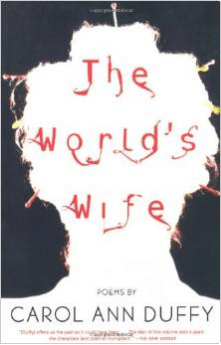
Cover for The World's WifeMy Review

My relationship with poetry is not so comfortable that I expect to burst out laughing when reading it. But that’s exactly what I did several times when reading The World’s Wife.

This book contains a clever, brilliant collection of poems united by a single conceit. Duffy looks at legendary figures, that is, some figures of myth and fairy tale and a few from real life, from the points of view of their wives. Occasionally, male figures become females. In any case, the result is to turn the myth, be it legendary or real, on its head.

The first time I laughed out loud was when reading the Poem “from Mrs. Tiresius.” Regrettably, I did not know who Tiresius was, so I looked him up. It turns out he was a blind prophet who managed to offend Hera, so she turned him into a woman. In the poem, when Tiresius comes back as a woman, his wife at first tries to help him, takes him shopping, teaches him to blow-dry his hair.

Then he started his period.

One week in bed.
Two doctors in.
Three painkillers four times a day.

That’s when Mrs. Tiresius loses patience, and I laughed.

These poems are cheeky, earthy, inventive, and sometimes extremely powerful. Although many of the wives view their men’s activities with cynicism, the poems are not always so, as in the beautiful sonnet called “Anne Hathaway,” in which Hathaway fondly remembers the activities that took place in the second best bed. I love this book.

What does this book say about wives or the experience of being a wife? In what way does this woman define “wife”—or in what way is she defined by “wife”?

Literary Wives logoThere are 30 poems in this collection, each of them from the point of view of a different woman. The most common viewpoint is a certain cynicism about the wives’ husbands or their activities, but that is by no means true of every poem. In many, though, the man or the love of man is a source of pain.

At first, Penelope looks for her husband and waits for him to come home. Then she gets involved in her embroidery and meets his return with a certain dismay. Mrs. Sisyphus laments that ever since he started pushing that stone up the hill, he’s been ignoring her for his work. Mrs. Midas cannot believe the greed and stupidity that made her husband wish for something that keeps him from eating or touching her ever again. Mrs. Aesop is bored stiff by her husband’s constant platitudes. Naive Little Red Cap let the wolf seduce her with poetry, but ten years later she sees he is a dog with no new tricks.

Some of the poetry can be somewhat misandrist, and most of it ends in some sort of triumph for the woman, occasionally one that is gruesome.

The Wives

Be sure to read the reviews and comments of the other wives!

Day 563: The Scottish Chiefs

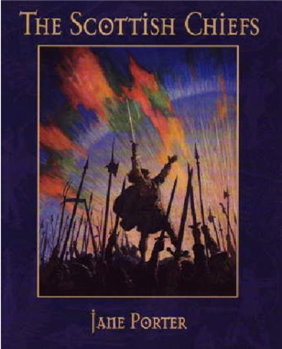
Cover for The Scottish ChiefsWritten in 1810, The Scottish Chiefs tells the romanticized story of William Wallace, the Scots hero we know today as Braveheart. Jane Porter was a contemporary and acquaintance of Sir Walter Scott, who deemed her the first author of historical fiction, then went on to write some himself.

The novel begins in 1296 and covers roughly eight years. After the untimely death of Alexander III, Scotland could not decide between two claimants to the throne—Robert Bruce or John Baliol—and called upon its neighbor, Edward of England, to adjudicate. He chose the weakest candidate, Baliol, and shortly afterwards seized the country for England. At the start of the novel, his governors have been mistreating Scotland for two years by imprisoning its leaders and taking their property for themselves.

William Wallace has been minding his own business and trying to stay out of trouble when he is summoned to meet with Sir John Monteith. Monteith passes him a metal box given to him by Lord Douglas before Douglas was kidnapped by the English. Monteith’s home is overrun by English soldiers, and he is afraid someone will discover the box, so he asks Wallace to remove it. However, the soldiers glimpse it under his plaid, and assuming it is treasure, they soon arrive at his home to take it. Wallace escapes, but his wife Marion is murdered by the dastardly Heselrigge, English governor of Lanark.

After his wife’s murder, Wallace vows to devote his life to freeing Scotland from the English. The novel follows his adventures and his defeats of the English in battle. Wallace’s victories are muddied by the jealousy and treachery of many of the Scottish chiefs, who refuse to believe the purity of his motives and fear his growing power over the populace.

The novel is written in the overblown style of Romanticism. It features a godlike Wallace, heroic figures like beautiful and saintly Helen Mar and faithful Edwin Ruthven and villains such as the perfidious Lady Mar and vicious Heselrigge. The dialogue is florid. However, the deeds described are truly exciting, and Porter manages at times to build quite a lot of suspense. The introduction by Kate Douglas Wiggan, educator and author of Rebecca of Sunnybrook Farm, relates how her copy of the novel was in tatters from re-reading when she was a child and how she would beg for ten more minutes of reading time when called to supper.

While reading this novel, I was trying to decide whether a modern youngster would love it or be bogged down by its style and length. I am not sure, but children read for plot, and there is much in this tale to make it a page-turner. That it is about a man who was truly a hero should make it even more exciting to them. In any case, if the writing style of early 19th century Romanticism doesn’t bother you, I think anyone might enjoy reading this novel.

Day 562: We Are All Completely Beside Ourselves

Cover for We Are Completely Beside OurselvesBest Book of the Week!
Reading Karen Joy Fowler’s fluffy The Jane Austen Book Club made me willing to try a novel that did not sound appealing on the surface. But my experience with Fowler’s previous books in no way prepared me for the profound and moving We Are Completely Beside Ourselves.

Rosemary Cooke starts her story in the middle, when she is at college and has just been arrested for a small release of her inner “monkey girl.” Rosemary has worked hard to hide her past from her new friends at college. The daughter of a behavioral scientist, Rosemary was raised with a chimpanzee Fern as her sister until she was five years old. Then Fern was abruptly removed from the household when Rosemary was away visiting her grandparents. Rosemary’s beloved brother Lowell was angry with the entire family from then on and disappeared completely during his senior year of high school.

Since then, Rosemary’s family has been broken. Her mother had a breakdown from which she never entirely recovered, and her father is remote and alcoholic. Rosemary herself has never felt as if she fits in, after years of being teased by her classmates as the “monkey girl.” Although she seldom stopped talking as a child, now she rarely says anything.  Then Lowell comes to see her, and she has a chance to recover her own history.

Although this novel is written in a light and lively tone, it eventually brought tears to my eyes. It explores such subjects as reconciliation with oneself and others, human relationships and responsibilities toward other species, and the complexities of issues surrounding scientific experiments with animals. It is odd and unusual and incredibly intelligent.

Day 561: Lucky Us

Cover for Lucky UsI was enchanted by Away, so I was excited to find that Amy Bloom had another book out. This novel is good but does not live up to the other.

Eva Acton has not met her older half-sister Iris until Eva’s mother dumps her on the front porch of her father’s home. Up until then, Eva worshipped her father, but she begins to see that he has his flaws, a second family being a major one of them. Another is stealing the money Iris wins in talent competitions.

Once Iris has managed to hide enough money from her father, she and Eva take off for Hollywood, where Iris is determined to make it big. At that point, Eva’s formal education comes to a halt, when she is 14.

Iris is beginning to have some success when her chances are ruined by betrayal and scandal. The girls, their friend Francisco, and their father, who has joined them upon premature news of Iris’ success, set off for New York.

This Depression-era novel is written in a light, jaunty tone, narrated mostly from Eva’s point of view punctuated by letters. For after a lot has happened, the girls are eventually separated.

The conflict of the novel is around some choices Iris makes, causing Eva to take on responsibilities and struggles that Iris has initiated. Iris commits several unconscionable acts.

http://www.netgalley.comI cared about what would happen to Eva and some likable friends, but I felt that the end of the novel was too easy on Iris. I also felt that this novel lacked the originality of Away. It is interesting, though, because I was never sure what would happen next, and the narrative style has its charms.


Day 560: Shah of Shahs

Cover for Shah of ShahsI remember the Iranian revolution very well, so when my book club selected any book by Ryszard Kapuściński, I chose Shah of Shahs.

Before the revolution, I dated an Iranian student who called himself a revolutionary. Since I never knew him to work toward a revolution in any way, I always figured that he thought he was doing something fashionable or expected by espousing the cause. (I’m not saying that many weren’t sincere or that they didn’t have reason to want a change in government.) Still, I never believed that the Iran those students got was the one they wanted.

Shah of Shahs is an odd book, not exactly journalism, not as incisive and fact-based as, say, an essay by Hitchens, full of opinion and supposition. The book jacket refers to Kapuściński as a mythographer and to the book as a combination of journalism and literature. Perhaps it is this combination that I have trouble with.

What the book does provide is plenty of information about the roots of the people’s discontent—and they were truly a mistreated and abused nation. Kapuściński starts by describing his room in a Teheran hotel, where in 1985 he is the only remaining occupant. His room is cluttered with photographs and scraps of notes from interviews. He puts them in order, describes the photos—beginning with one of the Shah’s grandfather—and relates bits of the history of Iran. Later, he describes his interviews with intellectuals who returned from abroad, people whose relatives were tortured by the Savak, people who were afraid to speak or act for fear of torture, people who took part in protests at the risk of their lives, and so on. In one case, he tells the story about an old man who complains about the heat at a bus stop, calling it “oppressive.” He is hauled off by the Savak for using the word “oppressive,” and he probably wasn’t seen again.

The book is sparely written. It also contains fascinating material that brought me to a better understanding of the dilemmas of Iran. But especially toward the end of the book, it indulges itself in flights of philosophical rumination about the causes of revolutions, which I did not find as interesting.

Day 559: Snow Country

Cover for Snow CountryPerhaps I did not spend enough time considering Snow Country, because I kept feeling as if I was missing something. I couldn’t figure out if this problem was cultural or more an issue with the misogyny of the 1950’s, when it was written.

The novel follows the affair of Shimamura, an effete and sophisticated intellectual, with Komako, a simple country girl who during the novel becomes a geisha. Part of my initial problem had to do with understanding the implications of being a geisha. After all my prior reading lead me to believe that a geisha is different and in fact higher in status than a prostitute, I had to read the introduction to understand that in these hot springs villages, at least in the time the novel is set, a geisha was essentially a prostitute.

Nevertheless, when Shimamura meets Komako, she is a geisha in training, so clearly not a prostitute. Shimamura has come down from traveling in the mountains and immediately asks the hotel clerk for a geisha. None are available, so she sends him Komako. Shimamura spends the night talking to Komako but then asks her to send him a geisha. It is clear what he wants, but he seems to think he deserves some kind of credit for “behaving well” with her, whereas I, and Komako as well, understood his request as insulting. I do not think we’re supposed to like Shimamura, and I didn’t.

We know far more about Shimamura than we do about Komako. We first encounter him on a train on the way back to Komako’s village after the affair is already started. He is struck by Yoko, a girl who is tending to a sick man. Throughout, though, he is far more interested in his fantasies around Yoko than in actually getting to know her. The essence of Shimamura’s personality comes clear when we learn that he is an expert on occidental ballet even though he has never seen a ballet performed—and prefers not to.

For her part, Komako throws herself into the affair with Shimamura even though it is clearly doomed. Although Shimamura’s behavior remains consistent and it is clear that he is incapable of love, Komako is erratic. Toward the end of the relationship she says one thing and does another, she arrives roaring drunk, and she seems to have an inexplicable love/hate relationship with Yoko, as Yoko does with her.

Of course, the future for Komako is not bright, and she becomes more dissipated as the novel progresses. Although I feel we are supposed to sympathize with her, I found her exasperating. The love affair seems sterile, and I don’t see the point of it.

But this novel is set in the cold and gray snow country. Although part of the affair takes place in other seasons, the most important scenes are in the beginning of winter, and the affair ends in the fall. A sense of isolation permeates the novel.

The writing is beautifully spare, as Kawabata is a poet. I feel it is dense in meaning, but if so, I probably missed a lot of it.

Day 558: La Reine Margot

Cover for La Reine MargotIf you’ve been following my reviews of Maurice Druon’s Accursed Kings series about medieval France, you’ve probably seen me use the phrase “nest of vipers.” La Reine Margot, set a couple of centuries later, is just as full of intrigues, infidelities, betrayals, and even poisonings.

It is 1572, and the French court is celebrating the inexplicable marriage of Marguerite of Valois (Margot) to Henry of Navarre. France is at the height of the wars between Catholic and Huguenot, and Charles IX has proposed the union between his sister and the leader of the Huguenots purportedly to further peace.

Soon, though, we find out that the wedding is a trap for the leading Huguenots planned by Charles and his evil mother Catherine de Medicis. (Note that throughout I spell names as they were in the book.) For that evening of St. Bartholomew’s Day, troops are sent out all over Paris to massacre the Huguenots, who are in town for the wedding.

Thinking to rid himself of an enemy in Henry of Navarre, Charles has not considered his sister. Even though she and Henry are not romantically attached, the two have sworn to support each other. When Henry is trapped in the Louvre with the royal family, a combination of Margot’s support and his recanting saves his life. Margot has also rescued a young wounded Huguenot, La Mole, from the slaughter, providing a romantic subplot for the novel.

So begins the novel about how Henry of Navarre, aided by Margot, survives the machinations of the Valois family. The rumor is that Catherine recently murdered Henry’s mother by poisoning her, and Catherine also works in charms and horoscopes. Charles IX is unstable, first mistrusting Henry and then treating him like a brother. Henry d’Anjou, Charles’ brother, detests Henry of Navarre and thinks he is a threat to d’Anjou’s own right to the throne after his brother. François d’Alençon, the other brother, wavers in his decision to ally with Navarre.

Dumas was a writer of the Romantic movement, which de-emphasized rationality and emphasized emotion. The romantic plot involves the love affair between Margot and the naive and gallant La Mole, who is drawn into danger because of his love and religion.

My Oxford World Classics edition was fortified with copious notes, including information about which events were true and which were invented. Dumas is prone to using real people in his historical romances, and it was just a little off-putting to discover, for example, that the real La Mole was not a gallant Huguenot but a fundamentalist Catholic who was responsible for many murders during the massacre. Still, I found the real stories as fascinating as the novel.

If you like a fast-moving adventure that also involves political maneuvering, this is a good book for you. I was more interested in the nerve and political agility of Navarre than I was in the romance, but I still enjoyed the novel.

One caution—an abbreviated version of this novel is available as Marguerite of Valois. I have not read it, but if you want the more complete novel, look for La Reine Margot. (Yes, it is in English but also in French, so be careful if you order it online.)

Just a side note. I have written much about Dorothy Dunnett’s excellent historical novels. One of her Crawford of Lymond novels, Queen’s Play, is also partially concerned with the massacre.

Day 557: The Year of the Flood

Cover for The Year of the FloodThe Year of the Flood covers much the same time period as does the first novel of the Maddaddam trilogy, Oryx and Crake, only from the points of view of different characters. What the two main characters of this novel have in common is the Gardeners, an ecological religious cult.

Years ago, Toby was a pleeblander attending a mediocre college until one of the Corporations wanted her father’s land. After her father’s questionable suicide, Toby destroyed her identity and got along as best she could in the margins of society. When she found herself captive in an abusive relationship with a thug named Blanco, her friend Rebecca and the Gardeners came to her rescue. At the beginning of the novel, though, Toby is living alone in the Anoo Yoo spa after the Waterless Flood, long predicted by the Gardeners.

Ren lived in the elite Compounds where her father was a drug industry worker until her mother ran off with Zeb, a Gardener, taking Ren with her. She spent most of her childhood with the Gardeners until her mother split from Zeb and moved back to the Compounds, claiming to be a kidnapping victim. Ren is in isolation at the sex club where she works when the Waterless Flood occurs. Being locked away from others saves her from the plague.

Both women find they must leave their sanctuaries and venture out into a deadly world, the unintended consequence of the madness of Crake.

The Year of the Flood provides more insight about the events leading up to the Flood and the identities of the group calling themselves Maddaddam. The novel is ironically punctuated by the homilies of Adam One, leader of the Gardeners, and by Gardener hymns.

This novel is fascinating, full of sly humor and an incredible inventiveness. I can’t wait to read Maddaddam.