Day 557: The Year of the Flood

Cover for The Year of the FloodThe Year of the Flood covers much the same time period as does the first novel of the Maddaddam trilogy, Oryx and Crake, only from the points of view of different characters. What the two main characters of this novel have in common is the Gardeners, an ecological religious cult.

Years ago, Toby was a pleeblander attending a mediocre college until one of the Corporations wanted her father’s land. After her father’s questionable suicide, Toby destroyed her identity and got along as best she could in the margins of society. When she found herself captive in an abusive relationship with a thug named Blanco, her friend Rebecca and the Gardeners came to her rescue. At the beginning of the novel, though, Toby is living alone in the Anoo Yoo spa after the Waterless Flood, long predicted by the Gardeners.

Ren lived in the elite Compounds where her father was a drug industry worker until her mother ran off with Zeb, a Gardener, taking Ren with her. She spent most of her childhood with the Gardeners until her mother split from Zeb and moved back to the Compounds, claiming to be a kidnapping victim. Ren is in isolation at the sex club where she works when the Waterless Flood occurs. Being locked away from others saves her from the plague.

Both women find they must leave their sanctuaries and venture out into a deadly world, the unintended consequence of the madness of Crake.

The Year of the Flood provides more insight about the events leading up to the Flood and the identities of the group calling themselves Maddaddam. The novel is ironically punctuated by the homilies of Adam One, leader of the Gardeners, and by Gardener hymns.

This novel is fascinating, full of sly humor and an incredible inventiveness. I can’t wait to read Maddaddam.
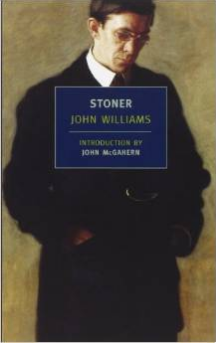
Day 556: Stoner

Cover for StonerBest Book of the Week!
When I first began reading Stoner, I was afraid it was going to be a bleak modernist novel. But it is the opposite of bleak. It is a novel about a shy, awkward man who loves. Williams called it “an escape into reality.”

Williams begins the novel by describing William Stoner’s career at the University of Missouri:

“He did not rise above the rank of assistant professor, and few students remembered him with any sharpness after they had taken his courses.”

It seems that Williams will be writing about a nonentity, but this is not the case.

On the surface, Stoner does not have a happy life. He is the son of a dirt-poor farmer who decides that William should attend college to learn new agricultural techniques. So, Stoner arrives at the University of Missouri a gawky, unsophisticated boy who has only a mild interest in his courses and begins an undistinguished career.

Then in his sophomore year, he takes a required English literature survey course. Although he is speechless in class, he realizes he has found the thing he loves and so changes his major. He eventually earns a doctorate and begins a teaching career at the university.

He makes an unfortunate choice for a wife, marrying a girl whose training makes her more suitable for a society wife than that of an impoverished instructor. It is not clear why Edith marries him except possibly to get away from home. She makes very clear how distasteful she finds sex, and he is too inexperienced to know what to do about it.

Edith’s sexuality changes briefly when she decides she wants a child. After their daughter Grace is born, though, Edith takes little interest in her or in him. Stoner, on the other hand, falls madly for Grace. He takes on almost all the care for her in her first five or six years of life. Then Edith does everything she can to separate them and mold Grace into the type of girl Edith thinks she should be.

Stoner’s solace is in his work, for which he eventually finds a talent for teaching Medieval literature. His progress in his career is hindered, though, by university politics. He finds himself in a dispute over the fitness of a student to enter the doctoral program. Although Stoner’s position is completely justified and his actions misrepresented, he earns himself the enmity of the student’s mentor, Hollis Lomax, who eventually becomes department chair.

Stoner falls in love and finds for awhile some tenderness, but he knows his relationship will be short-lived. It is also ended by university politics.

What Williams accomplishes in this novel is to turn that first assessment of Stoner on its head. Stoner is a flawed man who owes many of the difficulties of his life to inaction, but he is doing work he loves, he is completely conscientious in his efforts, and he even manages a minor victory over his enemy after years of patience. The introduction to the novel states that although readers think Williams is depicting a sad life, he sees it as a novel about love, all the forms it takes, and the forces against it.

You may think this novel sounds dreary. It is not, and it is not often that you feel as if you know and love a character so thoroughly.

Day 555: Mastering the Art of Soviet Cooking

Cover for Mastering the Art of Soviet CookingAlthough Mastering the Art of Soviet Cooking is billed as a memoir, it is written with the help of the author’s mother and begins long before Von Bremzen was born, with the start of the Soviet Union. It is an unusual memoir, tracing as it does the history of the Soviet Union, decade by decade, through the meals cooked by one family.

In an entertainingly wry writing style, Von Bremzen relates the changes in Soviet approaches to government over time and the way these changes affected the populace. She begins by explaining how Lenin’s asceticism nearly eliminated Russian cuisine because of the idea that food was decadent (and hardly any food was available).

Von Bremzen ironically and knowingly traces the history of Soviet Russia through famine and glut, for each decade featuring a dish that seems to represent it (although one decade features ration cards). The recipes are at the end.

Von Bremzen relates her own mother’s history as the rebellious daughter of a prominent Soviet military officer, her mother totally rejecting the party line. Larisa was terrified throughout the Stalinist era and longed to leave the country. Anya, herself with a difficult start as a child not allowed to join the Young Pioneers or visit Lenin’s tomb (things she secretly yearned for), had finally found a comfortable place when her mother dragged her off to Philadelphia.

This amusing book is fascinating for people who are interested in Russia, which I have always been. Darkly funny are the countless contrasts between the official views of the country and Von Bremzen’s descriptions of the actual plight of the population. It is difficult to describe the divided viewpoint of the author, who obviously loves Russia and the 60’s vision of what it was, while at the same time being deeply skeptical of everything about it.

This book is unusual, intelligent, and well-written, about a woman’s attempts to reconcile her feelings about her country and upbringing.

One Lovely Blog Award

One Lovely Blog logoHow nice! Sarrah J. Woods of A Bringer of New Things has nominated me for the One Lovely Blog award. Thank you, Sarrah! The award rules are these:

  • Thank the person who nominated you.
  • Share seven things about yourself that your readers still may not know.
  • Nominate 15 bloggers.
  • Notify the nominees that you have done so.
  • Put the logo of the award on your blog.

Seven Things about Myself

I don’t say very much about myself on my blog because it’s mainly for book reviews, so it should be easy to find seven things to say about myself that my readers don’t know (except those who are my close friends).

  • I live in Texas, where I absolutely hate the weather. I am originally from the north and have always liked cold weather. In a couple of years we are moving to Washington state, where my husband and I have already bought a house on five acres of land. I can’t wait for snow and foggy days. What a change from baking for six months a year!
  • I moved to Texas from Michigan. Once I got here, I said to myself “Five years tops.” It has been more than 30.
  • I have four inside cats and one outside cat, also a dog. No, I am not the crazy cat lady. Our inside cats were born in our wood pile and we cat-napped them when they were old enough. Their mother is our outside cat. Although we have had these cats for 10 years, the mother is still feral and won’t let me pet her. She lets my husband pet her (a little bit) because he feeds everyone.
  • I work as a technical writer and editor in the software industry. I also taught writing classes for various colleges and universities for more than 15 years.
  • I got married for the first time when I was 45. Such a change in life.
  • I have always wanted to visit Russia. I think it’s because of the onion domes.
  • I took four years of Russian in college. I don’t speak it because that was a long time ago.

My Nominees

I can’t really think of 15 nominees since I don’t read lots and lots of blogs. I apologize if some of these bloggers have already received the award. Cecilia, of Only You, I would nominate you, but I know you got nominated yesterday! My nominees are:


Day 554: The Testament of Mary

Cover for The Testament of MaryIt is years after the crucifixion. Mary is living a quiet life in Ephesus, visited by two of her son’s disciples. It is clear their visits are unwelcome, as they have been trying to force her memories to agree with the documents they’re writing. But Mary has always seen her son’s followers as men with something lacking in them, and she insists on telling her her own truths.

This provocative novella takes the position that Mary was not a believer but was simply trying to save her son from his fate. She grieves his loss and regrets that at the end her courage failed her. While the disciples try to place her and Mary (Toíbín does not name anyone Mary Magdalene, but that is whom he means, I assume) at the grave witnessing a resurrection, they were actually fleeing for their own lives.

While the novella seems to accept some of the miracles, the raising of Lazarus is more of a horror than a wonder. Mary also notices that the jugs of water are brought forward quickly at the wedding at Cana and that only one of them was opened beforehand. Toíbín evokes an atmosphere of feverish excitement and hard fanaticism during these scenes, wherein both Jesus’ enemies and his followers push her son toward his fate.

This novella, which was shortlisted for the Booker Prize, is thought-provoking in its exploration of cult-like origins for Christianity and the shaping of Christian myth after Jesus’ death. As always with Toíbín, it is meticulously and beautifully written.

Day 553: White Oleander

Cover for White OleanderBest Book of the Week!
This reading of White Oleander is my second, for my book club, although I have not reviewed it before now. I believe I appreciated the novel even more on the re-read.

Astrid Magnussen nearly worships her poet mother Ingrid. At twelve years old, Astrid has already lived an unusual vagabond life with her mother. Now the two have settled for awhile in the dry heat of Los Angeles, reeking of creosote with the forests bursting into flame.

Ingrid, herself stunningly beautiful, believes that nothing is important but beauty. She tells Astrid stories of ruthless Viking ancestors who take what they want, for she sees weakness in Astrid and wants to root it out. She is clearly a narcissist. For pleasure, she brings home beautiful young men and then unceremoniously discards them. She keeps Astrid up all night looking at the stars. Although Astrid fears Ingrid will one day leave her, she is smart enough to realize that with her mother everything is always about Ingrid herself.

Then Ingrid falls in love with Barry, an ordinary man. For once, Astrid feels a little secure, as if she has a father. But when Barry dumps Ingrid for a younger woman, Ingrid becomes insane with rage and does something terrible. She ends up in prison, and Astrid is abandoned to the foster care system.

This novel is sometimes beautiful. The beginning dealing with the relationship between the two and their earlier lives is poetically told. Other times it is brutally powerful, as Astrid is torn from her precisely kept home and thrown into a series of horrendous foster homes. Even more heartbreaking is what happens when she finally finds a loving one.

White Oleander is original and gorgeously written, about the search for love and a safe harbor, about betrayal, madness, self-absorption, and self-discovery. The lovely but poisonous white oleander is a symbol for Ingrid’s motherhood, as Astrid finally realizes she will always ache for her mother’s love and never have what she wants.

Day 552: Dracula

Cover for DraculaHaving experienced other gothic classics of the 18th and 19th century, I was delighted to find Dracula unexpectedly readable. I was also surprised to find how little it resembles its many theatrical and movie productions, even those that attempt to stay closer to the original work.

All versions begin the same, however, with poor Jonathan Harker sent out by his office to Transylvania to complete a property deal with his client, Count Dracula. While staying at Dracula’s castle, he begins to suspect something is badly amiss and eventually fears for his life.

Back in England, his fiancée Mina Murray corresponds with and later stays with her good friend Lucy Westerna at a seaside town. In one day, Lucy has received proposals from three different young men, who all feature strongly in the novel. Dr. Jack Seward is in charge of a local insane asylum. Quincy Morris is a manly, amiable Texan, whom I feared all along was designed for a ghastly death. Lucy’s chosen is Arthur Holmwood, another manly young man who is soon promoted to a lordship by the convenient death of a benefactor. (I don’t think these things work this way, since Arthur is not his benefactor’s relative, but never mind.)

After a freakish storm, a Russian ship arrives unmanned at the port where Mina and Lucy are staying with Mrs. Westerna, who is gravely ill. As it arrives, a large dog jumps off it and runs ashore. Aboard is not a single live human. We horror aficianados know that Dracula has arrived.

While Mina waits for news of Jonathan, Lucy begins sleepwalking and behaving oddly. Dr. Seward makes notes about a patient who eats bugs and babbles about his master. Soon Van Helsing will be needed.

Unlike in most of the spin-offs, except for Jonathan Harker’s experiences at the beginning, Dracula is mostly an unseen menace for much of the novel. I’m guessing that the original readers did not necessarily realize the identity of that bat fluttering outside Lucy’s window.

In any case, the novel covers a lot more ground than does the standard remake. It is epistolary, written entirely as letters and journal entries. It is well written and moves along nicely except for the occasionally long-winded expulsion of pseudo-scientific mumbo-jumbo by Van Helsing or Seward. In the true gothic fashion, it is a classic battle of good versus evil, with the prize the soul of our heroine Mina.

Modern readers may be bothered by the depiction of the two women. Lucy is supposed to be a modern woman—who else would have three suitors at a time? She is both innocent and pure in herself and quite the seductive vamp when under the spell of Count Dracula. The men do a lot of harm to both her and Mina by trying to protect the “little women” from knowledge of what is going on. Again, try to judge the novel’s attitudes by the standards of its own time, when it was simply considered a whomping good tale.

Day 551: Mrs. Dalloway

Cover for Mrs. DallowayMrs. Dalloway is preparing for a party at her home. She goes out herself in the morning to pick up the flowers.

Clarissa Dalloway enjoys her walk. She loves the air, the invigorating city of London, the people. As she walks, she thinks about events from her past, particularly a summer when she was being courted by Peter Walsh at her home of Bourton.

On her walk, Mrs. Dalloway briefly encounters an old friend and we follow him and his thoughts for awhile. So through the day, the novel moves from the consciousness of one character to another, culminating in Mrs. Dalloway’s party. Thoughts and memories are triggered by random images, as Woolf tries to replicate human consciousness.

Woolf’s express purpose in writing this novel was to depict one day in a woman’s life. She also does a turn on the marriage plot—for we see thirty-some years later how that plot worked out.

Mrs. Dalloway harks back to her youth, when it seemed possible she would marry Peter. They argued a lot, though, and it seemed to her that he criticized her. We learn from Peter’s memories that he suddenly had the flash of a thought that she would marry Richard Dalloway. Convinced of this, he left for India. Now, he has returned to tell her he is in love again—with a much younger married woman who has children and is not of his class. Still, by the end of the novel it is as if he has forgotten his new love.

Clarissa married comfort and stability in Richard Dalloway. Instead of a challenging and more bohemian existence with Peter, she has a very structured life. But she is recovering from illness and sleeps in a narrow, prim bed in the attic. It is unclear whether she is happy, except in the delight of living she feels by her nature.

Septimus and Rezia Smith are a couple unknown to Clarissa who are also important to the novel. Septimus is suffering from a delayed shell shock and hallucinations from his experiences in World War I. Rezia, the wife he brought back from Italy, is taking him to see Sir William Bradshaw. Bradshaw is a Harley Street specialist who appears later at Mrs. Dalloway’s party.

As with other modernist novels, I sometimes felt I was missing something. At other times, though, I felt that my reaction was supposed to be something like “This is what life is.”

Having recently read The Hours (wrong way around, I know), Michael Cunningham’s tribute to the novel, I was fascinated by how, with slight adjustments of character and by breaking the novel into three time periods, he invokes even stronger feelings and gives us a fresh look at the material.