Day 525: Nine Coaches Waiting

Cover for Nine Coaches WaitingIn honor of Mary Stewart’s death earlier this month, here’s a review of another of her classic romantic suspense novels. She was really the master of this genre, writing literate novels with intelligent, plucky heroines and lots of excitement.

Linda Martin arrives in 1950’s France to take up a post as governess to a little boy, Comte Philippe de Valmy. Although Linda has been living in England since her poet father’s death, she has grasped this chance to return to France, where she was born. When the de Valmy’s stress that they want a governess who speaks only English, Linda decides to deceive them in a small way by pretending she does not speak French.

As Linda settles into her life at the Château Valmy, she occasionally feels some disquiet about events or comments she overhears. Philippe is an orphan whose parents died in an automobile accident. Until recently, he was living with his Uncle Thierry, an archaeologist, but Thierry went off to work on a dig. Philippe is a lovable boy, but he seems afraid of his aunt and uncle. Léon de Valmy is confined to a wheel chair. He was once a member of the international social scene, but since his polo accident he has focused his activities on the estate, which belongs by right to Philippe. Although he is a charismatic personality and Linda likes him, she thinks he treats Philippe with undue strictness. His wife Héloïse is beautiful but cool.

Linda has a dramatic meeting with Raoul, the de Valmy’s handsome and worldly son. He seems disposed to admire her, but she cannot believe he is serious. Despite herself, though, she finds herself falling in love.

A couple of disturbing near-accidents happen to Philippe. During a walk in the woods, he is almost shot, apparently by a careless hunter. Later, Linda notices a weakness in the railing of Philippe’s balcony and shoves something across it. This action keeps him from falling to his death when he runs out to the balcony to see who is arriving. Soon she becomes afraid that someone is trying to kill the little boy she has been hired to protect.

Photo of Mary Stewart
Mary Stewart

Stewart knows how to set a scene and build suspense. She is also an extremely good writer who is able to make you care about her characters. Because of its setting in the château, this is one of the more gothic of her suspense novels. It is also one of the most romantic. Nine Coaches Waiting is the first Stewart novel I read, and it has remained one of my favorites.

Day 524: Things Fall Apart

Cover for Things Fall ApartThis book is another one for my Classics Club list. It is the late 19th century, and at the beginning of Things Fall Apart the Nigerian villagers have only heard of white men. They lead their agrarian life, counting wealth in yams and cowrie shells, and occasionally go to war.

The main character of the novel is Okonkwo. He is a proud man, once a great wrestler, who is intent on accumulating wealth and honor. His father preferred playing his flute to cultivating yams. Okonkwo did not respect him and has a secret fear of ending like him. To compensate, he is occasionally brutal and rigidly observant of the village customs, especially the “macho” ones.

After a woman from their village is murdered while visiting another village, the elders go to negotiate a settlement. They return with a hostage, a boy named Ikemefuna. He is handed over to Okonkwo and becomes part of his household. Okonkwo grows to care for him like a son and thinks Ikemefuna is a good role model for his own son Nwoye, in whom he fears weakness. After three years, though, the elders decide to kill Ikemefuna. An old man advises Okonkwo not to take part, but he does not want to look weak.

After Ikemefuna’s death, things begin to go wrong for Okonkwo. First, he is banished from his village for seven years for accidentally killing a man. Although he fares well in his mother’s village, he just wants to return home. While he is gone, though, missionaries arrive in his home village and a colonial government is set up. Nwoye and others convert to Christianity. Tragic cultural misunderstandings ensue between the Europeans and the villagers.

I was sympathetic to Okonkwo at times, but I did not like him. He is not fleshed out as a character, because he is more of a symbol for his culture. His tragedy stands in for the clash of cultures between the whites and the villagers. Certainly, the colonial government is arrogant and more interested in enforcing European concepts of law and morality than in trying to understand the local customs.

Things Fall Apart is a sparely written novel that is one of the most widely studied in African literature. Although I recognize its merits, I sometimes had difficulty staying with it.

Day 523: Corrag

Cover for CorragBest Book of the Week!

Corrag tells two tales, both based in history. One is the story of the witch Corrag, a woman about whom little is known except in lore. The other is the story of the infamous massacre at Glencoe, where at the orders of King William, British soldiers attempted to murder an entire clan after accepting hospitality from them.

The Reverend Charles Leslie arrives in the town of Inverary looking for information about Glencoe, because he thinks that public knowledge of the event will help the Jacobite cause. He hears that the witch Corrag, awaiting her trial by burning, was present at the event, so he goes to see her. He is repulsed by her, a tiny young woman with pale eyes who is filthy, with matted hair. As a religious man, he is horrified to be in the same room with a witch. But she agrees to speak to him about Glencoe if he will hear the story of her life.

So, Corrag begins telling her story. She is a gifted story teller who loves the beauties of the world, and we can see Leslie’s changing attitude toward her in the letters to his wife that begin each chapter. She is the daughter of Cora, a persecuted “witch” of northern England. Sensing the end, Cora sends Corrag off to ride north and west for safety. After much hardship and poor treatment, Corrag finally arrives in the valley of Glencoe, where she is left alone at first and eventually earns a place because of her healing skills.

This novel is haunting and at times almost poetic in style. I was in tears most of the time I read it. Corrag tells affectingly about her feelings for the world and particularly for one man. Glencoe is the only community that ever accepted her, and she loves it. She is finally able to repay the people of the glen by saving some of their lives.

The real Charles Leslie anonymously published a pamphlet about Glencoe that struck the world with horror. This reimagining of the circumstances around the event is fascinating, especially for those interested in Scottish history. The novel is also extremely touching.

Day 522: Véra (Mrs. Vladimir Nabokov)

Cover for VeraBefore I start on my review of Véra, I just wanted to comment on the death of Mary Stewart, which I just heard about. I have been reading and re-reading Mary Stewart’s books since I was a young girl. Not only did she write some of the best romantic suspense stories ever, but she also wrote a much-praised historical-fantasy series about Merlin. Her works were well grounded in their settings and beautifully evoked places (some of which we will never see again, such as 60’s Damascus and Beirut). To my surprise, my post about her book This Rough Magic continues to be one of the most visited on my site. We are going to miss Mary Stewart. I have re-read Stewart’s books so many times that I can write reviews of them from memory. I’ll post another one soon.

***

I’ve read two biographies now by Stacy Schiff, and both of them are about elusive women. Cleopatra was elusive because most of the information about her life is available only from prejudiced sources. Véra Evseevna Nabokov was elusive because she wanted to be.

Véra considered Nabokov to be a genius and his work to be of sole importance. She never publicly acknowledged her own contribution to it. Even the subtitle of this biography reflects the way she presented herself, always as Mrs. Vladimir Nabokov.

I don’t know a lot about Nabokov. I have read only one of his books, Lolita, but I found it astounding. Despite my dislike of the subject matter, reading it was an amazing experience, and I found the use of language astonishingly beautiful. But you do not need to be familiar with Nabokov’s oeuvre to find this biography, which won the Pulitzer, fascinating.

The Nabokovs had a truly collaborative relationship even though they never publicly acknowledged it. Although Véra denied helping him write, he often called her his first reader. Visitors heard her tell him to reword phrases or even remark, “You can’t say that!” For years, she typed up his manuscripts from his note cards or his dictation. She oversaw the translations of his work into different languages, even laboriously correcting them in the several languages she spoke. She was exacting about the use of words. She took care of all Nabokov’s correspondence, even to friends and family, as well as his business and financial affairs. She was the gatekeeper for interviews and visitors. She also drove him everywhere (and carried the luggage). Her entire married life was dedicated to providing him time and peace to write.

In areas even more directly affecting the success of his literary career, it was at Véra’s suggestion that Nabokov begin to write fiction in addition to poetry. Once the Nabokovs emigrated to America, Véra convinced Vladimir to begin writing in English. She pulled the manuscript of Lolita out of the fire on three different occasions, and it became his most famous work. Students taking his classes at Cornell were bemused by his “assistant,” who provided quotations or page references just when he needed them, drew complex diagrams on the blackboard, and erased it after class. Véra also taught his literature and language classes for him on many occasions and was acknowledged as a better, more systematic Russian language teacher than her husband.

Véra never seemed to resent this role she had taken on; she fostered it. But she was in no sense a nonentity. In correspondence she was much more direct than her husband. Although they tended to share correspondence—he would start a letter, perhaps; she would finish it; he would sign it—she was always left to impart the hard news—the refusal of contracts, the dictation of terms, the correction of translations. Many people believed that she was a dragon who was screening Nabokov’s mail or keeping people away from him, but she was doing what he wanted.

The couple was seldom seen apart. Although Nabokov had an affair early in their marriage and liked to flirt with women, he dedicated almost all his books to Véra. They had an extraordinary marriage, and this is an extraordinary, surprisingly entertaining book.

Day 521: The Dead in Their Vaulted Arches

Cover for The Dead in Their Vaulted ArchesThe tone of The Dead in Their Vaulted Arches is a little more somber than in the previous Flavia de Luce mysteries. Just as Buckshaw was about to be sold out from under the family in the previous novel, we learned that Flavia’s mother was found. Years ago lost in a mountaineering accident, Harriet de Luce was the owner of the house. Her fortune could not be passed along to her family without proof of her death. Now, her body is on the way home.

Flavia is surprised to find her mother’s remains have received a military escort. In fact, ex-prime minister Churchill is at the village’s small train station when the body arrives.

A tall man approaches Flavia at the station and asks her to tell her father that “the Gamekeeper” is in jeopardy. Moments later he is dead, having been pushed under a train.

I was a little surprised to find Bradley playing a few of the tricks that I associate with less skillful mystery writers. One of them is to spin out the story by having a character delay doing what is obviously urgent. Flavia waits quite awhile to convey this message from the tall man.

Part of the charm of these novels is always 11-year-old Flavia, who combines high intelligence with childish naïveté and some wild ideas. This time she decides to bring her mother back from the dead using some old chemistry experiments. While trying to do this, she finds her mother’s will inside her jacket. She doesn’t pass that on right away, either.

Flavia’s adventures this time include flying in a Gipsy Moth and getting involved in espionage. Of course, there is a murderer to capture and family secrets to explore.

Still, I didn’t find this novel as much fun as I usually do. Probably because of the subject matter, Bradley has to step back quite a bit from the humor.

Flavia is growing more thoughtful, although she is still as reckless. The novel hints at a change of scene in upcoming books, and although I think Buckshaw is wonderful, perhaps we need one.

Day 520: Iceland’s Bell

Cover for Iceland's BellIceland’s Bell is a curious novel. Most of the characters are based on actual people who were involved in court trials in Iceland and Denmark at the turn of the 18th century. One way to look at this novel is as the Icelandic version of Bleak House.

The novel begins with Jón Hreggviðsson, a disreputable farmer. He has been sentenced to a whipping for making a bawdy joke about the Danish king. While he is awaiting punishment, the king’s hangman has him help take down Iceland’s bell.

Although Iceland’s bell does not feature much in the novel, it is a symbol for the treatment of Iceland by its Danish overlords. The novel makes clear how impoverished the nation is and how the Danes bleed it dry. Iceland’s bell is at the time Iceland’s only national treasure. It has hung for centuries and is rung for court hearings and before executions. After a war with Sweden, the Danish king orders the bell to be removed so it can be melted down to help rebuild Copenhagen.

Jón Hreggviðsson has his beating and then goes off drinking with some men, including the hangman. On the way home the drunken men get lost in a bog. According to Jón’s story, when he wakes up the next morning, he’s lost his hat and his horse, so he takes the ones that are nearby. These turn out to belong to the hangman, who is later found dead in a nearby stream. A few days later, Jón is accused of his murder. We never find out if he murdered the hangman or even if the hangman was murdered, but thus begins a series of trials that last 32 years.

The day after Jón returns home from his beating, two other important characters enter the novel. Arnas Arnæus is a famous Icelandic scholar and a professor at the University of Copenhagen who comes to Jón’s farm with a group of eminent Icelanders searching for old manuscripts. Among the trash in Jón’s mother’s bed, Arnæus find several pages from a Skálda, a manuscript of Eddaic poems. Arnæus is trying to rescue Iceland’s heritage from destruction by searching out these old manuscripts. Having discovered the fragment of Skálda, he considers it the jewel of his collection.

With Arnæus is the bishop, his wife, and her sister Snæfríður, the beautiful young girl known as Iceland’s Sun, daughter of the magistrate. Snæfríður, we learn later, is in love with Arnæus. Arnæus leaves Iceland, promising Snæfríður to return for her. However, he soon marries an elderly rich Danish woman to save his precious manuscripts from being claimed for debt.

When Arnæus returns to Iceland years later, it is as a representative of the Danish king. He comes with the mission to end some of the Danish abuses of the Icelandic people. But his reversal of some of Snæfríður’s father’s decisions takes the perversity of their personal affairs to the international level.

Iceland’s Bell is written with the stark and cynical humor I encountered in Independent People. Laxness brutally depicts the state of the Icelandic people and their diminishment by the Danes. This novel is dark and comical at the same time—and beautifully written.

Day 519: Northanger Abbey

Cover for Northanger AbbeyNorthanger Abbey seems to be the Austen novel people like least. Perhaps this is because Catherine Morland is an ordinary girl, naive and not overly bright, so the opportunity for witty conversation is lost. But Austen has some fun with the fad for Gothic novels at the time. One of young Catherine’s misadventures results from her dreaming up a lurid past for her new friends’ family, her imagination influenced by her choice of reading. Austen also creates some broadly comic characters in the greedy and crass Isabella and John Thorpe.

When I learned that Val McDermid was attempting an update, I was intrigued, because McDermid is better known for her chilling thrillers. She places her updated version of the novel in Edinburgh during the festival. This could have been an inspired choice if she had made more use of the setting.

Cat Morland is attending the festival as the guest of her neighbors, the wealthy Allens. She meets Bella Thorpe, who befriends her because she likes Cat’s brother James (although this is not of course obvious to Cat). Bella’s brother John in turn begins pursuing Cat. Cat, though, is already interested in Henry Tilney, son of General Tilney, the owner of Northanger Abbey.

Much of the plot of Austen’s original book rides on the Thorpes’ assumption that Catherine is the Allens’ heir. McDermid implies a similar motive for their friendliness.

McDermid has not changed the plot of Austen’s novel in any major respect, except for the reason why General Tilney throws Cat out of the house in the middle of the night. In that instance, she chooses to pursue a theme that has been cropping up a lot in her later fiction, and the choice is unfortunate. She has set us up to expect something else, and the motive she chooses doesn’t fit in well with anything that has already happened. It is clear that General Tilney is unusually friendly with Cat because he thinks she is wealthy, so to alter the reason for this dramatic scene at the last moment throws us off.

Although the novel seems promising at first, with some witty observations about the festival attendees, we soon fall into the banalities of conversation and texts between vapid young women. Cat just loves vampire fiction and actually believes vampires might exist. You can see where this might lead in terms of the original novel, if McDermid had given it a bit of a twist. I am sick of vampire fiction, but I was almost hoping one would appear in the darkness of an Edinburgh street.

http://www.netgalley.comCat and the Tilney siblings are likable, but Cat doesn’t capture my sympathy as much in her current guise. Again, I’ll stick with Austen.

Just as a side note, those wily internet marketers must have noticed my searches for Northanger Abbey, because I got an email about the Complete Northanger Horrid Novel Collection. This collection includes all of the gothic novels referred to in Austen’s novel. All mine on my iPad for a mere $.99! Well, why not? I’ll be reporting back later.


Day 518: The Fall of the House of Walworth: A Tale of Madness and Murder in Gilded Age America

Cover for The Fall of the House of WalworthJust a quick note before I get started about the Classics Club Spin #6. The spin selected #1, so I’ll be reading Herland, by Charlotte Perkins Gillman!

The Fall of the House of Walworth begins in the 1950’s with Clara Walworth living in a crumbling mansion in Saratoga Springs. She obsessively goes through the possessions of her once-eminent family, not realizing that its members have hidden from her a shocking truth. Her father was once imprisoned for the murder of his own father.

The book then returns to trace the history of the Walworths, a family of prominent figures who became New York state aristocracy. In particular, it looks at the career of Reuben Hyde Walworth, the last Chancellor of New York. It was his younger son Mansfield Walworth who was murdered in a New York City hotel room by Mansfield’s own son Frank, then only 19 years old.

The book relates the story of the marriage of Mansfield and Ellen Hardin. Ellen was Mansfield’s step-sister after the marriage of his father to her mother, Sarah. As a young girl, Ellen was apparently carried away by Mansfield’s streak of romanticism. But she did not realize he had already gained a reputation as a wastrel and a bully. O’Brien theorizes that the family may have hoped the love of a good woman would help him to reform.

The book examines the history of Mansfield and Ellen’s marriage and the reasons the situation reached such heights of drama, including a strain of mental instability in the family. Mansfield was an author of overblown romantic novels, who saw himself as a misunderstood genius. O’Brien’s comments about his dreadful writing and excerpts from his novels show us how deluded Mansfield was about his own talents, even in a sentimental age. They also provide a hint of amusement to the book.

Cultural historian O’Brien has written an interesting true story of an unusual crime that shocked the country. Frank Walworth’s trial provided the test case for the new concept in law of second degree murder. The book also provides insight into the views and treatment of epilepsy, at the time considered a mental illness.

Day 517: The Empty Family

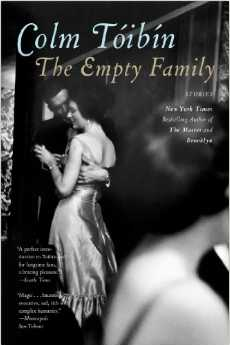
Cover for The Empty FamilyIn this collection of short stories, Colm Toíbín writes empathetically about the human condition. People remember how they have loved, their desire, their loneliness.

In the only historical fiction story, “Silence,” Lady Gregory tells Henry James a tale over dinner. Even though her story is not true, it encapsulates a kind of truth about her relationship with her lover during her marriage to her much older husband.

In “The Empty Family,” a man returns to a seaside village in Ireland after years of absence in California. He meets some old friends and considers his former life in that town and the life he just left.

In my favorite story, “Two Women,” an elderly Irish set dresser remembers her affair with the only man she ever loved. One day on the set where she is working, she meets his widow, the woman who married him after they parted.

In “One Minus One,” a man returns home to be with his dying mother. He is full of regret and longing because she never cared much for him.

These stories are precisely written, sad, and evocative.