Day 509: Mountains of the Moon

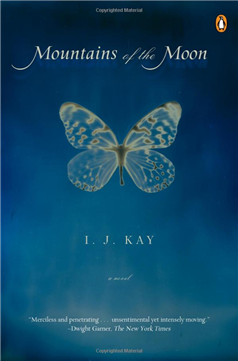
Cover for Mountains of the MoonBest Book of the Week!
It will be difficult for me to put into words how unusual Mountains of the Moon is. The novel is about a woman’s act of creating herself despite a past that is nearly crippling, but its unusual quality is primarily in the style of narration.

At the beginning of the novel, Louise Adler is 31 and newly out of prison. She is doing what she can to make a fresh start, fixing up her dreary apartment, trying to find any kind of job.

The story shifts to when Lulu is a little girl. Brought up with her grandfather’s stories of the Mountains of the Moon, she pretends she is a Masai warrior, dressed in a bright strip of cloth and holding her spear on a perch high above the neighborhood.

Her home life is difficult. She loves her older brother Pip, but he is sent away to live with his father because of “disloyalty” to his mother. Her verbally abusive mother keeps her out of school and makes her stay up all night listening to her talk. Her physically abusive father is often away with his other family. When Baby Grady arrives, he is left to Lulu’s care much of the time, but she adores him.

This portrait of the imaginative little Lulu is charming, but fear always lurks around the edges of her world. We know something goes wrong for her, but Kay spins the story out by interleaving it with the present one. A third story line returns to when Louise is 21 and learning to deal blackjack at a casino. At that time, she becomes fatefully involved with a girl named Gwen and her friends.

Louise is a woman of many names and identities. As a child she plays gleefully with language, gobbling up new words but only saying parts of the ones she knows. As an adult she finally begins trying to make sense of herself as a person.

This novel is sometimes brutal and harrowing, other times endearing. Its narrative style reminds me a bit of that of The Bone People.We like Louise/Lulu and we want her to succeed, but there are secrets in store. This story is one of an unforgettable character.

Day 508: Conversations with Myself

Cover for Conversations with MyselfI was deeply disappointed with Conversations with Myself, which reads as if it was thrown together by people who don’t know much about publishing or the interests of readers. It was assembled from notes, diary extracts, letters, and interviews, probably without much interaction with the man himself. (Although it is solely credited to Mandela, it is fairly obvious from some of the notes that it was put together by committee.)

Context is one of the biggest problems with the book, that and organization. Perhaps some attempt was made to order the excerpts by subject or time. It is hard to tell. But except for short notes about where the information came from, no effort is made to explain the context of the excerpts. It is as if the editors of the book are assuming that its readers are intimately familiar with the events in Mandela’s life. He makes a journey, for example, and writes about it in his diary, but there is no introduction about the journey’s purpose.

One of the first things I encountered on beginning to read (besides three typos on the first two pages) was a note that an entry was from a letter to a particular person. The back of the book includes an alphabetical list with descriptions of some of the people mentioned. Naturally, I wanted to understand who Mandela was writing to. But the name was not listed.

Even if it had been listed, the information there is written like an abbreviated biographical dictionary or business résumé—in partial sentences, listing the person’s work positions, accomplishments, imprisonments, with lots of acronyms. When I am reading a book like this, I want to know the person’s relationship to Mandela. I want to read a blurb that gives me some sense of the person. I want to know if someone was Mandela’s friend for many years or a trusted colleague. As an extreme example, sandwiched between Winnie Mandela’s employment history and memberships in various organizations is the bald statement “Married to Nelson Mandela, 1958-96 (separated 1992).” That’s it for Winnie.

Let’s not forget the acronyms and organizations. Between my early attempts to look up names and acronyms in the back and the little information gleaned from doing so, I soon gave up referring to that list. As an example of the type of information offered, the African National Congress is explained in terms of its founding date, the dates it was banned, and its current status. But why was it formed? What are its goals? What has it achieved? Of course, I have heard of it for years, but I really don’t know much about it. Again, context.

This book could have been effective and interesting with more attempts to organize the material, write more informative introductions, and rework the appendix. Instead, it is simply confusing, with a few gems of thoughtful prose. I wish I had read The Long Walk to Freedom instead.

Day 507: My Wish List

Cover for My Wish ListMy Wish List is very popular in France and was just recently released in English. It is narrated by Jocelyne, a middle-aged woman who is feeling she missed something in life when the novel begins. She runs a fabric store and keeps a blog about sewing and knitting that is gaining a large audience. Still, she feels unsatisfied with her life and with her husband Jo, who has not always been kind to her.

Then Jocelyne wins more than $18 million Euros in the lottery. She is cautious about her money, not sure what to do about it or how it will change her life. Although she begins making lists about how she could spend the money, she hides the check in a shoe in her closet and doesn’t tell anyone she has won it.

Although I supposed this novel would be light and fluffy, it is more thoughtful than that. It is not in any way deep, but it does examine the question of whether money can buy happiness. Its outcome is unexpected.

http://www.netgalley.comIn the novel we get to know Jocelyne and to like her. The other characters are more sketchily drawn. Delacourt writes in the present tense, which can be a poor choice but in this case lends it a jaunty flavor even when the mood is somewhat somber. I found this novel mildly enjoyable.

Day 506: The Bastard of Istanbul

Cover for The Bastard of IstanbulTwo 19-year-old girls are the focus of The Bastard of Istanbul, which is full of colorful characters. First, though, we meet Zeliha Kazancı, twenty years before most of the action of the novel. She is notable on the streets of Istanbul during the 80’s for her miniskirts and incredibly high heels, her colorful outfits and jangly jewelry. She is defiant of convention, and bitingly invents rules of prudence for Istanbulite women as she makes her way to have an abortion. But fate intervenes.

In Arizona, Zeliha’s brother Mustafa is a student when he meets an American woman and her baby in the supermarket. Rose is newly divorced from an Armenian American, and she thinks nothing would enrage her husband’s family more than her dating a Turk.

Nineteen years later, Armanoush Tchakhmakhchian loves her father’s Armenian family, but because her parents have been at loggerheads her entire life, she does not feel totally at home on the Armenian side. She decides to visit her stepfather Mustafa’s family in Istanbul so that she can see the house her Armenian grandmother used to live in before they had to flee and try to learn more about her heritage.

In Istanbul, Asya Kazancı is even more of a rebel than her mother Zeliha. She is an angry girl who hates being a bastard and thinks of herself as a nihilist. She hangs out with a group of rather effete intellectuals at the Café Kundera. She is not pleased to learn her four aunties expect her to act as a hostess to her uncle Mustafa’s American stepdaughter.

Eccentric women dominate the Kazancı household. Asya’s great-grandmother Petite-Ma is suffering from Alzheimer’s. Her grandmother Gűlsűm is a bitter woman who spoiled her son Mustafa rotten only to have him go to America and never return. Her oldest auntie Banu is the only observant Muslim in the house, but she also is a soothsayer, who learns the future from two djinnis that sit on her shoulders. Cevriya is a rather didactic schoolteacher, and Feride toys with different types of mental illness. Zeliha, whom Asya also calls auntie, is as colorful as ever and owns a tattoo parlor.

Shafak writes in a light-hearted style that mixes in folk tales, superstitions, and family legends and is often comic. Yet it deals with some serious subjects, one being modern Turkish identity and another the Armenian diaspora. Armanoush finds when she arrives that most of the people she meets have never heard of this latter subject that has her American-Armenian friends so angry. The subject matter is an odd contrast with the light tone, for Armanoush’s visit brings old family secrets out into the open, and they are dark ones.

This novel is well written and interesting, but I can’t decide how much I like it. I feel that the narrative style somehow keeps the reader aloof from the characters so that they remain unknowable. Still, the novel gives glimpses into life in a fascinating country and informs us on historical events of which many people still are unaware. And it includes a recipe.


Day 505: The Red Road

Cover for The Red RoadIt is 1997. Young Rose Wilson is waiting for her pimp Sammie one night when Pinkie Brown, a young man she knows, asks her to hide a knife for him. Although she has had a crush on him, she suddenly understands he is attempting to use her. She tries to push him away and ends up accidentally stabbing him to death. Terrified about what Sammie will do to her, she attempts to hide from him that she is covered in blood as they drive away from the area. But he finally sees the blood, so she attacks him in panic, killing him. Then she realizes she has nowhere to go and no way to hide her crime, so she sits in the car and waits for the police.

In the present time, Detective Inspector Alex Morrow is set to testify against Michael Brown. He was found guilty years ago of the murder of his older brother Pinkie. Now he is up on weapons charges, as caches of guns with his fingerprints on them were found buried in his back yard. But Alex soon learns something puzzling. Brown’s fingerprints were found at the scene of a murder that happened three days before in an abandoned building on the Red Road, when Brown was in custody. Although Alex is inclined to believe this is some ploy by Brown’s defense, Anton Atholl, she can’t figure out what they have to gain from it. In any case, court is dismissed because of news of the death of another defense attorney, Julius McMillan.

Back in the past, it is Julius McMillan who saves Rose. After Rose admits everything she did, he figures out a way for her to serve minimal time for Sammie’s death, as long as no one connects her to the killing of Pinkie Brown. To save her, he is forced to make a deal with some powerful but unscrupulous men.

Alex’s investigation is taking some unexpected detours, and eventually she figures out that there was a conspiracy to pin Pinkie’s murder on Michael years ago. Michael’s fingerprints were switched for those of the real murderer, who has just killed again. Although Alex begins to realize she will be up against some powerful people, she just can’t let something like that go.

Denise Mina’s mysteries are set in a gritty Glasgow. Alex is an abrasive and stubborn heroine whose career keeps being dead-ended because she insists on going up against corrupt politicians and police. The novels are smart and interesting, with convincingly drawn characters.

Day 504: The Power of Habit: Why We Do What We Do in Life and Business

Cover for The Power of HabitI borrowed The Power of Habit from the library because it was mentioned in an advice column and because I have some habits I would like to change. Its conclusions are based on solid research, but my main criticism of the book is that it is exactly one of those management books I have learned to despise. I guess I should have known by the inclusion of the word “business” in the subtitle.

What characterizes these books is that they have very little actual content. They usually make a few points, no more than 10, and the lack of substance is disguised by filling the book with anecdotes and repetition. As some of them are very popular, I guess business managers haven’t figured out that one example doesn’t prove anything.

Unlike most of these books, this one at least is full of notes and other evidences of an actual basis in research. However, its emphasis is on changing habits in a business environment or community. Only the first few chapters, which are admittedly interesting, and the appendix have much useful application for an individual.

If you are interested in the neuroscience behind the conclusions in this book, you can probably find more in-depth information in its source material, which is abundant. The actual content of the book only takes up 286 pages, with the same concepts and simple illustration repeated endlessly, and the final 100 pages devoted to notes, source material, and an index.

If you are simply interested in this subject, the book is well written and easy to understand. Note that all of the raves on the back cover are by authors who write exactly the same kinds of books.

Duhigg is obviously talented, as he is a writer for the New York Times and a contributor to some serious news magazines. I would like to see him tackle something of substance.

Day 503: Tomorrow There Will Be Apricots

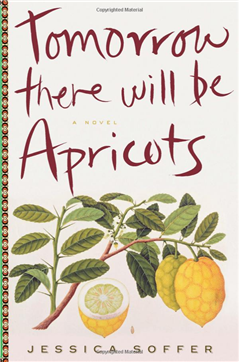
Cover for Tomorrow There Will Be ApricotsBest Book of the Week!
Tomorrow There Will Be Apricots is a brilliant, touching novel about the complexity of human relationships and the longing for love and acceptance. It is also a mouthwatering novel centered around food and the love of cooking. (I have no idea, though, why lemons are on the cover instead of apricots.)

Lorca is a teenage girl who yearns for love and affection from her mother Nancy. Nancy is a noted chef who remains emotionally aloof, so Lorca tries to please her by cooking food that she likes. The two live in a small New York apartment with Nancy’s sister Lou, who seems jealous of any attention Lorca gets from Nancy.

Lorca cuts herself for release, because something feels better than nothing. When she is caught doing it at school, she is expelled for a week. Instead of getting Lorca help, her mother informs her she is sending her away to boarding school.

One night Lorca overhears Nancy tell Lou that the best food she ever ate was masgouf at a restaurant that has since closed. Lorca believes that if she can learn to cook that dish for her mother, she won’t be sent away. So, she begins trying to find out about the restaurant with the help of her friend Blot.

Victoria narrates the novel in alternate chapters with Lorca. She is an old Jewish woman who fled Iraq with her husband Joseph when they were young. The two used to own and run the restaurant, which they closed when Joseph became ill. He dies early in the novel.

Victoria is full of regret, because she was so afraid that Joseph would love their child more than her that she insisted upon giving up their daughter for adoption when they were young and refused to have another child. Now she feels she deprived Joseph of part of his life and wants above all things to find their daughter. When she first sees Lorca, she is sure she is her granddaughter, and Lorca, whose mother was adopted, soon believes Victoria is her grandmother.

Whether this is magical thinking or not you can find out by reading the novel. It is ripe with the flavors and scents of the Middle East. This novel will touch you. It will also make you want to run out and eat some Middle Eastern food. Oh, and the recipe for masgouf is included.

Day 502: The Poisoned Crown

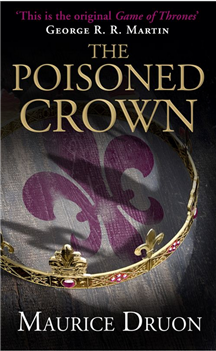
The PoCover for The Poisoned Crownisoned Crown begins with the beautiful and devout Clémence of Hungary on her way into a pit of vipers, the court of Louis X of France, and marriage with the king. Louis has managed to rid himself of his inconvenient first wife. His attention span is short, however, so by the time Clémence arrives after a horrendous journey he is more involved with an ill-conceived siege against the Count of Flanders than with arrangements for the wedding. Still, the new queen is soon esteemed for her gentleness and generosity, even by her horrible husband.

During Louis’ short reign, France has already descended from relative prosperity to famine, and the progressive steps taken by his father have all been rescinded. Robert of Artois, always trying to cause trouble for his aunt Mahaut, has provoked her barons to rise up against her in Artois. The cardinals have still not settled on a new pope. In short, France is in chaos. Louis’ younger brother Philip of Poitiers has striven to dissuade his brother from his poorer decisions, but Louis sends him off to the papal conclave.

Another character who has served in previous books as almost comic relief will soon become more important. This is Guccio Baglioni, the very young nephew of a rich Lombardi merchant. He has fallen in love with the daughter of impoverished nobility, Marie Cressay, and hopes to marry her, without understanding how much beneath them her family considers him. He has just helped escort Clémence of Hungary to France when he is badly injured.

The curse against the Capet kings of France continues in this third book of Druon’s excellent series The Accursed Kings. Those who are following it will not be surprised to learn how short Louis X’s reign will be.

Day 501: Waiting for Wednesday

Cover for Waiting for WednesdayThe writing duo Nicci French has come out with another powerful Frieda Klein mystery with Waiting for Wednesday. Although it deals mostly with another case, there is still the threat of a serial killer from the first book in the background.

DCI Karlsson and his team are trying to solve the murder of Ruth Lennox, a housewife whose face was smashed by a heavy object. Although her death appears to be part of an interrupted robbery, when the police find the thief, he has an alibi for the actual time of the murder. Soon Karlsson and his team find evidence that Ruth was leading a secret life.

Frieda is recovering from injuries incurred at the end of Tuesday’s Gone, and she is on leave from her practice. Her absence from the case does not prevent another psychoanalyst who is working with the police, Hal Bradshaw, from seeing her as a threat and attempting to professionally humiliate her.

Bradshaw has set a trap for Frieda and some other analysts he dislikes by sending in graduate students for consultation who pretend to have sociopathic thoughts and ask for treatment. Frieda immediately realizes her subject is pretending and sends him away, but something he says captures her attention and she begins trying to track down the source of the story. In doing so, she meets Jim Feary, a retired journalist who is sure he has happened upon traces of a serial killer. When Frieda takes Jim and his evidence to see Karlsson, though, Karlsson believes that her judgment is impaired because she is still traumatized by her experiences and that Jim is a nutcase.

http://www.netgalley.comFrench presents a complex set of mysteries in this novel, which is really gripping and ultimately suspenseful. While Frieda flounders with too much going on in her usually quiet life to allow her to make her recovery, Karlsson, Yvette, and Riley struggle with a case that gets more and more complicated. Even if you can figure out a piece of one puzzle, as I did, there is still a lot more going on in this intelligent mystery novel.