
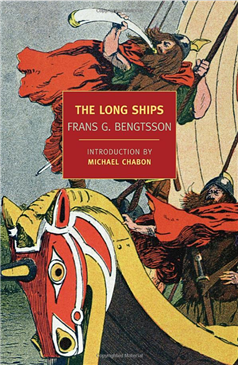
 This week’s Best Book is The Long Ships by Frans G. Bengtsson! Oops! I forgot! Honorable mention to The Hour I First Believed by Wally Lamb.
Day 500: Little Bird
 Little Bird is a simple picture book about small things. A man drives a big red truck up to the edge of a cliff and lets out a flock of brightly colored birds.
“Some days are different,” the book tells us, and the man finds one small black bird still in the truck. He tries to get the little bird to fly away with the others.
The illustrations by Albertine are simply drawn and brilliantly colored. They are a joy to look at.

The text is sparse, perhaps less than 50 words in the entire book. “There are no greater treasures than the little things,” it says.
This book is a gem for small children, who will love the pictures and the charming story. Adults will enjoy reading it to them.
Day 499: Literary Wives! The Zookeeper’s Wife: A War Story

Here it is time for another Literary Wives club meeting. Please also see the reviews of my fellow “wives!”
- Ariel of One Little Library
- Audra of Unabridged Chick
- Carolyn of Rosemary and Reading Glasses
- Cecilia of Only You
- Emily of The Bookshelf of Emily J.
- Lynn of Smoke and Mirrors
If you have read the book and would like to participate, you can add comments to any of our pages or to the Literary Wives Facebook page.
Let’s get right to the book!
The Zookeeper’s Wife tells the true story of Jan and Antonina Zabiński, the keeper of the Warsaw zoo and his wife during World War II. After the bombardment by the Germans and their invasion, the Zabińskis struggled to keep the zoo animals alive, but they were also responsible for providing temporary shelter in the zoo grounds and in their house to hundreds of Jews. Jan, who was a member of the Polish Underground, found ways of smuggling people out of the ghetto, and he and Antonina kept them at the zoo until they could be placed elsewhere, sometimes for a few days, sometimes for longer periods.
The book is rich with details about life in their unusual household, full of animals and of hidden people who came out cautiously at night. It tells stories of lucky escapes and frightening encounters with the Nazis. It also provides information about life in the ghetto and some of its heroic leaders. I found some of these stories extremely touching, such as that of Henryk Goldzmit, a children’s author who went by Janusz Korczak. He abandoned his literary career to found an orphanage for Jewish children, and when the Nazis decided to ship all the children to Treblinka and almost certain death, went with them so they would not be frightened.
Although some of Ackerman’s many digressions from the main story add interest and color to the book, I unfortunately found others disruptive to the flow. For example, she spends more than a page on Jacques Offenbach simply because Antonina played one of his pieces on the piano to warn the hidden residents when strangers approached. Ackerman, a nature writer, spends another very long paragraph just listing the types of bugs in an insect collection entrusted to the Zabińskis. After awhile, these digressions began to feel like padding.
I also felt that Ackerman’s writing sometimes verges a little too closely on fiction. She is prone to rather florid descriptions of things she can only be imagining, often including inapt or odd metaphorical language. Although she introduces the book by saying she got the dialogue directly from Antonina’s diaries, she fictionalizes other things, such as the thoughts of sculptor Magdalena Gross, that could not have come from her sources. This style of writing for a nonfiction subject makes me uncomfortable. In fact, I read this book when it first came out and remembered it as a work of fiction.
What does the book say about wives or the experience of being a wife?
 In what way does this woman define “wife”—or in what way is she defined by “wife?”
It is interesting to me that Jan Zabiński describes Antonina at one time as “just a housewife,” because she is clearly so much more than that. She helps him administer the zoo and take care of the animals even before the war. During the war, she takes care of a household of refugees while Jan is out until late most nights and is gone for some extended periods of time. Although he is described as authoritarian and occasionally harsh, he trusts her implicitly to run things and keep everyone safe, even through scary encounters with Nazi officials and drunk soldiers. Although she would define herself as a wife and her husband as the master of the house, it is clear that the two respect each other and trust each other to handle difficult and dangerous situations. Antonina also defines herself as a mother, with the fierce determination to protect her children and her other charges.
Day 498: The Hour I First Believed
 The Hour I First Believed is described on its jacket as an exploration of faith, and as such I didn’t think it would be very interesting to me. But it is really more about a man’s struggle to face the problems of his life and his own demons. It is an extremely interesting and affecting work.
Caelum Quirk is not always a likable protagonist. He has anger issues—went after his third wife’s lover with a wrench—can be withdrawn and drink too much, says the wrong thing quite often, and earned my personal disregard at the beginning of the novel by referring to two different women as a ballbuster and a nutcracker. Lamb had to work hard to get my sympathy for his character after that, but he did accomplish that by the end of the novel. Still, whether I liked Caelum or not, I couldn’t tear myself away from his story.
Caelum is trying to salvage his marriage after the wrench incident, so he and his wife Maureen decide to move away from Three Rivers, Connecticut, the town where his family has a lot of history, and get jobs in Colorado. They are settled there and are doing okay, although still having relationship issues, when Caelum is called back to Connecticut because his beloved Aunt Lolly has had a stroke. She dies shortly after he returns, and Maureen is making arrangements to come for the funeral but decides to work one more day at the high school where Caelum teaches English and she is a nurse. Unfortunately, the high school in question is Columbine, and the school day she works is the day two students go on a rampage.
Maureen would normally be out of the area of trouble, but that day she decides to help Velvet Hoon, a troubled drop-out, fill out some papers in the library. Although she is not killed, she hides in a cupboard for hours before she is found, and subsequently suffers from post-traumatic stress disorder that barely allows her to function. She also struggles with an addiction to uppers.
Caelum and Maureen move back to live on Caelum’s family farm, a place for which he has mixed but mostly negative feelings. His father was a drunk of whom he was ashamed. He remembers his grandfather as judgmental and his mother as cold. Only Lolly seemed to care for him.
Troubles are not over for Caelum and Maureen, but I don’t want to reveal more about that. Caelum must also deal with his feelings about his family. His great-great grandmother was an early fighter for abolition and women’s rights, and she was instrumental in establishing the women’s prison down the road from the farm. It had a long history of treating the women with dignity and had a low rate of recidivism until its values were changed by modern tough-on-crime politics. Caelum’s great-great grandmother’s papers are in a spare room of the house. When Caelum is forced by financial circumstances to rent part of the house to a couple evacuated from New Orleans because of Hurricane Katrina, the wife, a women’s studies graduate student, asks if she can examine them. This and other events lead Caelum to several discoveries about his family.
This novel is sprawling, even a bit messy, because it seems to want to deal with everything. It features large events such as Columbine, 9/11, and Katrina, as well as the inequity of the American justice system, PTSD, drug addiction, grief, love, trust, religion, infidelity, and other issues. It is interesting, frustrating, and ultimately worth reading.
Day 497: The Last Pre-Raphaelite: Edward Burne-Jones and the Victorian Imagination
 Years ago in London I was wandering through the Tate with my friends, tired of seemingly endless rooms of Italian Renaissance paintings, when I walked into another room and was simply blown away. The room was full of life-size paintings of stunning beauty, with gemlike colors, exact details of greenery and complex woven fabrics, and narrative depictions from myth and legend. They were by the Pre-Raphaelite Brotherhood, and they must be seen in person to be fully appreciated. Ever since then I have been interested in the Pre-Raphaelites, so when I read a glowing review of The Last Pre-Raphaelite in the New York Times, I tracked it down.
Although all art movements go in and out of fashion, the Pre-Raphaelites seem to come in for more than their fair share of controversy. I have even now picked up art history books that don’t contain a single Pre-Raphaelite picture. Edward Burne-Jones was the youngest of this group of painters, although he was outlived by Holman Hunt. He was also a prolific designer of stained glass windows and even jewelry.
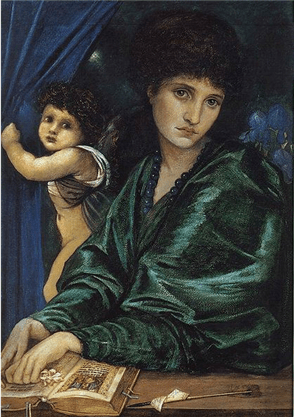
MacCarthy’s biography is a fairly exhaustive study of Burne-Jones’ life and works, his marriage and family, life-long association and partnership with William Morris, his mentoring of younger painters and friendships with many important figures in art, literature, and politics and with a string of little girls, and his famous affair with Maria Zambaco. It discusses his association with the Pre-Raphaelites, the Arts and Crafts movement, and the philosophy of Aesthetics.
Burne-Jones believed strongly that beauty should be available to everyone. Hence, his involvement with William Morris in producing items of home decor, in illustrating manuscripts, and in designing stained glass windows for public venues. In fact, he is closely associated with the revival of the stained glass industry in England.
One surprise of this biography was to find the personality of a puckish jokester underneath Byrne-Jones’ ascetic, attenuated appearance. He continued throughout his life a schoolboy habit of drawing little caricatures of himself and his friends, particularly teasing ones of his good friend Morris. Although generally a moral person, he was understanding of the foibles of others and supportive of his friends, even those of whose habits he did not approve. He was beloved by many.

I was interested throughout this book, even though much of it had to do with Burne-Jones’ struggles to finish work. He apparently had far more ideas than he could ever accomplish and was always working on many projects at the same time. The book is full of beautiful photographs of his art—although unfortunately most of them are too small to see the details—as well as of himself, his family and friends, residences, etc. The interiors of rooms are stunning examples of the Arts and Crafts movement.
A small quibble is the epilogue, which is concerned with the revival of interest in Burne-Jones. It is interesting up to a point, where it seems to be attempting to trace of ownership of every single work. Still, this is a fascinating biography.
Day 496: My First Classics Club Review! The Long Ships
Best Book of the Week!
Today I’m posting my first review for The Classics Club, the one chosen for me by the Classics Club Spin #5! The Long Ships is a great start to the Classics Club for me. I found it to be a rousing adventure story full of deadpan humor.
This book is the result of Bengtsson’s desire to write a realistic novel about the Vikings. A poet, Bengtsson also wrote essays and a biography of Charles XII, but he became more widely known for The Long Ships.
His protagonist Orm Tostesson is only a boy when the novel begins. Orm is eager to go a-viking to Ireland with his father and older brother, but his mother tends to be protective of him, so he stays home. Shortly after the men leave, he attempts to stop some sheep stealing on the part of a group of Vikings from Lister and is kidnapped by them. The Vikings soon find him an able and intelligent companion, so he becomes part of their crew rather than being kept a slave.
In the course of their adventures down the western coast of Europe, they are initially successful but eventually are captured and sold as galley slaves. In return for a service they performed for a Jew from Córdoba, they are freed to serve as bodyguards for lord Almansur, the regent and imprisoner of the young Caliph of Córdoba. There they serve for years until circumstances force them to flee for home.
This voyage is the first of three related in the novel, during which “Red” Orm meets his bride to be, loses her when his best friend Toke steals her father’s concubine, goes a-viking to England to try to retrieve her from English priests, and many years later travels down the Dnieper to bring back a stash of hidden gold. Even when he is settled at home, he is involved in tiffs with his neighbors, attempts to murder him on the orders of the evil King Sven, visits from unusual acquaintances, rowdy celebrations, and a Thing, a convocation of various groups of Vikings for settling their differences.
There is plenty of action in this novel, but what I find most charming are its air of insouciance and its ongoing (although somewhat grisly) humor. It has a sense of playfulness, especially about the differences between the Norsemen’s old religion, Christianity, and Islam, to which Orm and his fellows are temporarily forced to convert. Take, for example, this passage from the prologue, about the arrival of the shaven men, or priests, in Skania:
They had many strange tales to relate, and at first people were curious and listened to them eagerly, and women found it pleasant to be baptized by these foreigners and to be presented with a white shift. Before long, however, the foreigners began to run short of the shifts, and people wearied of their sermons, finding them tedious and their matter doubtful . . . . So then there was something of a decline in conversions, and the shaven men, who talked incessantly of peace and were above all very violent in their denunciation of the gods, were one by one seized by devout persons and were hung up on sacred ash trees and shot at with arrows, and offered to the birds of Odin.
To give you another idea of the humor in this novel, a Viking tells a story of a wedding that broke up into a fight. When the bride sees the groom’s friends beating up one of her relatives, she hits the groom with a torch, which starts his hair on fire, beginning another fire in which 11 people are killed. Everyone agrees that it was the best wedding they ever attended.
The story of Red Orm is told in a detached manner but by a truly talented storyteller. It is full of sly humor and observations of human folly. I really enjoyed it.
Best Book of the Week!
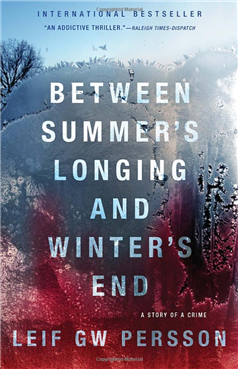 This week’s Best Book is Between Summer’s Longing and Winter’s End by Leif G.W. Persson!
Day 495: Just One Evil Act
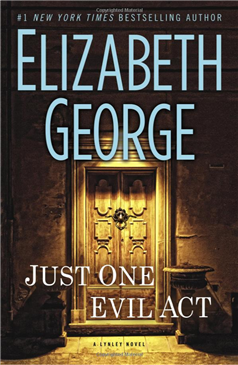 I can chart my changing attitude toward Elizabeth George’s Inspector Lynley mystery/thrillers simply by how I treat the new books. I used to get them as soon as they were available and read them immediately. This one I had for a couple of months before reading it. They are still page turners, don’t misunderstand me, but George has put her characters, and fans, through a lot.
George is not a proponent of the idea of keeping her characters’ private lives out of her mystery novels—very much the opposite. At first their absorbing lives made these novels stand out. But by now she has put Lynley through a brother accused of murder, a fiancée marrying his best friend, a seemingly hopeless romance, a murdered wife, and an ill-judged affair with his alcoholic boss. Heretofore, Sergeant Barbara Havers, although sometimes rebellious and unruly, has been a rock of good judgment, often better at finding the criminal than Lynley is. So, now it’s her turn to go off the deep end.
At the end of the previous novel, Believing the Lie, Barbara’s neighbor Taymullah Azhar had his sweet young daughter Hadiyyah kidnapped by the girl’s mother Angelina, who returned to Azhar pretending a reconciliation in order to get an opportunity to take the child. The situation is complicated because the parents never married and Azhar’s name is not on Hadiyyah’s birth certification, so for now he has no legal right to her (although, if that is so, since Angelina abandoned them, British law must be really weird). In addition, he has no idea where they have gone.
The Met can’t apparently help him, so Barbara takes Azhar to a private investigator, Dwayne Doughty, and they hire him to find Angelina and Hadiyyah. Eventually, though, Doughty reports back that there is no trace of the two to be found.
The tables turn quickly, though, when Angelina returns with her lover Lorenzo Mura, claiming that Hadiyyah has been kidnapped from them, so Azhar must have taken her. When it appears that Azhar is just as alarmed as Angelina and that he has an alibi for the time of the kidnapping, they all return to Lucca, Italy, where Angelina and Mura have been living. Inspector Lynley is assigned to go along as liaison between the parents and the Italian police. Isabelle Ardery, the boss, refuses to let Barbara come along.
Barbara absolutely refuses to believe that Azhar has had anything to do with the kidnapping. She has already given information to a tabloid journalist to create enough furor in Britain about the kidnapping for someone to be assigned to the case, and that liaison with Mitchell Corsico is not only a breach of trust but a major source of drama—and irritation—for the rest of the novel. The novel ends with Corsico assuming Barbara is in his debt. I certainly hope George doesn’t plan to pursue that subplot, because I found it to be too far over the top, with the journalist demanding more disclosures about every 15 minutes (an exaggeration, admittedly) and always when Barbara urgently needs to be doing something else.
Unfortunately for Barbara, as she breaks all the rules set by her new boss, John Stewart, to investigate the case from her end, it begins to look as though Azhar did indeed plan the kidnapping and execute it with the help of some of Doughty’s contacts in Italy. We readers actually know where Hadiyyah is, although we don’t know the identity of her kidnapper. But we also soon learn that her kidnapper has died, leaving Lynley and the excellent Italian detective Salvatore Lo Bianco to figure out who he was and where he put the child. Lo Bianco’s efforts are hindered by the actions of his incompetent boss.
In the midst of all this, Angelina dies, and it becomes obvious that she was murdered. Soon, it looks as though Azhar could be implicated in that, too.
My problem with this novel is Barbara’s behavior, as she goes overboard to protect Azhar. First, there are the leaks to Corsico which, after the first one, seem totally unnecessary. Then she begins concealing and attempting to alter evidence. I won’t go on. Even worse is how this trouble is wrapped up at the end of the novel, either by a cheat or a completely unlikely act on the part of Ardery.
You can tell I had a mixed reaction to this novel. On the one hand, it is extremely gripping. On the other hand, especially if you have been following the series and care about Barbara, you occasionally want to throw the book across the room. For the last four or five books, I’ve been wondering whether to quit the series, but I always end up picking up the next one.
Finally, I was upset by how the novel ends for Azhar and Hadiyyah, who for a large part of the series have been two of the most likable characters.
Day 494: A View of the Harbour
 Elizabeth Taylor was a mid-twentieth century writer who was interested in the realistic depiction of ordinary lives, particularly those of the working class. In A View of the Harbour, she provides glimpses into the lives of residents along the harbor of a shabby seaside village in post-World War II England.
Newby has seen better days. The trendy tourist area has moved away around the point, and all that is left aside from a few houses are a wax museum, a pub, a small store, a closed-down fun fair, and a lighthouse.
The main characters of this novel are Beth and Robert, a married couple, and Beth’s longtime friend Tory, recently divorced. Beth labors under the delusion that she is observant, but most of her focus is on her writing, as she is an author. Toward her family she is myopic. She doesn’t see when her five-year-old daughter Stevie is manipulating her, and she pays very little attention to her older daughter, Prudence, or to her husband. All family drama provides fodder for her prose.
Most people in town seem to think Prudence is slow, but she has noticed something that others haven’t—that her father is secretly visiting Tory.
Tory is torn between her feelings for Robert and her loyalty to Beth. She mostly seems to be at loose ends, however. She still cares for her ex-husband Teddy and makes a point of stopping in to see him if she is in London. In Newby she flirts with Bertram, a retired naval officer with ambitions to be a painter but little talent, and dallies with Robert.
Loneliness is a strong theme of this novel. Tory is clearly lonely, even though she is beautiful and has no trouble attracting attention. The attention she wants, from Teddy, is not available. Lily is a recent widow who goes to the pub nightly for companionship. She is timid and terrified of the walk home in the dark. The proprietor of the wax museum, she is afraid to pass the figures on the way up to her flat. The brief attention she gets from Bertram ends unfortunately.
Maisie, the hard-working daughter of invalid Mrs. Bracey, manages to attract Eddie, the boarder, but Mrs. Bracey is immediately jealous of the distraction of Maisie’s attention. Mrs. Bracey is a complex character. We have sympathy for her because she is paralyzed, but she has a terrible tongue and is a vicious gossip. She easily finds a way to squash Maisie’s romance.
Taylor’s characters are too realistic to be entirely likable, although Beth is less at fault than Robert or Tory. I found Maisie and Prudence the most sympathetic of the characters.
Taylor is highly regarded but relatively unknown because she was overshadowed in her time by the more famous Elizabeth Taylor. Her writing is observant of the small details of life. Although there is not much humor in the novel, Tory’s letters from her young son at school are believable and funny. My overall impression of the novel is that the lives of its characters are as sad and dilapidated as the village.
Day 493: Between Summer’s Longing and Winter’s End
Best Book of the Week!
Between Summer’s Longing and Winter’s End is difficult to place in genre because while it is about the investigation of a crime and its repercussions, it is also reminiscent of the more cerebral of John Le Carré’s political thrillers without so much being a thriller as a record of law enforcement incompetence. The novel is crammed with characters who are mostly concerned with pursuing their own agendas, whether it be the chief constable of Sweden with his ridiculous intellectual exercises or a member of the secret police who is more concerned with pursing graft and sexual exploits than doing his job.
The novel is a fictional dissection of the possible scenario behind the true-life assassination of the Swedish prime minister Olof Palme in 1986. It is the first of a trilogy of which only two novels have been published in English, but it stands fairly well on its own.
Between Summer’s Longing begins with an apparent suicide. A man living in a student apartment in Stockholm plunges to his death from his window. The apartment door is locked from the inside, and there does not appear to be any other explanation for the incident, even though the man’s shoe fell shortly after the body, killing the small dog that had just saved his master’s life from the falling body. The dead man is identified as John Krassner, an American journalist.
There are a few odd things about the crime scene, including the unusual message the man apparently left as a suicide note and the lack of a manuscript he had supposedly been writing. Still, everyone appears to be ready to wrap things up when police Superintendent Lars M. Johansson discovers that his own name and address are on a slip of paper inside a hollow heel of the man’s shoe.
In a separate time stream, the novel returns to several months earlier when the Swedish secret police get a tip to keep an eye on John Krassner. Chief Operations Officer Berg is informed by his people that they are having difficulty finding out what Krassner is up to because he seldom leaves his room, which is close by that of several students. He puts police Superintendent Waltin in charge of an operation to lure Krassner out of the house at a time when it will be empty and send an independent operative in to search his apartment. That operation takes place the night Krassner is killed, but Waltin’s operative assures him he was finished and out before the death.
Persson takes us down some labyrinthine trails before finally getting to the assassination and also before we find out exactly what happened to Krassner. In the meantime we encounter espionage agents, secret societies, sexual deviants, drunks, and incompetents, almost all of whom work for the regular or secret police or the government. If there is any hero of the novel, it is Superintendent Johansson, who figures almost everything out.
The novel is gripping and well written except for a couple of murky passages, but I wasn’t sure if I found them murky because of my own lack of understanding of Swedish politics of the 80’s or if they were perhaps even purposefully murky. Persson himself was a whistle blower in the Swedish police, so it should not be a surprise to learn that the novel is cynical, sly, and full of intrigue.
 What? Me Read?