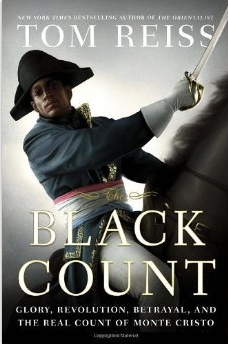
Day 484: The Black Count: Glory, Revolution, Betrayal, and the Real Count of Monte Cristo

Cover for The Black CountTom Reiss, previously the author of the fascinating biography The Orientalist, seems to be drawn to unusual figures who were famous in their own time but have become virtually unknown. Such is the case with Thomas-Alexandre Dumas—the father of the famous author of The Count of Monte Cristo, among other classics—who reached the heights of his fame as a great soldier and general of revolutionary France.

Dumas, who went by Alex rather than Alexandre or Thomas, had a colorful past. He was born on the island of Saint-Domingue (now Haiti), the son of a black slave and a French marquis, Antoine Davy de la Pailleterie. His father was a wastrel and a scoundrel who, although he apparently did not raise his son in slavery, sold him in order to raise the passage money for his own return to France after his family had thought him dead for years. After claiming his right to his title and property (which his relatives had been maintaining and improving for years at their own expense), Pailleterie redeemed his teenage son and brought him up in privilege.

However, shortly after entering manhood, Alex broke with his father, took his mother’s name, and proceeded to make his own way as a soldier. He was the first person of color to become a general-in-chief of the French army and was the highest ranking black officer in the western world of his time.

This book is an account of Dumas’ fascinating life, in which his physical courage, ability, and principled behavior won him acclaim. Unfortunately, he was not as gifted politically and inadvertently made an enemy of Napoleon Bonaparte, who perceived him as a rival and really comes off here as a jealous and power-hungry opportunist. Bonaparte’s resentment, in combination with an abrupt change in policy of the French government to remove the rights previously granted subjects of color, ended in the loss of his career and a death in neglect and poverty.

The book is written in an energetic and informal style for the general public, although it is copiously documented in the back. The Black Count is an engrossing story of an event-filled life.

Day 483: Reread: The Strangled Queen

Cover for The Strangled QueenThis article is a repeat review of the second book in Maurice Druon’s excellent Accursed Kings series. I wrote my initial reviews years after I read the books, from memory. This review is from a recent reread in preparation for my first review of the third book in the series.

The name of Philip the Fair would glow down the centuries only by the flicker of the faggots he had lighted beneath his enemies and the glitter of gold he had seized. It would be quickly forgotten that he had curbed the powerful, maintained peace in so far as it was possible, reformed the law, constructed fortresses that the land might be cultivated in their shelter, united provinces, convoked assemblies of the middle class so that it might speak its mind, and watched unremittingly over the independence of France.

So says Druon in his prologue to The Strangled Queen about Philip IV of France (Philip the Fair), whose death in 1314 begins the action of the novel.

Marguerite of Burgundy has not heard of Philip’s death. She and her sister-in-law Blanche, Philip’s daughters-in-law, are imprisoned in the Château-Gaillard for adultery, and she does not know that her husband has become the king of France, Louis X. When her cousin Robert of Artois comes to tell her, she naïvely believes he wants to help her, unaware how he has assisted in her downfall. What he actually wants is for her to agree to an annulment, as now she poses a big problem to the succession.

But Marguerite doubts when she should not. Although she would gladly exchange her harsh prison for a convent, she is afraid that once she signs, those in charge of her will leave her where she is. She also does not want to declare her daughter a bastard, the other requirement of her release.

Louis X soon sets his sights on marrying Cleménce of Hungary. To do so, he must get a pope installed who will agree to give him an annulment. However, the cardinals have been arguing ever since the death of Pope Clement V, who with Philip the Fair was a victim of the curse of the Grand Master of the Knights Templar (whose death by burning at the stake is referred to in the quote at the beginning of this review).

The weak and stupid Louis is faced with a battle between the forces of order and progress, represented by Enguerrand Marigny, his father’s coadjutor, and the old ways of feudalism, represented by his uncle, Charles of Valois. Whoever can get Louis a pope or his marriage with Cleménce will ultimately win, but in the meantime he begins stripping away all of the governmental reforms instituted by his father.

Bitingly told, about a fascinating period of French history, these novels introduce us to a world of complicated alliances, treachery, and politics, as well as murder and mayhem. Lately the novels are being marketed as the original Game of Thrones. There are certainly strong similarities.

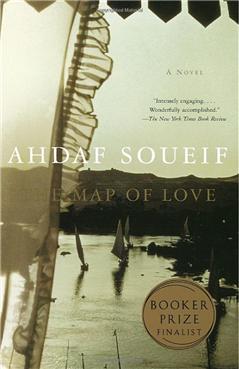
Day 482: The Map of Love

Cover for The Map of LoveBest Book of the Week!
The Map of Love is an absorbing novel to read now, just after the Arab Spring and during the troubled times that have continued on. It is a love story certainly, its title tells you that, but it also explores the roots of the political turmoil in present-day Egypt and some of the other countries that used to be a part of the Ottoman Empire.

The novel follows the course of two cross-cultural love affairs 90 years apart. In 1900 Anna Winterbourne travels to Egypt in an attempt to overcome her grief. She is the widow of a man who recently served in the Soudan, and even though their marriage was not a happy one, she is sorrowful that she could not help him overcome his despair at participating in an unjust war. Almost accidentally, she meets Sharif al-Barroudi, a Cairo lawyer and activist, and falls in love with him.

Anna’s diary and letters are discovered by her great-granddaughter, Isabel Cabot. Isabel herself has fallen in love with ‘Omar al-Ghamwari, a famous Egyptian-American orchestra conductor who is rumored to work with the Palestinians. ‘Omar feels that their age difference is too great for a relationship, but he suggests that Isabel take her find to his sister Aman in Cairo so that she might help Isabel translate some of the materials.

Aman becomes absorbed in reading Anna’s diaries and letters and realizes very soon that she and Isabel are related, for Anna’s beloved sister-in-law Layla is Aman’s own grandmother. With Layla’s diaries of the same time period, she begins to reconstruct Anna’s story and that of Egypt’s history during a turbulent period. Aman has returned from life abroad to live in Cairo in another turbulent time.

Anna’s courtship is fraught with difficulties, but once she and Sharif are married, she is caught up in his work for Egyptian independence from the Ottoman Empire and from British oversight. As the years go by, his efforts extend to attempts to keep Palestinian land, once owned by his family and by his neighbors and occupied by hundreds of thousands of Muslims, from being bought up by Zionists who would expel them.

The blurb for this novel stresses the similarities between the two love stories, and there are many points of similarity, but the focus of the story in the current time is more with Aman than with Isabel and ‘Omar. Aman is at first at loose ends in Cairo, but she becomes involved with trying to help the fellaheen who occupy her family’s land, as they are treated unjustly by a corrupt and paranoid government. I was frankly more interested in Aman and in Anna and Sharif than I was in Isabel and ‘Omar, who are much less present in the novel.

For me, not very politically aware in regard to problems in this part of the world, this was a fascinating and revealing reading experience. It points up the complex history of the area from a point of view we westerners seldom hear. It is affectingly told in the context of a great love affair between two lovingly created characters. The characters of the two sisters, Layla and Aman, are also vivid. This novel is beautifully written and evokes for us a vibrant culture.

Day 481: St. Lucy’s Home for Girls Raised by Wolves

Cover for St. Lucy'sDifficulties of youth and adolescence are the themes of Karen Russell’s unusual collection of short stories. Many of them are set in the Florida Everglades among bizarre and tacky theme parks or tourist destinations, where children sled through the sand on crab shells or visit enormous conches.

The first story, “Ava Wrestles the Alligator,” provides an introduction to the two sisters who are more fully developed in Russell’s later novel Swamplandia! Abandoned momentarily at their Everglades theme park home, Ava has a murky encounter with the Bird Man and tries to rescue her sister Osceola from her ghost lover. That story is expanded in the novel, which I really enjoyed.

Although certainly all are unusual, some of the stories are more bizarre than others. In “from Children’s Reminiscences of the Westward Migration,” a 19th century family makes a difficult crossing west, their wagon pulled by their father, the Minotaur. In the title story, human children of werewolves are sent away to be raised by nuns so that they can have a better life than their parents.

Russell’s stories are at once peculiar and oddly touching, full of young misfits who are even more out of place than all adolescents think they are. At times funny, such as the descriptions of the wolf-girls’ canine behavior when trying to adjust to their new school, the stories all reverberate with longing. Russell’s writing is brilliantly fierce and original, sparked by her own peculiar vision.

A few of the stories felt to me as if the author was just trying to think of the strangest ideas possible, and she almost lost me in “Lady Yeti and the Palace of Artificial Snows.” But ultimately, I enjoyed the stories, although I prefer the more developed characters and plot of Swamplandia!

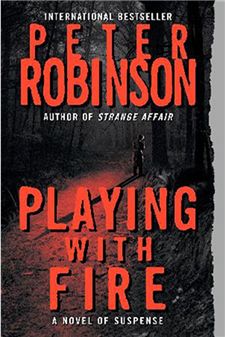
Day 480: Playing with Fire

Cover for Playing with FireThis DCI Alan Banks mystery begins with a fire on a couple of canal barges. A squatter named Tina Aspern has been killed on one and an artist named Tom McMahon on the other. Accelerant is present, and it appears that McMahon’s boat was the origin of the fire.

On the scene appears Tina’s boyfriend Mark Siddons, but his alibi that he was with another woman after a fight with Tina checks out. Banks and DI Annie Cabbot and their team are able to discover very little about McMahon except that he has failed as an artist and buys cheap old books from a store owned by Leslie Whitaker.

Soon another fire kills Roland Gardiner in his caravan (mobile home). The police are trying to link the two men, but Gardiner was unemployed and almost a recluse. Tests reveal that both McMahon and Gardiner were drugged before the fires were set.

Annie’s boyfriend Phil Keane, an art expert, suggests that one use for old paper is to employ it in forged artworks. When the police find a fire-proof safe in Gardiner’s caravan containing money and some drawings that seem to be Turners, Banks and Cabbot think they may at least have uncovered a motive. But who could the murderer be? Is it Leslie Whitaker?

Finally, tracing a rented Jeep leads them to a shadowy figure, a man who does not seem to exist. He turns out to be very dangerous indeed.

Playing with Fire is a fast-paced and complicated mystery. Some sixth sense made me guess the killer almost as soon as he appeared, but I don’t think the solution is obvious. If you enjoy an intelligent police procedural, I think you’ll like Robinson’s series. The only other book I have read by him, which was not really part of the series (a more atmospheric novel in which Banks appears but is not part of the story), I enjoyed even more.

Day 479: Jane Austen: A Life

Cover for Jane Austen: A LifeIn Jane Austen: A Life, noted biographer Claire Tomalin has handily accomplished a difficult task. Because most of Jane Austen’s letters and papers were destroyed by well-meaning relatives, very little first-hand information about her life is available. As a 19th century unmarried woman, her experience was circumscribed, so the events of her life are ordinary ones. Descriptions of a life like this could be thin and lifeless, but Tomalin manages to provide us with a biography that is full of interest and lively and creates a convincing idea of Austen’s character.

From records, letters, the remaining few of Austen’s papers, and accounts of her by relatives, friends, and neighbors, Tomalin reconstructs the story of not only Austen’s life but of those who were important to her. Tomalin acquaints us with the members of Austen’s family and the bustling environment in the Steventon Rectory, where Jane’s father ran a small boys’ school. She describes friendships and visits to neighboring families. Even though Austen never used her own neighborhood in her books, it is easy from them to imagine the daily social calls and the housewifely tasks with which she and her female relatives were engaged.

It is not too hard to imagine the relationship between Jane and her sister Cassandra as close to that of Lizzie and her sister Jane in Pride and Prejudice, although Tomalin never mentions that either of these characters were based on real people. Still, the two sisters were extremely close.

Unlike Lizzie and Jane, though, both Jane and Cassandra were disappointed in love, Cassandra because her fiancé died, and Jane because her suitor needed to marry a woman with money. Tomalin makes the points that a married Jane Austen would probably have been too busy or too distracted to produce a body of literature and that later in life she seemed to understand some of the benefits of remaining single. As to the first point, it is certainly true that being removed without warning and against her will from Steventon because of the retirement of her father, and her family’s failure to settle anywhere for ten years afterward, completely cut off Austen’s literary production for that time period.

It seems that Austen’s status as a spinster with no money of her own gave her no control at all in her life about such questions as where she would live and even in one case when she could return home from a family visit. That is, she had no control until her late thirties, when she began to publish her novels. Even then, she ultimately earned very little money from them but enough to give her a small amount of autonomy.

Although most of the events of Austen’s life were relatively small, Tomalin’s book provides an absorbing account. I did not always agree with her interpretations of Austen’s novels, but I feel that this book allows me to know Austen and her family and friends a little better.

Day 478: Mr. Timothy

Cover for Mr. TimothyAlthough not typical holiday fare, Mr. Timothy picks up some of Dickens’ characters about 20 years after A Christmas Carol and has the added similarity of being set at Christmas time. The main character is Timothy Cratchitt, familiar to us as Tiny Tim.

Timothy is depressed and aimless. The patronage of Ebenezer Scrooge, or Uncle N as he is known in this novel, has had the unfortunate effect of making Timothy dissatisfied with his roots while not fitting him for much else. Most of his family has died or moved away, and he is depressed about the death of his father six months before. In despair, he has left his usual haunts and gone to live in a brothel, where he teaches the owner, Mrs. Sharpe, how to read. Although he has some desire to make his own way, he lacks purpose and initiative, still accepting an allowance from Uncle N. He seems to be on his way down in life.

Timothy goes out dragging the river for bodies one night with his friend Captain Gully, and they pull out a young girl. She has an odd brand on her back, like a G with eyes. Timothy realizes he has seen this brand before, on another girl the police were examining as he went by, who was found dead in an alley.

Timothy has several times spotted another young girl around the city and tried to approach her, but she has always run away. With the help of a street urchin named Colin, he finally tracks her down. Philomela is Italian and has had something traumatic happen to her of which she will not speak. When Timothy tries to take her home to safety, two different parties attempt to remove her from his custody on the street. A charity worker insists she will take Philomela to a home, and a mysterious man in a coach tries to kidnap her. Philomela and Timothy get away, but now Timothy is determined to find out what is going on.

This novel is a slow starter and fairly depressing at the beginning. Although it is feasible to theorize that Scrooge’s help could result in such unhappiness (ala Great Expectations), I wasn’t sure I wanted to think of the original story in these terms. However, the novel successfully invokes a Dickensian atmosphere, including the comic characters and character names, and it picks up its pace as Timothy gets involved in the mystery. After the first 50 pages or so, I was involved and trying to figure out the mystery, which is as entangled as any Dickens effort.

Day 477: The Fault in Our Stars

Cover for The Fault in Our StarsBest Book of the Week!
It seems as if I have read more books lately from which I do not get a sense of the characters’ personalities. I don’t feel as if they could be real people but just projections of the author’s plot. But that is not the case with The Fault in Our Stars, which creates for us some unforgettable personalities.

Hazel Lancaster is a sixteen-year-old with thyroid cancer that has spread to her lungs. Unlike the other kids in the support group her mom has talked her into attending, she doesn’t have any hope of survival. She just wants to live as long as she can. At the group, she meets Augustus Waters, a seventeen-year-old ex-basketball player who has lost one leg to osteosarcoma but has a generally good prognosis.

Hazel is witty, smart, and well read. She is obsessed with a novel called An Imperial Affliction by Peter Van Houten, which is about a young girl suffering from a fatal illness, and literally ends in the middle of a sentence. As she and Augustus discuss their favorite books, Hazel explains that she just wants to know what happened to everyone else in the novel. Augustus decides to use his wish from the Genie Foundation to take Hazel to Amsterdam, where she can meet Peter Van Houten and find out what happened after the novel ended.

This novel is about teenagers falling in love, and rarely has fiction depicted two more appealing people. My one very small criticism is that they are scarily smart and funny, in intelligence reminding me more of Salinger’s Glass family than of normal kids. But Green has got the juvenile speech patterns down.

Frightfully well written, touching, funny, and ultimately sad, this novel has much to offer teens, young adults, and adults. Hazel and Augustus are affectingly human, and even Hazel’s parents, those cumbersome quantities so often ignored or eliminated in children’s or young adult fiction (note, for example, how much we see of Bella’s father in Twilight), are deftly characterized by their affectionate jokey interactions with Hazel.

Again, I feel that my capabilities are stretched here in my inability to adequately express how good this novel is. When I first started reading it, I was afraid of manipulation, as there seem to be a lot of “affliction of the month” children’s books out there right now, but that feeling left me almost immediately.

Day 476: The House of Special Purpose

Cover for The House of Special PurposeThe House of Special Purpose is an alternative history novel that looks at the end of the Russian monarchy with just a slightly different twist. It’s a familiar one, though, that Grand Duchess Anastasia escaped the execution of the royal family. Why is it always Anastasia, I wonder? This information is not a spoiler, for it is evident early on.

Most alternative histories start with the change to history and show how things would be different. This one is the portrait of Anastasia’s relationship with the main character, Georgy Danilovich Jachmenev. In fact, history isn’t changed in this novel except for that of a couple of people.

Unfortunately for my enjoyment of this novel, I could not suspend my disbelief for two of the foundations of the plot. The first is that the Tsar would appoint a peasant’s son, Georgy, to guard the Tsarevich Alexei on the basis of one incident, misunderstood as bravery. The second, even more vitally, is that Anastasia would give a boy with this background, and presumably no education (although oddly well spoken), the time of day. That she would throw herself into a love affair with him almost at first sight is utterly unbelievable. It is unlikely that he would even have been allowed to talk to her.

I’m not sure why Boyne had to stretch our disbelief so far. He could have made our hero a minor member of nobility or even a middle class boy and I would have bought it. Think me elitist if you will, but I don’t believe Boyne has any idea what life was like in the Russian peasantry.

With this problem always in mind, it was difficult for me to enjoy the novel, which, except for journeys back to the past, is about a fairly complex marriage. But again, it doesn’t deal with, for example, any difficulties Anastasia—or Zoya as she is called through most of the novel—might have had coping with the problems of a normal, even impoverished life. We skim over things like that, as well as how effortlessly Georgy seems to adjust to life in the Winter Palace. Or whether in post-revolutionary Russia, any couple could just jump on a train and travel to Paris without identity papers.

So, on the one hand I was absorbed by the novel at times, on the other it seemed too unrealistic. It is well written, and Georgy and Zoya are appealing characters, but it does not, in the end, constitute a convincing story.