
 This week’s Best Book is Unaccustomed Earth by Jhumpa Lahiri! A close contender is The Travelling Hornplayer by Barbara Trapido.
Day 475: The Beggar King
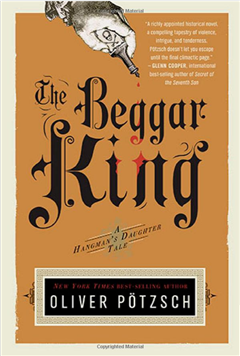 Behavior is a problem in The Beggar King, the third of Oliver Pötzsch’s Hangman’s Daughter series, but the first I have read. Characters who are in peril of their lives stop running away from their pursuers to have arguments; characters who are fighting for their lives start flashing back to their pasts instead of concentrating on not being killed. To be very clear about this problem, the characters do what the plot requires. When the plot requires the three main characters to be apart, for example, Pötzsch has them begin arguing or just has someone walk off instead of finding a plausible reason for separating them.
The novel begins in 1662, when the Schongau hangman, Jakob Kuisl, gets a letter from his sister in Regensburg saying she is very ill. When he arrives at the bathhouse her husband owns, he finds her and her husband brutally slain. Immediately afterwards, the authorities rush in and arrest him. Now it is up to the Regensburg hangman to torture him into a confession.
In the meantime, back in Schongau Magdalena Kuisl and her lover Simon Fronwieser have run into trouble. As the hangman’s daughter, Magdalena is considered to be among the lowest rungs of society, and she is not allowed to marry Simon, a member of the middle class. A series of encounters with a group of bullies finally ends in the Kuisls’ house being set on fire. Instead of helping her mother and her eight-year-old twin siblings (who by the way behave more like four or five than eight) as might be expected, Magdalena and Simon decide to run off to Regensburg to start a new life.
I have been to Regensburg, which is a beautiful medieval city with an interesting history. We learn a bit about this history, and that is probably the most interesting part of this novel. The city is mostly described to us in terms of its mud and filth, however, not in terms of its lovely pastel stucco buildings decorated with beautiful medieval-era murals or winding cobblestone streets.
However unlikely, our three main characters have stumbled into two plots, one of revenge against Jakob for events during the Thirty Years’ War, the other involving an imminent threat to the Reichstag. Soon, all three protagonists are wanted by the authorities, Magdalena and Simon for arson after someone burns down the bathhouse with them in it, Jakob because he has escaped. Nevertheless, they chase all over the city without anyone noticing them unless Pötzsch needs them to be noticed. In the meantime, they unfailingly trust the wrong people and assault the ones who are trying to help them.
This novel is certainly full of frantic activity. Whether it is plausible at all is the question. I was particularly irked by the last 50 to 75 pages, in which all three characters are in peril in separate locations. Just as one scene reaches a climax, Pötzsch switches the action to another location. This tactic might foster suspense if done once, but Pötzsch uses this technique repeatedly over 50 pages simply to spin things out. I found this tactic so irritating that I almost quit reading at the end of the book!
Although the novel is written moderately well, the characters are one-dimensional and their behavior is driven by plot. The plot itself is ridiculous.
Day 474: The Travelling Hornplayer
 The Travelling Hornplayer revisits some of the characters I loved in Brother of the More Famous Jack. But first it starts with Ellen. Ellen has always had a close relationship with her sister Lydia, and the two girls’ adolescent silliness and charm is vividly depicted early in the novel in lively dialogue. But Lydia dies at age 17 while Ellen is away at university. She runs unexpectedly out into the street from the home of the man Ellen and Lydia call The Novelist and is hit by a car. Lydia has been consulting him about (well, actually cribbing from him) her essay for her A levels on Wilhelm Müller’s Seventy-Seven Poems from the Posthumous Papers of a Travelling Hornplayer. It takes awhile before we find out the cause of her death.
The Novelist is Jonathan Goldman, whose family so charmed Katherine, the heroine of Brother of the More Famous Jack, now his wife. Jonathan and Katherine have only one child, Stella, whose childhood illnesses and learning disabilities have led Katherine to do everything for her. Finally almost on her own at university in Edinburgh, where she becomes Ellen’s roommate (almost on her own because her mother arrives periodically to do the cleaning), Stella makes a series of spectacularly poor decisions that result in tragedy for herself and others and a separation from her family.
This sounds like a sad tale, and in some ways it is, but it is told lovingly and movingly, with intelligent characters and witty dialogue. Trapido depicts characters of surprising depth and complexity. She is a really beautiful writer, and I love her work.
 A word about this cover. I was unable to find a good-sized picture of my book’s cover without the Amazon Look Inside logo on it. That cover, which shows two young girls comparing their identical outfits, conveys the feel of the novel much more successfully than the one above, which looks like children’s fiction or chick lit to me. Here it is in a smaller size.
Day 473: The Immortal Life of Henrietta Lacks
 In 1951 an African-American woman died of cervical cancer in the colored ward of Johns Hopkins, founded as a hospital for the poor. Her doctors had routinely removed cells from her unusually virulent cancer. The cancer was fast acting and when the woman died, her body was riddled with tumors. Her name was Henrietta Lacks, and her cells have been used ever since for research and experimentation, resulting in many medical breakthroughs.
At that time, scientists had been trying to find a way to preserve cells, but all their attempts failed. None of the cells lived more than a few days. At Johns Hopkins the staff used their usual method of attempted preservation for Henrietta’s cells with little hope of success. Henrietta’s healthy cells died like the others, but not only did the cancerous cells survive, they reproduced dramatically.
Henrietta’s cells helped solve a fundamental problem in biological and medical research, that of having a supply of human cells readily available for use in various experimental studies. George Gey, the head of the department, immediately began shipping them to any scientist who needed them. Henrietta’s cells, called HeLa, are known and used throughout the world.
In the meantime, the Lacks family was completely unaware that Henrietta’s cells were in use. An impoverished family of little education, they had difficulty understanding the use the cells were put to when they did learn about them, which wasn’t until 1973. Even at that time, researchers at Johns Hopkins took further samples from the family without their informed consent. Deborah Lacks, Henrietta’s daughter, understood them to be performing a test for cancer, not medically available at the time. Even though the removal of Henrietta’s cells was commonplace in the 1950’s and did not break any medical code of ethics, at the later time that further samples were taken from the family, this was certainly not the case.
In clear prose, Rebecca Skloot tells the story of Henrietta Lacks’ cells and their uses in the biomedical industry but also the story that has hitherto been neglected, that of Henrietta herself and her family. The book brings up issues of racial discrimination, medical ethics, and other issues in biomedical research, such as cell contamination. It also affectingly tells the story of the Lacks family.
Day 472: Miss Peregrine’s Home for Peculiar Children
 The inception of this novel is extremely creative. Ransom Riggs began collecting unusual old photos from bins in resale shops. Then he became acquainted with similar collections owned by other people. He noticed that many of the more interesting photos were of children and decided to write a story around them (some having been lightly edited).
Jacob Portman has grown up hearing his grandfather Abe’s stories about life in a children’s home during World War II after he escaped the holocaust. These stories featured children with seemingly magical abilities all staying in a lovely school on an island off Wales. As he grows older, he dismisses these stories as fairy tales.
Now Abe is getting paranoid and senile, and 16-year-old Jacob is trying to keep his parents from putting him in a home. One day Abe calls Jacob demanding the key to the arsenal of weapons he keeps in his shed. Jacob’s father has hidden the key for fear his father could be dangerous. When Jacob arrives at his grandfather’s home, the old man is dead, and in the woods Jacob thinks he sees a monster with tentacles in its mouth.
Jacob suffers from horrible nightmares after this incident, so his parents put him into treatment with a Dr. Golan. Not so sure he was hallucinating, Jacob decides he wants to travel to the island in Wales and try to find out about his grandfather’s past. His father agrees to take him only after Dr. Golan decides it is a good idea. When Jacob arrives on the island, though, all he can find is a ramshackle old house destroyed in a World War II bombing containing a chest full of odd photographs of children.
Of course, there is more to it than that, and eventually we find ourselves back in the past and in the requisite battle of good against evil. That’s where the creativity of this novel breaks down for me. I love the Harry Potter books, which also have this theme, but they have a richness of detail and originality that is lacking in many other works in this genre. Perhaps I am a poor audience for books written for teens, too, for I often feel they lack fullness of characterization and have a certain first-person teenage narrative style that I find irritating (adult author pretending to be a teenager). This novel also callously discards Jacob’s parents, those too cumbersome quantities for fiction for this age. First, the parents are flat ciphers, and finally we leave them behind altogether.
This is not to say, though, that older children and teens won’t enjoy this novel. I think they will, and they’ll be entertained by looking at the pictures. I think young children could get nightmares from some of them, though.
Perhaps this is unfair, but I’m an adult, and I’m only going to give the best reviews to books that entertain me as an adult, even if they’re for younger people. That’s a high standard but one that is possible to meet and that is a characteristic of the best children’s and young adult fiction.
This book was written to have a sequel, by the way, so don’t expect the ending to be neatly wrapped up.
Day 471: Unaccustomed Earth
Best Book of the Week!
Although all of the stories in Unaccustomed Earth feature characters who are immigrants and first-generation Americans of Indian descent, they are about a lot more than that. They are about the common problems of all people.
In the story “Unaccustomed Earth,” Ruma grieves over the loss of her mother while her father fears she is making the same life for herself that embittered his marriage to her mother. In “Hell-Heaven,” a girl observes her traditional mother’s infatuation with a young graduate student in light of her mother’s detached marriage with her father. Amit and his wife Megan try to create a romantic weekend while attending the wedding of a woman Amit once had a crush on in “A Choice of Accommodations.” The best of the stories are the last three, interlinked, about two people who meet each other several times at significant junctures of their lives.
Lahiri’s stories speak to us deeply. With details of life and human behavior so finely observed, they become stories about characters for whom we care.
I am generally a novel reader, because short stories often feel to me as if a lot is missing. But Lahiri’s gift is for saying so much in so few words. You find yourself pondering her stories and characters long after you stop reading. They reveal a profound insight into the human heart.
My Classics Club List
 It’s a coincidence that I picked this book cover to illustrate my short classics list for the Classics Spin 5, because this book is the one selected for me to read as part of the spin! Having committed to that much, I decided I might as well join the Classics Club. In the Classics Club, you select your own list of 50 or more books and a date by which you decide to have read them all, within five years.
Since I am posting this list today, my deadline date is February 12, 2019.
Here is my proposed list, also located permanently under my About menu.
Early Classics
- Beowulf (Seamus Heaney translation)
16th Century
- Henry VI Pt I by William Shakespeare (1591)
- Henry VI Pt. II by William Shakespeare (1596-1599)
- Henry VI Pt. III by William Shakespeare (1591)
17th Century
- Don Quixote by Miguel Cervantes (1605 and 1615)
18th Century
- Robinson Crusoe by Daniel Defoe (1719)
- The Vicar of Wakefield by Oliver Goldsmith (1761-1762)
19th Century
- The Moonstone by Wilkie Collins (1868)
- Bleak House by Charles Dickens (1852-1853)
- Our Mutual Friend by Charles Dickens (1864-1865)
- The Idiot by Fyodor Dostoevsky (1868-1869)
- Queen Margot by Alexandre Dumas (1845)
- Middlemarch by George Eliot (1871-1872)
- Far from the Madding Crowd by Thomas Hardy (1874)
- The Perpetual Curate by Margaret Oliphant (1864)
- The Scottish Chiefs by Jane Porter (1810)
- Vanity Fair by William Makepeace Thackeray (1848)
20th Century
- Things Fall Apart by Chinua Achebe (1958)
- The Long Ships by Frans G. Bengtsson (1941 and 1945)
- Sisters by a River by Barbara Comyns Carr (1947)
- O Pioneers! by Willa Cather (1913)
- The Hours by Michael Cunningham (1998)
- Rebecca by Daphne du Maurier (1938)
- Troubles by J. G. Farrell (1970)
- Light in August by William Faulkner (1932)
- Selected Poems by Robert Frost (1934)
- Herland by Charlotte Perkins Gilman (1915)
- Goodbye to All That by Robert Graves (1929)
- Their Eyes Were Watching God by Zora Neale Hurston (1937)
- Brave New World by Aldous Huxley (1932)
- The Remains of the Day by Kazuo Ishiguro (1989)
- Snow Country by Yasunari Kawabata (1956)
- Troy Chimneys by Margaret Kennedy (1953)
- The Call of the Wild by Jack London (1903)
- Death in Venice by Thomas Mann (1912)
- Selected Poems by Edna St. Vincent Millay (1992)
- Beloved by Toni Morrison (1987)
- The Beggar Maid by Alice Munro (1978)
- Ada by Vladimir Nabokov (1969)
- That Lady by Kate O’Brien (1946)
- Giants in the Earth by A. E. Rolvaag (1924-1925)
- A Wreath of Roses by Elizabeth Taylor (1949)
- The True Heart by Sylvia Townsend Warner (1929)
- The Age of Innocence by Edith Wharton (1920)
- Summer by Edith Wharton (1917)
- Greenbanks by Dorothy Whipple (1923)
- Night by Elie Wiesel (1958)
- Stoner by John Williams (1965)
21st Century
- The Broken Road by Patrick Leigh Fermor (2013)
- The Known World by Edward P. Jones (2003)
Best Book of the Week!
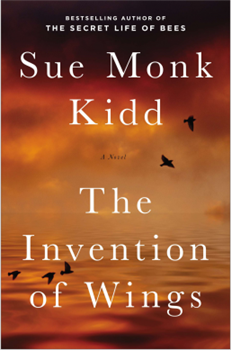 This week’s Best Book is The Invention of Wings by Sue Monk Kidd! Also be sure to check out The Iron King (which would be the best book, but I already picked it two years ago).
Day 470: Reread—The Iron King
 I already reviewed The Iron King during my first year of blogging, but that review was based on my memory of the novel, having read it several years before. I recently re-read it and would just like to mention it again, as it is so good and easier to find now that the first three volumes of the series have been republished.
The Accursed Kings series concerns the history of the last Capet kings of France. The first in the series, The Iron King, begins with some fateful acts that eventually affect the future of the kingdom.
The novel begins in England with Queen Isabella plotting with her cousin, Robert of Artois, against her three sisters-in-law. Queen Isabella, the daughter of Philip IV of France (known as the Philip the Fair or the Iron King), is unhappily married to Edward II of England, who disdains her and lends the power of his throne to the Despensers, the family of his male favorite. Isabella is disposed to make trouble. Her cousin has brought her his conviction that at least two of her three sisters-in-law are being unfaithful to their husbands, her brothers, the princes of France. Isabella and Robert hatch a plot to expose them.
Robert of Artois has his own reasons for the plot, for his father’s property was awarded to his aunt Mahaut instead of to him so that it would pass into the hands of King Philip the Fair’s two younger sons when they married Jeanne and Blanche, Mahaut’s daughters. Robert is only too happy to ruin Marguerite, Queen of Navarre and wife of Philip’s oldest son, along with the two other girls, as she is Mahaut’s cousin.
Awaiting their own fates are the last four members who are not in hiding of the once wealthy and powerful Knights Templar. Years before they had refused to admit Philip the Fair as a member, as it was against the rules of their order to admit royalty. Since then, Philip has plotted their ruin, assisted by Pope Clement, who covets the riches of the order. Now they have been condemned of heresy, largely on trumped up charges.
Early in the book, Jacques de Molay, Grand Master of the Knights Templar, is burned at the stake. During his burning, he curses the King, Pope Clement, and Guillaume de Nogaret, Secretary-General of the Kingdom, to their thirteenth generation. The Pope is dead within 40 days, de Nogaret soon after. Thus the name of Druon’s fantastic series, The Accursed Kings, for you can be sure that Philip the Fair will be dead by the end of the novel.
This series is being marketed as the original Game of Thrones. Perhaps there are some similarities. The court is a nest of vipers—those in power are constantly engaged in political machinations and those not in power in other kinds of plots. The world Druon presents is fascinating, depicted with cynicism and wry observations. The novel is extremely well written, about an extraordinary time in French history.
Day 469: Nicholas St. North and the Battle of the Nightmare King
 A moonbeam goes to earth and into a cave and accidentally frees a spectral boy trapped in the heart of Pitch, the Nightmare King. The spectral boy was the only thing keeping Pitch prisoner, so now he and his Fearlings are free to haunt the nights of children.
Away in the far north, the last of the great wizards Ombrik Shalazar protects a village from the bad influences in the world. Pitch almost invades the village, but he is fought off by North, a young man who was formerly a bandit and happens to be in the village to protect the children. This is the beginning of a battle that will involve flying reindeer, mystical lamas, yetis, and the Man in the Moon.
This story is the first of the series called The Guardians, a franchise that also includes the movie The Rise of the Guardians. It is written to be read to younger children or read by children who are slightly older, maybe up to eight or nine years old. It is straightforwardly told in a fairy tale style, and although it has imaginative ideas, the writing style is not distinctive. There is not much to interest an adult, humor for example, but kids will certainly enjoy it.
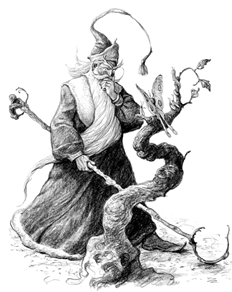
The book is illustrated by William Joyce in black and white pictures, which although interesting, do not have the charm of some of his brightly colored picture books. The style is a bit on the steampunk side, and I’m sure the pictures would have been more interesting in color. Many of them seem dashed off, although others, such as this one of Ombrik, are beautifully detailed. In reading part of the story about the Man in the Moon, I realized I had read the precursor to this book, which was a lovely picture book for younger children with pictures in a steampunk style.
 What? Me Read?