
 This week’s Best Book is Housekeeping by Marilynne Robinson!
Day 445: Annals of the Former World: Crossing the Craton
 In the final short book of Annals of the Former World, John McPhee examines the craton, the flat land that lies in the central Midwest of the continental United States. If you have read my reviews of the other books, you might remember that McPhee wrote each one about a separate geologic area near I-80, along which he traveled with different geologists telling the story of the formation of the country. Each of those four books was published separately, but Crossing the Craton was added when the complete volume was published, perhaps for completeness. (I think it was published separately at a later time.)
Because there are few outcroppings in the Midwest, little can be seen of the rock underlying this area, a thin veneer over the basement rock that comprises 90% of geologic time. McPhee explains that until very recently this basement, or Precambrian, rock was neglected in geology texts. Because Precambrian rock by definition has no carbon in it from living things, carbon dating was not available. Nothing was known about the rock. For a long time it was thought to have been there since the creation of the earth, but that idea has been found to be incorrect.
Just in the last 40 years or so, new kinds of dating methods and other technological advances have allowed geologists more insight into what is going on beneath the surface in these older rocks. Gravity maps have revealed a huge tectonic rift, for example, that runs from eastern Nebraska through Iowa, Minnesota, and Wisconsin and under Lake Superior, where it joins one rift shooting north into Canada and another running right through Michigan. This three-pronged rift is similar to the one that runs down the Red Sea to meet the rift in the Gulf of Aden and the East African Rift, only that one is much younger.
In this book McPhee explains how the Canadian Shield and the central portion of North America were mostly likely created. He also looks at recent technologies such as zircon dating and aeromagnetic mapping, and speculates on the discoveries about the basement rock that could emerge in the future.
Although this is the shortest book in the volume, more the length of an essay, its emphasis on technology makes the subject matter of lesser interest to me than that of the previous books.
Day 444: Murder at Mansfield Park
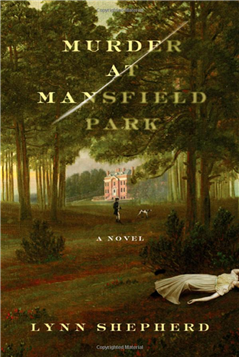 It’s hard to explain my fascination with the books of Lynn Shepherd, even to myself, when she repeatedly skewers the books and some of the characters I love with her dark reinterpretations.
The cover of Murder at Mansfield Park quotes the literary critic Lionel Trilling: “Nobody, I believe, has ever found it possible to like the heroine of Mansfield Park.” Apparently, Shepherd shares his views.
That heroine, of course, is Fanny Price, and I have to admit I do like her in the original novel, even though she is not my favorite Austen heroine. Shepherd had to jump through some hoops in her recasting of Fanny, however, to get her to be really unlikable.
In Shepherd’s novel, instead of Fanny Price being the despised, impoverished orphan living with wealthier relatives, Shepherd transforms her into a spoiled heiress, whom the Bertrams and the dreadful Mrs. Norris treat better than their own children. Fanny’s marriage with her cousin Edmund Norris has long been planned, at least by Mrs. Norris.
Mary Crawford in the original novel was the worldly socialite whose lax views eventually shocked Edmund into dropping her, but in Murder at Mansfield Park, she is the heroine. Her brother has been hired to redesign the grounds of Mansfield Park. In this novel, she has switched positions with Fanny Price in that she and her brother have little money, and Mrs. Norris treats them with disdain.
Fanny shows little desire to wed the introverted Edmund and finds entertainment in filching suitors from her cousin Maria Bertram and being nasty to everyone. I would not usually give away an event that occurs well into the novel, but the blurb makes no secret that Fanny is eventually found murdered after going missing for some weeks. Suspects abound. Charles Maddox, Shepherd’s sleuth, arrives to solve the crime.
I don’t think I enjoyed this reimagining of Austen’s novel as much as I have some of Shepherd’s others, even though she is amazingly adept at recreating Austen’s writing style. I think my reaction is because she probably could have achieved a similar effect, more subtly, without changing so many aspects of the original story.
I don’t mean to imply, however, that I didn’t enjoy the novel. Shepherd has made a very interesting career for herself by putting a dark spin on classic novels, and it is always entertaining to read her. She is a wonderful writer, and she gets the period details and style of dialogue correct. I think my favorite of hers, however, is still her chilling rewrite of Bleak House.
Day 443: The Mischievians
 The Mischievians is a charming little book. It doesn’t have much of a plot but is entertaining nonetheless.
Two children send up a balloon asking for help. Their homework keeps disappearing, so they are in trouble with their parents. Next, a hole opens up in the earth and they fall through into the laboratory of Dr. Zooper, who tells them all about the little monsters lurking in their house.
What do the monsters do? Steal just one sock, hide the remote control, create belly button lint, and of course steal homework, among other serious crimes.
The book is breezily written with just a bit of gross humor that kids like.
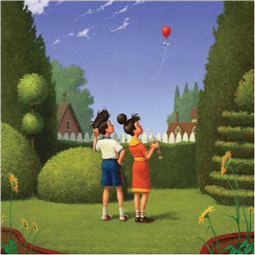
As usual with Joyce, the illustrations are beautiful. The pictures featuring the children are charmingly retro, and the little monsters are cheerfully grotesque. Letters in the text are occasionally tweaked out of place by a mysterious hand. The cover is designed to look like an old, worn out book.
This book is for a little older kids than The Leaf Men, probably suitable for six- to eight-year-olds, although smaller kids will enjoy it, too.
Day 442: Housekeeping
Best Book of the Week!
A few years ago I was reading about a nonfiction work called A Jury of Her Peers, which discusses the routine misogyny in the American publishing and academic communities that has resulted in the neglect of works of countless American women writers. This book accomplishes the astounding task of tracing the careers of every significant American woman writer through the twentieth century, including not just the literary writers but even many popular genre writers.
On the Amazon page for the book, the author, Elaine Showalter, includes a great list: Top Ten Books by American Women Writers You Haven’t Read (But Should). My book club read several selections from that list and thoroughly enjoyed all of them. I still have not read them all, but I just recently finished Housekeeping.
First, let me warn about the blurb on the book cover, which makes this novel sound like a cheerful story about an eccentric family. It is not like that at all. The picture on the cover will give you a better idea of the novel.
Ruth and her younger sister Lucille are young girls who have repeatedly been abandoned. As children, they were left on their grandmother’s porch in the cold, remote town of Fingerbone, Idaho, by their mother, who went off to commit suicide by driving off a cliff into the huge glacial lake next to the town. This lake is the scene of another family tragedy, the place where their grandfather, a railroad worker, died when his train plunged off the bridge on the way back from Spokane.
The little girls are raised by their grandmother, a stiff, strict woman who forgets, on the rare occasions when she hugs them, that she has pins and needles stashed in a cloth in her bosom. When she dies, her maiden sisters-in-law take her place, a couple of timid, incompetent great-aunts who feel unequal to the task of raising two growing girls.
Lily and Nona find and summon the girls’ Aunt Sylvia, who was estranged from her mother for years. As soon as Sylvie arrives, the two old ladies skedaddle back to their comfortable room in the Hartwick Hotel in Spokane. Sylvie stays, but the girls are always afraid she will leave. Everything about her seems transient. She keeps a $20 bill pinned inside her lapel and never takes off her coat. She finds old friends in the railroad yard and in box cars and sometimes sleeps outside.
Ruth and Lucille have been inseparable, but soon Ruth feels her sister drifting away, as Lucille makes friends at school and becomes more aware of some salient facts: how unusual their household is and how the townspeople have begun viewing their living environment. Instead of acceding to Lucille’s perfunctory request to let Lucille make her more presentable, tall ungainly Ruth seems to grow more feral. As Lucille turns away from Sylvie and Ruth, Ruth is forced to depend even more on Sylvie.
Water is a persistent image in this disturbing novel. The lake, the scene of their family tragedies, is always there, cold, deep, and mysterious. Many of the girls’ illicit adventures involve exploring this lake. The town floods every year. The landscape is dripping and the road to town muddy. In the early days of Sylvie’s residence with the girls, she buys them cheap sequined ballet slippers to wear to town through the mud.
Every word in this novel is carefully chosen, every sentence exquisite. We can track Ruth’s growing eccentricity and unusual mind by the increasing oddness of her metaphors as she narrates the novel. Housekeeping is a stunning portrait of loss, longing, and fear of abandonment.
Day 441: The Talented Mr. Ripley
 The first Ripley novel, The Talented Mr. Ripley, is a re-read for me after I recently bought a set of three Ripley novels. If you are familiar with Tom Ripley only through the terrific movie starring Matt Damon, prepare to find the original Ripley a lot less likeable.
We first meet young Tom Ripley just eking out an existence in New York, but he is already engaged in a con—inept because he can’t even collect the proceeds of his mail fraud. Nevertheless, when a middle-aged man seems to be tailing him one night, he is afraid it is the police.
The man turns out to be a wealthy businessman named Herbert Greenleaf. He has been trying to get his son Dickie to come home from Italy and take up his responsibilities, but Dickie has shown no interest in returning. Apparently, some of Mr. Greenleaf’s friends have misunderstood the depth of Tom’s friendship with Dickie, whom he has only met once or twice, and have recommended he send Tom to Italy to try to convince Dickie to come home. Tom sees in this project a free trip to Europe, getting out of New York at a very good time, but he also intends to do his best for Mr. Greenleaf.
Tom is a man with a troubled past and a will to succeed with the right people. Except for his fastidiousness, he seems almost a blank slate, so eager to please that he constantly lies about himself, his work, his education. He wants to be liked but finds people shying away from him after awhile. He is a talented mimic. Tellingly, he only feels guilty when he tells the truth about himself.
Tom travels out to the small seaside village of Mongibello to find Dickie, who does not remember him. In an attempt to ingratiate himself, Tom confesses why he is there and how much Dickie’s father is paying him. Dickie is amused by this and invites him to stay, encouraging Tom to spend the money from Dickie’s father on the two of them even though Dickie has plenty of his own money.
Tom becomes enamored—it is unclear whether of Dickie or Dickie’s lifestyle—for Dickie is free to go wherever he wants, and his only serious endeavor is to try to paint, which he does badly. Dickie’s close friend Marge Sherwood poses a problem to their friendship, though. She is immediately jealous and suspicious of Tom, telling Dickie he is probably gay. Since Tom’s sadistic aunt, who raised him, used to taunt him with being a sissy, Tom has sought to deny this, even to himself.
None of these characters is particularly likable. Dickie is a spoiled rich kid who uses Tom but believes himself used, who thinks only of himself, and strings Marge along so he’ll have some company in the long winter months. Marge, although seen only through Tom’s eyes, is clinging and jealous. Tom is, of course, Tom, whom we only begin to understand slowly.
The situation is ripe for disaster, and Tom eventually commits a much more serious crime than mail fraud. This event happens only a third of the way through the book, and the fascination of the novel is in watching how Tom Ripley hides his crime, how he manages to profit by it, and what he is forced to do to avoid suspicion. He is surprised to find within himself an ability to coldly and analytically carry through his crimes with little notice—actually commit them almost without planning—although he is somewhat bumbling when it comes to the cover-up.
But Ripley learns, and we watch with fascination as he slowly develops his inner sociopath. This is an absolutely spellbinding novel by an author who was depicted in a recent biography as a sociopath herself. Another goal for my personal reading—pick up that biography!
Best Book of the Week!
 This week’s Best Book is In the Lake of the Woods by Tim O’Brien! A close competitor was The Son by Philipp Meyer.
Day 440: Sleep, Pale Sister
 A gothic novel that involves a haunting and characters in opium-fed delirium? What’s not to like? Unfortunately, there is quite a bit not to like in Sleep, Pale Sister, an early book by Joanne Harris.
In Victorian England, Henry Chester is a twisted, hypocritical man who maintains an upright, righteous reputation in society while justifying to himself his own dark secrets. He is an artist who loves to paint romantic pictures of virginal young women.
Henry has been unable to find a wife who meets his fastidious criteria, but one day he spots a young girl of pale, ethereal beauty in the park. He pays her family to allow him to paint her and eventually decides that, even though she is yet too young to marry, he will raise her to be the wife he wants, someone passive, docile, and asexual.
Unfortunately, he is doomed to eventual disappointment, for when he finally weds her, he finds his young wife, Effie, has married him for love, and her very ardor on their wedding night disgusts him. Soon, she is an ailing wife whom he keeps drugged with opium, and he takes his pleasures elsewhere.
Sitting in church one day, Effie finds she can lift herself out of her body at will and look at those around her from above. Whether this is an effect of the opium is unclear, but in these states she seems to see and hear things that she should not know about.
At an exhibition of Chester’s paintings, Effie meets a rival artist, Mose Harper, who is struck by her beauty. Mose is a total scoundrel who dislikes Henry, so he sets out to seduce Henry’s naive wife. Mose soon finds himself with an unexpectedly passionate lover.
These three characters alternate the narration of the novel, but there is a fourth voice, Fanny Miller, the madam of a whore house who has her reasons for wanting revenge against one of her clients. As soon as she is sure which client it is, she will know what to do.
And I also hinted at a ghost.
Almost everyone in this novel is vile. Effie is the most sympathetic character, but she is too submissive to Henry and too naive about Mose to really capture us. Essentially, she has very little dimension to her character, is too easily bent to the will of another to be very interesting.
The setting in the Victorian era gives Henry almost complete control over Effie’s fate, and he is soon planning a way to rid himself of an inconvenient wife.
Day 439: Shanghai Girls
 In 1937 Shanghai, Pearl Chin and her younger sister May are having the time of their lives. Thoroughly westernized and modern girls of a wealthy family, they spend their time shopping, socializing, and having their portraits painted. They are two of the Beautiful Girls, whose images appear on advertisements and giveaway calendars.
Pearl has a slight source of discontent at home, for she feels her parents favor and spoil the more beautiful May. Nevertheless, the girls are inseparable.
They are heedless to the rumblings of trouble, including the changes in their home and in their own father’s voice when he wants to tell them something. Soon he forces them to listen. He has gambled away his fortune and has arranged for his daughters to marry the sons of a wealthy businessman from the United States.
It is not long before they have met and married Sam and Vernon Louie. Sam seems pleasant to Pearl, but Vernon, May’s husband, is only fourteen and never speaks. Their father is stern and humiliates the girls on the morning after the wedding. The men leave to conduct their business and agree to meet the girls in Hong Kong before sailing, but the girls have no intention of going.
All this while there have been other signs of trouble. The Japanese are invading China and working their way toward Shanghai. The girls and their mother are forced to try to make their way to Hong Kong amid the brutality of war. Finally, they have no choice but to flee to America. A lot has already happened to the girls, but there is much more to come.
Shanghai Girls is an absorbing historical novel that examines the treatment to which Chinese immigrants were subjected for decades in the United States. The novel continues until the early 1950’s, when we learn how the Red Scare affected scores of settled Chinese immigrants, many of whom had long lived in America when China was taken over by the Communists.
I wasn’t sure how believable I found the end of the book, but it is clearly the setup to a sequel. Although I missed the delicate writing style of See’s earlier novels, her style here is appropriate for this more modern story. I am not sure I want to follow Pearl’s heedless daughter Joy into danger, but I probably will.
Day 438: In the Lake of the Woods
Best Book of the Week!
In the Lake of the Woods is a mystery, but not in the traditional sense. It is also a harrowing look at one man’s tormented psyche after the trauma of war.
It is September 1986. John Wade and his wife Kathy have retreated to a remote cabin on Lake of the Woods in far northern Minnesota after John sustained a brutal defeat in a state senatorial campaign. Wade had been beating his opponent handily until information about Wade’s past surfaced, or perhaps it was only rumor.
One day Kathy disappears. Thinking she is just out for a hike, Wade does nothing for awhile, waiting for her to return. Late that night he goes into the village for help.
This all seems fairly straightforward, but O’Brien periodically presents us with a story about what actually happened, only the story is different each time. As O’Brien reveals more, we learn that Wade was behaving oddly the night before Kathy disappeared–or did she disappear that night? Is she lost, did she leave on her own, did something happen to her? We learn that Wade has taught himself to forget anything he doesn’t want to think about–as if it never happened.
O’Brien shows us the psychological makeup of a man who has undergone a great deal of trauma–whose father committed suicide when he was ten, who spent his boyhood in the basement teaching himself magic tricks, who served in Vietnam. But he is also a man who periodically spies on his wife, who calls himself the Sorceror, who makes of himself a master manipulator, who has horrible nightmares.
O’Brien alternates chapters about the search with those that explore Wade’s past. He also includes chapters of excerpts from interviews of those involved and from other sources as diverse as books on psychology, biographies of politicians, and records of military massacres, such as the Battle of Little Bighorn and My Lai.
This novel is absolutely riveting, written in spare and beautiful prose, disturbing and powerful. It is not so much a mystery as a novel about mystery–why we find it fascinating and what we can never know, a single human soul.
 What? Me Read?