Review 2508: I Am Not Your Eve

This is an interesting yet difficult novel about one of Gauguin’s Polynesian “wives,” whom the blurb calls his muse. Although much of it is about her, Teha’amana, a very young girl, it is told with several voices—those of Gauguin’s daughter, his European wife (briefly), Teha’amana’s Foster Mother (called only that in the book), and very occasionally Gauguin himself.

The broad story is of Gauguin arranging a “marriage” on Tahiti with a very young girl. Their relationship is one-sided. She basically does what he tells her to do while he continues to talk about her as if she were free. Their relationship starts with rape and mostly consists of sex and posing for his paintings. She dislikes the food he eats. When she returns home after eight days to her mother as custom dictates, she tries to stay there.

From Denmark, Gauguin’s daughter writes about him in her diary. She seems to be the only family member who misses him. When his painting of Teha’amana arrives, her mother shoves it into the attic instead of taking it to Paris to sell, and she goes up to commune with it.

Interleaved with these stories are Polynesian creation tales and other myths.

This novel is poetically written, but it was sometimes difficult to know which narrator was speaking. There were a few times, for example, when I thought I was reading a myth but it was actually part of Teha’amana’s story. Also, I was occasionally startled by Gauguin’s point of view of Teha’amana’s behavior that seemed radically different from how she was feeling. Teha’amana’s expression of her point of view is very different from a Western way of telling things, so I didn’t always feel I understood what was going on.

The book only briefly mentions other girls, but apparently Gauguin had three very young Polynesian “wives,” hopefully one after another rather than at once. I couldn’t tell. Much of the content within the mythology sections and in Teha’amana’s story are very sexual in nature, although not graphic.

I read this book for my Walter Scott project.

Related Posts

Moloka’i

Under the Wide and Starry Sky

Euphoria

Review 2507: Literary Wives! Euphoria

Today is another review for the Literary Wives blogging club, in which we discuss the depiction of wives in fiction. If you have read the book, please participate by leaving comments on any of our blogs.

Be sure to read the reviews and comments of the other wives!

My Review

Oh, dear, Elin Cullhed and editors, morels come out in the spring. By October, it’s unlikely that any could be found, worm-eaten or not. Chanterelles are what you pick in the fall, among others.

Euphoria is about Sylvia Plath, set in the last year or so of her life. It begins when her daughter is one year old and she is pregnant with her son. It ends a few months before her death.

Before I get into my review, I want to comment on something. When I began reading this novel, I knew very little about Plath except she was a poet, she was married to Ted Hughes, and she committed suicide. Very recently, I read her novel, The Bell Jar, just by coincidence because it filled a hole in my Century of Books project. While I was reading Euphoria, I got the sense that there was a big controversy when Plath died. Some blamed her death on Hughes, who left her a few months before for another women. Certainly, there was a lot of anger against him for burning her diaries. Perhaps I’m seeing some reflection of the opposite side, but I ran across a post by All That’s Interesting, a blog produced by material collected from other sources, that states that Plath was at the nadir of her career when she died. Actually, her novel was recently published (one month before), she had been on BBC reading her poetry, and had recently finished her most famous poem, “Daddy.” So, where did this “nadir” idea come from? Maybe from Ted Hughes’s supporters?

That novel starts with the couple having moved to Devon at Hughes’s insistence. Plath liked living in London and feels lonely in the country, pregnant and left alone with her one-year-old Frieda while Ted goes up to London. Frieda wants attention all the time, and Sylvia has difficulty finding time to work or get anything done. Her marriage already seems rocky to me, alternating sometimes vicious verbal battles with voracious sex. Sylvia admits to liking being mistreated and having a fascination with death. She is extremely needy and jealous. He is always walking away.

The novel is written from Sylvia’s point of view. She is almost always either ecstatic or depressed. With her, as depicted by Cullhead, it is I, I, I. There isn’t so much a plot here as a detailed examination of her feelings as her children grow and her marriage breaks down. Jealous or not, she immediately recognizes that Aissa Wevill is after Ted.

This novel is sometimes difficult to read. Sylvia’s shifts in mood or reactions are sometimes hard to understand, and occasionally her thought processes were hard for me to follow.

What does this book say about wives or about the experience of being a wife?

Literary Wives logo

Well. Certainly Sylvia would be a difficult woman to be married to. First, she’s possibly bipolar, unsure of herself, and obsessed with Ted. But Ted, I think, is not exactly a model husband, even for his time. He helps out sometimes (which is actually unusual for his time) but he withdraws a lot because he has to write. Sylvia has to ask for time to write even though it is her fellowship that is supporting them at the beginning of the book. There are a few signs that he may be threatened by her as a writer, although other times he celebrates with her.

I know this is a time when men generally weren’t involved much with family life and childcare—and sometimes he cooks, does dishes, or takes care of the kids—but I was shocked when he left Sylvia, sick with puerperal fever but with an infant and toddler to care for, to go fishing, in winter no less.

I don’t think this book says anything about marriage in general, just something about this particular, very volatile marriage. It seems like the volatility that made it exciting at first was what did it in finally.

As so often happens when one person in a couple is attracted to someone else and wants to leave, that person begins finding fault with the person he wants to leave in order to make himself feel better about this betrayal. Often, the very things that attracted him in the first place are the things that irritate him later. You may find fault with my pronouns, but it is often these pronouns that this applies to.

Related Posts

Mrs. Hemingway

Passion

Owls Do Cry

Nonfiction November: Week Five

Here we are at the last week of Nonfiction November. The prompt for this week is

Week 5 (11/25-11/29) New To My TBR:  It’s been a month full of amazing nonfiction books! Which ones have made it onto your TBR? Be sure to link back to the original blogger who posted about that book! (Deb)

I have added a bunch of books to my TBR this week! Some of them were ones that I intended to put on it but forgot until reminded by a thoughtful blogger! Others are brand new to me. So, let’s go! I thought I’d divide these into books I already knew about and books I learned about this week.

Books I already knew about but forgot

Actually, a friend of mine recommended this book to me quite some time ago, and I forgot about it. So, when I saw it on Readerbuzz this month, I immediately put it on my list. Thanks Deb! It’s Sapiens: A Brief History of Humankind by Yuval Noah Harari.

I’ve had my eye on A Fever in the Heartland by Timothy Egan since it came out. Okay, I am interested in the history of fringe organizations. I’ll never forget reading Under the Banner of Heaven by Jon Krakauer. Also, I found Egan’s book about the dust bowl to be interesting. Notice how I made no attempt to use this book’s really long and bulky subtitle. C’mon you guys! Some subtitle on a nonfiction book is expected, but you don’t have to tell everything on the cover! The blog that reminded me of this book was Joy’s Book Blog.

I didn’t write down which blog reminded me of Caste: The Origins of our Discontent, because it was mentioned on several. I have been meaning to read this book, especially because I thought Wilkerson’s book about the Great Migration was excellent.

One morning as I was driving to my art class, I heard an interview with Amy Tan. I didn’t know that she had been more or less restricted to her house because of a condition that causes her to faint with no warning. She told how she got interested in looking at the birds in her backyard and how she eventually trained some of them to eat from her hand. The book is also illustrated by herself! I made a resolution to get that book right away, but I forgot all about it until Shoe’s Seeds and Stories wrote about it this week.

Those are the books I knew about before, but look what I picked up this week!

Books that piqued my interest this month

These books appear in the order that I wrote them down.

What could be more exciting than the story of women in 1938 tackling the Colorado River to see what botanical specimens they can collect? They were expected to die! I found out about Brave the Wild River by Melissa L. Sevigny on The Book Stop blog! Another unnecessarily long subtitle, guys.

I can thank Unsolicited Feedback for listing two books that I put on my TBR this year. One of them is Our Moon (long subtitle) by Rebecca Boyle. I’ve always liked the moon, and Boyle hooks it into effects on our intellectual development, science, and other topics.

The other book is Around the World in 80 Birds by Mike Unwin, illustrated by Ryuto Miyake. OK, I like birds. In this beautiful book, Unwin picks 80 birds from around the world and tells us all about them.

Thanks so much, Unsolicited Feedback!

This one looks like a page-turner, Spy Princess: The Life of Noor Inayat Khan by Shrabani Basu. It’s about the first woman wireless transmitter in occupied France during World War II. She assumed a dangerous resistance post, was betrayed, and ended up dying in Dachau. I put it on my TBR thanks to Literary Potpourri!

And stepping back to World War I, Margot at War by Anne de Courcy is a biography of Margot Asquith, the wife of Britain’s Prime Minister during World War I and how she affected the office. This is a staid description, but this book with its examinations of the couple’s private lives sounds quite juicy! Thanks to Hopewell’s Library of Life for this suggestion!

Finally, thanks to Helen of She Reads Novels for just yesterday reviewing another true crime novel by Kate Summerscale, The Peepshow: The Murders at 10 Rillington Place. I have found Summerscale to be reliably good and interesting but didn’t know she had another book out. I like me a good true crime.

Last year, I listed six or seven nonfiction books in my TBR, but only managed to read three of them (along with nine others). This year, I’ll try to make a point of doing better.

Review 2506: The Voyage of the Narwhal

In 1855, Erasmus Wells has spent years working with the items in his father’s collection of specimens, ever since he himself returned from an ill-fated exploration in the South Pacific. The members of the expedition were mocked, but the worst thing was the acclaim given to the leader after he released his book—cut and pasted from the journals and records he confiscated at the end of the trip—including Erasmus’s—but giving them no credit.

But Erasmus almost unwillingly finds himself departing on a voyage to the Arctic, to be lead by his sister Lavinia’s young fiancé, Zeke Vorhees. Zeke was raised like a younger brother to Erasmus and his brothers. He is handsome and charismatic, but may not make good leadership material. However, Erasmus has promised Lavinia he will take care of Zeke.

And Zeke proves divisive as a leader almost from the beginning, determined to do what he wants even if it unnecessarily risks the lives of his men. He almost immediately gets on bad terms with Mr. Tyler, the sailing master, even though he should be relying on Tyler’s experience. Although the purpose of the voyage is to find out more about the Franklin expedition, Erasmus becomes worried that Zeke has other intentions.

Periodically, the novel looks back at the people left behind, particularly Alexandra, who has been hired to keep Lavinia company. She is also hired by Erasmus’s brothers to color illustrations for a book of exploration, and later begins to engrave, but she yearns to travel herself.

Barrett builds suspense as the novel moves from Erasmus’s loneliness and sense of isolation to his fears about the results of Zeke’s leadership to a sense of true peril. This is a truly fascinating novel that builds on the records of actual voyages of exploration during this period. Although Erasmus has his flaws, he is a sympathetic main character. I’ve read several really good historical novels this year, and this is one of them.

Related Posts

Minds of Winter

The Wager: A Tale of Shipwreck, Mutiny, and Murder

The Ghost of the Mary Celeste

A Century of Books: How Am I Doing? November Report

In January, I foolishly decided to join Simon Thomas’s Century of Book Challenge, even though I knew that reading 100 books, one for each year in a century, from 1925-2024, would be tough because last year I only read 169. So, how am I doing?

Here are the holes in my project with the books listed for this month below. If you want to see the details, see my Century of Books page.

  • 1925-1934: entry needed for 1928
  • 1935-1944: entry needed for 1939
  • 1945-1954: entries needed for 1948 and 1950
  • 1955-1964: entries needed for 1955, 1957, and 1960
  • 1965-1974: entries needed for 1969 and 1973
  • 1975-1984: entries needed for all years except 1975, 1976, 1978, 1980, and 1984
  • 1985-1994: entries needed for all years except 1987, 1988, 1989, and 1992
  • 1995–2004: entries needed for all years except 1998, 1999, and 2004
  • 2005-2014: entries needed for 2005, 2006, 2007, and 2013
  • 2015-2024: complete!

Since October 30,, I read the following books. As we’re closing in on the end of the year, I decided to mark the ones that fill one of my holes in bold from now on. I didn’t do well on this project this month because of the several other projects I was reading for in November.

  • Beauvallet by Georgette Heyer from 1929
  • Murder after Christmas by Rupert Latimer from 1944
  • The Late Mrs. Prioleau by Monica Tindall from 1946
  • The Dancing Bear by Frances Faviell from 1954
  • The Fledgling by Frances Faviell from 1958
  • The Stone Angel by Margaret Laurence from 1964
  • This Real Night by Rebecca West from 1984
  • A Death in Summer by Benjamin Black from 2011
  • Fever Dream by Samanta Schweblin from 2014
  • Euphoria by Elin Cullhead from 2020
  • The Trees by Percival Everett from 2021

Review 2505: Novellas in November! Fever Dream

Fever Dream was another book I found on Literary Hub’s 50 Best Contemporary Novels under 200 Pages list. It is mysterious and unsettling and qualifies for Novellas in November.

Amanda, a young woman, is in bed talking to a boy named David. Together, they are trying to reconstruct the story of what happened to Amanda. Amanda is telling David the story, prodded by his questions, but it is clear that David remembers more than Amanda does. The story starts out with David’s mother, Carla. It soon becomes clear that Amanda is dying.

I don’t want to tell much about this story because almost anything I say would interfere with the plot unfolding itself. Let me just say that the story is eerie and a ghost story, in its own way. And to watch out where you pick to go on vacation.

The novella is sparingly written, so sparingly that the lines were given extra space just to make it to 185 pages. It’s quite a creepy little book, combining superstition and ghosts with an unstated environmentalism.

Related Posts

Such Small Hands

Picnic at Hanging Rock

We Have Always Lived in the Castle

Review 2504: Novellas in November! Margaret the First

Margaret the First is another of the short books listed on the Literary Hub’s 50 Best Contemporary Novels under 200 Pages post. I read it for Novellas in November.

This biographical novel is about Margaret Cavendish, Duchess of Newcastle, called Mad Madge in her time. She was the first woman to write for publication. And write she did—philosophy, poetry, plays, and even utopian speculative fiction. She was also very shy, tended toward agoraphobia, and wore extravagantly creative clothing.

Although some of the book is about her childhood, most of it concerns her life during her marriage. Her husband, William Cavendish, was about 30 years older than she, was a Marquess when they married, and was fighting on the King’s side of the English Civil Wars. The court was banished to France, where she had been a waiting lady to the English queen. Although she returned to England to try to reclaim some of her husband’s possessions, he was considered too big a traitor to the Parliamentary side to come back himself. It wasn’t until the Restoration that the couple was able to return and reclaim some of his fortune.

The novel is written in a telegraphic style that doesn’t seem telegraphic. That is, Dutton manages to convey a great deal of substance in a very short work (160 pages) through clever word choice and phrasing. The first half of the novel is in first person but it switches to third person, while still remaining from Margaret’s point of view.

I enjoyed this novel a lot. It is a feminist work written in a sharp, modern style, and it has inspired me to look for more to read about Cavendish. It ends with some recommendations for further reading and a few pages of bibliography.

I should note that the title of one of my favorite books, The Blazing World by Siri Hustvedt, came from the title of a utopian novel by Cavendish. I didn’t know that.

Related Posts

The Blazing World

Lark

Samuel Pepys: The Unequalled Self

Nonfiction November: Week Four

Here we are already coming up on week four of Nonfiction November. It’s gone by really fast. This week, the prompt is as follows:

Week 4 (11/18-11/22) Mind Openers: One of the greatest things about reading nonfiction is the way it can open your eyes to the world around you–no plane ticket required. What nonfiction book or books have impacted the way you see the world in a powerful way? Is there one book that made you rethink everything? Is there a book where, if everyone read it, you think the world would be a better place? (Rebekah)

I don’t think any of my nonfiction choices this year impacted me as strongly as expressed in the prompt. Rather, some reaffirmed my interest in topics that I have neglected. I like reading books that tell me something I didn’t know about, and this year, the only one that fits in that category is David Grann’s The Wager: A Tale of Shipwreck, Mutiny, and Murder. It is about an ill-conceived venture of 1740 to capture rich Spanish ships in the Pacific Ocean. It was part of the War of Jenkin’s Ear, a conflict I also know nothing about (something to look up!). The expedition left too late for good conditions and had misestimated when the best weather for rounding Cape Horn would be. The Wager was the smallest ship in the fleet. It underwent some problems before getting to the Horn, and when it did, it was shipwrecked. What was most interesting was what happened among the crew once it was wrecked.

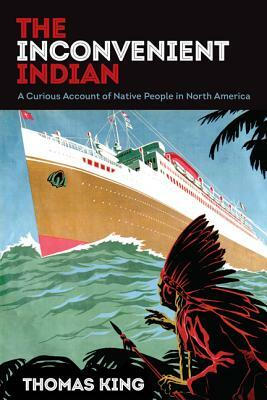
Another book that restressed some reading I had already done was The Inconvenient Indian: A Curious Account of Native People in North America by Thomas King, which I have not yet reviewed. It merely reconfirmed and built upon my reading from way back, when I read Bury My Heart at Wounded Knee by Dee Brown. Our history with dealing with native peoples is shameful, and our double-dealing hasn’t stopped. I need to get more informed on this issue and see what is going on today.

As I mentioned before, I really didn’t read much nonfiction this year despite my resolve to read more. It just didn’t happen that way, but I’ll try harder next year.

Review 2503: Death of a Hollow Man

Caroline Graham does something interesting in Death of a Hollow Man. She spends half the book with an amateur theater group preparing to perform Amadeus, letting readers get to know her characters.

Inspector Barnaby’s wife Joyce works on costumes and plays minor characters. Harold Winstanley is the director, with a high regard for himself. Esslyn is playing Salieri. He has an eye for the ladies and recently dumped his wife Rosa for 19-year-old Kitty. When Rosa finds out Kitty is pregnant, a state Esslyn denied her, she is furious.

Others of the group are Deirdre, much-put-upon assistant director, whose father has dementia, putting her into a constant fret. There are David and Colin, son and father set designers and technicians. Tim and Avery are a gay couple who do lighting. The Everard brothers are Esslyn’s toadies. And young Nicholas is playing Mozart and trying to get into drama school.

Many in the group thrive on rumor and innuendo, and the atmosphere is toxic, what with Harold’s rudeness and his ego that must be constantly fed, Esslyn’s coldness, and the tension between Rosa and Kitty. Nicholas comes in early one day and sees Kitty having sex with someone in the light booth. He thinks it is David because he’s the only other person he meets that early. Rumors about this create more tension and end in a misunderstanding that makes havoc on opening night. But does it have anything to do with the death at the end of the play? For the taped straight razor that Salieri uses to cut his own throat has had its tape removed.

People who want a quick start to their mysteries might not appreciate Graham’s technique in this one of following the group over days, but it really helps develop the characters. I enjoyed this mystery, although being used to the character of Cully from the TV series, I was a little taken aback to find her depicted as acerbic.

Midsomer Murders made Joyce discover many of the bodies. I don’t know if Graham did that or not, but Joyce is right there on the spot for Essyn’s death.

Related Posts

The Killings at Badgers Drift

Magpie Murders

Final Acts: Theatrical Mysteries

Announcing a new blog

Dear book blogging audience, OK, this has nothing to do with books, or maybe it might at some time, but not now. Still, some of you might find it interesting.

I have always been interested in art, although I am not schooled in it. In middle school, my electives were band class and orchestra (flute) until I got braces in 9th grade and ruined my embouchure. I wanted to take art in high school, but I was afraid that all the people who took it through middle school would know more than I did, so I took something else (and I can’t remember what). As an adult, I occasionally took a six-week class, but I never had a lot of time to work on it.

However, once I retired and moved to Washington, I thought that art classes might be a fun thing to do with my sister, who has always been much more persistent in working on art. We both enrolled at an art school in Vancouver, and I have been going there ever since. (My sister dropped out after a couple years.)

Although I never felt very strongly about myself as an artist, just recently things have been opening up for me. I won first place at the county fair (a big $1.50 and a ribbon), I sold a print of that painting, I shared a booth with my sister in the Battle Ground Art Fair this September, and I joined the Battle Ground Art Alliance. In December, an art gallery is opening up in Battle Ground, and one of my paintings will be for sale there.

A discussion with the webmaster for the BGAA’s website about contact information on their page for me (I submitted my email address and he was advising me to use something else) led me to create a blog about art. It isn’t a sale blog, although I may join the blog owned by the BGAA’s website for selling art once I get my act in gear. It will be a weekly blog talking about my experiences in painting and art. It’s called What? Me Paint? Check it out if you’re interested. So far, there is only one post, but you can see photos of two of my paintings.