
 This week’s Best Book is The Lowland by Jhumpa Lahiri!
Day 420: NW
 I’m not sure what I think about NW. In reading a few reviews, I almost wish I had come to Zadie Smith first through one of her more traditional novels, as NW is almost a deconstruction of form.
NW is the postal code of an area of northwest London where Smith’s characters were brought up and reside. They were all raised in the same housing project, a group of towers that dominates the area of the impoverished and ethnically mixed Kilburn. In each section of the novel, we follow a different character.
Leah Hanwell has escaped the projects but lives within sight of them in a nicer neighborhood. She is of Irish and English heritage, married to Michel, who is half Algerian, half Guadaloupan. Her best friend Natalie Blake is first generation English of Caribbean origin. It seems that for every character in this novel, ethnic heritage is a mixed bag and not a way to find an identity.
Leah has come to resent Natalie, who has been the most successful of their acquaintances. Leah misses their former closeness and feels they now have little in common, especially since Natalie had children. The issue of children is a stressful one for Leah, who has been secretly taking birth control pills while her husband thinks they are trying to conceive. The only absolute and pure love Leah has to bestow goes to her dog Olive.
Leah is home alone when a woman comes to her door claiming to have an emergency. When the woman recognizes Leah as a former resident of the same building in the projects, all pretence of an emergency seems to disappear as they exchange information about common acquaintances. Even so, Leah impulsively hands over a fairly large sum of money. Afterwards, she vacillates between sympathy for this woman–a drug addict on the con–and a resentment that she’s been cheated. Telling Michel about it sets up a situation that ends badly.
In the second section of the book, Felix starts out his day of running a few errands in a cheerful mood. He is going to visit his father, say goodbye to an old girlfriend, perhaps buy a car. He is happy in his life. He has kicked a drug habit, is in love with his girlfriend, has a good job, and wants to lead a more productive life. We don’t anticipate what happens to Felix.
The bulk of the novel belongs to Natalie, who has remade her life, including changing her name from Keisha. She is a lawyer married to a day trader, with two children. She lives in a beautiful house in an upscale neighborhood. She is outwardly a confident, take-charge woman, but inwardly much more tentative. As one of her friends says, she’s been telling everyone all their lives that she is different from them. Yet surely, her impulse is more to fit in.
Natalie and her husband Frank pretend to be a loving couple, but when they are not out in public they spend little time with each other. Natalie doesn’t enjoy her children, either. Of all the characters, including a homeless drug addict named Nathan that Leah and Natalie had crushes on when they were all kids, she seems the most discontented. In one way, she has erased her former life. In another, she drags it along with her. All she enjoys is her work.
The novel is presented in a fragmented way. Conversations begin in the middle and sentences are cut off. Issues remain unresolved. Dialogue and descriptions are vivid but gritty, such as when Leah and Natalie push a stroller through a trash-lined neighborhood to find an ancient church in the middle of a traffic circle, its tombstones covered in graffiti. Smith’s novel is ambitious, an urban slice of several lives.
A little side note. The paperback copy of this novel has a typo on the back cover where it calls a character by the wrong name. I kept waiting for that character to appear until I figured out what was going on. That’s a pretty big mistake. Just sayin’.
Day 419: The Bones of Paris
 Happy Halloween! I tried to select a book that was appropriate for the occasion, although I didn’t have a ghost story lined up.
Laurie R. King’s series about Mary Russell and Sherlock Holmes is very popular, but I prefer her Kate Martinelli series or, even better, some of her dark psychological stand-alone novels. Folly is my favorite. With The Bones of Paris, she brings some of that darker sensibility to what looks like the beginning of a new mystery series.
Harris Stuyvesant is an ex-FBI agent who has been scraping a living in Europe by taking private investigation work. Among the hordes of American expatriates in 1929 Paris, he is searching for a young woman, Pip Crosby, whose relatives have not heard from her in months. A cause for possible embarrassment or worse is that Harris met Pip in Nice the year before and had a brief fling with her. Ever since a disastrous incident that ended his career and cost him his fiancée, he has been living an aimless and bohemian existence.
Two of Harris’ first stops in his search for Pip are Pip’s flatmate, Nancy Berger, and the Paris Missing Persons Bureau. Nancy seems to have a hangover but is actually suffering the effects of travel. She just returned from an archaeological dig in Greece and has not seen Pip for months. Harris finds the police officer, Doucet, concerned about what may be a series of killings.
Harris’ attentions soon narrow on three men connected with the art world whose names keep surfacing in connection with Pip and who all have a fascination with the macabre. The artist Man Ray‘s photographs of Pip focus on a gruesome scar from an accident in her youth. Count Dominic de Charmentier is a wealthy patron of the arts who owns a theatre that alternates grotesque and frightening scenes with comic ones. He also hosts parties that feature macabre decorations and terrifying staged events. Didi Moreau is a creepy, disturbing artist who makes displays of found objects, including human bones. Pip has a few of these displays in her room, as well as some of Man Ray’s photographs. When Harris begins investigating these men more closely, he finds to his alarm that his ex-fiancée, Sarah Grey, is working as de Charmentier’s assistant.
King evokes the time and place with mastery, introducing us to a dissolute café culture populated with famous figures such as Cole Porter and Josephine Baker. She also cleverly raises the creep factor by interjecting short chapters about the bones that underlie parts of Paris, foreboding snippets of conversation, and other indications that something monstrous is going on behind the scenes of glittering nightlife.
Day 418: Old Possum’s Book of Practical Cats
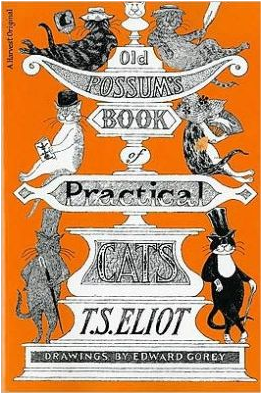 It took me longer to find this wonderful book than to read it. I came across it months ago in a used book store, bought it, and immediately opened it up. After I read the first poem, I got interrupted and put it down. Shortly thereafter, my husband, in a fit of tidiness, put it “somewhere safe.” He finally found it again, months later.
Some of you may know that T. S. Eliot’s Old Possum’s Book of Practical Cats is the source material for the musical Cats. Since the book is not as well known on this side of the pond as I assume it is on the other, I had not read it until lately and was frustrated during the musical at not being able to understand most of the words, much less which cat was which.
But these poems are delightful. They zip along with the kind of rhythm and rhyming that smaller children adore, and although I don’t think they’ll understand all the vocabulary, that can be explained to them. I was wondering whether modern children would understand or care about things like the clubs along St. James, but I decided that was unimportant. They would focus instead on Macavity, who isn’t there (I have a cat like that), on the names like Rum Tum Tugger that roll around in your mouth awhile, and on the proper way to address a cat (“O Cat”).
A comment on the cover I have shown here. This cover is not for the copy I bought, which was illustrated by Axel Scheffer. I thought Scheffer’s illustrations were cute, but it was hard to tell one cat from another. The reason I’ve attached the cover with Edward Gorey’s illustrations to my review is that Gorey’s version was the one I chose to buy for my young niece.
Day 417: Annals of the Former World: Rising from the Plains
 Rising from the Plains was my favorite book of Annals of the Former World. In this third book of the series (or third section of the complete book), John McPhee examines the geology of Wyoming along I-80 and makes a side trip to Jackson Hole.
McPhee travels with geologist David Love, and he enlivens the geological discussion with a discursion on the settling of Wyoming, particularly with the history of Love’s own family. He begins with Love’s mother, Ethel Waxham, a Wellesley graduate who arrived in the wintery landscape by stage to take up work as a schoolteacher. Waxham kept absorbing journals that describe the harsh conditions as well as the striking characters she encountered. Waxham was courted and won by a rancher, John Love, a nephew of John Muir, the great writer and naturalist. McPhee has tales to tell of Love’s adventures, including his acquaintance with Robert Leroy Parker and Harry Longabaugh (Butch Cassidy and the Sundance Kid).
This book continues to explore questions raised by too comprehensive an application of the theory of plate tectonics. It introduces the concepts of hot spots and plumes and their involvement in the formation of structures.
The book delves deeper into the story of the discovery of oil shales and uranium in the area. It touches on issues of ecology and preservation of natural areas.
Of all the parts of Annals, Rising from the Plains is the widest in scope. McPhee has a talent for making his subjects understandable and readable–and very interesting.
Day 416: The Lowland
Best Book of the Week!
Today we have a treat–one of the novels that made the short list for this year’s Booker Prize.
As boys in Calcutta, brothers Subhash and Udayan Mitra are inseparable, even though their personalities are so different. Udayan, the younger boy, is bold, reckless, and charismatic. Subhash is quiet and responsible.
As they reach college age, Subhash dedicates himself to his studies while Udayan becomes involved with the Naxalites, an obscure radical leftist group that takes its name from solidarity with the poor farmers of Naxalbari who rose up against their landlords in 1967. Subhash, who is apolitical, stays away from these activities and soon goes to Rhode Island to attend graduate school.
Subhash is called back to India because Udayan is dead. He returns to a home of grief, where his parents hardly speak to him or move from their balcony overlooking the street, where his mother goes out periodically to tend the small stone marker in the Lowland, a marshland where the boys had played and where the police shot Udayan in custody.
Subhash’s parents do not speak to his brother’s wife Gauri, and soon he understands that they hope to drive her away and take custody of her unborn child. So, Subhash offers to marry her and bring her back to the States so that he can care for her and the child. Gauri agrees.
Although Lahiri chooses to begin her novel in turbulent times, both in India and the United States, where demonstrations against Vietnam are taking place, her characters seem distanced from this activity, even though their lives are irrevocably changed by what happened in India. Incidents are described, but at a level that seems far removed from their reality. Only at the very end of the novel do we understand Udayan’s viewpoint, and it is just of the last few moments of his life.
I don’t know if this is a criticism, though. This novel is not so much about these political activities as about Udayan’s actions and their results, about the emotions that arise from them. The novel is about the complexities of grief and how they evoke other emotions–anger, isolation, inertia. As Maureen Corrigan remarks in her review of Unaccustomed Earth, “All that lushness electrifyingly evokes the void.” In The Lowland, we’re not so much faced with lushness as a marshy wasteland. This wasteland is in itself a metaphor. In the monsoon season it is one marsh, but when it becomes drier, it is separated into two ponds, just as Subhash and Udayan, and later Subhash and Gauri, are together and separate, each failing to comprehend the other.
Finally, the novel is about betrayal. Spanning more than 50 years and four generations, this novel, apparently broad in scope, is actually more concerned with private and personal tragedies. It evokes an atmosphere that is at once poignant and arid.
Best Book of the Week!
 This week’s Best Book is Stone’s Fall by Iain Pears!
Day 415: Antony and Cleopatra
 Of the Shakespeare tragedies I have been reading, I think I have the least sympathy for the characters in Antony and Cleopatra (except perhaps for Othello–I have no sympathy at all for him). One of the problems is in, of course, how their relationship has historically been portrayed–with Cleopatra as a manipulative slut instead of a sovereign trying desperately to save her kingdom from being swallowed up by the Roman Empire. But the victors always get their way in portraying the conquered.
Antony and Cleopatra is, of course, the play about the last years of the relationship between Marc Antony and Cleopatra of Egypt, their political maneuverings with Rome and particularly with Octavius Caesar, and their deaths.
I believe the traditional way of looking at this play is of the great man brought down by his fascination with a rapacious woman. However, pay attention to the difference between how the characters talk about the nobility of the Romans and how the Romans actually act. I think something more subtle is going on here. I don’t see much evidence of a great man in this play. I see a soldier who pretends to be a noble Roman and is not. I see a female ruler who is more of an enigma, who controls her own shifting image, like a chimera.
 Not having the strongest grounding in classical literature, it is not always clear to me what is going on during the political maneuverings and battles, and which characters are on whose side. Of course, it is a historical fact that Cleopatra fled the battle of Actium with her ships at a strategic point, causing the battle to be lost. Why she did so is still a mystery.
For a different view of Cleopatra, although maybe a closer view than Schiff thinks, see Stacy Schiff’s excellent biography.
Day 414: Seven Locks
 Seven Locks contains a surprise. I can say no more about it, for fear of spoilers, except that I suspected it from very early on.
In the Hudson River Valley of 1769, a woman is struggling. It is a difficult life on the small farm outside the village, full of hard work, and she is not getting the help she needs from her husband. He prefers to hang out in the village tavern or go hunting with his dog. He is a man of great charm, but he likes to think and daydream and lie in the fields drinking instead of doing his work. His wife has had to learn to chop wood, and the hay spoils in the fields. Her husband has a knack of turning every request for help into an argument, ending with him stomping out with his gun. Soon, she has the reputation of a scold.
One day he does not come back, leaving her alone with her two children. After waiting a few days, she rallies the men of the village to look for him, but he is nowhere to be found. Now she has a harder life, trying to rally her children to help her so they can continue to care for the animals, keep the house warm, and put food on the table. The villagers, at first helpful, turn against her, though, and soon rumors are floating about. She drove her husband away, or worse.
We also follow this story from the point of view of Judith, her daughter. She misses her father but is loyally supportive of her mother. Her brother resents the added work, and she would rather read, so neither of them is as helpful as their mother could wish. As the nation moves toward revolution, especially after her brother joins the army, Judith wants only freedom from the farm and her mother’s life.
Seven Locks provides us an unusual look at the remnants of the life of the early Dutch settlers and the ways they were forced to change with the emergence of the new nation. It is a touching portrayal of the difficulty of one family’s life and of one woman’s spirit. Sparely but vividly told, it is a tale to make you thoughtful.
Day 413: Doll Bones
 I just realized I had inadvertently reviewed a slew of historical novels in a row, so here’s something contemporary.
I really appreciate a children’s book that has as much to offer an adult as a child. I’m thinking of those books of Frances Hodgson Burnett, Philip Pullman, J. K. Rowling, or Robert Louis Stevenson as examples. Doll Bones doesn’t actually fit into that category, but I’m sure that tweens and younger kids will enjoy it.
Zach Barlow is growing up. He’s put on enough height this year to join the middle school basketball team. What he still enjoys most, though, are the games he plays with his best friends Alice Magnaye and Poppy Bell, where they use dolls and action figures to act out elaborate stories. However, they never touch one doll belonging to Poppy’s mom that they call the Queen, an old porcelain doll that seems very creepy.
Zach’s dad left him and his mother for a few years, but now he has returned to them and is still trying to figure out how to be with them. One afternoon Zach comes home thinking about what will happen next to Pirate William, only to find his dad has thrown away all his toys and dolls. Zach is too upset even to explain to Alice and Poppy why he won’t play anymore. The two girls are devastated.
One night the girls come to see him. Poppy explains she’s had a ghost visitor who says her ashes are inside the Queen. The ghost girl has asked them to bury her ashes in her grave in East Liverpool, Ohio. Poppy believes the ghost and wants to go on a quest to return the bones, which are in the bag that makes the doll’s body. So, despite their fears of getting into major trouble, the kids get on a bus in the middle of the night to travel from Pennsylvania to Ohio.
Of course, on this trip they run into difficulties, including getting scared off the bus part way and having to make their way on foot or any other way they can find through a landscape of urban blight. On the way, some adults creepily seem to believe there are four of them. Eventually, they solve the mystery of who the girl is and what happened to her. As they meet these difficulties they grow up a little and figure out better how to handle their changing relationships.
I think kids will relate to the problems of Zach, Alice, and Poppy. I also think they’ll like the spookiness of the story. Doll Bones falls among the more innocent of contemporary books for tweens and younger teens, with a few chills but no violence or bad language. It would make a good story for any kid from ages eight or nine to, say, twelve or thirteen.
 What? Me Read?