Day 405: The Child’s Child

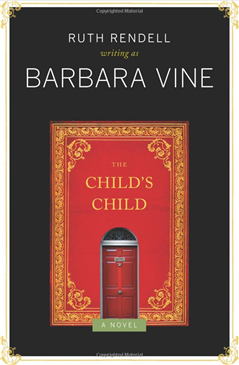
Cover for the Child's ChildEven though The Child’s Child is a relatively short novel, it seems to take a long time to get to the payoff. Although Barbara Vine’s novels are more character studies than thrillers, they always involve a certain amount of suspense.

This book uses a novel-within-a-novel structure, with the exterior novel taking place in 2011 while the interior one begins in 1929. The themes of unwed motherhood and homosexuality and the extent to which both are stigmatized are the same in both stories.

Grace Easton is a graduate student working on a thesis about the portrayal of unwed mothers in literature. She and her brother Andrew have inherited a house and impulsively decide to share it instead of selling it. However, they have not discussed issues such as how to deal with prospective mates, and soon enough Andrew, who is gay, has brought home James, a writer. Grace and James do not get on, and she begins to feel uncomfortable in her own home.

One evening Andrew and James witness a brutal crime against a gay friend, about which they will be called upon to testify. James is extremely upset by this event, and his reaction leads to unforeseen complications.

Grace has promised to read the manuscript (the interior novel) written by an acquaintance’s father with a view to telling the acquaintance whether it is publishable. She has been avoiding reading it while she works on her thesis but finally begins. We are led to understand that, while presented as a novel, it is actually a true story of the writer’s relative.

In the interior novel, Maud Goodwin becomes pregnant at fifteen and is immediately rebuffed by her family, with the exception of her brother John. John has recently taken a new job in a different county, and his solution to his sister’s problem is to set up housekeeping with her, the two of them posing as husband and wife to avoid her shame. John is homosexual, which of course was illegal in those days, and has vowed to remain celibate, so he knows he will never marry.

The interior novel takes up the bulk of the book, which I found unfortunate. I thought John was in some ways foolish, and Maud becomes a bitter, ungrateful woman. My immediate thought, even as John was deciding what to do, was that Maud’s situation could just as effectively and more sensibly have been taken care of by her posing as a widow and sharing a house with her brother.

Sadly, John lacks judgment in where he bestows his affections, and when he chooses a partner he basically seals his fate. I had some sympathy for John, but he exits the novel fairly early on, and I grew to dislike Maud more and more.

It isn’t until the narrative returns to the present time that I feel the novel regains its focus and finally provides some payoff, and the long-anticipated suspense. In addition, sadly, the themes of the novel seem labored and obvious, to the point where the author has characters voicing them instead of letting the reader figure them out. If you want to try Barbara Vine, the name Ruth Rendell uses for her psychological suspense novels, I suggest instead A Dark-Adapted Eye, which is one of my favorites.

Day 404: Swamplandia!

Cover for SwamplandiaBest Book of the Week!

Swamplandia! is the third book I’ve read in the past few months that has a strong young female voice (with Tell the Wolves I’m Home and Where’d You Go, Bernadette). All of them were very good.

Before I start, though, a comment on the cover for the hardcover copy of the book, which is not the one I read or the one shown here. I was not really clear about whether this book is considered appropriate for young adults or not (probably), but the hardcopy cover makes Swamplandia! look like a children’s book, showing a very young girl piggyback on a character who looks somewhat like the Mad Hatter, both watching an alligator. Let me warn you that Swamplandia! is definitely not for young children.

Thirteen-year-old Ava Bigtree and her family live on an island in a hokey-sounding amusement park in the Florida Everglades called Swamplandia! There, they dress up as Native Americans (their grandfather, who founded the park, was a German-American farmer from Ohio) and breed and wrestle alligators. Ava’s mother Hilola was the main attraction until she became ill with cancer and eventually died.

Since then the family has tried to cope with its grief while also attempting to save the floundering park. Homeschooled and with little contact with the mainland, the Bigtree kids have been raised in a sort of dream land. They all possess a thorough and subversive knowledge of the history of Florida and of its flora and fauna but not many skills for dealing with the outside world. Kiwi spends almost all his time reading, Osceola believes she has a ghost lover, and Ava is aiming to become a world-famous alligator wrestler.

When tourists stop arriving on the ferry, Chief Bigtree, the children’s father, makes one of his mainland journeys to raise money to save the park, but not before Kiwi apparently abandons them to get a job with the park’s competitor, The World of Darkness. Sixteen-year-old Osceola and Ava are left alone on the island until Osceola floats away on an old barge to join her lover.

Frantic to save Osceola, young Ava joins up with a mysterious man named the Bird Man, who claims to know his way into hell, which is where Ava assumes she must go to bring Osceola back from her ghost lover. As our apprehension grows, we follow Ava’s journey while periodically cutting over to observe Kiwi’s serio-comic adventures at the hell-themed World of Darkness.

Russell creates a lush world in Swamplandia! and a compelling narrator in the innocent/wise Ava. The language of the novel is gorgeous, its heroine engaging. You will find yourself immersed in a damp world bursting with life, and you won’t want to leave it until you know what happens to Ava.

Day 403: The Town

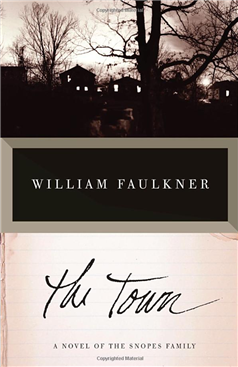
Cover for The TownThe Town is the second of Faulkner’s “Snopes” novels about the rise to power of Flem Snopes in Jefferson, Mississippi. Written in a style that is remindful of a bunch of old Southern men sitting on the porch swapping stories, it is narrated by three different alternating voices. As a pioneer in novels with multiple narrators, Faulkner is a master.

One of the narrators is a character we met already in The Hamlet, V. K. Ratliff, the itinerant sewing machine salesman who is most knowledgeable about Snopes’ true character, having been deeply scorched by him. Ratliff enlists the Jefferson city attorney, Gavin Stevens, in his observations of Snopes. The third narrator is Charles Mallison, Stevens’ nephew, who tells us himself that he wasn’t even alive during the times of his first tales but was told the stories by his cousin Gowan.

The novel covers the events of nearly 20 years, from the arrival of the Snopes family in Jefferson to the events shortly following the death of Flem’s wife Eula. Although some of the events are tragic, the tone of The Town is more comic than that of The Hamlet, perhaps because the lives of the folks in Jefferson are not as grim as those of the poor sharecroppers in the first novel.

The novel focuses first on the young Gavin’s infatuation with Eula Snopes. Rumor has it that Snopes’ appointment as power-plant supervisor–highlighted by his attempted theft of all the plant’s brass fixtures accompanied by an effort to frame the plant’s two black firemen for the theft–is in return for him closing his eyes to his wife Eula’s affair with Manfred de Spain, the town’s mayor. Young Gavin, newly returned from university at the time, is incensed by this rumor and determined to protect Mrs. Snopes’ reputation. Later, as Eula’s daughter Linda grows up, Gavin tries to save her from “Snopesism” by helping educate her and trying to get her a place in an eastern university.

These two novels are fascinating because of Faulkner’s ability to make central a character who barely has a line of dialogue in either book. He effectively makes Snopes the major presence in the novels by having the other characters observe the results of his actions while endlessly speculating about what he actually does and why he does it. As always with Faulkner, the prose is beautiful.

Day 402: Dust and Shadow

Cover for Dust and ShadowIn Dust and Shadow: An Account of the Ripper Killings by Dr. John H. Watson, Lyndsay Faye combines a great deal of research into the Jack the Ripper killings in 1888 with a vast knowledge of Sherlock Holmes literature to offer an entertaining solution to the crimes. The novel begins nearly 50 years after the events, when Dr. Watson places his narrative of the murders into a safety deposit box on the eve of war.

Inspector Lestrade comes to consult Holmes after the second murder, when police begin to realize the two deaths may be linked. Holmes immediately begins pursuing his usual means of detection–inspecting the body and the scenes of the crimes, trying to find out where the victims were last sighted, questioning the victims’ friends–and he very quickly figures out that another murder is related. He even hires an alert young prostitute, Mary Ann Monk, to make her own enquiries and observations after she identifies the body of her friend, Mrs. Nichols. However, he is soon frustrated by his lack of progress. The only lead Holmes has come across is the story of an elusive sailor, being sought by a friend who thinks he may have been involved in the first murder, that of Mrs. Nichols.

Soon Holmes and Watson have something else to worry about, for a member of the press is printing details of the crimes unknown to but a few. He has been alleging that Holmes himself may be the murderer.

Faye’s novel is atmospheric and absorbing. Its greatest accomplishment, though, is in successfully capturing the narrative style of Doctor Watson, making us believe that this could be a Holmes story. Although I was about 100 pages ahead of Holmes in solving the murder (which would never happen in a real Holmes story), I still found the solution ingenious as well as the reason why the crimes are recorded in history as unsolved (when, of course, Holmes solved them). This novel is a very good first effort. I have Faye’s next book awaiting me in my pile.

Day 401: Literary Wives: Ahab’s Wife Or, The Star-Gazer

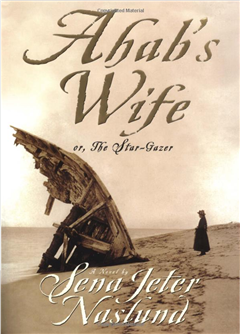
Cover for Ahab's WifeToday I am doing something a little different–participating in a virtual book-discussion group with Literary Wives. Literary Wives is a group of bloggers who are wives and are reading books about how wives are depicted in fiction. Toward the end of my normal review of this month’s choice, I will answer some specific questions that appear in every Literary Wives review. Be sure to check out the other reviews by Audra of Unabridged Chick, Ariel of One Little Library, Emily of The Bookshelf of Emily J., Carolyn of Rosemary and Reading Glasses, Cecilia of Only You, and Lynn of Smoke and Mirrors.

I have quite got to like what appears to be a newish fashion of rewriting works of fiction from a different viewpoint. Although it has produced some mediocre results, it has also produced some gems, a few of which are Wide Sargasso Sea by Jean Rhys, The Solitary House by Lynn Shepherd, and now, Ahab’s Wife by Sena Jeter Naslund.

I was somewhat put off by Naslund’s writing style in her most recent novel, The Fountain of St. James Court; however, it is imminently suited to her most well-known novel, this one, which is a reworking of Moby Dick. This novel is truly an adventure. It begins with a brief look forward to Una Spenser’s delivery alone in a cabin in the wilds of Kentucky of Ahab’s child, which does not live long, and the subsequent discovery that her mother has died in the snow while going for help. If this isn’t enough going on, while she is in labor, Una also has an encounter with bounty hunters looking for an escaped slave. Later, she helps the slave girl escape.

After this glimpse ahead in time, the novel returns to take a relatively straightforward path, beginning with twelve-year-old Una’s banishment from this same cabin in Kentucky. Una has faced some abuse at the hands of her father because of a difference in religious beliefs, so her mother sends her to her Aunt Agatha and Uncle Jonathan, where they live on a lighthouse island off Massachusetts. So begins Una’s fascination with the sea.

Although not every 19th century woman would think life with a loving, thoughtful, intellectually curious family confining, Una eventually finds it so, when she is sixteen. Her feelings are complicated by the arrival of two young men who come to prepare for the installation of a new light for the lighthouse. They are best friends Giles Bonebright and Kit Sparrow. Una knows she likes them both but is not at first sure which one she likes best. This fateful meeting is to affect the rest of Una’s life.

But I am writing nothing here that reflects how unusual this novel is. First, it documents the extraordinary life of an extremely uncommon character. If some of the other characters are not so fully drawn, you really feel as if you know Una. Next, in its occasional long asides and fits of oratory, it is a fitting companion to Moby Dick, with its dissertations on bits of whaling gear and its exhortations by Ahab. If any woman is a match for Ahab, Una is. Finally, its language and ideas are lyrical and soaring, as Una grows intellectually, meets her own life full on, and becomes acquainted with historical figures from her time and place.

If I have a caveat, it is that I feel the exceptional Una would have had more problems of acceptance in the actual 19th century American setting. In keeping with a theme about the enjoyment of life, not only does Una throw off debillitating experiences with little trouble or regret, but she also finds warm friends and acceptance everywhere she goes. It would give away too many plot points to discuss why I find this unlikely.

For Literary Wives: What does this book say about wives or about the experience of being a wife?Literary Wives logo

This novel does not draw on a conventional idea of a wife, particularly for the time it is set. For Una, being a wife seems to mean giving unstinting loyalty up to a point, but this loyalty can vanish fairly quickly if the relationship becomes disrespectful, and Una’s natural ebulliance takes her over some terrible difficulties with relative (and perhaps unlikely) ease.

I don’t think Una lets the conventional notions of wifehood affect her at all. She just does what she wants and what she thinks is right, but her ideas of right are different from other people’s. For her, a husband seems to be the more modern idea of a partner. Certainly, mutual respect, sexual attraction, and love enter into this equation but not so much the typical 19th century idea of duty.

In what way does this woman define “wife”–or in what way is she defined by “wife”?

I don’t think Una is defined by “wife” at all. I think “person” is more what Naslund is interested in. In a review of this book, it was referred to as a feminist, earth mother, reinterpretation of Moby Dick. I don’t see the earth mother so much, but the feminism is certainly there. “What was a promise? A way to enslave the future to the past,” Una thinks at one point.

Day 400: Annals of the Former World: Basin and Range

Cover for Annals of the Former WorldBest Book of the Week!

Beginning in 1978, John McPhee began a series of journeys across the United States along the length of I-80. His goal was to form a picture of how the geology of the country evolved over time. This project proved to be so large that he ended up breaking it into chunks, publishing four books that he finally combined into one (with an extra section). Basin and Range is the first book of Annals of the Former World, the combined volume, for which McPhee won the Pulitzer. Although I am reading the large volume, I have decided to break up my review by the original works, as reading this book has involved a lot of concentration.

Although the book begins with the genesis of the idea during an outing McPhee took with a geologist in New Jersey and briefly covers other areas of the world, Basin and Range concentrates on the Basin and Range area of western Utah and eastern Nevada. McPhee is a journalist who majored in English, but his interests lead him to take courses in geology, among other sciences. To supplement his basic knowledge and interests, he traveled with and interviewed noted geologists.

Basin and Range discusses changes in basic geological theory from the 17th century, providing readers with a primer on plate tectonics by using examples of various structures in the Basin and Range. In the course of these discussions, McPhee expatiates on some of the larger debates in the history of the science and tells us about some of the more colorful characters. All the while, he conveys his fascination with geology and his appreciation of language. He finds inventive ways of suggesting the vastness of the time he is discussing and the relative rapidity with which major geological forces can create change.

I have an interest in geology that is only basically informed, mostly from a couple of classes, science TV programs, and a former job in a related industry. I always considered myself a dunce at science and so never followed up this interest seriously. McPhee throws around geology terms without always explaining them, so I found myself looking up terms like “oolite” and “craton,” but in general he is gifted with the ability to make this topic abundantly clear. Although I was not sure at the beginning of the book that I would read all the parts, I am certainly planning on continuing. I am finding it fascinating to try to imagine the changes in the Earth that he describes.

Day 399: Beautiful Ruins

Cover for Beautiful RuinsAt times I wasn’t sure how much I liked this novel, whether it wasn’t going to wrap its many threads into too neat a package. It does wrap things up, but ultimately in a satisfying way.

The novel begins in 1962, when Pasquale Tursi is a young man. He dreams of turning his very small Italian seaside village into a tourist attraction, so he is futilely trying to create a beach on a small strip of waterfront when a boat pulls in. It is carrying Dee Moray, an American actress who has been working on the troubled set of the movie Cleopatra. She has fallen ill and has come to Porto Vergogna to wait for her lover at Pasquale’s hotel, the Hotel Adequate View. Pasquale is immediately smitten.

In present-day Los Angeles, Claire Silver is contemplating leaving what she thought was her dream job, as chief development assistant for the legendary film producer Michael Deane. Claire’s vision for the job had been that she would help develop many exciting projects, but unfortunately for her, Deane hadn’t produced a hit in years until Hookbook, a TV “reality” show, like Facebook for dating. Since then, she has spent her time listening to pitches for sleazy reality programs.

This day might be her last Wild Pitch Wednesday, when anyone who can get an appointment can pitch her an idea. If she takes the new job she’s been offered, she’ll return to film archiving–for the Church of Scientology.

Shane Wheeler is on his way from Portland, Oregon, to present an idea at Wild Pitch Wednesday. A failed novelist, he has decided to trying pitching an idea for a movie about the Donner Party. On the way into the building, he encounters Pasquale, who has come all the way from Italy to try to find Dee Moray. Pasquale’s only lead is an ancient business card he got from Michael Deane, who was an assistant on the movie at the time, taking care of problems such as those posed by the scandalous affair between Elizabeth Taylor and Richard Burton. Shane, Claire, and Michael Deane soon find themselves involved in helping Pasquale find Dee.

These are only a few of the characters we encounter as the story moves backwards and forwards in time, moves from person to person in point of view, and takes us from rural Italy to Rome to the inner circles of Hollywood to the Fringe Festival of Edinburgh to an amateur theatre performance in Idaho. On the way we are entertained by wry observations on the Hollywood film business and the music business, and the straight narrative style is carried forward by partial movie scripts, acts from plays, pitches, pseudo-pitches, a chapter from a novel, and some brief notes.

At times knowing, at times amusing, at times sweet, Beautiful Ruins is an engaging postmodern love story and commentary on the entertainment industry.

Day 398: The Strange Fate of Kitty Easton

Cover for The Strange Fate of Kitty EastonIf you prefer a book to leap immediately into action, this is probably not the mystery for you. The second in a series, it starts slowly, with Speller taking the time to develop the setting and characters.

Laurence Bartram is a young man damaged by World War I, during which his wife and child died and he was injured. Laurence is an expert on church architecture, and he is happy to be summoned to the estate of Easton Deadall by his friend, William Bolitho. William wants him to look over  a small but unusual church, for which William is designing and installing a window.

Laurence is soon pulled into the affairs of the Eastons, a family that is haunted by the war, but moreso by the disappearance in 1911 of the young daughter of Digby Easton, the oldest of the three Easton brothers. Digby died during the war, but Kitty still obsesses her mother Lydia, an invalid who sometimes speaks of her as if she is alive.

The middle Easton son, Julian, has been doing his best with the estate, which Laurence finds beautiful but slightly crumbling, while Lydia’s sister Frances takes care of her. Laurence finds the subject of Kitty lurking behind every conversation and wonders if they will discover her body in the course of their renovations. Soon, the third Easton brother, Patrick, returns to Easton Deadall after an absence of years, first at Oxford and then on an archaeological dig in Greece. It becomes obvious that there is tension between him and Julian.

The family decides to make up a party to visit the Empire Exhibition. William, who was left wheelchair bound by the war, does not feel he can handle it, and Lydia is too ill, but the rest of the family goes. The expedition includes Eleanor, William’s wife, and Laurence. They also bring along David, the estate’s man of all work, and the teenage maid Maggie to help care for William and Eleanor’s young son Nicholas. At the exhibition, Maggie and Nicholas go missing, and although the others find Nicholas, Maggie is nowhere to be seen.

Distressed by Maggie’s disappearance, which can’t but echo the earlier one of Kitty, the family begins falling apart and secrets emerge, especially about the charismatic Digby and his relationships to his family and to his troops during the war. A few days after the disastrous outing, Laurence and David are clearing an area in the church to prepare for the installation of William’s window when they discover a trap door in the floor under the altar. When they open it, they find the body of a woman. The police are able to quickly ascertain that the body is of a woman too old to be Maggie, but then, who can it be? Could it even be Kitty, grown up and returned from wherever she has been?

Laurence does not exactly detect so much as look into a few things the others haven’t thought of, and he eventually unearths a tangle of secrets. Although the novel takes awhile to get going, I soon found myself unable to put it down. It slowly and skillfully builds to suspense. I found it well worth my patience.

Day 397: Sylvester, or the Wicked Uncle

Cover for SylvesterOn occasion, I reread a few of Georgette Heyer’s Regency romances, which have been some of my favorite reading for many years. Just recently, I reread Sylvester, which in some editions is titled Sylvester, or the Wicked Uncle.

The extremely eligible bachelor Sylvester, Duke of Salford, has decided to take a wife. His only difficulty is in deciding which of five eligible girls to marry. When his beloved mama mentions that she and her best friend made a plan for their children to marry many years before, he decides to go inspect the girl, his godmother’s granddaughter, to see if he might like her. Although he is warm and thoughtful to those he cares for, since his twin brother’s death, he has been aloof to others and comes off as haughty.

Sylvester’s visit is disguised as a hunting party, but Phoebe Marlow is informed by her detestable stepmother that the duke is coming to make her an offer. Unfortunately, Phoebe has already met Sylvester and took such a dislike to him that she used him as the villain in a novel she wrote. That novel is going to be published, despite all expectation. Normally, she would not expect him to recognize himself in a silly gothic romance that pokes fun at various society figures, but for the mention of Sylvester’s very distinctive eyebrows.

Fearful of her stepmother’s pressure and not understanding that Sylvester has no intention of proposing, Phoebe talks her childhood friend Tom into escorting her to her grandmother’s house. However, an accident and a snowstorm strand her and Tom with Sylvester in a small country inn.

After Phoebe gets to know and like Sylvester, she is horrified to find out that he has a nephew, since in her silly romance his character is a wicked uncle who wants to steal his nephew’s fortune. Another horror lurks, because Phoebe’s book proves to be a smashing success, much read by society members, who are all trying to identify their friends. Since Phoebe has never brought herself to admit to Sylvester that she wrote a book, she soon fears that people will find out she is the author.

Heyer creates delightful, engaging characters and puts them into silly and unbelievable situations, which is part of the pleasure of reading her novels. They are very well written, with entertaining and sparkling dialogue and a complete understanding of the customs, dress, and speech of the period. If you decide to read Sylvester, get ready for some fun. Many of Heyer’s novels have been re-released in the past few years, so they should not be hard to find.