Day 396: Back to Bologna

Cover for Back to BolognaThe Aurelio Zen series begins as fairly traditional mysteries featuring the bemused Italian detective. Gradually, they become more and more comic. In Back to Bologna, Dibdin presents us with more of a spoof than a mystery novel.

Zen is not feeling his normal self. He is just recovering from a stomach operation, and he is also coping with troubles with his girlfriend, Gemma. She is leaving for Bologna to meet her son when Zen is also recalled to duty and sent to Bologna to solve the murder of a football team owner.

The victim is Lorenzo Curti, a millionaire entrepreneur who was found dead in his Audi, stabbed by a Parmesan cheese knife. Zen actually has little desire to investigate. His main reason for coming to Bologna is to keep an eye on Gemma.

A ridiculous situation is created by a celebrity cook-off between local semiotics professor Edgardo Ugo and the singing TV chef Romano Rinaldi, or Lo Chef. Ugo has suggested in a newspaper article that Lo Chef can’t cook, which has sparked a rivalry and this competition. Gemma gets tickets to the cook-off, and Zen ends up being arrested after Ugo is shot in the wake of the comic event.

Dibdin presents us with a large cast of characters, including a rich student of Ugo’s who is an “ultra” football fan, the student’s illegal immigrant girlfriend “Princess Flavia of Ruritania,” and the worst private detective imaginable. Despite the large number of characters, the solution is not at all difficult to guess. 

Zen does very little detecting as we watch a series of incredible mishaps result in the murderer being delivered right at Zen’s feet. Although I found this novel mildly amusing, my interest in this series has been winding down, and I think this is a good place to stop.

Best Book of the Week!

Cover for Brother of the More Famous JackFirst, those of you who have looked closely at the blog the last few days might have noticed a new feature. Under the List of Books, I have added links from the title of each book directly to its review. This feature should make it easier for you to find the reviews of books that interest you. I’m sorry I didn’t do it sooner. I thought it would add all of the links into my comments section, like it does when I put links to my blog articles in other articles. However, I have figured out how to avoid that, too!

Now, on to the Best Book for the week, which this week is Brother of the More Famous Jack by Barbara Trapido!

Day 395: Macbeth

Cover for MacbethAs with Hamlet and King Lear, the succession is a theme in Macbeth, even more so as the play was written in response to the Gunpowder Plot, in which Guy Fawkes and others attempted to blow up Parliament with King James I in it. This event was extremely traumatic for the British, as we can clearly imagine. Macbeth is, of course, Shakespeare’s famous tragedy about Macbeth’s attempt to usurp the throne of Scotland.

One theme of the play that harks back to the Gunpowder Plot is equivocation. Many of the statements in the play seem as if they mean one thing when they actually mean something else, from the witches’ predictions to Macbeth’s assurances. Equivocation was a Jesuitical doctrine that said that under examination, the truth could be substituted with “mental reservation,” in which one makes deceptive utterances but thinks the truth. It was used by Henry Garnet, the Jesuit Provincial, who learned of the plot as part of a confession. Edward Coke, a member of the Privy Council, which interrogated Garnet, called it “open and broad lying and forswearing.”

In fact, there are other references within the play that refer to James and demonstrate that the play was written in his support. Most obvious is James’s interest in witchcraft. He attended witch trials and in 1597 wrote Daemonologie, which Shakespeare used as source material for his scenes with the witches.

Banquo, Macbeth’s friend, whom Macbeth has murdered because of the witches’ prediction that Banquo will be the father of kings, was purportedly an ancestor of James I. Finally, there is the reference in the play to the healing of the king’s evil, a practice James observed that was followed after him by the British monarchy up to the Hanovers.

So, the play was written in honor of James I, to demonstrate the havoc wrought by breaking the succession. In the service of what is essentially historical propaganda, Duncan is made purer than he actually was and Macbeth more evil. The facts that Macbeth had a claim to the throne of Scotland and that the Scottish succession was not hereditary at the time are ignored. For an alternate interpretation of the story, see the wonderful King Hereafter by Dorothy Dunnett, one of the best historical novelists of all time, in my opinion.

But these facts don’t really spoil our appreciation of the play, which is one of Shakespeare’s most atmospheric, with its ghosts, witches, sleepwalking, murders, and walking wood. I think I prefer the directness of Macbeth to the convoluted plots of some of Shakespeare’s other tragedies. It is certainly a powerful play.

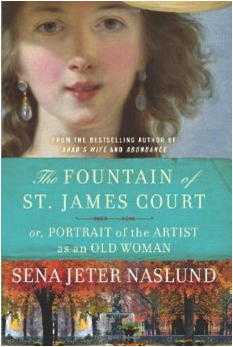
Day 394: The Fountain of St. James Court or, Portrait of the Artist as an Old Woman

Cover for The Fountain of St. James CourtI received this book in a First Reads giveaway from Goodreads. I haven’t read Naslund before, so I am not sure whether she adapted her writing style for this novel, but it took me awhile to accustom myself to it. She follows the activities of two artists, one Kathryn Callaghan, a fictional older writer in the current time, and the other a once-living person, Élisabeth Vigée-Le Brun, a painter known especially for her portraits of Marie Antoinette.

The modern-day story begins at midnight next to a fountain of Venus in a neighborhood of Louisville, Kentucky. Kathryn, or Ryn, is taking her newly finished manuscript to her friend Leslie’s door because she can’t wait to deliver it.

The novel’s structure is a book within a book. Chapters following one day in Ryn’s life are interleaved with chapters covering the whole of Vigée-Le Brun’s life, which are from Ryn’s book. Both stories are about the theme of what it means to be an artist and what you must give up of your personal life to pursue your profession. The novel is said to be a deliberate variation on Joyce’s Portrait of an Artist as a Young Man, but it has been so long since I’ve read it that I cannot comment on that.

This novel is contemplative, especially in the modern-day narrative, but the interleaving of stories in such short chapters slows down the pace too much. It literally takes until page 34 for Ryn to walk across the street and deliver the manuscript. Even with some chapters from the 18th century interleaved, the pace is frustrating. I found myself thinking, when is this woman going to make it across the street?

I found the story of Vigée-Le Brun’s life more compelling than the modern-day story, during which we follow Ryn’s every thought. She is an excitable, emotional woman who contemplates everything she looks at and repeatedly broods over the same things. We read about the russet and yellow fall colors or the appearance of the fountain many times. Nothing much happens all day until a late-night confrontation that seems artificially created to provide some tension.

I did not feel, however, that the two women, Ryn and Vigée-Le Brun, were two different people–they seemed to be the same person in different time periods. Vigée-Le Brun is slightly less emotionally excitable than Ryn, but their observations of the world around them, their attention to color and the details of design and structure, are very similar. Vigée-Le Brun’s narrative style, in first person where Ryn’s is in third person, is a little more formal as befitting an earlier age, but conversations in this story often sound stilted, and her first conversation with Marie Antoinette is positively sycophantic.

Naslund’s writing style, although sometimes vibrant and lyrical, often seems affected, particularly in the modern-day story. The copy I read was an advanced reader’s edition and it had quite a few typos, which I assume will be corrected. I was not quite as sure of some self-consciously unusual phrases, whether they were stylistic choices rather than errors. Naslund’s writing style tends to the unusual, to be sure, but I stumbled over some of these phrases. The only one I wrote down was an instance where some characters “made quick chat.”

I wanted to like this novel more than I did. I think the theme of women and art is worth exploring, although I’m not sure how much this novel actually explored this issue, despite its obvious intentions. I am actually curious about the alleged feminist leanings of Naslund and their effect on this book. Vigée-Le Brun has to put up with her father and then husband appropriating all her money and, in her husband’s case, only giving her a bit of it back as an allowance. When they divorce, he gets almost everything. Yet, she is determined not to let it bother her. I am not sure whether that is a feminist viewpoint or not.

However, the characters in this novel certainly reflect the “gift for pleasure” noted in reviews of Ahab’s Wife (which I am currently reading). The women go on pursuing their lives and dreams without much heed to their menfolk, they have cordial relations with those around them, they delight in color and the fineness of life. Their regrets and sorrows mostly focus on their children.

One thing that surprised me about the historical story was that Vigée-Le Brun hardly seemed to notice the causes of the French revolution or the revolution itself. There is one scene where a woman confronts her on the street and another where she grieves for the fate of so many. That’s about it.

Conversely, it is hard to believe that she would be shocked to the core by seeing a model of internal organs, as artists had been studying the body for hundreds of years. I do not know how much of this novel actually reflects Vigée-Le Brun’s true thinking and feeling. The danger when portraying a historical person is that you are imagining who the person really is–you don’t know–and you have no idea if you are doing them justice or injustice.

Day 393: The Cuckoo’s Calling

Cover for The Cuckoo's CallingBefore I go on to say some nice things about this mystery, I have to say that the author pulls one big dirty trick to put the readers off the scent. I can’t say what it is because it is too big of a spoiler, but this one thing lessened my enjoyment of what proved to be a very readable mystery. Of course, you probably know by now that this novel was written by J. K. Rowling. I was slightly more interested in figuring out whether—had I not known that—I could have guessed the novel was by a woman (probably) than by Rowling (probably not).

Robin Ellacot is excited to discover that her new temp job is with a detective agency, even when the office proves to be less than impressive and she is almost knocked down the stairs by the detective when she arrives. She is smart, pretty, newly engaged to be married, and always wanted to be a detective.

Cormoran Strike, her new boss, isn’t happy to see her. He has just been dumped by his fiancée, and anyway he can’t afford a secretary. As it is, he has nowhere to live but his inner office.

His luck looks like it may change when he gets a new client, a lawyer named John Bristow from a wealthy family. Bristow’s adopted sister was Lula Landry, a famous supermodel who fell to her death from her apartment balcony several months before. The police have decided her death was a suicide, but John is convinced she was pushed.

Strike, although he really needs the money, is inclined to turn down the job because he thinks the death is a suicide. He is a man with very high principles, a former Royal Military Police officer whose army career ended after he lost a foot in Afghanistan. Something in the “evidence” Bristow has collected makes him decide to take another look, however.

Lula was a manic-depressive, but Bristow claims she was on her meds and under control. Her contacts on the day she died include her on-again, off-again drug-using rock star boyfriend Evan Duffield; her supermodel friend Ciara Porter, who has alibied Evan for the night of the death; the famous designer Guy Somé; and a strange friend from rehab who may be named Raquel.

Neither Lula’s adoptive nor her birth family are stellar human beings. Her mother Lady Yvette is now dying but has been needy and clinging and disapproves of Lula’s search for her real father. Her uncle Tony is nasty. Her birth mother, Marlene Higson, only cares about the money she can make from their association.

The novel is fast moving and interesting, with a complicated plot. Robin shows her value as a bright employee with initiative and is an engaging character. Strike is complex, a tough, wounded guy who is very systematic in keeping records and carrying on his investigation.

I liked this novel and will be happy to read another one. I’m just unhappy about the trick Galbraith played, one that makes little logical sense once you know the identity of the killer, and the Psycho-esque wrap-up used to explain it at the end of the novel.

Day 392: The Invention of Murder: How the Victorians Revelled in Death and Detection and Created Modern Crime

Cover for The Invention of MurderJudith Flanders, a British journalist and history writer specializing in Victorian times, has written an entertaining and exhaustive book showing how the Victorian fascination with murder grew and forced improvements in policing. In addition, it resulted in the evolution of the detective novel. Flanders begins this discussion with the interest in a few major crimes from before the Victorian era, explaining how public response changed during the Victorian age.

One theme of the book is class. Flanders effectively shows that the public interest in murder was for crimes that involved the middle or upper classes, with a tendency of the newspapers and popular songs and legends to elevate in class the murderers who were from the lower classes. Newspapers flagrantly made up “facts” about accused murderers that sensationalized their backgrounds or their crimes, including changing their social class. Even as late as the Jack the Ripper murders, interest was probably only taken by the public (since the victims were lower-class prostitutes) because of the number and viciousness of the crimes.

Flanders tells us about a series of panics that took place as a result of a growing audience for this kind of subject matter. Once a tax was removed from newspapers in 1855 that had kept the price high enough to restrict their circulation to the middle and upper classes (although the poor shared newspapers or picked them up in coffee houses), circulation greatly expanded and the papers found a new audience for sensationalism.

Even though there had only ever been a very few cases of murder by poisoning, in the early and mid-nineteenth century a poisoning panic resulted from a highly publicized murder case. In the ensuing rash of accusations, people were brought to “justice” when there was no actual proof that anyone had been poisoned let alone any proof that the accused was guilty of any wrongdoing. Unqualified persons were allowed to testify on the “scientific” evidence, including one Alfred Swaine Taylor, who for years testified to the presence of arsenic using a test that actually introduced arsenic into the sample through copper gauze. Even worse, the lower class “poisoners,” who usually had little or no legal representation, were invariably hanged, while the middle and upper class accused often got off completely or with lighter punishment, even if there was more real evidence against them.

Eventually, with improvements in the science of criminology and the rise of public indignation about some obvious miscarriages of justice, the police force was compelled to become more professional and the law to pass more stringent rules of evidence.

Frankly, our lurid interest in crime hasn’t changed, as shown by the prevalence of true crime shows on TV. A large part of the fascination and entertainment value of this history has to do with the details of the crimes as well as the plots of the many plays, novels, and penny dreadfuls that derived from them. Flanders has written an entertaining and lively history for anyone interested in true crime, the evolution of the mystery novel, or the history of advancements in criminology.

Day 391: Brother of the More Famous Jack

Cover for Brother of the More Famous JackBest Book of the Week!

It seems as if many American readers are not familiar with the British writer Barbara Trapido. She is one of my favorites and yet I sometimes find her books hard to come by. I think she is absolutely delightful. Brother of the More Famous Jack is her first book, but I have not run across it until now, when I explicitly searched for it.

Katherine Browne is a naive but stylish eighteen in the early 1970’s when she meets the family of her philosophy teacher, Jacob Goldman. She immediately falls in love with their untidy, chaotic household and their witty brilliance, but particularly with their oldest son, Roger. Jane is the dowdy, schoolmarmish, upper-crust wife and mother, who plays gorgeous duets with Roger and tends cabbages. Jacob is witty, sometimes vulgar, and subversive. He flagrantly fondles his wife over the kitchen sink. The beautiful Roger is studying to be a mathematician. Jonathan has large feet, loves to fish, and is somewhat gauche. Katherine finds him a bit alarming. And there are the littler ones, bright and noisy. Everyone speaks his or her mind without fear. To Katherine, brought up quietly by a middle-class, widowed mother, this is a heady environment.

After a summer in Kenya, Roger returns to begin at Oxford and immediately starts seeing Katherine. Their affair does not end well, however, for Roger has embraced the snobbery that the rest of his family disdains. When he drops her, he catalogues all her “faults,” including her lack of interest in math and science and her middle-class background. Katherine’s self-esteem plummets and she flees to take a position teaching English in Rome.

She does not return to England until, after ten years, a tragedy brings her home to her mother. Eventually she begins a renewed acquaintance with the Goldmans.

Written in a humorous, breezy style, the novel is still touching and affecting. The dialogue is the best part of it, vivid, witty, and literate. (The title of the novel is Jacob’s appellation for W. B. Yeats.) Katherine is an engaging heroine as she learns to find her own way through life. Full of high spirits and eminently readable, this novel is a gem.

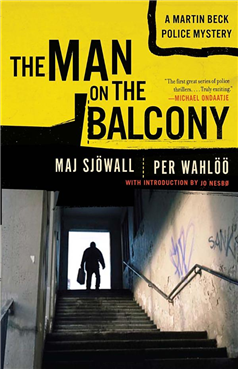
Day 390: The Man on the Balcony

Cover for The Man on the BalconyAlthough it is the third in the Martin Beck series, The Man on the Balcony is considered a breakthrough novel, one of the first realistic police procedurals. Written in 1967, it is based on an actual case from 1963.

The novel begins with a description of a man watching the activity of a Stockholm summer day from his balcony. The scene seems very ordinary, but we know it is important because of the title of the novel. Later, a detective in Martin Beck’s division takes a phone call from a woman who complains that a neighbor is standing all day long watching children from his balcony, but the detective dismisses the woman as a crank. Such activities are obviously not illegal. Although a call like this might send chills down our spines these days, this novel takes place in a more innocent time and place.

The police have actually been working hard on the case of a mugger who attacks people in the parks and robs them. But almost under their noses the body of a nine-year-old girl is found in the park. She has been raped and strangled and her panties stolen. This case becomes the priority, but it is not long before the police suspect that the mugger may very well have seen the murderer in the park.

After a second girl is murdered, Beck realizes he has another potential witness–a three-year-old boy who went off to play with the victim and came back alone. The boy can barely talk, however. Although the book is notable for its realism, this was the only point that I found unrealistic, as usually three-year-olds can speak quite well with some occasional interpretation from their parents.

As Martin and his coworkers doggedly follow every lead and wait impatiently for forensics results, they become more and more stressed and depressed, hoping they can catch a break before the killer strikes again.

These novels are extremely well written. Although the pace is much more leisurely than you would find in an American mystery novel, the novel still builds up a fair amount of suspense. Sjöwall and Wahlöö, the husband and wife writing team, set the standard for this type of mystery to come. Ever since I picked up the first Martin Beck novel, Roseanna, I have been impressed with this series.

Day 389: A Dance with Dragons

Cover for A Dance with DragonsA Dance with Dragons is the fifth book in George R. R. Martin’s A Song of Ice and Fire series. Sadly, we have now all caught up with the author.

On the Wall, Jon Snow has been elected Lord Commander of the Night Watch, but he is having trouble holding his own against his enemies. He is aided by the only one of the battling kings to come to the Night Watch’s assistance, Stannis. Jon is considering allowing the wildings through the Wall, as they are fleeing from Winter. This idea is not at all popular with the Watch, as they have spent many years fighting the wildings to try to keep them north of the Wall.

Far north of the Wall, Bran Stark and his friends have traveled to a secret cave in search of the three-eyed crow. Bran’s intention is to learn to be a greenseer, and he has traveled there for instruction. He is learning that a greenseer communicates through the weirwoods, the ancient trees worshipped by the oldest religion in the Seven Kingdoms.

Across the Narrow Sea and east at Slaver’s Bay, Daenyrys is ruling the city of Meereen but does not want to lose sight of her goal to return to the Seven Kingdoms with an army. Tyrion Lannister, on the run, is on his way to join her. Also on that side of the Narrow Sea, in Braavos, young Arya Stark is training to be an assassin.

The rapacious Cersei Lannister looks like she is down for the count, as her plot to remove her daughter-in-law has resulted in she herself being imprisoned by the Faith of the Seven. But it is always a mistake to underestimate Cersei.

Jaime Lannister is still traveling the Riverlands and has besieged Raventree Hall, the home of the Blackwoods, the last family supporting Robb Stark that has not surrendered. Brienne is on her way to find him to tell him about Sansa Stark’s peril, as they both promised her mother to keep her safe.

The series continues to be very exciting. The characters are thoroughly developed and it is easy to become engrossed in their fates. The complexity of this imagined world is impressive. I am waiting for the next book to come out, but I understand that won’t be for about another two years.