Day 346: Behold, Here’s Poison

Cover for Behold Here's PoisonAlthough Georgette Heyer’s Regency romances are some of the best historical fiction around, also entertaining are her few mystery  novels, set in the time period in which they were written (this one in 1936). The only problem with many of them is that the murderer is frequently the only unlikeable character (except the victim, usually) and therefore highly identifiable. However, Heyer’s novels are character driven, and her lifelike and amusing characters are what make them so enjoyable.

There are plenty of characters to dislike in Behold, Here’s Poison. Gregory Matthews is found dead at his country home. His family assumes the death is because of his bad heart, but the police find traces of nicotine poisoning.

Suddenly, all of the surviving Matthews are suspects, including the domineering Aunt Gertrude, hypocritical Zoë Matthews, and malicious nephew Randall. Inspector Hannasyde and Sergeant Hemingway find that one big stumbling block is their difficulty in figuring out how the poison was administered.

The dialog is especially witty in this novel and the characters lively. As always, Heyer is a brilliant writer.

Day 345: The Chalice

Cover for The ChaliceI am not sure why I found this novel so irritating. Possibly it is because it is a sequel, but nowhere on the cover is that indicated, and this novel is definitely one that requires knowledge of the previous book, which I have not read.

Joanna Stafford is a former Dominican novice after the dissolution of the monasteries by Henry VIII. At the beginning of the novel she is in Canterbury with some ex-monks about to commit some serious act, but then the action turns back several months.

Joanna is living in Dartford with her young cousin and her friends Brother Edmund and Sister Winifred, a former monk and nun who are sister and brother. Some of the townspeople are suspicious of the former residents of the priory, but Joanna has plans to continue there and set up a loom to weave tapestries.

Soon, however, her cousins Gertrude and Henry Courtenay arrive to invite her and her cousin Arthur for a visit. Little does Joanna know that Gertrude is aware that Joanna is the subject of a prophecy, which a group of Catholics believe will save Catholicism in England. Apparently, in the previous novel she received a prophecy and was told she would learn it in full after she received three prophecies. Since her family was destroyed as the result of a prophecy, however, she has promised never to dabble in it again. She is soon subject to immense pressure from Gertrude Courtenay and others, including the Lady Mary Tudor and the Spanish ambassador Chapuys, to see a seer.

The novel does not seem very coherent. Joanna is told she must hear the prophecies of her own free will, yet all kinds of pressures and threats are applied to make her hear them. She is refusing to hear the prophecy, then she isn’t. Then we go through the same thing with the next prophecy. Some of her decisions seem completely unlikely for a person who is extremely religious and was previously a novice. At one point in the book she throws herself at two different men within the space of weeks.

It takes an incredibly long time to feel certain that we’ve learned of everything revealed in the first book–new facts keep popping up until nearly halfway through the volume. This is not a stand-alone novel by any means. Whether it would be more satisfying for someone who has read the first book I cannot answer.

Day 344: Tuesday’s Gone

Cover for Tuesday's GoneTuesday’s Gone is the second mystery/thriller featuring psychotherapist Frieda Klein in a series that is turning out to be quite exciting. A social worker calls on a mentally ill client for a first visit at a grimy, squalid hostel. The client, Michelle Doyce, leads her in to her apartment and introduces her to her guest–a naked man who has been long dead.

The police, embattled with cost-cutting measures, are inclined to close the case even though the victim has not been identified, but DCI Karlsson wants to see what Frieda Klein makes of Michelle, who seems to be talking nonsense. Frieda soon concludes that, rather than having strangled the victim, Michelle suffers from a rare disorder that makes her unable to distinguish the animate from the inanimate and was trying to help him.

When the victim is finally identified, he turns out to be Robert Poole, an apparently charismatic and charming con man and identity thief. He seems to have several potential murderers, but none of them appears to bear him any ill will.

In the meantime, Frieda is slowly beginning to realize that the case from the first book, Blue Monday, is not closed, because the murderer is not dead, as believed. Frieda is sure he is lurking somewhere nearby. She is also involved with troubles with her family and among her friends, as well as the return of her ex-lover Sandy from the US.

Frieda is an interesting character–a loner who likes to walk the streets of London at night and prefers to keep her own counsel yet has several close friendships. The mysteries are involving and complex, and although I figured out who the murderer was before the secret was revealed, it was only a bit earlier. Although the married writing team who calls itself Nicci French builds suspense slowly, the final chapters of the novel are quite thrilling.

Day 343: Poor Caroline

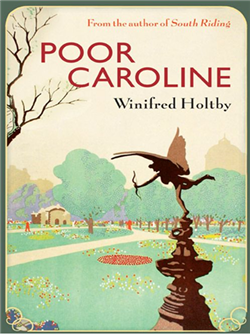
Cover for Poor CarolinePoor Caroline begins with the death of Caroline Denton-Smyth, a do-good spinster who has dreamed of forming the Christian Cinema Company, which will clean up the film industry. This satire of charitable organizations is a little different from the other Winifred Holtby novels I have read, which are about small town Yorkshire.

Caroline, an elderly eccentric, although virtually penniless, forms the film company and manages to put together a board of directors of dubious character. Basil St. Denis is an elegant dilettante who is hoping to use the charity to make some money. Clifton Johnson is a seedy American scammer. Joseph Isenbaum is a wealthy social climber (and not a Christian) who wants St. Denis to sponsor his son at Eton. Charles Guerdon is a Quaker nonentity, Father Mortimer is carrying scars from World War I, and Hugh Macafee is a film inventor who is obsessed with his work. The makeup of the board alone is an object for satire.

Caroline is in some ways admirable, with a buoyant, energetic personality, who devotes herself to one cause or another, only to have it fail or have the rest of the workers desert her. However, she is totally self-absorbed as she pursues her goals.

There are only two completely sympathetic characters in the novel. Caroline’s young cousin, Eleanor de la Roux, wants to learn to be successful in business and break ground for other women. Roger Mortimer, a young Anglican priest, wants to live a life of poverty and service and falls in love with Eleanor.

I am not sure whether I like this novel or what I think about Caroline herself. She is completely blind about her charities, and from the point of view of her relatives has cadged from them shamelessly for years. Certainly she is a believable type, reminiscent of Mrs. Jellyby in Dickens’ Bleak House, who spends all her time on charities for Africa while her children are uncared for and her house falls to pieces.

Day 342: The Tryst

Cover for The TrystThe Tryst is an odd book by Michael Dibdin, the author of the Aurelio Zen mysteries. Although billed as a crime novel, it takes some time to get around to the crime. In fact, it misleads us into thinking it is one type of novel when it is actually another.

The novel follows the actions of two characters, a homeless boy and the therapist who is trying to figure out why the boy is pretending to be insane. Gary Dunn has come to the psychiatric hospital where Aileen Macklin works as a psychiatrist requesting institutionalization and insisting that someone is trying to kill him.

We find out that Gary, a glue-sniffing boy who lives with a bunch of junkies, has befriended an old man. Although Gary’s mates would like to rob the man, Gary has become involved in the old man’s long, involved story about a former employer who sees a beautiful woman no one else sees. In the story, the employer follows the woman to his death. This story eventually connects the fates of Aileen and Gary.

Ultimately, the novel doesn’t work that well, because it starts out being a crime thriller and turns into more of a gothic novel/ghost story. It is too much one kind of novel to work successfully as the other kind. Although the novel is well written and interesting, it reads almost as if Dibdin started with an idea and changed his mind in midstream. For a better example of a book that combines a crime story with a ghost story, read Johan Theorin’s fantastic The Darkest Room.

Day 341: Nightwoods

Cover of NightwoodsBest Book of the Week!

Charles Frazier sets his novels in backwoods North Carolina. His first novel, Cold Mountain, was set during the Civil War. His second, Thirteen Moons, went further back to the treatment of the Cherokee in the earlier part of the 19th century. Nightwoods, his third, deals with more recent times, a small mountain town in the early 1960’s.

Luce is a troubled young woman with a traumatized past who has taken up a secluded life as a caretaker for an old disused lodge across the lake from town. She is unprepared when a social worker brings her the young twin children of her murdered sister Lily, an almost feral boy and girl who refuse to speak and like to start fires.

Stubblefield is lazing away his life on the coast of Florida when he learns his grandfather has died and left him, aside from a load of debt, the lodge and a road house and a considerable number of acres on the mountain. When he goes to inspect the lodge, he is immediately smitten by the skittish Luce.

Trouble is on the way, which we know from the beginning of the novel. Bud, the husband and murderer of Luce’s sister Lily has been released from prison because of a hung jury. He is on his way to town in search of the money he stole, which he gave to Lily one night when he was drunk and she refused to give back to him. He beat her to death trying to get her to tell him where it is, and now he thinks the children know.

This novel is at times tender, as Luce blindly copes with the two damaged children in the best way she can, instinctively treating them with delicacy and kindness. At the same time, the violent Bud resembles a character from a Carl Hiaasen or Elmore Leonard novel, almost comic at times in his psychopathic ineptitude.

The result is an enthralling novel that is both a love story, not just between its characters but with the beauty of nature, and a thriller with a true feeling of danger. As usual with Frazier, the novel is wonderfully well written, with entrancing descriptions of nature.

Day 340: Death on the Nile

Cover for Death on the NileIn this classic Agatha Christie mystery, Hercule Poirot observes a young couple at a restaurant in London and thinks their behavior indicates that the woman loves the man too much. A few months later he meets them again in Egypt, but the man, Simon Doyle, has married the woman’s rich friend Linnet. The first woman, Jacqueline de Bellefort, is haunting their every move during their honeymoon. Poirot thinks no good can come of it and tries to tell Jackie to leave the Doyles alone.

The Doyles sign on for the same Nile river cruise as Poirot. To their fury, Jackie appears on board. Also on board is Poirot’s friend Colonel Race. Race is hunting a criminal who has murdered several people. He believes the person is on board, but has not been able to identify him.

On a tour of some ancient ruins, a boulder falls, nearly missing Linnet and Simon. The obvious suspect is Jackie, but she was on the boat the entire time.

That evening, the drunken Jackie makes a scene in the lounge and then shoots Simon in the leg. The next morning Linnet is dead from a gunshot wound, but both Simon and Jackie seem to have solid alibis. The nurse was with Jackie all night, and Simon was incapacitated with his injury. Poirot and Colonel Race begin looking into other enemies that Linnet may have had.

I think Agatha Christie is the best of the “Golden Era” mystery writers at characterization. She quickly sketches convincing and sympathetic characters. Sometimes you even sympathize with the murderer. Her books are also often set in exotic locations and give you a flavor of a certain place and time. I always find Christie’s mysteries to be enjoyable, and they make fun beach reading.

Day 339: A Visit from the Goon Squad

Cover for A Visit from the Goon SquadBest Book of the Week!

Describing this delightful and quirky novel is going to be difficult, so I hope curious readers will try it even if I am unable to convey a sense of it.

First, I call it a novel, but it can be just as accurately described as linked short stories. Each chapter is written from the point of view of a different character who knows one or more of the other characters. The chapters all center around the subjects of music and public relations.

The book begins in New York with Sasha, who is the assistant to Bennie, a music executive, sometime after 9/11. She is on a desultory date with Alex, but she also has a problem with kleptomania. While in the bathroom, she steals a woman’s wallet and then has to watch while Alex gets involved in helping the woman.

Next is a middle-aged Bennie, who torments himself with feelings of shame about past experiences. He takes his son to visit a sister act in order to fire them for not producing an album in the specified amount of time. He realizes he is beginning to see his legendary taste diverge from that of his younger coworkers.

Then we jump back thirty years to Rhea, a teenager in San Francisco who is a member of a punk rock band called the Flaming Dildoes with her friends Bennie (yes, the same Bennie), Scott, Alison, and Jocelyn. Rhea observes Jocelyn’s budding relationship with a middle-aged record executive named Lou, who will become Bennie’s mentor. Rhea is dismayed as Lou gives Jocelyn drugs and gets her to perform sexual acts in public.

These are just the first of the vignettes, which range forward and backward in time over 40 years and extend in structure to a touching PowerPoint presentation and a parody of a celebrity interview. They make stops in Arizona, Italy, and South America but somehow center on New York. Fans of Egan will already be familiar with a certain type of hip, aware New Yorker that appears in her fiction.

By turns funny, touching, and sharp as a razor, Egan’s observations are always entertaining and her intelligence apparent. An obvious theme of this work is the effect of time on characters but another one is how technology seems to have sped time up, the book ending in a futuristic world where public relations is centered on the tastes of babies. The PowerPoint chapter shows us that another theme is pauses, in music and in life.

One of the things I wanted to do when I finished reading A Visit from the Goon Squad was to read it again so that I could know what I was looking for from the beginning and fully understand all the connections. And that is what I plan to do, having inserted the book into my pile of future reading to enjoy again.