Day 338: Raylan

Cover for RaylanMy husband and I recently got hooked on the TV show Justified, which is just as surprising to us as to anyone who knows us, because it is fairly violent. One of the things we like about it is the well written, darkly humorous script. After we watched a couple of episodes, I paid more attention to the credits and discovered that the series is based on stories by Elmore Leonard, which explains a lot. It was with interest, therefore, that I discovered this book, titled after the main character in the series, Raylan Givens.

Marijuana growing has become the cash crop for Harlan County, Kentucky. As a deputy US Marshall, Raylan Givens isn’t concerned with drug enforcement. But Dickie and Coover Crowe have decided to expand their drug business by dealing in body parts. When Raylan tries to serve a federal warrant against Angel Arenas, another marijuana dealer with ties to the Mexican Mafia, he finds him bloody in his motel room with his kidneys removed.

Raylan is on to Dickie and Coover very quickly, as they’re not the brightest of bulbs. He is more interested in catching the doctor who is removing the organs, figuring the Crowe boys aren’t smart enough to cook up this scheme themselves.

This case is solved about midway through the novel, and Raylan gets roped into providing security for Carol Conlan, a representative for a coal company that wants to blast the top off the last remaining mountain in the area. Raylan is not sympathetic, but he is more concerned about the old man who was supposedly shot to death by Boyd Crowder after firing his shotgun at Carol. The old timers who knew Otis claim that if he was shooting at Carol, she’d be dead.

The writing is darkly humorous, with the style of the local dialect skillfully recreated. My problem with this novel is it has no focus except perhaps around the character of Raylan. It reads as if it were quickly put together from several short stories rather than plotted out as a novel. I was a little disappointed.

Day 337: A Folly of Princes

Cover for The Stewart TrilogyIn the sequel to Lords of Misrule, Prince David Stewart is now a young man ready to challenge his ruthless uncle Robert Stewart for the Governorship of Scotland, under the weak rule of David’s father, Robert III. Jamie Stewart, our hero, who has always suspected Robert Stewart of having his lord, the Earl of Douglas, murdered, has declared himself David’s man.

But the Stewarts are an unruly bunch. David’s governorship is more fair and less corrupt than his uncle’s, and he puts in place reforms, but he takes no care in dealing with the proud nobles of Scotland and behaves wildly and promiscuously in his private  life. Although Jamie continues to support him, he is disappointed in his prince and fears that all will not be well.

While this is going on, changes in the Plantagenet monarchy in England threaten the border. At the same time, Donald of the Isles is making his own forays farther north. This northern threat gives Jamie an opportunity of renewing his acquaintance with Alexander Stewart of Badenoch.

Again, Nigel Tranter does a wonderful job of explaining the complicated politics and alliances of early 15th century Scotland, while spinning an absorbing adventure story.

Day 336: 61 Hours

Cover to 61 HoursEvery once in awhile when I want some purely escapist reading, I pick up a Jack Reacher novel by Lee Child. I haven’t read these books in order, in fact I’ve only read a few, but they are certainly exciting, to say the least. For those who are not familiar with Reacher, he is an ex-army major who has become a drifter, wandering around the country and taking care of situations that he mostly falls into.

Jack has hitched a ride on a bus full of senior citizens when an accident strands them in the small town of Bolton, South Dakota, in the middle of a snowstorm. With our inside information, we readers know that the car crash is not actually an accident. Outside of town, a Mexican drug cartel has taken over an abandoned military facility. The local police are guarding Janet Salter, an old lady who is  a key witness against the cartel.

It is simply chance that causes Reacher to become acquainted with Janet. But when he learns that the police are expecting a visit from an assassin, he decides to help protect her.

I have seen comments on Amazon from hard-core Jack Reacher fans complaining that this novel is not as action packed as the others and that the series is deteriorating. I don’t really have any complaints, but then I have only read a couple of the novels. I found the book fast paced and exciting.

Day 335: A Time of Gifts: On Foot to Constantinople: From the Hook of Holland to the Middle Danube

Cover for A Time of GiftsIn December 1933, nineteen-year-old Patrick Leigh Fermor set out alone on a great adventure, a walking trip from Amsterdam to Istanbul, or as Fermor still called it, Constantinople. (It was renamed in 1930.) He had no idea when he left that he would not return until 1937. In 1977, he collected his notebooks from the trip and wrote A Time of Gifts and its sequel Between the Woods and the Water.

Although Leigh Fermor had one notebook stolen from him with all the rest of his gear, he otherwise must have kept careful account and his memories of the trip must still have been vivid, for the result is an entrancing account of scenery and architecture, tales of chance encounters, glimpses of foreign customs and celebrations, and so on. Jan Morris, who wrote the introduction, calls him “one of the great prose stylists of our time,” and Wikipedia, quoting an unnamed British journalist, “a cross between Indiana Jones, James Bond and Graham Greene,” presumably for his work with the Cretan resistance in World War II as well as his writing. (He was also a friend of Ian Fleming.)

From his drinking bouts with Dutch barge men to his extended stays in various German, Austrian, and Czech castles, Leigh Fermor plunges enthusiastically into every experience on offer. At one moment he is sleeping in a barn, in the next hanging out with fashionable youth in Vienna. Along the banks of the Danube he is mistaken for a 50-year-old smuggler. All of these adventures as well as his observations of nature are described in beautiful, evocative prose. To add interest to the modern reader, he is describing a Europe that no longer exists.

If I have any complaint, it is one of my own education, for Leigh Fermor’s writing assumes for his audience a familiarity with classical culture that is no longer common. The book often alludes to mythology and refers to obscure historical events that I do not fully understand. Finally, in the footnotes, which are Leigh Fermor’s original ones, all utterances in modern languages (some of which I could have taken a stab at) are translated, but the quotations in Latin are not. They are not integral to comprehension, but it is a little frustrating to be unable to understand them. (Of course, I could have googled them, but I was almost always reading this on the bus.) That being said, I look forward to reading the sequel.

Day 334: Pawn in Frankincense

Cover for Pawn in FrankincenseBest Book of the Week!

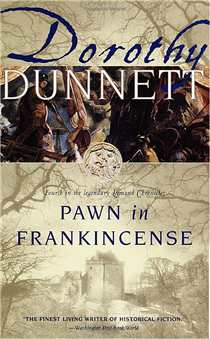
In the fourth exciting book of the Lymond Chronicles, Francis Crawford of Lymond sets out to find his two-year-old child by Oonagh O’Dwyer, hidden somewhere in the vast Ottoman Empire. He disguises his personal mission with the official one of delivering an elaborately decorated piano from the King of France to the Sultan in Constantinople. Another goal is to find and kill the traitor Graham Mallet Reid, who has the child in his power. The problem of the child is complicated because Lymond doesn’t know which of two boys, one Reid’s by his sister Joleta, is his own. Another complication is that if any harm comes to Reid, the boys, under the protection of Sulieman, will both be murdered.

Accompanying him and his household are a couple of merchants, including the mysterious Marthe. Raised in the household of the Dame de Doubtance, Marthe, except for her sex, could be Lymond’s identical twin.

After some disastrous adventures, Lymond believes he has sent home the redoubtable fifteen-year-old Philippa Somerville, who foisted herself upon him thinking he would need her help to care for the child. However, she is actually on her way to join the seraglio to find one of the boys, Kuzum, while Lymond searches in the stews of the city for the other one, Khaireddin. Philippa’s role in this novel is a major one, with her character and her opinion of Lymond changing and maturing as their adventures continue.

Aside from the intrigues taking place in an empire that is Byzantine in its complexity (not to make a pun), Lymond is hampered in his activities because of sabotage by a member of his own household staff. He also suffers from his usual problem of failing to explain his actions to his adherents, such as Jerrott Blyth, so that they become angry and occasionally work against him.

In action that moves from Marseilles across Europe to North Africa and finally to Constantinople, Lymond’s concerns grow to involve the fate of nations.

Day 333: Pigeon Pie

Cover for Pigeon PieThis exceedingly silly book about Britain just before World War II has its amusing moments. Although it is not one of Mitford’s best, it still made me laugh out loud at times. The novel spoofs British high society, spy stories, and religious cults.

The heroine is Lady Sophia Garfield, a stupid, frivolous society matron who lives happily, mutually ignoring her husband, who admires Hitler. As events move toward war, she begins to suspect she has a nest of German spies in her home. Although no one believes her, she eventually manages to foil them.

One of the funniest moments for me has to do with Lady Sophia’s chief social rival, whom she distinctly remembers as the ordinary school girl Baby Bagg but who goes around pretending to be a Russian princess, Olga Golgothsky. Inclined to the theatrical, Olga frequently makes remarks about what would happen to her if she went to Russia–she says she would be handed over to the peasants to do what they please. Our heroine reflects on what Russian peasants must be like, thinking that if she were handed over to British peasants to do what they please, they would put her in the best bedroom and give her a cup of tea.

Day 332: A Serpent’s Tooth

Cover for A Serpent's ToothHaving caught up with author Craig Johnson in the Walt Longmire series, I was waiting with interest for this next book, which just came out.

Walt is attending a funeral when a batty old lady begins telling him about the angel who lives in her house and does chores for her while she’s out. At first inclined to dismiss what she is saying, Walt stops to listen and decides to go out to her house. There he finds a teenage boy fixing the plumbing. The boy bolts and Walt finds evidence that he has been living in the spring house.

Once Walt is able to locate the boy, he finds out he is Cord Lynear, a fifteen-year-old castoff of a fundamentalist Mormon group called the Apostolic Church of the Lamb of God that has a compound in the county and another one in South Dakota. In his attempts to find Cord’s home, Walt learns that a woman named Sarah Tisdale was looking for the boy at a sheriff’s office in South Dakota and that several men arrived and took the woman away. Walt comes to believe that this woman is one who has been missing for seventeen years, and so his focus changes to finding out what happened to her. The Mormons, however, disclaim all knowledge of her.

The more he looks into it, the more Walt feels that something is going on in their compound, and not anything legal. He is further bemused by the arrival of an old man who states he is Cord’s bodyguard and claims to be Orrin Porter Rockwell, a Mormon hero who would be 200 years old, were he still alive.

Walt is also sensing undercurrents in his relationship with his volatile lover and undersheriff, Vic Moretti. She has stated a desire to go to the homecoming game with him wearing a corsage in the school colors–a request that Walt finds unusual, to say the least. All the activity is preventing him from discussing it with her, however.

This novel is certainly a worthy entry to the series, packed as it is with puzzles, intrigue, and action. My only very slight critique is that some early references in the book made it easy for me to guess what all the skullduggery–that is, the illegal enterprise–was about.

Day 331: Peaches for Father Francis

Cover for Peaches for Father FrancisLast seen in Paris in The Girl with No Shadow, Vianne Rocher has been living there on a boat with Roux and her two daughters. However, the wind is about to blow her back to Lansquenet, the village she left at the end of Chocolat. In fact, her summons comes from the dead, as she receives a letter from her long-departed friend Armande. Armande’s grandson has reached his majority and, with other papers, received and forwarded a letter for Vianne telling her that Lansquenet needs her help.

Roux is mysteriously reluctant to return to Lansquenet, so Vianne takes her daughters Anouk, 15, and Rosette, 5, for the journey back to the village. She arrives during Ramadan and finds the village practically in a state of war. A large population of Moslems has moved into Les Marauds, the slums where Vianne had her chocolaterie. At first cautiously welcomed into the community, the Moslems now are at odds with the original inhabitants.

This state of affairs is almost uniformly being blamed on Ines Bencharki, a veiled, mysterious woman dressed in black. However, it has most urgently affected the fate of Vianne’s old nemesis, Father Francis Reynaud. He has been accused of burning Madame Bencharki’s home, the same building Vianne used for her chocolaterie, which Ines had turned into a school for Moslem girls. Father Francis is expecting to be transferred out of the village by the bishop. Ironically, he finds himself forced to turn to Vianne for help.

Although I continue to enjoy Vianne and her family, I feel that this novel does not contain the magic of the previous two and is a little more predictable. Vianne’s doubts about Roux’s fidelity seem too foreseeably wrong. We know that Vianne favors the underdog, but considering Reynaud’s unrelenting treatment of her in Chocolat, their alliance seems unlikely. The flavor of the small village that makes us want to return there, so evocative in Chocolat, is missing.

Also, few of the secondary characters, so colorful and interesting in the other books, are given much consideration here. Luc, whose house Vianne and her family are staying in, barely gets a mention. Even though Vianne makes friends with several of the Moslem women, their personalities do not stand out, one from the other. Only the old lady Omi is her own self. The sole old friend who gets any attention is Joséphine.

Nevertheless, it is always a pleasure to spend time with Vianne. There is real danger in this novel and an evil villain. And as always, the novel is beautifully written.