Day 314: The Brutal Telling

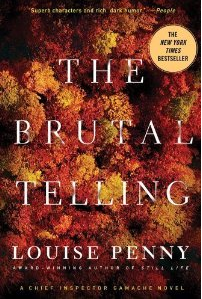
Cover for The Brutal TellingI was unable to judge the difficulty of this mystery because I read its sequel first and therefore knew how the mystery would be solved. The other Louise Penny books are not quite so dependent upon sequence, but I suggest that you read The Brutal Telling before Bury Your Dead, if at all possible.

That being said, I still found the novel to tell a compelling story.

A body is discovered in the bistro/antique shop of the small village of Three Pines. The bistro owners, Gabby and Olivier, are appalled but also confused. No one knows who the man is or where he lives. At least they say they don’t, but the reader knows from the first that Olivier knows more about the man than he is saying.

Inspector Gamache and his team quickly determine that the victim was not killed in the bistro. Soon, they find a cabin deep in the woods that apparently belongs to the man, apparently a hermit. They are amazed to find it stuffed with priceless antiques, first edition books, and treasures from Europe thought to have disappeared during World War II. Gamache begins wondering how Olivier has made such a success of the antiques side of his business. And where did Olivier, or for that matter, the victim, come from in the first place?

Louise Penny’s novels always have more going on in them than the mystery. The setting of the small village is beautiful. The characters are interesting, and we learn more about them with each visit. Gamache is warm and perceptive. As always, I think the covers of the paperback editions should win a prize for most beautiful artwork.

Day 313: Murder on the Eiffel Tower

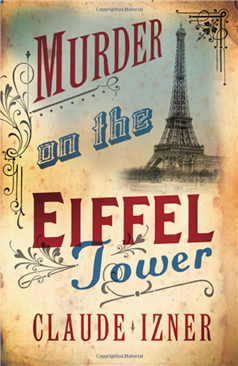
Cover for Murder on the Eiffel TowerThis mystery set at the opening of the Eiffel Tower has a nice sense of history and is well written, but like mysteries written early in the genre (which it is not), it depends almost entirely upon determining opportunity. There is no indication of motive until the lengthy written confession at the end of the novel–standard early detective fiction nonsense–that is, charming in earlier fiction, but not so much now. This novel was published in 2009.

People begin being killed by “bee stings” on or near the Eiffel Tower the day before Buffalo Bill arrives in Paris for the opening of the 1889 World Exposition. Bookseller Victor Legris starts looking into these incidents after he notices that Kenji Mori, his father figure and business partner, met with more than one of the victims near the time they were killed. He also begins to fear that the woman to whom he is attracted, Russian illustrator Tasha Kherson, could be involved.

I found Victor to be silly, not very good at investigating, and prone to overlooking clues. Many secondary characters are only sketchily drawn and therefore difficult to keep straight. So for me, despite all its promise and its setting in an exciting period of time, Murder on the Eiffel Tower was not a success.

Day 312: Castle

Cover for CastleEven from the first moments of reading the unusual Castle, the novel seems to be about more than is on the surface. That notion turns out to be the case.

Eric Loesch returns to the town where he grew up and buys a large piece of property outside of town. Then he starts fixing up the farm house. He almost immediately becomes fixated on a large rock on the property and eventually finds the ruins of a castle behind it.

This activity seems all very straightforward, but something more is going on, we’re sure. Loesch is an unusual man, as demonstrated throughout by his thoughts and actions. His reactions to seemingly ordinary conversational gambits seem extreme. His emphasis on privacy seems excessive. We also feel, although we don’t know why, that he may have a military background.

Castle is a novel that unfolds slowly but keeps your attention throughout. It becomes clear that there are painful incidents in Loesch’s past, but the novel takes its time getting to them, and Loesch seems to be in denial about some of them.

The writing is skillful, particularly in delineating Loesch’s character through his behavior. In fact, I don’t know when I’ve understood the personality of such an unusual character so particularly before without the author actually telling me about it.

The revelations at the end of the novel are not, for the most part, foreseeable, although I could eventually predict at least one important plot point. All-in-all, Castle is a disquieting, dark tale.

Special Post. Change of Pace

Magic of ReadingTo start out today on a different note, I’d like to post a picture of this beautiful painting called The Magic of Reading. This picture appeared today on the Texas Education Agency web site, and is student art, by Elvina Almeida of the Dealey Montessori Vanguard and International Academy, in Dallas.

Day 311: Lords of Misrule

Cover for The Stewart TrilogyNigel Tranter was a historian and a prolific historical fiction writer whose work can be uneven. During the 1950’s through 1990’s he wrote more than 60 historical novels, some of which employ dialogue and characterization only to drive the plot forward. Such is not the case, however with Lords of Misrule, the first book in his Stewart Trilogy, a novel that is fully realized.

Jamie Douglas is a young esquire to the Earl of Douglas, the most powerful man in 14th century Scotland, certainly more powerful than the King, Robert II, a sorry descendent of Robert the Bruce and doddering old man who just wants to be left alone. The King has spawned a clutch of squabbling Stewarts who are waiting to see what happens when he dies. Unfortunately, his oldest son, John, seems unsuited to power, and his second son, Robert, is ambitious and dangerous.

When Jamie’s lord is foully stabbed in the back by his own armorer during battle, Jamie fears that any of several powerful men may have had enough to gain in the subsequent power vacuum among the Douglasses to have suborned the armorer. But when Robert Stewart, acting as his father’s Governor, appoints his good friend Archie Douglas to take the position of Earl, Jamie’s suspicions point to Robert.

Jamie and some other men lie in wait outside the armorer’s home after they figure out where he is hiding, in hopes they can capture him and question him about who paid him to murder the Earl. Their plans go awry, however, ultimately sending Jamie Douglas north in pursuit of another man, to the Highland territories of the dreaded Alexander Stewart, Earl of Buchan, known as the Wolf of Badenoch.

This novel provides a fascinating glimpse into the rivalries and political in-fighting among the early Stewarts. It has an appealing protagonist, although Jamie is a bit too honest and outspoken for his own good. It also includes a romance, as Jamie is drawn to two different Stewart women while serving a third, his Earl’s widow. Having learned most of my Scottish history from the excellent historical novels of Dorothy Dunnett, I am not accustomed to thinking of Douglasses as heroes, but Jamie makes a good one.

Day 310: The Killer Inside Me

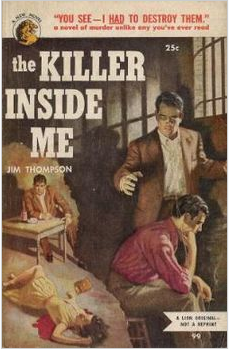
Cover for The Killer Inside MeJim Thompson’s classic noir thriller The Killer Inside Me was one I had never read, so I picked it up out of curiosity. Normally, I am not drawn to classic noir, even though I like a crime novel that is dark. This brief novel easily kept my attention, though.

Lou Ford is a deputy sheriff in a small Texas town. He projects the image of a jovial good guy, maybe even a little stupid, who continually spouts clichés. But he has actually been hiding his sociopathic tendencies for years.

Ford begins a sadomasochistic relationship with Joyce Lakeland, a prostitute. He sees a way to use his relationship with Joyce to get revenge for his brother’s death. As a teenager Ford sexually abused a little girl, and his foster brother Mike took the blame. After he got out of jail, Mike died in a construction accident, and Ford has blamed the local owner of the construction company for Mike’s death.

Ford and Joyce begin blackmailing the owner of the construction company in return for keeping his son’s affair with Joyce secret. Then Ford sees a way to take it all one step further. Of course, things don’t always go as planned.

As in reading Patricia Highsmith’s Ripley novels, a large part of the fascination of this disturbing book lies in wondering how Ford is going to get out of one fix after another. Thompson’s writing is deft and tight. You will be glued to the page, even if you don’t like noir.

Day 309: Parrot and Olivier in America

Cover for Parrot and OlivierBest Book of the Week!

Peter Carey’s Parrot and Olivier in America is a fictional riff upon Alexis de Tocqueville’s trip to America in the early 19th century, from which resulted the classic Democracy in America. Olivier de Garmont is the character meant to be Tocqueville, an aristocrat with liberal leanings who is nevertheless an elitist snob.

Parrot is his servant, a man who has lived a colorful but frustrating life. An Englishman, he has had his life disrupted since he was a boy by another French aristocrat, the Marquis de Tilbot, who spirited him away from England after his father, a typesetter, was arrested as an accomplice to forgery.

In dangerous post-revolutionary France, Olivier’s mother has decided it would be wise for Olivier to leave the country, as his liberal leanings have offended the conservatives, but he is unacceptable to the liberals because of his aristocratic birth. She ends up shipping him off to America with Parrot as his secretary, on loan from Tilbot and instructed to report back Olivier’s movements.

But America inflames Parrot’s own democratic leanings. He believes himself to have a talent for engraving that he has never been able to develop while working as Tilbot’s servant, and he resents his status as a “vassal.” While Olivier feels that their rocky start has developed into a relationship that is almost love, Parrot affectionately? calls him “Lord Migraine.”

This novel is narrated in alternating chapters by Olivier and Parrot. It is entertaining–wittily and robustly written–although sometimes we seem to have stumbled into a Dickens novel, especially when reading about Parrot’s early life. In fact, I read recently that Carey wrote an earlier book, Jack Maggs, based on Magwich of Great Expectations, so that feeling is probably not too far off.

Day 308: Love in a Cold Climate

Cover for Love in a Cold ClimateLove in a Cold Climate is more of a companion novel to Nancy Mitford’s The Pursuit of Love than a sequel, because it focuses on a different group of characters. Fanny is still the narrator, and she returns to tell a little more of her own story but mostly that of her beautiful friend and distant relation Polly Hampton.

When Fanny receives an invitation to stay with the family upon their return from India, she is happy to renew her friendship with Polly. Polly’s demanding mother, Lady Montdore, has been pushing her toward marriage, but Polly resists. Polly has always been difficult to read, unlike Fanny’s Radlett cousins from The Pursuit of Love, who “told everything.” Although Polly is so beautiful that she could have her pick of the eligible bachelors, she tells Fanny that she finds the whole life of the social season boring.

Lady Montdore is a rapacious, snobbish manipulator with social ambitions, although not without charm. Another family member who is important to the novel is also a snob, “Boy” Dougdale, the husband of Polly’s aunt, Lady Patricia. Fanny and her cousins have always called Boy “the Lecherous Lecturer” because of his tendency to furtively grope very young girls. Much to everyone’s surprise, Polly’s secret comes out when, shortly after Lady Patricia’s death, she marries a reluctant Boy, for she has been in love with him for years.

Polly is ostracized from her family and cut out of her father’s will as a result. But the plot thickens upon the arrival of Lord Montdore’s heir, the effeminate and hilarious Cedric Hampton.

As usual with Mitford, we have a strong suspicion that all her ghastly and funny characters strongly resemble real-life society members of her time. Her novels are full of vivid characterizations and incisive dialogue. Even in today’s world, so removed from her own, her novels are extremely funny.

As a side comment about the cover art, I find the covers of the most recent editions of Mitford’s novels to be too romantic and to do nothing to convey the spirit of her novels. I was able to find a better cover for The Pursuit of Love, but this was all I could find for Love in a Cold Climate.

Day 307: Unnatural Death

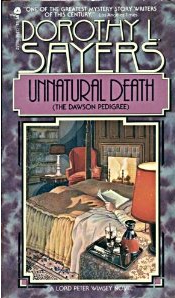
Cover for Unnatural DeathAfter a long battle with cancer, Miss Agatha Dawson dies, leaving her considerable fortune to her great niece, Miss Whittaker. Nothing may be suspicious about this, but a local doctor is uneasy. He did not attend her at her death, but he treated her earlier and distrusts Miss Whittaker. When he cautiously voices his doubts, he is drummed out of the community for blackening Miss Whittaker’s name. So, he turns to Lord Peter Wimsey for assistance.

Miss Dawson’s nurse insists that the old lady was delirious the last month of her life and couldn’t possibly have written a will. The witness to Miss Dawson’s will claims that Miss Dawson did not want to be involved in the signing of the document. This does seem suspicious. Lord Peter is vaguely interested, but when he starts looking into the case, odd things happen. The first is that the maid dies.

Lord Peter and his friend Inspector Parker pursue the case, Lord Peter with his usual humor and urbanity. Lord Peter is an interesting character. A World War I veteran who is still haunted by the events of the war, he hides his nerves with bouts of silliness. He is a collector of rare books and a pianist who also flies his own plane and barrels around the countryside in his motorcar.

By and large, I enjoy Sayers’ Lord Peter Wimsey novels, although on occasion they get bogged down in a myriad of details, for, as a Golden Age mystery writer, Sayers prefers to present her readers with puzzles rather than motives. However, the complexity in Unnatural Death is created with the plethora of suspects who managed to traipse through the dying woman’s bedroom, all with their own stories–an approach that is more to my taste than complicated railway timetables.