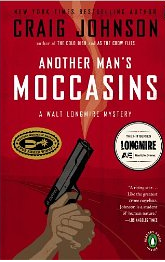
Day 298: Another Man’s Moccasins

Cover for Another Man's MoccasinsThis Walt Longmire mystery interleaves the present-time story with flashbacks to Longmire’s experiences during the Vietnam War. I wasn’t sure I was going to enjoy this development, but the novel turned out to be very good, as the two stories are linked.

Walt is helping his daughter Cady recover from her experiences in Philadelphia (detailed in the previous book) when he is called out to the body of a young woman found along a county highway. Walt immediately recognizes the woman as Vietnamese. Next to the body is a huge Crow Indian, who runs away from Walt. In chasing him down, Walt discovers that he has been living in a culvert. When Walt takes him into custody, he won’t speak.

The discovery of the Vietnamese girl triggers memories of Walt’s first homicide investigation as a marine in Vietnam. The girl’s identification shows she is named Ho Thi Paquet, but in among her possessions, Walt find the picture of another woman who resembles someone he knew in Vietnam. With the help of his friend Henry Standing Bear, Walt finds out that the girl is connected with a large human trafficking ring in Los Angeles.

Walt decides that the Crow, identified as a mentally ill Vietnam vet named Virgil White Buffalo, probably didn’t kill Ho. He also doesn’t think it is a coincidence that a Vietnamese “tourist” has appeared, staying in a motel in Absaroka County.

As I have said before, I really enjoy this series. I enjoy the sense that the landscape of Wyoming is as much of a character as the people in the novels, and I like the recurring characters, who keep developing new dimensions.

Day 297: Persuasion

Cover for PersuasionMost people have probably read Pride and Prejudice, which is a wonderful book, but if I had to pick my favorite Jane Austen heroine, it would be hard to decide between Elinor Dashwood of Sense and Sensibility and Anne Elliot of Persuasion. Probably fewer people are familiar with Persuasion.

Anne is no longer in the bloom of youth. Seven years ago she fell in love with a young naval officer named Frederick Wentworth, but Sir Walter, her superficial, supercilious father, did not approve. Perhaps the gentle Anne would not have been dissuaded from marriage, but her older friend and mentor, Lady Russell, talked her out of the engagement because of Wentworth’s lack of wealth and social position. Anne listened because she viewed Lady Russell as a surrogate mother, and she hasn’t heard from Wentworth since.

Now the family has fallen upon hard times, and Sir Walter is forced by his profligacy to lease their house and take rooms in Bath. He and Anne’s fashionable sister Elizabeth care very little for Anne, and they leave her to close up the house and make all the arrangements for its occupation by an Admiral Croft. Much harassed, she readies the house and tends to her hypochondriac, selfish sister Mary Musgrove. At least she enjoys the company of the children and Mary’s genial in-laws, with their two daughters Henrietta and Louisa and Anne’s brother-in-law Charles.

Anne meets the friendly Admiral and Mrs. Croft, and between their society and that of the Musgroves, begins to find a little pleasant enjoyment. However, she is soon dismayed to learn that Frederick Wentworth is Mrs. Croft’s brother, and he will be arriving soon. Wentworth is now wealthy and has retired from the service.

When he arrives, Wentworth pays little attention to Anne; in fact, she overhears him saying that she has changed so much he would not have recognized her. This remark distresses her very much, as her feelings have not altered. Soon he appears to be courting Louisa Musgrove. Anne finds it easiest to send Mary off into company while she stays home with her nephews.

After Louisa has a fateful accident on an outing in Lyme Regis, Anne finds herself taking charge and summoning help. Then she returns with Wentworth to notify Louisa’s parents. Feeling superfluous after the Musgroves leave with Wentworth for Lyme Regis, Anne decides she has no choice but to join her unpleasant father and sister in Bath.

What I love about Anne is her understated good will. Despite the insults by her family members and their general bad treatment of her, she tries to help them and to be a true sister and daughter to them. Despite Wentworth’s slights and attention to Louisa, she hides her feelings and remains faithful in her heart. Anne has much in common with Elinor Dashwood, except that Elinor is well regarded by her family and Anne is not. There is something delicate and understated in this novel, and in all of Austen’s work, that I appreciate in this more tempestuous modern world.

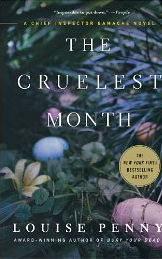
Day 296: The Cruelest Month

Cover for The Cruelest MonthThe village of Three Pines in remote southern Quebec has a psychic visiting, so bed and breakfast owner Gabri arranges a séance on Good Friday evening. It is not very successful, but some of the participants decide to try again at the deserted Hadley house the next night. A few additional people attend, and several of the group are filled with foreboding. The Hadley house has, after all, been the scene of frightful crimes.

In a dusty, candle-lit room, the participants hear a horrible noise and one of their party drops dead–Madeleine Favreau, a vibrant, popular woman who shares a house with Hazel Smyth. When Inspector Gamache and his team arrive, they find that someone has slipped Madeleine the banned drug ephedra, which, combined with a weak heart, has resulted in a fatal heart attack.

The investigators find motives for several of the people at the séance, mostly those of jealousy or thwarted love. But Gamache’s team is also dealing with its own problems. Senior officers want to destroy Gamache because of his role in accusing a popular superior officer of crimes years ago and so have inserted a spy into his team. However, they have found other ways to strike, as Gamache begins finding newspaper articles attacking him and his family.

As always with Louise Penny’s mysteries, the plot is compelling and Gamache and the other characters are interesting. Of course, it is unusual that a small village like Three Pines would suffer so many violent deaths, but it is a pleasure to continue revisiting the village and its inhabitants, so I think we have to suspend our disbelief. I also think the series deserves some kind of prize for the most beautiful cover art.

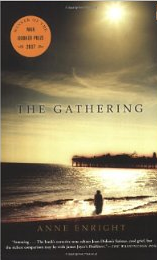
Day 295: The Gathering

Cover for The GatheringA large family in Ireland is gathering together for the wake of their brother, Liam, who drowned. Veronica Hegarty, his sister, travels to London to collect the body and keep vigil with it.

This novel follows her consciousness as she thinks about her relationships with her own husband and the rest of her family and considers why her brother’s life turned out the way it did. She describes Liam as a “terrible messer,” who was an alcoholic and finally put stones into his pockets and walked into the sea.

She also remembers her grandmother Ada, and imagines scenes involving her grandmother’s relationship to Veronica’s grandfather and to another man when she was a young woman. Veronica muses about life growing up in her grandparents’ house and the connection with her brother’s secrets and troubles. She feels guilty that she did not help him and that no one sympathized with him when he was alive.

This novel is angry, heavy, and sometimes repels the reader. By page 55, I felt that the narrator was inordinately concerned with the mechanics of men’s penises. Still, it is an evocative story about a woman’s grief and her struggle to understand her brother.

Day 294: Death on the Nevskii Prospekt

Cover for Death on the Nevskii ProspektGiven my interest in Russia and the time period, this novel should have been a slam-dunk for me, but I was disappointed. Lord Francis Powerscourt is asked to investigate the death of a British diplomat in Russia, who was discovered with his throat cut on a bridge across the Nevskii Prospekt. No one in the British government knows why the victim was in Russia, and the Russians, having reported his death, pretend that they know nothing about it.

Powerscourt’s investigations seem to be pointing to the victim having had a secret meeting with the Tsar. In addition, Powerscourt may be running up against the Russian secret police, the Okhrana.

The book begins with a completely unnecessary chapter or two devoted to efforts to try to persuade Lord Powerscourt’s wife to release him from his promise not to take any more investigations. In addition, the real circumstances of the death seem completely unlikely. Characterization was minimal, and the plot had several unlikely points.

Dickinson’s historical research is commented on in the blurbs, but there was little in the novel that anyone doing the most cursory reading about Tsarist Russia’s last days wouldn’t know.

Day 293: Before the Poison

Cover for Before the PoisonI never read anything by Peter Robinson before. I looked him up because of the TV series “DCI Banks,” as he is the author of the Inspector Banks series, but then I found that Before the Poison was already on my list of books to read. It is not an Inspector Banks novel, but I found it gripping from start to finish. Although it is not a mystery novel in the traditional sense, it involves an investigation of events in the past with revelations about the present and even the hint of a ghost story.

Chris Lowndes is a recent widower, a British composer of film scores who has been living in California for 35 years. He has purchased a large house in rural Yorkshire sight unseen with the intent of making his new home there and writing more serious music.

At the beginning of the novel, he arrives at his new home, which is beautiful and old but very isolated. He is puzzled to find some personal possessions left behind although the house has been leased for many years and asks his rental agent to find out who used to own it, as he bought it from a solicitor’s office.

Lowndes soon learns that his house was the scene of a notorious murder. Grace Elizabeth Fox, a nurse during World War II, was found guilty in 1952 of murdering her husband, the local doctor. Lowndes becomes interested in the murder and soon finds that the evidence against Grace was circumstantial and mostly based on the fact that she was having an affair with a much younger man. As he tracks down information and villagers who were alive at the time, Lowndes begins to wonder if there was a crime at all or if Doctor Fox died from natural causes.

Alone in the house most of the time, sometimes stranded by bad weather, Lowndes occasionally battles with depression, misses his wife, and is kept awake by strange noises in the house and thinks he glimpses a woman in the mirror of a wardrobe. He is also attracted to Heather, the realtor, who is having marital problems. And he keeps seeing a hooded figure out by the old lime kiln. Eventually he comes across a diary belonging to Grace, which relates her experiences as a nurse during the war.

This novel is atmospheric and very interesting. A few times I thought I knew where it was going, but it went somewhere else. I wasn’t really interested in the subplot involving Heather–I didn’t really like her–but otherwise I was totally engrossed by the novel.

Day 292: Russia Against Napoleon: The True Story of the Campaigns of War and Peace

Cover for Russia Against NapoleonDominic Lieven explains in the introduction to Russia Against Napoleon that the popular conception of Russia’s role in the battles with Napoleon in 1812-14 is mostly derived from Tolstoy’s War and Peace. Tolstoy posited that the fate of Napoleon’s army was mostly a result of luck on the part of the Russians and the brutality of the Russian winter. Lieven also explains the reasons why most scholarship on this subject has been done from French, German, Austrian, or British records.

However, Lieven is able to convincingly show that the Russian victories, although of course partially due to luck, were mostly because of the understanding of Russia’s Emperor Alexander I and his field marshall, Mikhail Barclay de Tolly, of the kind of war Napoleon was good at and their refusal to give it to him. That is, Alexander and Barclay de Tolly planned from the beginning for a long, drawn-out war that would lure Napoleon deep into Russia, to be followed by a second campaign in Germany and France.

Lieven is a professor of history with the London School of Economics and an acknowledged expert on Russian history. Interestingly, he is also the descendent of three of the generals at the Battle of Leipzig.

Lieven’s book explains in the clearest terms the details of every campaign in those three years, taken from the Russian letters, diaries, and records that have not been readily available until recent years, as well as from the records of British observers and others of the combatants. He provides insight into the political jealousy and maneuverings and even to the details of staffing and provisioning the armies and maintaining the long supply lines needed when the Russian army entered western Europe.

Lieven’s analysis of war is comprehensive, and even though it is very detailed, it never seems to get bogged down in minutia. It introduces us to some colorful characters and vividly and suspensefully describes the battles.

The book’s only weakness for me was that it assumed a little more knowledge of the events immediately preceding these years than I had and knowledge also of the functions of the vast numbers of different types of troops. However, that lack of knowledge on my part did not really impede my understanding or detract from this very interesting history.

Day 291: Brat Farrar

Cover for Brat FarrarI have only read a few mysteries by Josephine Tey and have had mixed reactions to them. I really enjoyed The Daughter of Time, but disliked The Franchise Affair. Brat Farrar is completely different from either of those novels, and I enjoyed reading it.

Patrick Ashby, the 13-year-old heir to the Ashby fortune, disappeared three years go. This novel isn’t a mystery about whether Brat Farrar is an imposter–we know that from the beginning–but about what actually happened to Patrick.

Brat, an orphan who bears a surprising resemblance to the Ashbys, is talked into impersonating Patrick, despite his better instincts, by a ne’er-do-well cousin of the Ashby’s. This cousin has carefully coached him for his part, with the understanding that after Brat inherits, he will pay the cousin a pension. Once Brat arrives at the house, he feels surprisingly at home with the place and the family, except for Simon, his supposed twin brother.

The characters are likeable, and the story keeps your attention, even though I figured out the solution to the mystery fairly early on.