
 This week’s Best Book is Await Your Reply by Dan Chaon!
Day 290: The House of Velvet and Glass
 The House of Velvet and Glass is a slow starter, which I don’t usually complain about, because if I’m enjoying a book enough, it can move as slowly as it wants. Nevertheless, considering how much I enjoyed Howe’s first book, I was surprised at how impatient I became with this one.
The novel begins with Helen and Eulah Allston, two entirely trivial women, mother and daughter, journeying back from a European husband-hunting expedition–on the Titanic. Although we’re told which ship they are on only at the very end of the first chapter, as if it were an ironic or surprising fact, the ship’s identity was very clear from early in the chapter.
Three years later, Sybil Allston is comforting her grief and anger at the death of her mother and sister on the Titanic by visiting a psychic. She is wholly convinced that she is receiving messages from the afterlife. On one of her visits, the psychic gives her a piece of crystal called a scrying stone.
Sybil’s father Lan Allston is a wealthy man who made his money through shipping, but he seems to spend all his time in his dark back parlor. Her brother Lanny looks as if he may be entering the life of a ne’er-do-well gambler and womanizer.
Not everything is as it seems, but I became extremely impatient waiting for the novel to go somewhere while we occasionally skipped backward in time to Lan as a young man in Shanghai or to Helen and Eulah on the Titanic.
Eventually, the novel becomes about a woman discovering her own powers, and the second half of the novel is much better than the first. But I did rebel against one thing. I particularly dislike it when characters in historical novels behave like modern people. I felt it would be extremely unlikely that Sybil would urge her father to bring home a woman they both think is a prostitute (and by their lights, is one) just because she has her brother’s blood on her dress. And I certainly don’t believe that her father would encourage Sybil to get to know her, although there turns out to be a reason for that. Completely unbelievable is the scene where Sybil takes her to her club or the scene where she goes, however, unwittingly, with her to an opium den.
So, a very mixed reaction to this novel. Ultimately, it became interesting, although the much-vaunted twists at the end were largely foreseeable.
Day 289: Birds of a Feather
 Maisie Dobbs is a “psychologist and investigator” solving cases in post World War I London. Birds of a Feather is the second book in the series by Jacqueline Winspear. Maisie’s background is unique, in that she is a former serving girl who was taken up by a mentor, educated, and trained in some unusual techniques to use in her investigations.
Maisie accepts the case of a wealthy owner of grocery stores, Joseph Waite, to find his daughter Charlotte, who is in her 30’s, and return her home. As Maisie investigates the case by locating Charlotte’s friends, they begin dying. At each crime scene, a white feather is left. White feathers were traditionally given to young men during World War I to shame them into enlisting, as they are a symbol of cowardice.
I read the first book in this series, Maisie Dobbs, and was not enthralled with it, so I only read this novel because it was chosen for my book club. I finally decided that I like the book a little, but it certainly has its flaws. Winspear is not very good at delineating Maisie’s character, I feel. Maisie also speaks surprisingly modern American English for a British woman in the 1930’s.
The biggest problem I have with Maisie, though, is that the unusual skills she has picked up to use in her investigations are far too New Agey to be convincing for a character in the 1930’s. It does not help my enjoyment of the novel, I fear, that I find many New Age ideas irritating.
In addition, it makes no sense to me at all that no one seems surprised to find the detective is a young woman. Even in P. D. James’ classic An Unsuitable Job for a Woman, written in 1972, characters express surprise to find a woman in that role. All-in-all, this makes too many anachronisms in the series to suit me.
Finally, I know this is a silly quibble, but I feel that Winspear spends too much time describing Maisie’s clothes.
Day 288: The Return
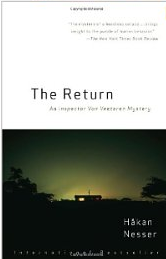 During a nursery school outing in a forest, a little girl finds a body. A corpse, headless, handless, and footless, is buried in the woods and has been there at least six months.
Inspector Van Veeteren has some difficulties even identifying the body. Any man the age of the corpse who has been reported missing does not fit the description.
Van Veeteren has already entered the hospital for colon surgery before a woman reports that the body may belong to her estranged brother–once a famous athlete who was accused of cheating and was later found guilty of murdering two of his ex-lovers. It appears that the victim, Leopold Verhaven, had been released from prison shortly before the murder.
The investigation of Verhaven’s murder naturally leads back to the murders for which he was imprisoned. Van Veeteren has plenty of time to read the trial transcripts in the hospital and finds that Verhaven was convicted on very little evidence. Eventually the team is lead to consider whether Verhaven was guilty of the murders at all.
As Van Veeteren follows up on his own while on leave, his team having been removed from the case, we get a lot of insight into his character, although not as much into that of his team members. This novel is interesting and dark, and in the course of it, a line is to be crossed.
Day 287: The Dragonriders of Pern
 Anne McCaffrey’s fantasy books about Pern were a guilty pleasure for me starting in high school. For years, I picked up every one of the books, until it seemed as if she was simply dashing them off. I understand that the series is continuing, written by McCaffrey’s son Todd.
I recently reread The Dragonriders of Pern for old time’s sake. This book incorporates three of McCaffrey’s Pern novels: Dragonflight, Dragonquest, and The White Dragon.
Dragonflight was my introduction to and the first novel in the series, and I still enjoyed the tale of Lessa, revenge, and a new life. Lessa has been living as a kitchen drudge in the hold that Lord Fax invaded when she was a child, murdering the rest of her family, who had been the hold’s rulers. For years she has been nursing her thirst for revenge, and sees an opportunity when F’lar, a dragonrider, comes to the hold in search of female riders for the as-yet unhatched dragon queen. Soon, she finds herself renouncing some of her plans and going off with the weyrfolk. This novel still has all its original magic, featuring a fully realized fantasy world, an immanent threat, and an engaging hero and heroine.
Dragonquest begins seven “turns” after Dragonflight. F’lar and Lessa are now weyrleaders, and they are trying to unite all the weyrs in the battle against thread, which looks as if it might consume their planet. At the end of Dragonflight, Lessa went back in time to bring forward the weyrs from the past for help. Now those weyrs are behaving like a bunch of feudal lords, and F’lar and Lessa are searching for solutions to the problems. This novel was also just as good as I remembered.
The White Dragon seems much more of a children’s novel. Lord Jaxom is the son of Lord Fax, whom Lessa got F’lar to kill in a duel in Dragonflight. As a lord holder, he is expected to take on duties that have nothing to do with weyr life, but when he is a boy, he accidentally impresses a white dragon. The dragon never grows very big and seems to be unsuited to the regular tasks of weyr life. But Jaxom is convinced that his Ruth can fight thread and act just like any other dragon. This novel seems much more juvenile than the other ones, and I find it much less interesting.
I should also say something about the edition, which is cheaply constructed and poorly edited. I found many typos that I don’t think I encountered in the original versions of the novels.
Day 286: Await Your Reply
Lucinda Rosenfeld with the New York Times was stuck by this novel’s bleakness. I was more struck with its cleverness. In fact, I think I’ll have a hard time conveying what an incredible novel it is.
At first, it seems to be a set of three stories about people who are not connected, but the connections begin to occur to you as you read it. Although the novel plays with time by relating incidents out of order, you eventually understand how the characters and the incidents are related.
Ryan is traveling to the hospital with his severed hand in an ice bucket. He has been holed up in a remote cabin in Michigan with his father Jay, but a violent incident has just occurred. Later, we learn that Ryan was a student at Northwestern University until he was contacted by Jay, who told him he was his real father–that the parents who raised him actually were his aunt and uncle. Ryan, feeling his life is a sham, has abandoned his school and parents and gone to work with his father as an identity thief.
Lucy has run off with her high school science teacher George, who has promised her they are going to make a lot of money. Lucy has been dying to leave her hick life in a hick Ohio town, as she sees it. She is dismayed, however, when they arrive in Nebraska at an abandoned motel shaped like a lighthouse near a dried-up reservoir and take up residence in a creepy old house the description of which reminds me of the one behind the Bates Motel.
Miles has been searching for his twin brother Hayden for ten years. After a period of extreme mental illness in high school, Hayden disappeared. Miles has never been sure whether his brother’s condition was real or faked, because Miles and his brother used to spend a lot of their time creating elaborate fantasies. Now, every once in awhile, his life working in a mail-order magic store is interrupted by a paranoid and semi-coherent letter from Hayden offering Miles clues of his whereabouts, which sends him off in pursuit. Each time he arrives late, after his brother has left the area, and finds that his brother has been using a different name, working a different job. Now Miles is driving to the farthest reaches of Canada to try to find Hayden.
The novel is constructed like a puzzle, providing the pieces, but jumbled up, and building a sense of suspense and dread. You become completely absorbed in reconstructing the events and connecting the stories. You begin to wonder what has happened to some of the characters, who seem to have disappeared.
My only small problem with the novel is a key incident, where a character is lured to Africa by the classic Nigerian Letter scam, which offers a huge amount of money for helping a stranger get a larger sum out of the country. This scam is well known on the Internet, and I in fact ran into it in letter form about 20 years ago. I have always been incredulous that anyone would fall for it, although I realize that people still do. But the character who falls for it in this novel is one who has long used the Internet for identity theft. It seems as if he would be likely to know of the scam, even though his character is one who seems compelled to believe in the fictions he has created.
This novel is about identity and its relationship to death. Various characters take on different identities throughout the book. In doing so, they come to view their old selves as dead. It is almost as though Chaon views identity and selfhood as being entirely fluid–or perhaps his message is that this is a change wrought by our uses of the Internet.
Special Post! Best Book of the Week!
 This week’s Best Book is Gilead by Marilynne Robinson.
Day 285: Full Dark House
 The back cover of this mystery calls it “mapcap” and “great fun.” I found it mildly amusing in a silly way.
John May arrives at work in the present time to find the place has been blown up, apparently with his partner Arthur Bryant inside. He investigates this incident while he thinks back to their first case together.
John joined Arthur during the Blitz in World War II working in the Peculiar Crimes Unit. Their case was that of a dancer at a theatre in Covent Garden who is drugged and then dragged into the elevator with her feet sticking out, so that when the elevator moves, her feet are cut off.
There are many gothic touches in this novel, which is not surprising because the author is apparently a writer of horror fiction. However, after references to phantoms, vampires, spiritualism, and so on, the murderer turns out to be human after all. I came away feeling that this book promises more, in the way of humor and the unusual, than it actually delivers.
Day 284: The Big Short: Inside the Doomsday Machine
 In The Big Short, Michael Lewis, a former Wall Street bond trader and financial journalist turned author of best-selling nonfiction, explains what happened in the bond market from 2002 through 2008 that nearly destroyed the economy. He begins, however, a little earlier, with the first financial debacle involving the subprime mortgage market in the 1990’s that, once it was weathered, everyone assumed would not reoccur.
Let me start with a quick comment that I am not by any means knowledgeable in financial matters or even usually interested in them, so it’s possible my brief synopsis could have some mistakes, but this is my understanding.
The problem began with greedy subprime mortgage dealers lending money to people for houses they could not afford (and for which they would normally not qualify) using adjustable rate mortgages and balloon payments and sometimes requiring no down payment. That this money was loaned at all was a reflection of the profitability of this market, where deals were made and then put into packages with other deals and sold immediately to someone else.
Eventually, a few discerning traders and analysts who set out to understand the structure of some of these bonds realized that when the higher interest rates kicked in on the mortgages, or sometimes when the first payment was due, the home owners would default. They also realized that if enough of these bad mortgages were packaged together, the bonds encompassing these packages of subprime mortgage deals would default. Once they could find no serious difficulties with their reasoning, these few traders decided to bet against–or short–these bonds.
A disturbing feeding frenzy went on among traders who did not understand how risky these packages were. And those that did not understand the packages included the rating agencies, like Standard and Poor’s, who apparently made no effort to understand them. In fact, the bond traders willfully convinced the rating agencies to rate bond packages almost completely composed of these bad mortgages as triple A.
The book is full of colorful characters and stories that lend interest to the descriptions of the financial details. I occasionally had problems grasping the details of what was going on, but by and large, Lewis has explained this disaster in a way that is eminently readable and incredibly scary. If you have any illusions about the morals of the people running our financial institutions before you start reading, prepare to give them up.
Day 283: My Alsace
 During a visit to Alsace several years ago, I was fascinated by this book, especially by the pictures, but I could only find it in French. Then, awhile back, I found it on Amazon in English.
My Alsace was written by Hansi (Jean-Jacques Waltz), a beloved Alsatian poster and children’s book artist who grew up in the late 19th century under German occupation. In the 19th and early 20th centuries, the region of Alsace, which identifies itself as French, changed hands between Germany and France four times. In the German school at Colmar as a boy, Hansi only learned about the great Prussian victories and the defeat of Alsace in his history classes. He deemed this period the worst in his life and wanted Alsatian children to know that Alsace has a prouder history.
My Alsace is a selection from the history he wrote in 1912 and some writings from after World War I. The latter section of the book goes on to tell about the trouble he got into with the German authorities during World War I because of his jokes about Germans in the earlier book. He was originally fined and later he was given a year’s prison sentence for insulting a German officer. He published the latter part of the book in 1919 to celebrate the region’s liberation from the Germans.
Hansi’s drawings are wonderful. He was well known for his pictures of Alsatian villages, people in traditional costumes, and celebrations of Alsatian life from an earlier time. The text is amusing, although it is full of anti-German satire. Written for children about eight years old, it is also entertaining for adults.
 What? Me Read?