Day 274: Red Water

Cover for Red WaterBest Book of the Week!
I read this book on the recommendation of friend Dave Palmer. Thanks, Dave!

In Red Water Judith Freeman has accomplished something difficult–created characters whose beliefs I have no sympathy for, and who I’m not sure I even like, and made me want to read about them.

The novel is about the aftermath of the Mountain Meadows massacre of 1857, when 120 Arkansas emigrants on their way to California were slaughtered in southwestern Utah. This event is one for which the Church of Latter-Day Saints has never to this day admitted responsibility. In particular, this novel is about John D. Lee, the Mormon bishop who was eventually hanged for his part in the event, from the points of view of three of his wives.

Red Water begins with Lee’s execution in 1877, as Emma Lee looks back at her conversion to the religion in England, journey to Utah, and acceptance of Lee as a husband. Although he is twice her age and she will be his eighth wife, he is charismatic and commanding, and she marries for love.

Once she arrives in southwestern Utah, a barren and harsh landscape, she begins to hear things that disturb her. The initial version she is told of the massacre is that the settlers were slaughtered by Indians. But Lee has their stock in with his, and the settlement has a room stuffed with men’s, women’s, and children’s clothing, some of it badly stained. Other versions of the story come out, ones that point the finger partially, or wholly, at the Mormon men, some alleging her husband was a leader. But Emma feels she must trust her husband.

Emma finds she has other hardships. She is not Lee’s eighth but seventeenth wife, although the other nine have left him. There is jealousy among some of the remaining wives. Lee’s families are so far-flung that Emma often goes days without seeing him. The land is bleak and unforgiving, and the work is hard. But Emma decides to face every hardship cheerfully.

Ann is Lee’s child bride, married to him at the age of 13 shortly after his marriage to Emma. Her narrative begins after Lee’s death as well, when she has long been separated from the family. On a pursuit of a horse thief from Idaho to southern Utah, she finds herself back in Lee’s old territory and reflects upon her life with him.

Ann marries Lee to keep her mother, who has lost faith and criticized the Mormons, under Lee’s protection. Despite their age difference, she is also attracted to him. After an initial rough start with Emma, the two became the closest of friends.

However, by the time Brigham Young sends Lee away from the southern settlements that he helped found and banishes him from the order as a scapegoat for the massacre, Ann has made some disillusioning discoveries and decides that Lee’s driving forces are greed and the pursuit of power. She leaves the family to wander on her own, often dressed as a boy.

Once Lee is thrown off by the Mormons, Emma and Rachel keep faith with him, but only Rachel willingly shares his prison. Her narrative is the last. As an old, bitter woman, she fights to survive in a remote area of northern Arizona where Lee has sent her.

This novel is fascinating for the details of the characters’ beliefs and the hard lives that they must live in settling these wild parts of the country. I also find fascinating the ability of men to rationalize as the will of god whatever foul or greedy things they want to do. Freeman’s portrayal of her characters, however, is amazingly unjudgmental and perceptive.

On a side note, for those who are interested in this subject, an excellent nonfiction source about modern fundamentalists, whose beliefs and rationalizations are strikingly similar to those depicted in this novel, is Jon Krakauer’s Under the Banner of Heaven.

Day 273: Sun and Shadow

Cover for Sun and ShadowTwo people are murdered in their apartments and their heads exchanged. Erik Winter and his team try to figure out what this means, fearing that a serial killer is at work. At the same time, Erik tries to cope with his father dying in Spain and his girlfriend’s pregnancy.

Edwardson, as with other Scandinavian mystery writers, tends to depict police work more as a grind than as food for a thriller. In this case, suspense was generated because, from almost the beginning, I was convinced the murderer would kidnap Erik’s girlfriend.

The novel was also clever enough to trick me. I was sure that the murderer was a certain character, but the book made me think that the killer was another person. It turned out I was right all along.

If you are interested in a slower-moving mystery that grows organically and is probably more realistic than our American mysteries/thrillers, you may enjoy reading Ǻke Edwardson.

Day 272: Moby Dick or, The Whale

Cover for Moby DickThose who know me well will be surprised to see me reviewing this book, because one of my stories is of my horror, when first trying to read it, to find an entire chapter about one rope. At that point, Moby Dick became the first book I ever stopped reading. However, I got interested in trying it again by listening to the Moby Dick Big Read. I listened to the beginning chapters and finally picked up a copy to finish it.

The plot, of course, is about the sailor Ishmael, who decides to go whaling for the first time, the people he meets, and his experiences–and about the obsession of his captain, Ahab, to kill the whale that took his leg.

Moby Dick is not for everyone. The novel is not simply an adventure tale about whaling but also a dissertation on whaling history, a series of philosophical essays, an explication on types of whales, on the different parts of a whale, on pieces of whaling equipment (hence, the chapter on the rope), even a musing on the color white.

The novel also has a sort of schizophrenic narration, starting out as first-person limited from the point of view of Ishmael, but then at other times taking the point of view of Ahab. The writing style rips back and forth from simple story telling to a kind of heightened, bombastic oratory. Characters do not so much speak as give speeches.

The novel is immense, but it is meant to be immense–the way Melville saw America and its possibilities. I have over the years read different interpretations of this work (the whale as a symbol of evil, etc.), but one that strikes a chord with me is that it is a reflection on some of the American political ideas of the time, particularly Manifest Destiny. While seeming to admire the grandiosity of such ideas, Melville is, with one whaling story, also warning of their possible effects and ramifications.

I can see why some academics have devoted their careers to this work, because it can be endlessly examined and interpreted. I finished reading it this time, but I can frankly admit that it is still a bit too much for me and is probably better suited for someone who is more contemplative in his or her reading.

Day 271: The Abyssinian Proof

Cover for The Abyssinian ProofIn 19th century Istanbul, the magistrate Kamil Pasha  is assigned to find out who is stealing valuable relics throughout the city and selling them to London. He is instructed to find the relics and bring them back to where they belong. One of the relics is contained in a reliquary that has been guarded since the last days of the Byzantine Empire by a sect of Abyssinian descent called the Melisites. The relic is called the Proof of God.

Kamil is an upright and dedicated civil servant. While he is investigating, he learns about the history and beliefs of an odd group of people, the descendents of Abyssinian slaves who live in an abandoned cistern and are part of the city’s underworld.

In pursuit of the relic thieves and in investigation of some apparently related murders, we follow Kamil through the subterranean passages under Istanbul.

Kamil is also attracted to Elia, a refugee artist who lives in his sister’s house. Elia has suffered terribly, though, and is not really prepared to pursue more than friendship.

As with Barbara Nadel’s more modern Turkish mysteries, I find novels set in this exotic locale interesting, and the history presented in The Abyssinian Proof is fascinating. Sometimes, I wish that Kamil Pasha wasn’t quite such a serious man, however.

Day 270: The Secret Garden

Cover for The Secret GardenBest Book of the Week!
The Secret Garden was one of my favorite books as a young girl. I recently had occasion to reread it and was surprised to find it just as entertaining as I remembered. I also noticed for the first time how beautifully written it is.

We might be inclined to sympathize with ten-year-old Mary Lennox at the beginning of the novel. After all, she has survived a cholera outbreak in India that killed her parents, and she was left alone when the remaining servants abandoned the house. But Mary is spoiled and bad-tempered. She goes to live with her uncle, Archibald Craven, in Yorkshire, and she doesn’t like anything she sees. The food is horribly bland. The house is located on a desolate stretch of moor, and her uncle isn’t even there, so she is to be kept by servants. Well, she knows how to handle servants.

To her surprise, the English servants are not afraid of her temper; they expect her to do as she’s told. Largely left to her own devices, she explores the huge, rambling house and the gardens around it. Her young maid Martha tells her the story of a secret garden that used to belong to Uncle Archibald’s wife. His wife died, and he had the garden locked and the key buried.

Running around outside, Mary starts to improve her health and temper. She makes friends with a robin, and Martha’s mother sends her a jump rope. Soon she is rosy-cheeked and stops turning her nose up at the food.

Mary makes the acquaintance of the taciturn gardener, Ben Weatherstaff, and eventually finds the door and the key to the secret garden. The plants are dead, because it is early spring, but she wonders if the garden can’t be revived with a little help. She gives Martha some of her allowance to buy gardening tools, and Martha’s young brother Dickon delivers them. Dickon is a fascinating boy who roams the moors and makes friends with the animals, and with Mary. Soon, both Mary and Dickon are working every day in the secret garden.

Her nights have occasionally been disturbed by someone crying. One night she follows the noise and finds that a boy is living in the house, her cousin Colin. He is an invalid who has not been out of his bed for years, and he is even more spoiled than Mary. After putting him in his place, Mary begins to feel sorry for him. She reads him stories and tells him about the secret garden as if it were story, but he soon figures out that it is true. Eventually, she and Dickon take him out into the garden in a wheelchair.

This book is a tale about how living things can heal bodies and minds. As Mary’s health improves and she works in the garden, her temper improves. The magic of the garden brings Mary together with her friends and eventually reunites the Craven family.

Day 269: The Song of Achilles

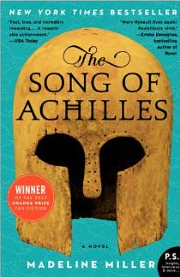
Cover for The Song of AchillesMadeline Miller has attempted a difficult task in The Song of Achilles–to make the story of Achilles, Patroclus, and the Trojan War more understandable to a modern audience. To some extent she succeeds, but in some cases I think she interjects too modern a sensibility into the ancient tale.

I have never been a big fan of Achilles. The image of him sulking in his tent because of pique while the Greeks get slaughtered is not a pleasant one. But for the benefit of those who are not familiar with The Iliad, if there are any, I will leave that part of the tale for them to discover.

The novel is narrated by Patroclus, who is exiled as a boy after accidentally killing another boy. In Miller’s novel this gives him a horror of killing and he never learns to fight–the first instance of that modern sensibility I mentioned. Not only is there no evidence in the Greek myths that Patroclus didn’t fight, there is evidence to the contrary.

In exile, Patroclus is brought up with Achilles, son of the goddess Thetis, and Miller makes the interesting choice of having the gods and goddesses be characters in the novel, just as they are in ancient stories. Patroclus and Achilles become close companions and eventually lovers.

Here again is where modern sensibilities come in, not because the two were lovers–they almost certainly were–but in the way she treats the relationship. I’m no Greek scholar, but I’m fairly sure that such relationships were rather common, and I’ve read somewhere that in some armies they were encouraged because the friends fought better for each other. Yet here, the two hide their relationship, and Thetis despises Patroclus from the first. In fact, in The Iliad, the relationship is implied but not commented upon, more as if it is accepted.

I don’t want to sound too particular, though, because almost despite myself I was drawn in and ultimately touched, not by Achilles as much as by Patroclus.

In a class discussion of The Iliad years ago, when the students were commenting on Achilles’ behavior, the instructor made it very clear that despite what we may think of him today, to the ancient Greeks he was indisputably a hero. So, modern sensibilities come in again, as Patroclus worries that the Greeks will begin hating Achilles because he refuses to fight, and they do.

To a great extent, most of the characters in the novel are one- or two-dimensional–Agamemnon is stupid and brutish, Odysseus is wily and clever, and so on. Only a few characters are more fully developed. But then, the narrator is Patroclus, and his life revolves around Achilles, who is unbearably proud and full of himself. Yes, I still don’t like Achilles. To Miller’s credit, I don’t think I’m supposed to. Despite my caveats, though, I enjoyed the novel and am looking forward to reading another book by Miller.

Day 268: Still Midnight

Cover for Still MidnightWhen I first started reading this crime novel, I had the feeling it would end badly. However, although it is very complex, it ties up loose ends in a satisfying way.

Alex Morrow is a bitter Glasgow cop who feels she has to compete with her male colleagues, especially with Bannerman, who is favored by her boss. It is her turn to take the next big case, but when an elderly Ugandan man is abducted from his home, the boss gives the case to Bannerman.

We follow the inept, amateurish kidnappers, who have smashed their way into the house demanding a person who has never lived there or been inside. On the other hand, we watch Morrow’s attempts to work on the case without letting Bannerman take the credit for all her breakthroughs.

I have long been a fan of Denise Mina, who has written several gritty series providing us fascinating glimpses of a grim urban Scotland.

Day 267: Black & White

Cover for Black & WhiteI had an ambivalent reaction to Dani Shapiro’s Black & White. By coincidence, while I was reading it, I read an article about adult survivors of child abuse that helped me focus on what was bothering me about the themes and conclusion of this novel. I’ll talk about that later.

Clara Brodeur has not seen her mother since she left home at the age of 18. She is a seemingly ordinary housewife with a nine-year-old daughter, but she has a secret. Her mother is Ruth Dunne, a world-famous photographer who made Clara’s childhood miserable by documenting it with evocative, nude photos.

Clara’s life is interrupted by a phone call from her older sister Robin telling her that their mother is dying, and she can’t cope anymore. Despite herself, Clara finds herself in New York City, where she is forced to face her feelings about her mother.

The strength of this novel is its finely observed descriptions, especially of Clara’s memories of the photo shoots–both from the point of view of a young child and then overlaid with adult awareness. Shapiro accomplishes the difficult task of explaining only with words both how striking Ruth’s photos must be and why they are disturbing. Clara feels that she has had her life stripped bare for the entire world and her relationship with her mother destroyed because of Ruth’s obsessions.

Of course, the novel evokes questions about art and its importance, whether the creation of an object of art justifies Ruth’s treatment of Clara, the impact of abuse upon the family, and so on. Perhaps I should warn now about spoilers, although I will try not to reveal too much.

Emily Yoffe’s article in Slate deals with how there is often a societal pressure put upon adult survivors of child abuse to reconcile with their abusers  and bring them back into their lives as the abusers get older. She points out the possible destructiveness of this expectation as well as the possibility of more harm to the original victim, or as she puts it better, “the potential psychological cost of reconnecting.”

One of my problems with this book is that it buys wholeheartedly into this assumption that reconciling with and forgiving one’s abuser is automatically healing for the abused, with a much too indulgent and simple-minded conclusion. Robin has been telling Clara “it’s not about you,” and suddenly she realizes that is true. But it is about Clara. Moreover, when Clara asks why her mother didn’t stop, her husband answers “Because she couldn’t.” I’m sure that is true, and Ruth’s form of abuse is admittedly different than sexual or physical abuse, but if you ask a sex offender why he or she doesn’t stop, you’re going to get the same answer.

Shapiro’s novel provides too facile an answer to her heroine’s problems and then wraps everything up in a pretty package. Not a satisfying or particularly realistic ending to a novel of promise.

Day 266: Found Wanting

Cover for Found WantingI usually enjoy Robert Goddard’s convoluted thrillers, but this one seems a bit far-fetched.

Richard Eusden is a proper civil servant who has been estranged from his best friend Marty Hewitson for some years because of the latter’s drug habit and unreliability. Richard is on his way to work one morning when he gets a call from his ex-wife, Gemma, who has agreed to pick up an attaché case from Marty’s aunt and bring it to him in Denmark. Gemma wants Richard to go in her place. She tells Richard that Marty is dying of cancer.

Richard reluctantly agrees, only to find a stranger at the rendezvous instead of Marty. The stranger says Marty has been kidnapped and tells him his friend will die unless he hands over the case.

Richard chases the case and Marty through Germany, Denmark, and Finland, and ends up discovering a dark sectret that involves the Romanov’s last fortune, the Grand Duchess Anastasia, and the Tsarevich.

The novel has so many briefly drawn characters that I could not keep track of them. I also didn’t really buy that Richard would go through all of this for a man he had already established couldn’t be trusted. But ultimately my judgment is that this is silly stuff.