
 This week’s Best Book is River of Smoke by Amitav Ghosh!
Day 265: Here Was a Man: A Novel of Sir Walter Raleigh and Elizabeth I
 I don’t think I’ve read anything by Norah Lofts before, but even though she was a prolific historical novelist, I would rate this effort as mediocre.
Here Was a Man attempts to draw most of Raleigh’s life in a short space and does so by a series of vignettes illustrating important events. Although I am not completely familiar with his career, I know that Lofts has chosen to portray a couple of apocryphal events, in particular the cloak in the mud story, which I believe has no basis in fact. The other serious lack of the novel is any depth of characterization.
The novel begins with Raleigh as a teenager, listening to sailors’ tales and dreaming of traveling the seas. He is also full of ambition for worldly success, an ambition that sometimes works to his disadvantage.
We are told many times about Raleigh’s sense of adventure, but we don’t really feel it. In fact, he seems to spend more time in prison than on his adventures. It is curious, too, that although he has many enemies at court, at least in this novel he has done nothing to earn their enmity. I would doubt that was really the case.
Raleigh is probably a character who could support an interesting and exciting novel, but this is not it. To be fair, it looks like it may have been one of Lofts’ first works.
Day 264: The Ballad of Tom Dooley
 Sharyn McCrumb has written several series of light mysteries, some better than others. I have usually enjoyed her “ballad” series–atmospheric, sometimes ghostly mysteries set in Appalachia and each named after a traditional folk ballad. The Ballad of Tom Dooley, despite a background of historical research (because this folk ballad is based on a true case), is not her best, however.
According to McCrumb’s notes at the end of the novel, she got interested in the story after researching it for an article and decided that the prevailing theories of the crime are not satisfying. So, she reconstructed her theory of the crime in this book. As such, it is not so much a mystery as an explication.
Most people vaguely know the story, that Tom Dooley (actually Dula) met Laura Foster “on the mountain/stabbed her with [his] knife.” Another defendant, Ann Melton, was let go. But McCrumb says most people in Wilkes County, where the crime occurred, will tell you Ann did it. To McCrumb, knowing that Ann was Tom’s long-time married lover, Tom being guilty didn’t make sense.
The novel is narrated by two characters who were actually involved in the incident: Pauline Foster, who was Ann Melton’s cousin and servant girl; and Zebulon Vance, the ex-governor and senator of pre-Civil War North Carolina who defended Tom. Pauline is an interesting character–McCrumb depicts her as a sociopath who manipulates the others and wants revenge for Ann’s slights.
The biggest fault in the novel is the narration of Zebulon Vance. At first, I thought McCrumb’s intent was to depict him as a maundering old bore, possibly even senile, as his section is so repetitive and adds so little to the narrative. It is mostly about himself and has little to do with the story. But then I read that Vance’s career was one reason McCrumb wanted to do the story. Instead of adding to it, it detracts from and drags against the impetus of the plot.
The fact is that none of the characters are likable people, and the crime isn’t particularly interesting. From the author of some haunting stories, this novel is a disappointment. If McCrumb wanted to write about Vance, she may have done better to write a biography.
Day 263: A Great Deliverance
 Although Elizabeth George’s Inspector Lynley series seems to be floundering with the past few books, the first dozen or so were really good. A Great Deliverance is the first one in the series.
Father Hart comes to Scotland Yard to ask for help. Roberta Teys, the daughter of a farmer, has been found in the barn next to the bodies of her father and the family dog, both of whom have been attacked with an ax. Father Hart begs for someone to investigate the apparently open-and-shut case, as Roberta has confessed to the crime and now refuses to speak. Father Hart says he believes the girl, who seems to be mentally handicapped, is innocent. Barely registering in the background, someone is killing men on the subway.
Inspector Thomas Lynley is given the Teys case, and he has just been assigned Detective Sergeant Barbara Havers as his partner. Havers is a belligerent, untidy working-class woman who is being given a final chance, since she has failed to work well with other supervisors. She believes that the immaculate Lynley, the eighth Earl of Asherton, is nothing but an upper-class fashion plate, playboy, and womanizer.
Lynley is dealing with his own problems, because the woman he loves is about to marry his best friend, Simon St. James. He also bears guilt because St. James is crippled from an auto accident in which Lynley was driving. Lynley is actually relieved to be called away from the wedding reception to deal with the murder investigation.
Lynley thinks the roots of this murder may be in the past. Roberta’s mother disappeared when she was a child. Was she actually murdered? Roberta’s older sister also ran away from home. What happened to her?
This novel and the first books of this series perfectly meet my taste for mystery novels that are on the dark side. I find Lynley and Havers to be engaging, with fully developed personalities. The novels are complex and the plots exciting. I have not tired of the incidental characters, as I often do. I am just sorry that the more recent novels have taken some turns I do not find appealing or interesting, since for so many years, I could rely on an Elizabeth George mystery to be a great read.
Day 262: River of Smoke
A month or two ago I reviewed Sea of Poppies, Amitav Ghosh’s riveting first book in his Ibis trilogy. I have been waiting since then for a good opportunity to post my review of River of Smoke, the second book in the trilogy.
The various passengers and crew members of the Ibis have been separated and now several of them travel toward China on three different ships. Paulette Lambert has been taken on the Redruth by Filcher Penrose, a nursery man for a major botanical garden who hopes to exchange New World plants for those of China. He has hired Paulette, whose father was a renowned botanist, to help take care of the plants.
En route to China with a shipment of opium, the merchant Bahram Moddie, Ah Fat’s father, takes on the disgraced Raja Neel as a munshi, or clerk. Neel travels on the Anahita to Canton in Bahram’s entourage under the name of Anil Kumar.
The Ibis, now containing the owner Benjamin Burnham, is also on the way to Canton.
In Macao, Paulette meets a friend from her childhood, Robin Chinnery, the unacknowledged illegitimate son of a famous painter. As a woman, Paulette is not allowed into Canton. She can only go as far as Hong Kong, then a desolate, almost uninhabited island, where she searches for plants. But Robin goes on to Canton with a mission to try to find out for her and Penrose who painted a picture of a golden camellia and possibly to trade for such a plant.
Robin is in town during the unsettled days before the beginning of the Opium Wars, when the Chinese Emperor is trying to halt the opium trade into China, while the opium traders are purposefully trying to instigate war so that they can call for the intervention of the British navy. Robin’s entertaining letters to Paulette keep us informed about the political debate as he is befriended by Charles King, the only merchant of stature who believes China is in the right.
Bahram Moddie, a well-meaning man who loves Canton on sight, has unfortunately invested his entire fortune in this shipment of opium. He is caught between his conscience and his need to be successful as the Chinese government tries to keep the foreign ships at bay.
As rich in language and storytelling as the first book, this novel is completely engrossing, showing the American and British opium dealers as the venal, hypocritical men they are, with their self-serving arguments about Free Trade and their arrogant disdain for their Chinese hosts. I’m afraid it may be two or three years of waiting before I can read the final book in the trilogy.
Day 261: Blue Monday
 I never read Nicci French before and was at first irritated by Blue Monday because the reader is introduced to several characters, using a shifting third-person limited narration, without understanding who they are or why they’re important. Eventually, though, I was able to fasten on Frieda Klein as the main character.
The novel begins in 1985, with nine-year-old Rosie going home from school, followed by her five-year-old sister Joanna. Rosie takes her eyes off Joanna briefly, and the little girl is gone.
Twenty-two years later, a little boy, Matthew Faraday, disappears on his way home from school after his mother is late picking him up. Although at first the crimes don’t seem to be connected, Detective Chief Inspector Karlssen thinks they may be.
Psychiatrist Frieda Klein has recently taken on a new patient, Alan Dekker, who claims to be having such troubling obsessions that he can’t sleep or function correctly. They are about having a son, a boy he can play ball with. He is unable to have children but he doesn’t want to adopt. He obsessively wants a son, one who looks like him as a boy–exactly like the missing Matthew Faraday.
Confidentiality laws apparently not being exactly the same in England as they are in the states, after some soul searching, Frieda feels she must go to the police. Karlssen is impatient with her until she tells him that Alan had these feelings once before about having a daughter but they went away–just around the time of Joanna’s disappearance.
This psychological thriller, which is the first in a series, turns out to have a couple of twists I have never before encountered, so proved to be very interesting. Frieda is an unusual heroine, a cold, analytical person who roams the streets of London at night because of insomnia. I think it would be well worth it to continue reading books in this series.
Day 260: Team of Rivals: The Political Genius of Abraham Lincoln
 Best Book of the Week!
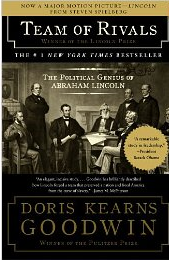
Doris Kearns Goodwin begins her examination of Lincoln’s administration by remarking that because so much has been written about him, everything might be thought to have been said. However, by examining his career in terms of the team he put together to run the country, she found much more to write about.
This team consisted of his rivals in politics. Edwin Stanton, who treated Lincoln with contempt on their first meeting and who Lincoln made Secretary of War, was griefstricken at Lincoln’s death. Salmon P. Chase, eternally Lincoln’s rival for the presidency and a frequent undercutter, was an extremely competent Secretary of the Treasury. William H. Seward, the favorite for the Republican presidential nomination that Lincoln won, was at first inclined to underestimate Lincoln but became his closest friend and advisor as Secretary of State. Edward Bates, the Attorney General, was a homebody who was not sure he wanted a public life and at first looked upon Lincoln as well-meaning but incompetent, but ended up thinking he was very nearly perfect.
Team of Rivals begins on the day of the Republican convention of 1860, in which, of the rivals who had some expectation of winning the nomination of the party, Lincoln would seem to have the least. Seward was the odds-on favorite, but he had made many enemies in the party. Chase’s overwhelming ambition for the presidency lead him on several occasions to ignore the warning signs that he would not be the nominee. Bates was willing to act if nominated but made no extraordinary efforts because he preferred his home life.
Goodwin’s narrative then turns farther into the past to trace the men’s respective careers. In this examination she shows how Lincoln cleverly set himself up to be everyone’s second choice for the Republican nomination.
The book follows Lincoln’s nomination, campaign, and stunning victory, but the bulk of it concerns the compelling story of how he put together a cabinet containing these men, who were not only rivals for the office but who were from different regions of the country and who had different views on the important issues of the day. He then managed to work with these men and run the country during one of its most difficult times. It was frequently rumored that Seward actually held the power, but Goodwin shows us that Lincoln was always in charge.
Through an examination of the diaries of the men, letters, and other sources, Goodwin provides us with the fascinating details of political machinations, the conduct of the war, the fights among the generals, the alliances and friendships, and the story of how several men, who began with no esteem of Lincoln at all, grew to respect and love him.
Goodwin’s book is one of the most absorbing history books I have read. Although it is long and takes awhile to read, it explains each issue in completely lucid terms and interesting detail. The most important thing I got from the book was a fuller understanding of Lincoln’s greatness, his humor, kindness, and magnanimity–and what a disaster for the country his death was.
Day 259: The Greatcoat
 I am not familiar with Helen Dunmore, but I looked for this book after reading a review of it on another blog citing it as a good ghost story.
At first I was inclined to dislike it. Isabel Carey is a new wife in 1952, married to a young doctor in a small village in Yorkshire. Isabel is a poorly trained housewife who spends her time disliking her new home in the bottom floor of the landlady’s house and feeling as if everyone is looking at her. She especially dislikes the landlady, Mrs. Atkinson, who paces back and forth on the floor above, sometimes all night.
Unable to get warm in the dank little house, one night she searches through a cupboard and finds an officer’s wool greatcoat, which she uses as an additional bedcover. The next night a strange man dressed as a World War II officer comes and taps on her window.
Soon the officer, Alec, begins coming to visit her and by his behavior shows that he thinks they are lovers. She knows almost immediately that he is a ghost but seems to passively accept their relationship. Who the soldier’s actual lover was should be almost immediately apparent, but Isabel doesn’t seem to guess.
At this point, I was extremely annoyed with the novel, believing I was supposed to find all this romantic when all I could think about was Philip, Isabel’s poor, hard-working husband, who only treats her kindly. The only negative thing about his character is his desire to protect Isabel from everything, and I believe that attitude was typical of the times. I also thought Isabel is a spoiled little brat who does little but complain and thinks nothing of launching into an affair with another man, ghost or not.
Eventually, though, the novel takes a more sinister turn, which is more to my taste. My final overall impression was ambivalence.
By the way, the Amazon write-up of this book (probably taken from the publishers) compares Dunmore as a historical novelist to Tolstoy and Emily Brontë. Aside from the oddness of an implicit comparison between those two writers, this is a gross overstatement of Dunmore’s abilities. What Dunmore has written is a slight, moderately entertaining novel that cannot be compared to the work of the other writers.
Day 258: Busman’s Honeymoon
 I have always thought that, with a few exceptions, the arrival of Harriet Vane into the Lord Peter Wimsey series pretty much ruined it. Some of those mysteries are not so bad, and Have His Carcase (wherein Lord Peter meets Harriet) and Gaudy Night (wherein Harriet solves a mystery on her own) are very good, but Busman’s Honeymoon is just too sappy. It is hard to know if Peter and Harriet’s marriage is Sayers’ idea of an ideal relationship or a reflection of some relationship she actually had, but I find that Lord Peter’s galumphing happiness contrasts strangely with Harriet’s odd undertones.
Lord Peter and Harriet are married and travel for their honeymoon to a house they bought in the country. But when they arrive, they find the house is not ready for them and the previous owner, Mr. Noakes, is nowhere to be found–until next morning when Bunter finds him dead in the basement. In the meantime, the servants have been cleaning, and all the clues are gone.
One positive point for the novel is that the Dowager Duchess shows up, a favorite character. We also get a little more background on the relationship between Wimsey and Bunter.
I guess this isn’t the best selection for Valentine’s Day, since I’m criticizing it for sappiness, but if you have different tastes than mine, you might like it. I see that the reviewers on Amazon are remarking at how romantic it is. And also commenting on the subtle humor. Well, I didn’t find it so subtle.
Day 257: Galore
 A whale comes ashore at the remote coastal town of Paradise Deep, Newfoundland, in the early 19th century. The people, who have been starving all winter, come out to scavenge what they can of the meat. When Devine’s Widow, an old Irish “wise woman,” cuts open the belly of the whale, a man falls out, pale as an albino, mute, but still alive. Although he stinks like a fish, the Devine clan gives him room in a shed and calls him Judah. Nevertheless, he is treated with dread and superstition until he goes out fishing one day with Colum Devine and they take a huge load of fish in waters that have been barren that season.
The Devines have been at odds with the powerful King-Me Sellers since he proposed marriage to a young Irish bondswoman years ago and she refused him rudely, then went off to marry Devine, practically the first young man she met. Their relationship was not improved years later when King-Me’s daughter Lizzy married Colum Devine.
When King-Me’s spite turns against Judah, the only way the Devines can save him is by marrying him to Mary Trephyna Devine, Colum and Lizzy’s daughter and King-Me’s granddaughter.
Michael Crummey’s multigenerational novel captures the relationships between these two families along with the history of the town, with all its eccentric characters, ghost stories, myths, and tall tales. The novel is fascinating, unusual, and beautifully written. I don’t usually enjoy magical realism, but in this novel it is handled so well that I accepted it and was engrossed in the story. Galore is probably unlike any novel you are going to read, although in its focus on a sea-going people and its occasional feel of a sea tale, it reminds me a bit of We, the Drowned by Carsten Jensen.
 What? Me Read?