Day 210: White Heat: The Friendship of Emily Dickinson and Thomas Wentworth Higginson

Cover for White HeatBest Book of the Week!

White Heat is an unusual biography that focuses on the friendship between Emily Dickinson and Thomas Wentworth Higginson. The book is unusual because so little is known of the daily life of Dickinson and much is known of that of Higginson. Brenda Wineapple has pieced together the story of their relationship from what is left of letters (Higginson’s to Dickinson were destroyed with much of Dickinson’s correspondence, but there are letters to others) and from poems sent to Higginson by Dickinson. Wineapple is the author of an admired biography of Nathaniel Hawthorne.

Their relationship was almost entirely in letters. By the time they began their correspondence, Higginson was a well-known writer of essays on nature and politics but was even better known as an ardent and radical abolitionist and advocate of women’s suffrage. He ran guns to Kansas during the free soil days and helped encourage many women poets and got them published. Later, he formed the first African-American regiment in the Civil War. On the other hand, Dickinson had published one or two poems and frankly didn’t seem much interested in publishing more, but preferred to send them off to friends. She remained obscure and unknown, in her later years not even leaving the grounds of her father’s house in Amherst.

Dickinson initiated the correspondence by sending Higginson a flattering letter containing a few poems and asking him to be her preceptor–to tell her if her poems “sing” and to give her advice. Of course, she knew her poems sang and apparently had no intention of taking his advice, so it can be assumed that she wrote hoping to start a correspondence.

Although Higginson has been criticized as too conservative in his poetic tastes and as a bungler for his role in Dickinson’s legacy, part of Wineapple’s purpose is to rehabilitate his reputation, for he was in his own time a brave man of principle whose poetic instincts far surpassed his own abilities as a writer. He found Dickinson’s poetry both shocking in its unconventionality, especially of form, and breathtaking in its beauty.

The two remained friends for the rest of Dickinson’s life, although they only actually met twice. Their letters were sometimes flirtatious, but Wineapple convincingly suggests that most likely neither of them had any intentions beyond friendship and esteem. Higginson was married to a lifelong invalid and seemed to be too upright to consider the idea of dalliance. When his wife Mary died, he shortly remarried a younger woman in the hopes of finally having a family. Later, Dickinson became enamored with and probably engaged to a much older man who unfortunately died.

One purpose of Wineapple’s book is to show what actually happened to Dickinson’s poems after her death, when they were published in two volumes in an edited form, with grammatical, punctuation, and even wording changes by Higginson and Mabel Todd. Higginson has been excoriated for this, but Wineapple suggests that Todd did most of the editing, some of which Higginson strenuously objected to. Certainly Todd alone released a third volume of poetry that was even more heavily edited. Higginson seemed unaware that Todd was handling Dickinson’s poems (with her sister’s permission) as an act of both self-aggrandisement and of petty revenge against Sue Dickinson, Emily’s good friend and sister-in-law, and the wife of Todd’s lover.

Wineapple’s biography is engrossing and occasionally poetic in its own right. It is an excellent analysis of this unusual friendship.

Day 209: A Darker Domain

Cover for A Darker DomainAt the beginning of A Darker Domain, Michelle Gibson comes into the police station to report that her father, Mick Prentice, is missing, actually has been missing for 25 years. He was believed to have left his small mining village during a miner’s strike to scab for another mine in Nottingham years ago, which was considered an act of betrayal. Now that his daughter is trying to find him, she learns he isn’t in Nottingham and never has been.

In the meantime, a case from the same period is being reopened, the kidnapping of Catriona Grant and her baby son Adam, during which Catriona was killed. Someone has found a copy of the ransom poster and a large pool of blood in a deserted Tuscan villa.

Detective Inspector Karen Pirie, head of the cold case group in Fife, is working both cases. The memories of the various witnesses appear as flashbacks and parallel narrations, and the story moves swiftly forward as Karen’s cases begin to converge. Val McDermid usually writes complex and exciting thrillers, and this novel is no exception.

Day 208: The Quiet Twin

Cover for The Quiet TwinThe Quiet Twin by Dan Vyleta seems to start out as a standard mystery, but it turns out to be something else entirely. I was attracted to it because in reviews it was compared to Rear Window, one of my favorite movies.

In a 1939 Viennese neighborhood, there is a rumor of a serial killer. A man was murdered not far away, and someone has killed Professor Speckstein’s old dog in a similar manner.

The courtyard behind Dr. Beer’s more respectable apartment building is shared by some tenements occupied by poverty-stricken tenants. The view that some apartments have into others sets up the situation reminiscent of Rear Window.

Dr. Beer is called to treat Professor Speckstein’s niece Zuzka, a college student who suffers from periodic paralysis. Speckstein is a disgraced former college professor who was once accused of child molestation but has hung onto his social position by becoming a Nazi party informant. Dr. Beer, a student of Freud, diagnoses Zuzka with hysteria.

Zuzka is bored and sleepless, so she watches the courtyard from the window in the middle of the night. She has seen a man across the way washing off makeup and what appears to be blood, so she decides to investigate whether he is the killer.

Also living in the courtyard is a drunken man and his little girl Lieschen, whose body is badly deformed from an accident. Zuzka befriends Lieschen while Dr. Beer worries what may happen to her under the Nazis, having heard about some of their ideas.

A brutish police detective named Teuben appears to investigate the murders, but his actual plan is to pin them on some hapless person.

Although Vyleta has tried to depict the atmosphere among the common people of Vienna under the Nazis, I am not so sure he succeeds. Dr. Beer seems to be one of the few characters who is aware of any threat. An aura of dread persists, but it seems more dependent upon my knowledge of coming events than on any feeling from the novel, although the novel is certainly bleak. Perhaps because I read In the Garden of the Beasts only a few weeks before, I expected an atmosphere that was much more fraught with peril.

Day 207: The Child in Time

Cover for The Child in TimeThe Child in Time is one of Ian McEwan’s earlier books, written in the mid-1980’s. It is an odd book, the themes and subplots of which all have to do with childhood and the relationships between children and their parents, but I did not come away from the novel with a coherent idea of its message.

Stephen Lewis is a writer of children’s books who has come to that vocation by accident, because an adult book he wrote was accepted as one for children. He is mourning the loss of both his small daughter and his wife. His daughter was stolen away from him in a supermarket two years before, and the marriage broke up as a result of grief.

Lewis spends his time drinking and watching television in his filthy apartment. Once a week he sits in on and daydreams through a series of government committee meetings on education, occupying a seat abandoned by his friend Charles Darke, who has retired from public life.

Although the novel focuses primarily upon Stephen’s slow recovery from depression and return to a more normal life, one of the subplots concerns his friend Darke, who with his wife offered refuge to Stephen in his worst days. Darke is a successful young entrepreneur married to a much older physicist, and the Darkes have always been Stephen’s ideal of a mature, adult couple. After running several successful businesses, Darke became a politician and then abruptly retired to the country amid rumors of a breakdown. Stephen eventually finds that his friend has been suffering from obsessions related to a childhood that was cut short by a controlling father.

Another odd plot development is a strange vision Stephen has on his way to visit his wife. He sees his parents meeting in a pub as young adults and confirms with his mother that this was an actual event from before they were married.

Although the description on the book jacket says the novel is about the importance of childhood, that specific concept seems to fit only the story of Charles Darke. As well as having themes about childhood and parenthood, the novel is about mourning and its preoccupations. Particularly perplexing is a side plot about a book on parenting secretly written by the paternalistic government and potentially planned to be fraudulently released as being a result of the committee work.

Set against a bleak England of the 1980’s, occasionally featuring beggars and soup kitchens, the novel seems oddly dreamlike at times while at other times dark and disturbing.

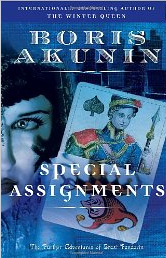
Day 206: Special Assignments: The Further Adventures of Erast Fandorin

Cover for Special AssignmentsI have been following Boris Akunin’s Erast Fandorin series for several years. At first I liked Akunin’s shy, skinny, intellectual young hero. But then Fandorin transformed himself into a muscle-bound Putinesque superhero wannabe, so I lost most of my affection for him.

Set in Tsarist Russia, Special Assignments is actually two novelettes about Fandorin cases. The first, “Jack of Spades,” is a silly case where Fandorin is pursuing a clever con artist. It is supposed to be funny, I think, but I mostly missed the humor and found it ridiculously overcomplicated.

The second story I did not finish once I grasped where it was going. Called “The Decorator,” it is about Jack the Ripper moving his operations to Moscow. However, it becomes quickly obvious that Jack is supposed to be not only a woman but one who is murdering prostitutes because they are defiling their bodies. The whole idea was so abhorrent to me that I refused to read any more of it.

Day 205: The Journal of Mrs. Pepys

Cover for The Journal of Mrs. PepysI began reading Samuel Pepys’ famous diaries years ago, but found it difficult to understand many of the oblique references to events of the time and found many of the entries very trivial. There was also a whole lot of drinking going on. However, I thought I’d give the fictional journal of his wife a try by reading The Journal of Mrs. Pepys: Portrait of a Marriage by Sara George.

The journal follows the course of the Pepys’ marriage and their rise in prosperity. George was careful to follow closely the events related in Samuel Pepys’ diary, which somewhat hampers the plot. The novel looks at these events from the point of view of Elizabeth Pepys, particularly how she reacts to her husband’s frequent absences and philandering.

The novel provides an interesting insight into the events leading up to and during the Restoration–particularly the eagerness with which the populous welcomes Charles II to the throne and the rapidity with which they tire of the court’s profligacy and debauchery.

Also of interest are some of the customs observed. I was intrigued by how freely the Pepyses behaved with their servants, treating them as if they were friends and then getting into spats with them for taking liberties. Also of interest were some of the social behaviors, like the celebration of Valentines Day, where women picked their valentines, who then had to buy them expensive gifts. And then there were the freedoms of male friends to walk up into ladies’ bedrooms or of both sexes to share bedrooms on a trip away from home without any indication of scandal.

Written mostly in modern English, the novel manages a fine balancing act between understandability and the correct use of outdated terms or terms that have changed their meanings with time.

Although I found the novel interesting enough, by nature of the concept, it could not follow the traditional plot structure of a series of building climaxes. There is a climax at the end, but generally the novel stays fairly level.

Day 204: Unspoken

Cover for UnspokenAs you have probably figured out by now if you have been following this blog, I have spent a lot of time trying mysteries written by Scandinavian authors. Unspoken by Mari Jungstedt is probably one of the less successful of them, although it has an interesting plot.

The novel is set in winter on the island of Gotland. Fourteen-year-old Fanny is missing. She seems to have no friends and only an unstable mother to care about her. She spends most of her time caring for the horses at the local racing stable.

Seemingly unconnected is the murder of an alcoholic photographer named Henry Dahlström. But Dahlström recently won a large sum of money at the race track. Inspector Anders Knutas and his team are investigating both incidents.

As I said, the plot for this novel is interesting, but the writing is so choppy as to be distracting, and the characters seem undefined. In addition, a love affair between Johan Berg, a reporter who gets involved in the investigation, and a married woman seems completely pointless, although I understand this is a continuing relationship from a previous book.

I noticed recently that there is a blog that evaluates book cover art, so I’ll just say this, sort of tongue in cheek. I was struck by how atmospheric the cover to this book was and just wish that half of that atmosphere spilled over into the novel.

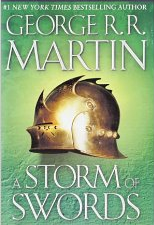
Day 203: A Storm of Swords

Cover for A Storm of SwordsBest Book of the Week!

My notes for A Storm of Swords, the third entry in George R. R. Martin’s A Song of Fire and Ice saga, say “This series just keeps getting better and better.” This novel picks up slightly before the end of the last one.

The evil King Joffrey Lannister has set aside his betrothal to Sansa Stark so that he can marry Lady Margaery Tyrell. Sansa is forced to marry Joffrey’s uncle Tyrion, the dwarf. Tyrion treats her gently, but she remains afraid of him. Soon, Joffrey is murdered, and Tyrion and Sansa are accused of the crime.

Jaime Lannister has made a deal with Catelyn Stark for his freedom in return for Catelyn’s daughters. He goes off firmly intending to meet his part of the bargain, escorted by the knight Brienne of Tarth.

Robb Lannister’s army has smashed the Lannister forces in the Westerlands, but Robb has ruined an important alliance with the House Frey by marrying Jeyne Westerling of the Crag instead of his intended Frey bride. He agrees to a Frey marriage for his uncle in an attempt to make amends.

Arya Stark is still wandering, trying to get home to Winterfell. The group she is traveling with encounters Sandor Clegane, The Hound, who kidnaps her.

Up at the Wall, Jon Snow has disappeared on a scouting mission with Qhorin Halfhand. Although Halfhand has commanded Jon to act as an oathbreaker so as to infiltrate the wildings, when he returns, the members of The Watch think he has betrayed them. Bran Stark and his friends Jojen and Meera Reed, having hidden in the crypts during the destruction of Winterfell, arrive at the Wall in Jon’s absence and go on farther north.

In the East, Daenerys Targaryen gives up one of her dragons to buy an army of eunuch slaves called the Unsullied. Her hatred of slavery is such that she orders the Unsullied to sack the slaver cities and frees all the slaves.

Martin shocks you at times by killing off some of your favorite characters. But are they all really dead? If you haven’t read any of these books, you’re missing an exciting series.

Day 202: The Lantern Bearers

Cover for The Lantern BearersIf you are historical fiction lover and are not familiar with Rosemary Sutcliff, I recommend that you try one of her books. She is best known for her novels about the Roman occupation of Britain and the interaction between the Romans and the various British peoples. Although many of her books are classified as children’s literature, the ones I have read are just as suitable for adults. My review today is of a Sutcliff book I read most recently, which unfortunately is the third book of her acclaimed Eagle of the Ninth trilogy, The Lantern Bearers. Although she wrote a series of eight books about the Aquila family, three are usually grouped together and sometimes can be purchased as one book. The other two are The Eagle of the Ninth and The Silver Branch.

The Lantern Bearers is about the desertion of Britain by the Romans and its subsequent inundation by marauding Saxons. Aquila is a soldier with the last battalion on Britain. He is recalled to his regiment to withdraw from Britain and leave his father and sister behind in the home they have occupied for generations.

Aquila finds that his heart is with Britain, so he deserts his regiment and returns home. However, the day after he arrives, his home is attacked by the Saxons, his father is killed, and he and his sister are enslaved.

Without giving too much away, I will say that the story eventually focuses on the rise of the British ruler Ambrosius and his adopted son Artos, from whom we get the stories of King Arthur.

I think these books are fascinating, although of the three in the trilogy, my favorite is The Eagle of the Ninth (which, by the way, was recently made into a very good movie that no one apparently went to see; I recommend it). If I had any criticism of this book, which is carefully researched, well written, and full of action, I would say that sometimes it seems as if Sutcliff thinks the Roman occupation of Britain was completely positive. I doubt if the Britains felt that way when they were conquered. However, even though her heroes are often Romans, her ideas are more nuanced than that.

If you decide to read this trilogy, I suggest you start with The Eagle of the Ninth, although the books are far enough separated in time to be read as stand-alones.