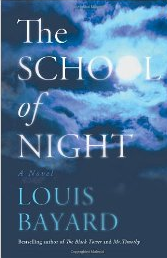
Day 201: The School of Night

The School of NightCoincidentally, this summer I read and reviewed Shadow of Night, and The School of Night by Louis Bayard is another novel that deals with the School of Night, a group of Elizabethan scholars who pursued forbidden knowledge. Its members were Sir Walter Raleigh, Thomas Harriot, and Kit Marlowe, among others. The School of Night follows events in two time periods, the present and 1603.

Ten years ago Henry Cavendish was an Elizabethan scholar with a promising future, but he was disgraced when he accepted as legitimate a forged letter supposedly by Sir Walter Raleigh and presented it at a conference. Since then, he has barely eked out a living, teaching part-time, doing editing work, and taking whatever jobs he can get. His only true friend is the eccentric Alonzo Wax, a collector and purveyor of rare books.

But Alonzo is dead, having drowned himself after trying to contact Henry, and Henry finds himself the estate executor. Shortly after the funeral, Henry is contacted by another collector, Bernard Styles, who shows him the second page of a letter by Raleigh that he alleges Alonzo stole from him. This letter makes a rare reference to the School of Night. Styles offers Henry a lot of money to find the letter in Alonzo’s papers and give it to him.

Henry also meets Clarissa Dale, who claims to have made Alonzo’s acquaintance after a lecture about the School of Night. Although she is not an academic, she has been having visions of Thomas Harriot and an assistant named Margaret and wants to find out why.

Henry has barely begun to work with Alonzo’s papers when Alonzo’s secretary, Lily Pentzler, is murdered and all of Alonzo’s books are stolen. This incident makes Henry and Clarissa wonder if Alonzo was murdered, too. Soon, Henry and Clarissa find themselves investigating the secrets of the letter.

Alternating with the present-time story is that of Thomas Harriot, the leader of the School of Night, as he explores Virginia and later works on his forbidden experiments while hidden away on the estate of the Earl of Percy. Finding that his maid servant Margaret can read, he begins to train her to assist him in his experiments.

Although I guessed one important secret early on, I found this novel deeply satisfying. It is full of twists and betrayals and has interesting characters. It treats the historical plot intelligently, and although this comment is not meant as a criticism of Shadow of Night, it deals more seriously with the School of Night than does Shadow of Night (which of course has a completely different focus).

I had not read Bayard before, but he is known for writing historical mysteries that feature such characters as a grown-up Tiny Tim (Mr. Timothy) and Edgar Allan Poe (The Pale Blue Eye). I am interested in reading more.
Day 200: Stranger in a Strange Land

Cover for Stranger in a Strange LandDay 200 for the blog!

First, let me preface this review of Robart A. Heinlein’s Stranger in a Strange Land by saying that I know this is a cult classic and my review may offend some die-hard Heinlein fans, if I have any readers who are die-hard Heinlein fans. So, let that be your warning.

The first sentence in my notes is “What an overrated book.” I read this novel long, long ago, and I vaguely remember thinking the first part was interesting but disliking the second part. Other than the barest outlines of the plot, that’s all I remembered. This time through, I liked the first part less and hated the second part.

Valentine Michael (Mike) Smith is the only survivor of the first manned mission to Mars. He was born on the mission to two of the astronauts and raised by Martians. Since that mission disappeared without a trace, no one knew he existed, so he is only discovered when a second mission goes to Mars. He is brought back as a young man, and political shenanigans ensue, especially when he turns out to be heir to a fortune. Besides these plot elements, the first portion of the novel deals, sometimes cleverly, with his adjustment to life on Earth. In the second part of the novel, he decides to start his own religion, which practices free love and teaches the psychic abilities he learned from the Martians.

The novel does not translate very well to the 21st century because of its blatant sexism and use of slang that I suspect was out of date when the book was published. The sexism is ironic in a way, because I believe that Heinlein would have thought his book was sexually liberating. Frankly, though, I don’t think that patting your female employees on the butt was considered liberated even in the early 1960’s.

Another criticism is that Heinlein appears to have no coherent vision of what a future world would be like. The novel reads as if he came up with a few ideas that he thought would be cool and interesting but not as if he sat down and imagined what fundamental changes might have taken place. For example, carpets are made of real grass, but he lacks the imagination to figure out that computers wouldn’t always need punch cards and we might not be using typewriters forever. As far as futuristic prescience is concerned, I would give a better grade to Jules Verne. My final point in this regard is that for a science fiction writer, he seems to know very little about science, and I mean the science that was known in his own time.

I think I could bear with these things because I generally have a rule not to judge a book on standards that are not of its own time. But the worst feature of the book for me was the hundreds of pontificating speeches made by Jubal Harshaw, a crusty author who I’m sure is meant to be Heinlein himself. Despite being presented in a conversation style, the speeches are pompous and pedantic and go on for pages and pages. Heinlein seems to be very proud of the ideas expressed and of the world Mike creates with his religion, but I think the environment in his church would give most people the creeps.

I made a good faith effort to finish the book, but I finally gave up less than 50 pages from the end. And if anyone says “grok” to me ever again, I’ll scream.

Day 199: South Riding

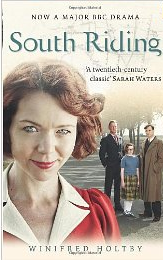
Cover for South RidingI had never heard of Winifred Holtby until I watched the excellent Masterpiece series South Riding. I enjoyed it so much that I picked up several of Holtby’s books. Holtby published 12 novels in the 1920’s and 1930’s, as well as pursuing a successful career as a journalist and nonfiction writer. She is known for regional fiction about Yorkshire and has a prize for regional fiction named after her.

Set post-World War I, South Riding is the story of the conflict between the landed gentry and social progressives in a Yorkshire town. Sarah Burton comes to town as the headmistress of a girl’s school. She has many progressive ideas and wants to improve the school and the quality of education provided to the girls. To accomplish her goals, she asks the town to invest more money in the school.

She immediately runs afoul of Robert Carne, a local landowner. He has very conservative ideas about the town and school, but he also has some heavy concerns. Previously prosperous, he has spent all his money on care for his mentally ill wife. He also has the care of a young daughter who is having her own problems.

Unlike the television series, the novel has a huge sweep and does not concentrate on Sarah, but presents the stories of about fifteen other major characters. It deals with issues like education, poverty, and governmental corruption as well as family relationships. The characters are all carefully delineated so that you feel that you know each one.

The novel is beautifully written, although it gets just a little preachy at the end. Some reviewers have compared Holtby to George Eliot because of her interest in local social issues and her breadth of scope.

Day 198: The Princess of Burundi

Cover for The Princess of BurundiJohn Jonsson, an unemployed welder, small-time crook, and expert on tropical fish, is found tortured and beaten to death at the beginning of The Princess of Burundi by Kjell Eriksson. A deranged man is roaming the town, his behavior escalating in violence. He has attacked one of his former classmates, and Jonsson is another. The attacks seem to be related.

Ann Lindell is on maternity leave while her colleage Ola Haver runs the investigation. But Ann is so interested, she returns from leave to help. Although the police think that the demented man, a victim of bullying years ago in school, is a likely suspect, they cannot find any proof that he is the murderer and begin wondering if they are off base. Does the murder have to do with Jonsson’s school days, the tangled relationships in the Jonsson family, or perhaps the tropical fish?

Although this was the second Ann Lindell mystery I read, I had the same difficulty I reported before in keeping the various police officers straight. However, I am still interested and want to get to know them better. The crime story was complex, and I was unable to tell where the novel was going until the very end.

Day 197: The Adventure of English: The Biography of a Language

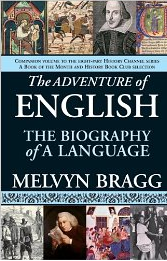
Cover for The Adventure of EnglishThe Adventure of English: The Biography of a Language is a history of the English language written for the general public. The author, writer and television personality Melvyn Bragg, has been responsible for some acclaimed television shows on the subject in England.

The book takes us from the introduction of English (or rather, the languages that would become English) into Britain with the invasions of the Angles and Jutes up to modern times and the versions of English spoken around the world. Bragg explains how English pushed other languages, liked Celtic, to the brink of extinction, and how numerous times the language has been threated by extinction itself, most particularly with the Norman invasion. The Normans spoke French among themselves and enforced its use at court and for all matters of legal business, a condition that lasted for centuries and posed a real threat for the survival of English. However, eventually the Norman kings began thinking of themselves more as Englishmen than Frenchmen and using English for business, starting with Henry V.

The book provides many interesting factoids, such as, that of all languages, Old English was most closely related to Frisian, still spoken by some people in the Low Countries. The explanation of how the British developed such extremely varied regional dialects (much more distinct from each other than American dialects) from the settlement and isolation of different peoples and tribes in different regions is interesting, especially the tale of how a man from rural Cumberland was able to communicate with Icelanders during World War II because of it.

However, the book contains some real irritants. One is the relentless personification of the language as a metaphor throughout the book. English is always gobbling up other languages or fighting them off. Another is the spin put on some of the information. For example, when the Catholic Church insisted on exclusive use of Latin and made translation of the Bible into other languages a heresy, it wasn’t seeking explicitly to destroy English but was rather protecting its priestly prerogatives. If priests weren’t needed to translate and interpret the Bible to their flocks, what would be their purpose? Of course, Bragg explains this, but he implies that the decision was a purposeful attempt to destroy English.

The lack of authority for some of Bragg’s statements is certainly a weakness throughout the book. There were times when I, with my little knowledge, thought he may have misrepresented or put a spin on some facts, but until I finished the book, I was assuming Bragg was a linguist, so I just thought that I was wrong. Now I’m not so sure.

Finally, although the TV series was probably very good, the book’s roots in television show too clearly in the shallowness of the approach. Some chapters, for example, are almost nothing but lists of words with a few paragraphs in between. Overall, although I learned a few interesting facts, I was disappointed.

Day 196: The Secret Keeper

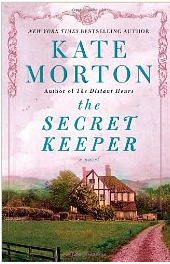
Cover for The Secret KeeperI loved The Forgotten Garden so much that Kate Morton’s other books, although very good, have not been able to hold their own against it. At first I thought The Secret Keeper would also be good but not great, but a terrific surprise at the end of the book made me change my mind.

The novel begins in 1961, when sixteen-year-old Laurel Nicolson is up in the treehouse on the family farm dreaming about her boyfriend. She sees her mother Dorothy go into the house with her baby brother Gerry. It is Gerry’s birthday, and Laurel knows her mother has left the birthday picnic to fetch the family’s special birthday knife so she can cut the cake. A few minutes later, a stranger goes to the door, and Laurel sees her mother stab the man with a knife. He is assumed to be the man who has been attacking women in the area.

Fifty years later, Laurel is a famous character actor who has come home to visit her ill mother. Her mother’s memory is failing, but she has asked Laurel’s sister Rose to get some things out of a box that has always been private. Among them is a photograph of Dorothy and her friend Vivien, who died during the Blitz.

Laurel’s memory of the long-ago incident with the stranger has become muddied and even inaccurate, but she begins to remember it more clearly when she decides to look into it further. She finds that the attacker was Henry Jenkins, Vivien’s husband. Since Dorothy must have known Henry, there is obviously more to the story.

From here the story alternates between Laurel’s investigation in the present and the war years of young Dorothy (Dolly) Smitham. Dolly is madly in love with Jimmy Metcalfe, a newspaper photographer who also has sole care of his senile father. Dolly wants to marry immediately, but Jimmy thinks they can’t afford it yet, so Dolly takes a job as a companion to a wealthy old lady in London. At a war effort volunteer job, she meets Vivien, who lives across the street with her husband, a successful novelist. Dolly, who comes from a lower middle class background, gets carried away with the idea of leading a more exciting, fashionable life. After a series of misunderstandings, she hatches a plan to get money for her marriage and talks the reluctant Jimmy into helping.

At this point, my major problem with the novel was a growing dislike for Dolly, who seems narcissistic and lacking in conscience. I kept wondering how she was going to develop into the beloved mother of five children. But the novel goes on to unearth secrets. With Morton’s gift for storytelling and excellent writing, I think this novel is as good or better than The Forgotten Garden.

Day 195: The Water’s Lovely

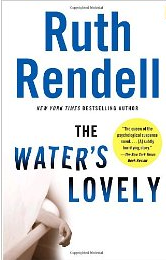
Cover for The Water's LovelyRuth Rendell is not for the faint of heart. She is certainly capable of building her readers’ sense of dread, and I felt one from the beginning of The Water’s Lovely, to the point where I almost couldn’t enjoy it.

Ismay suspects that her sister Heather drowned their stepfather Guy in the bathtub years ago to save Ismay from his advances. She and their mother assumed Heather’s guilt at the time but never spoke of it, and their mother is now mentally ill. When Heather gets seriously involved with a coworker, Edmund, Ismay begins to worry that she should tell him what Heather did. She stupidly records her theory on a cassette tape.

Rendell does a great job of portraying a slew of repellent characters, including self-obsessed Ismay; Edmund’s clinging, whiny mother; and Ismay’s selfish, manipulative boyfriend Andrew. The worst is Marion, the woman Edmond’s mother would like him to date. She likes to befriend elderly people she thinks will put her in their wills, and then she perhaps poisons them.

I worried what was going to happen with that tape, because Heather and Edmund were practically the only likeable characters in the book, except for the girl’s aunt Pamela and her friend Michael. Happily, the ending wasn’t as dreadful as I feared.

Day 194: Burning Bright

Cover for Burning BrightI’m afraid I cannot read any book by Tracy Chevalier without thinking of the purity of the character she created in Girl with a Pearl Earring. Unfortunately, I haven’t read a book by her that was as good, but I keep hoping for one.

In Burning Bright, set in 18th century London, Jem Kellaway, a young lad from the country, moves with his family into Lambeth. They settle into a row house owned by Kellaway’s new employer, next door to the poet and artist William Blake and his wife.

Jem befriends a London street urchin named Maggie Butterfield, and they spend some time with the Blakes. These two children are meant to represent Blake’s ideas of innocence and experience.

Jem’s father has taken a carpentry job with Astley’s Circus. Unfortunately, Jem’s sister Maisie soon attracts the eye of John Astley, the rapscallion son of the circus owner.

Most of the action of the novel centers around the unease generated in England by the French Revolution. Blake’s unusual publications have made him appear to be seditious, and he and his family are threatened as the hysteria rises.

Unfortunately, the characters and story are not very interesting, and William Blake is almost incidental to the novel. The novel does nothing to make the mysterious Blake more understandable to us.