Day 193: The Drop

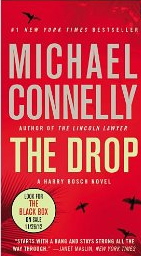
Cover for The DropSeveral people asked me recently if I had read any Michael Connelly. I hadn’t, so I read The Drop.

Harry Bosch is a cop who retired and then returned to work on the Open Unsolved unit. He is asked to take over another team’s case when DNA tests on the blood from an old rape and murder show that it comes from a sex offender who was only eight years old at the time.

Harry thinks he has a viable suspect in a man who was briefly the boyfriend of the sex offender’s mother, when he is told to drop the case. A city councilman who has always been his enemy has asked for him to investigate the apparent suicide of his son.

Harry begins to find what looks like corruption in city government, so he must tread carefully. In the course of the case, he also has reason to doubt both his current partner, David Chu, and his previous one, Kiz Rider.

The plot is reasonably interesting if you can get past the choppy writing, tendency to state the obvious, and unconvincing dialog. The problems in Harry’s growing affection for a program director for a rehabilitation center also seem contrived and premature, given the newness of their relationship. After all the raves about Connelly, I found him a disappointment.

Day 192: Home

Cover for HomeBest Book of the Week!

The beautifully written, subtle novel Home by Marilynne Robinson makes me thoughtful. It is 1957. After a failed ten-year engagement, thirty-eight-year-old Glory Boughton has moved home to Gilead, Iowa, to care for her elderly father, a retired Presbyterian minister.

Her father has been waiting 20 years for the return of his best-loved son, Jack. Finally, they hear that Jack is coming home. Always unreliable and setting himself apart from the family, he arrives late, and Glory feels ambivalent about his return. Soon, though, she sees that he is tired and having difficulty being there, and she tries to help him.

The novel carefully explores the relationships between the three of them–Glory loving but distrustful of the pain Jack has caused and protective of her father, Jack trying to make a new life in painful and distressed conditions, and their father forgiving and unforgiving at the same time. In the background are the events of the civil rights movement, toward which Jack and his father have radically different views.

Jack is delicate and fragile. He tells Glory he lived as a vagrant, drunk, and cheat until he met a woman named Della, and now Della has gone back to her parents. He tries to find work in town and writes countless letters to Della.

This novel is apparently related to a previous one, Gilead. I do not know whether it could be considered a sequel, although I know it shares some characters.

To modern readers the manners and dress of this devout Iowa family seem very old-fashioned, and some readers may find the novel slow, but I found it engrossing. It is, of course, a retelling of the tale of the prodigal son.

This is a simple story on the surface, but it depicts complex characters and relationships. It is a novel about family relationships and love, written with a delicate touch. I find it difficult to express how fine I felt it to be.

Day 191: The Wrong Mother

Cover for The Wrong MotherAgain, Sophie Hannah uses the technique of multiple narrations in the enthralling mystery/thriller The Wrong Mother, featuring Simon Waterhouse.

Sally Thorning is married with two children, and although she is happy, she feels worn out with working and child rearing. When a business trip is cancelled, she lies to her husband so that she can take some time at a spa. There she meets a man named Mark Bretherick and has a brief affair.

A year later she is out shopping when someone pushes her into traffic. When she arrives home, she sees a news report about a woman who apparently killed herself and her child. The woman’s husband is supposed to be Mark Bretherick, but the man on the television is not the man Sally met at the hotel. She does not want to go to the police because she doesn’t want her husband to find out about her fling.

In the meantime, police constable Simon Waterhouse thinks there is something wrong with the diary found for Geraldine Bretherick, in which she writes about how much she hates being a mother.

Although Hannah seems to have a very dark idea of human behavior if you look at the totality of her work, I always enjoy her twisty plots and her grasp of psychological manipulation. Her two recurring characters, Simon and Charlie, are also almost completely disfunctional in their abortive romance and occasionally behave very oddly as police officers. Still, if you like dark mysteries, her books are fun to read.

Day 190: Open: An Autobiography

Cover for OpenBest Book of the Week!

Those of you who know me will probably be surprised to see the review of a sports biography on my blog. I will freely admit that this is not a book I would have chosen for myself; instead, it was a choice of my book club. That being said, I found Open: An Autobiography by Andre Agassi to be extremely interesting and even touching.

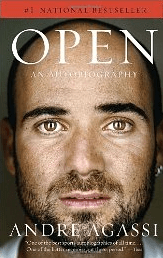
In making notes for my review, though, I came across another problem–how to review a biography of a living, well-known figure except by relating some of its disclosures. For some assistance on this, I took a peek at the review in the New York Times, but they obviously had the same problem. However, a phrase in that review caught my attention. The reviewer remarked that from the first time Agassi first appeared in the sport, he looked like a deer in the headlights. Now, look at the picture of him from the cover of the book.

This expression is a lead-in to a story about a sad, sad boy who seems to have finally grown up into a mostly happy, contented man. His big secret, which by now everyone knows, is that this athlete, who is considered one of the best tennis players in the world, ever, has always hated tennis. He was forced into the game as a young boy by his fiercely competitive (and I would say, although he never does, abusive) father, a former Olympic boxer who never succeeded professionally but was trying to live his life through his son.

His fate was so predetermined that his father gave him a tennis racket to hold in his cradle, and when as a boy he found he preferred soccer because of the camraderie (he frequently remarks on how lonely a sport tennis is), his father made him quit so he could spend more time on tennis. The vision of Agassi as a small boy facing the machine his father had rigged to fire thousands of tennis balls at him at an unbelievable speed is a chilling one.

I was particularly outraged by the attitude of his father and other adults toward his schooling. Agassi is clearly an intelligent person. He can remember, literally, everything, but as he explains in the book, except in English class he had difficulty grasping concepts. He had to have them explained to him a few times, and then he could remember them. When you watch his farewell speech at the 2009 U.S. Open or any of his speeches about his charter schools, you can see that he is a thoughtful, reasoned, even eloquent speaker who does not need notes. I am guessing that he may have had some sort of learning disability.

I feel so sorry for a boy who needed help with his lessons instead of a father who regularly had him skip school to play more tennis. Later he was sent to a tennis training school at the age of 14 (a school that sometimes sounds like something from Dickens and other times like Lord of the Flies), from which he was allowed to drop out of school to pursue, you guessed it, more tennis. This “preparation” gave him no other recourse–he was forced to follow a career in tennis because he had no other prospects and couldn’t do anything else.

Open is about Agassi learning to grow up and make peace with himself. It is terrifically engrossing, and his descriptions of some of the games made me wish that I had seen them. (Actually, I watched some of them on YouTube.) He avoids any kind of self-aggrandisement. In fact, as the title says, he is open for the first time in his life. Although he expresses himself honestly, he does not use the occasion of writing this memoir to slam other people or tell anyone’s secrets but his own. His depiction of certain other well-known figures (for example, his marriage to Brooke Shields and his rivalry with Pete Sampras) is balanced, and it seems, fair. Finally, I found it touching to see how a person who grew up in such a harsh environment would turn out to be so caring of others.

Day 189: The Girl with No Shadow

Cover for The Girl with No ShadowI just reviewed Chocolat recently, so I thought I’d continue with a review of The Girl with No Shadow, Joanne Harris’ sequel to that novel.

The wind is blowing trouble toward Vianne Rocher, now running a small chocolatierie in Montmartre in Paris. The trouble is coming in the form of a con woman with many names, whom Vianne will know as Zozie de l’Alba.

Vianne herself has another name. She is going by Yanne Charbonneau because of some problems that developed after the birth of her second daughter, Rosette, now four. Vianne has been doing everything she can to avoid standing out. Anouk is now known as Annie. Gone are the red dresses with bells hanging from the hems. Yanne is demure and nondescript and doesn’t use her magic, even to know what a customer’s favorite chocolate is.

Annie, at eleven, is unhappy with school and with the changes in their lives. Soon more seeds of discontent are sown. As Zozie weasels her way into their lives and prises away their secrets, she decides that when she leaves, she is taking Annie with her. So, she does her best to encourage Annie’s rebellion against her mother.

Again, Harris combines the gentleness and kindness of Vianne’s temperament with a fair amount of suspense. As we learn more about Zozie’s past, we find out just how dangerous and devoid of conscience she is.

As usual the writing is beautiful, sprinkled with the scents and flavors of the chocolatierie and a dash of magic.

Another novel about Vianne and her family is just out, Peaches for Father Francis, so I guess I had better get reading!

Day 188: The Nature of Monsters

Cover for The Nature of MonstersClare Clark seems to be fascinated with shit. Her first book, The Great Stink, featured a mystery during the digging of the London sewer system, and it seemed to revel in descriptions of filth. The Nature of Monsters also spends a great deal of time describing the sanitary conditions of 18th century London.

The novel begins with a description of the 1666 Great Fire of London and the subsequent birth of a disfigured child. This opening is perplexing, and it takes you awhile to figure out the connection to the rest of the novel.

It is 1718, and Eliza Tally has essentially been sold by her mother to a wealthy man’s son, although they first perform a semi-legal marriage ceremony. When Eliza gets pregnant, her mother goes to the man’s father to negotiate a settlement. The results are not what she expects, as Eliza is sold into servitude in London as a maid for an apothecary, whom she thinks is supposed to rid her of her child. But he has other plans.

Eliza is trapped in a bizarre household. She is never allowed to see the apothecary. His wife, Mrs. Black, is intimidating and maintains an iron control over the household. The apothecary has a slimy assistant, and the only other servant is Mary, a mentally handicapped girl. The atmosphere of the house is dark and creepy.

Convinced that he is a scientist and that he is making scientific experiments, the apothecary believes that what a pregnant woman experiences determines the formation of her child. Since he has a handy pregnant woman in his house, he decides to use her for his experiments. Clark has written another disturbing but well-written and suspenseful novel.

Day 187: A Perfect Spy

Cover for A Perfect SpyWhen I was younger, I used to confuse John le Carré and Ken Follett, but last year I went to see the excellent movie Tinker Tailor Soldier Spy. After that, I began reading le Carré again (my review of the novel is here) and have realized that he is the real spellbinder.

Although le Carré writes about espionage, these are not your typical James Bond novels. Le Carré is interested in the moral ambiguity of the work and in psychological drama rather than action. Nevertheless, his novels are extremely suspenseful.

At the beginning of A Perfect Spy, Magnus Pym has escaped his bosses in the British government and the Americans who are investigating him and has arrived at his secret rooms in a small British seaside town to write his novel, he says. As the British search for him feverishly and his boss Jack Brotherhood reluctantly begins to wonder if he is the traitor the Americans claim, Pym writes the sad story of his life.

Pym’s father has recently died, and Pym feels himself finally free to be himself, but perhaps even Pym doesn’t know who he is. His story begins with his charismatic father–a man who is beloved by many but who is also a liar, a cheat, a con man, and a thief. Pym learns to lie and pretend everything is fine from a master, and he goes on pretending for his entire life. But Pym’s motivating force, unlike his father’s, is never money. It is love. He will be anyone and do anything to make people love him.

Is Pym a traitor or isn’t he? As his boss and his wife frantically try to find him, Pym recalls the circumstances and tangled events that lead him to where he is in the present time, alone in his rooms contemplating the next step.

It is difficult to convey, without giving much away, just how compelling this novel is. Le Carré’s genius is that he can make you care for this deeply flawed character and keep you riveted by his story. A Perfect Spy is said to be the most autobiographical of le Carré’s books. It is certainly an involving novel.

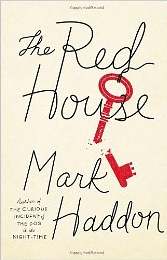
Day 186: The Red House

Cover for The Red HouseI really enjoyed Mark Haddon’s The Curious Incident of the Dog in the Night-Time, so I was looking forward to reading The Red House. Curious Incident employs unusual narrative techniques, such as including math games, to try to re-create the thought processes of an autistic teen. The Red House also plays with narration, only not as effectively.

After being estranged for years, siblings Angela and Richard have met again at their mother’s funeral. In an impulsive attempt to restore ties with his sister, Richard rents a holiday house in Herefordshire and invites the other family to join his for a week. Richard’s family consists of his second wife Louise and her teenage daughter Melissa. Accompanying Angela are her husband Dominic and their children Benjy, Alex, and Daisy.

Each of the characters is dealing with issues. Angela had a miscarriage 18 years ago, and she has dwelled on this lost child ever since, naming her Karen and neglecting her teenage daughter Daisy as a result of this obsession. Dominic is having an affair. Daisy has become very religious and fights with Angela about it. Teenage Alex is yearning to have sex with Melissa. Richard is dreading a possible lawsuit from a patient. Louise barely knows the other family and is having problems with Richard. Melissa is awaiting the time when her parents learn that bullying by her group of friends has caused another girl to attempt suicide. Only young Benjy does not seem to have some sort of obsession.

The book jumps among the narrations of all eight characters. The voices are not always so distinct that you can immediately tell them apart. The one that is distinct is expressed as disjointed lists of things, but it is difficult to attach to anyone. For awhile I thought it might be that of the dead daughter and later I thought it may be Angela having a nervous breakdown. Most often, to figure out who the narrator was, I had to relate the narration to something that was already going on. One technique Haddon uses is to interject part of what each person is reading, which at first helps you know which person it is, but after awhile becomes tedious.

Virtually plotless, this dour novel consists of the characters struggling with their own thoughts and with each other. Generally, I disliked most of the characters and thought the novel was a frustrating reading experience.

Day 185: Haunt Me Still

Cover for Haunt Me StillHaunt Me Still (published as The Shakespearean Curse in Britain) is another enjoyable literary mystery by Jennifer Lee Carrell. Shakespearean scholar and theatre director Kate Stanley visits Lady Nairn to discuss a production of Macbeth. Lady Nairn, once a renowned actress, plans a production of the play at the foot of Dunsinane Hill using some props from her own collection and wants Kate to direct.

Once the cast arrives at Lady Nairn’s Scottish castle, though, Kate sees a vision of Lady Nairn’s fifteen-year-old granddaughter Lily being murdered and finds the body of a local woman dead at the scene of what appears to be a pagan sacrifice. Then Lily is kidnapped. The ransom demanded is an earlier version of Macbeth that is reputed to include actual magical ceremonies.

On the romantic side, Kate and Ben Pearl have broken up, but Ben reappears, dating an actress in the play.

This novel is loaded with action, as well as witches, curses, cauldrons, crazed killers, some 16th century history, and an exploration of the myths surrounding the play. In other words, it’s a lot of fun.