
 This week’s Best Book is David Copperfield by Charles Dickens!
Day 175: Death Angels
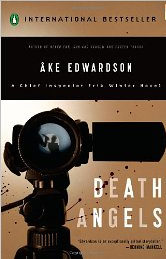 Although Death Angels is the fourth of Åke Edwardson’s books to be published in the United States, it is the first book in his Erik Winter series. I felt that this mystery flagged in the middle, although the beginning and ending were interesting.
Young men are murdered in a similar way in Sweden and London, so Erik Winter and his team get together with their London counterparts to solve the crime. When they begin to suspect that the murders may be connected with snuff films, Winter asks a childhood friend with ties to illicit porn for help. A break finally comes when a burglar reports seeing some blood-stained clothing in a house he’s broken into.
As I mentioned before, nothing much seems to happen in the middle of the book. It appears that some of the Scandinavian mystery writers are at pains to show realistically how long it takes to solve some crimes. This objective is a worthy one, but they need to also find a way to build suspense or keep the reader’s interest. The characters of the members of Winter’s team are not well developed, although an attempt is made to show other aspects of their lives. However, I especially disliked the subplot of the young cop with a pregnant wife who gets involved with a stripper.
Day 174: Pauline Bonaparte: Venus of Empire
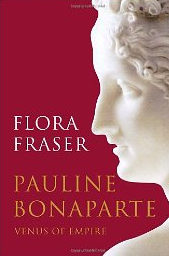 I didn’t know anything about Pauline Bonaparte before I read Pauline Bonaparte: Venus of Empire. I picked it up because it was by Flora Fraser, a noted biographer who specializes in 19th century women. (She is also the daughter of Antonia Fraser, the famous biographer.)
Pauline Bonaparte was Napoleon Bonaparte’s youngest sister, renowned for her beauty. She lived a colorful life and is immortalized by a life-sized, nude statue by Antonio Canova that resides in the Villa Borghese in Rome.
The connection with the Borghese family is not one that they cherish. Pauline’s second husband was Prince Camillo Borghese. During their long marriage, they lived mostly apart, and Pauline entertained herself with numerous flagrant affairs.
In fact, Pauline’s reputation was dreadful. Napoleon’s enemies spread numerous rumors about her, even stooping to claim that her relations with her brother were incestuous. Not only did she not care, she encouraged that particular rumor to show how powerful she was.
Although she could be very charming, she spent most of her career manipulating infatuated men and intimidated women. Stories abound of her using generals as footstools, turning people our of their own houses, and so on. A particularly odd one was that when she was visiting an officer of the church, she made him cut a hole in the ceiling of his bathroom over the tub so that someone could stand on the floor above her and shower her with milk.
Although extremely jealous of the prerogatives granted her sisters (as they were of hers) and generally hateful to the Empress Josephine (she and her sisters held onto Josephine’s train during her coronation so that she could not move forward), Pauline’s most positive trait was her loyalty to her family. She was devoted, although not faithful, to her first husband, General Victor Emmanual Leclerc. When Napoleon fell out of power, she was persistent in trying to improve his living conditions and tried to get permission from the British to share his exile.
Fraser’s biography is interesting and well written. I found Pauline to be a fascinating subject, although not an admirable person.
Day 173: David Copperfield
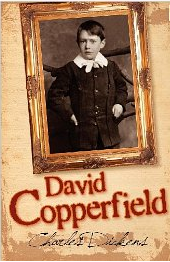 Best Book of the Week!
I believe that David Copperfield was the very first book I ever received as a young girl that was not a children’s book. My dad brought it home for me one day when I was sick (beginning my collection of Modern Classics back when they were hardcover), and it transported me to another world.
People have differing opinions about which Charles Dickens book is best. For example, author Nick Hornby blogged that Great Expectations was one of the greatest books ever written. I myself have never fallen under the spell of Great Expectations, though. David Copperfield is my favorite. Tolstoy thought Dickens was the best of all English novelists and considered this book Dickens’s finest work.
David is the narrator of his own story, and he begins it on the night of his birth. David is a posthumous baby, and the novel begins with the first appearance of Aunt Betsey Trotwood, who comes to greet the appearance of her niece and terrifies David’s gentle, foolish mother. When David turns out to be a boy, Aunt Trotwood is mightily offended and departs.
Although David’s early childhood is idyllic, worshipped as he is by his mother and Peggoty the maid, it soon takes a turn for the worse. David’s mother is courted and won by the stern, apparently upright (and ultimately cruel and hypocritical) Mr. Murdstone, and the house is taken over by his cold and fault-finding sister Jane. David is a true innocent with only good intentions, but at every turn he is found to be in the wrong. He is soon shipped off to a typically horrible (if you know Dickens) boarding school.
After a bit of a rocky start, David finds himself made a pet of the popular Steerforth and also befriends Tommy Traddles. However, his mediocre education is interrupted when his mother and baby brother die. Mr. Murdstone sends him to London to lodge with the feckless Micawber family and work in a factory. When the well-meaning but impecunious Micawber is sent to debtor’s prison, David tires of his degrading life and runs off to find the only family he has left, Aunt Betsey Trotwood.
Although Aunt Trotwood is still disappointed that he isn’t a girl, she is kind, and from here, David’s life improves. The story continues with his education, marriage, and young adulthood. It is loaded with some of Dickens’s most delightful characters and a few villainous ones. Alternately turning from comedy to pathos, Dickens expertly drives the story along.
I believe one reason I find David Copperfield so touching is that David’s early life is taken from Dickens’s own. Dickens’s father was sent to debtor’s prison and Dickens went to work in a factory at an early age. This connection translates into a moving experience for the reader.
When innocent and loving David is punished by his stepfather because he is so terrified he can’t recite his lessons or when he is sent off to work in a factory, who remains untouched? When Barkis is willin’ or Mr. Micawber appears on the scene, who doesn’t laugh out loud? When steadfast and valiant Ham dies trying to rescue his rival, who isn’t tearful? When the slimy Uriah Heep finally gets his comeuppance, who isn’t delighted?
If you are not used to reading Victorian literature, you may find the writing old-fashioned, but you will almost certainly be carried along by the story.
Day 172: The Weird Sisters
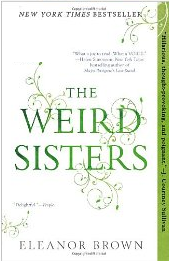 Rose, Bianca, and Cordelia Andreas are the daughters of a Shakespeare scholar who is obsessed with the Bard. From their earliest days they were taught to quote from Shakespeare plays, enact scenes, and use Elizabethan curses. Of course, they are named for characters from the plays. Their father’s way of communicating with them when they are away is to send them clippings from the Riverside Shakespeare. This is the setup for The Weird Sisters by Eleanor Brown. You might think such a gimmick would become tiresome, but it does not.
The three sisters have traits in common with their characters. Rose, like Rosalind, is smart and dutiful. Bianca is a flirtacious beauty. Cordelia is the much-loved youngest daughter. They are also a bit estranged from each other. Rose resents that she always has to be the responsible one, but Bean and Cordy think she takes too much upon herself. Both Rose and Bean are jealous of the unconditional love that Cordy receives from their parents. And Rose and Cordy think Bean has too great a need for attention, one that leads her to seduce men indiscriminantly.
When they receive a summons from their father because their mother has cancer (it says “Come, let us go; and pray to all the gods/For our beloved mother in her pains”), the lives of all the women are in disarray. Rose’s fiancé is about to leave for a job in England, and he wants her to join him. She believes she is too urgently needed at home, where she is the organizer. Bean (Bianca) has been fired from her job in New York for embezzling the money she needs to perpetuate her lifestyle. Cordy has been living from man to man like a vagabond when she finds she is pregnant.
They all return to their crazy, poorly run childhood home, where piles of books are everywhere and all members of the family are perpetually reading but not, perhaps, cleaning. Slowly, the small town in Ohio that Cordy and Bean have been running away from begins to seem not so bad.
The Weird Sisters is an amusing, touching novel about how each of the women finds her path and reconciles with her sisters. It is extremely well written, and oddly enough, you do not tire of its devices.
Day 171: Eye of the Red Tsar
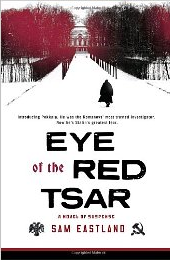 I had a strange reaction to Eye of the Red Tsar by Sam Eastland. I felt as if the author had researched the time and place without actually grasping anything about it. The novel is placed in post-revolutionary USSR with flashbacks to pre-revolutionary Russia. Tsar Nicholas II and Stalin are both characters in the book, in their different time periods, but you do not get any feeling that the author understands what kind of people they were or anything about the politics involved. Given my fascination with Russia, this novel would seem to be a great fit for me, but I have nothing but objections to it.
Pekkala, a Finnish soldier, is a prisoner in a labor camp in Siberia at the beginning of the novel. He was Nicholas II’s private investigator before the revolution, when he became known as The Emerald Eye. He remained completely faithful to the Romanovs, so when the family was captured by the Bolsheviks, he was exiled to Siberia. But at the beginning of the novel, he is released because Stalin wants him to find out exactly what happened the night the Tsar and his family were executed. Of course, this question has remained a mystery to the western world until recently, but I did not buy at all that Stalin and his predecessors would not have already known perfectly well what happened to the Romanovs.
My first objection is about how Stalin is characterized. The book takes place partly in 1929, when Stalin is only a few years away from his reign of terror. Yet he is depicted as quiet and thoughtful, not exactly true to the historical consensus. As a kind of extension of that thought, even though the book is about a time and place when everything is politicized, the novel provides no political context for the reader.
Another problem I have is with the narrative style. As Pekkala conducts his investigation, he remembers his past, in order. When I compare Eastland’s technique with that used in The Darkest Room, where characters have fleeting thoughts or disjointed memories that eventually add up to something, this novel seems incomparably clumsy in execution.
Finally (somewhat of a spoiler), I found it completely unbelievable, given the loyalty of the main character to the Romanovs, that he would willingly agree to work for Stalin at the end of the book. I forgive myself for revealing this turn of events, as it is easy to see it coming. Readers are told at the beginning of the book that Stalin is known as the Red Tsar. Obviously, since Pekkala was the Emerald Eye under the Nicholas, he will become the Eye of the Red Tsar under Stalin.
Special Posting! Best Book of the Week!
 This week’s Best Book is We, The Drowned by Carsten Jensen.
Day 170: The Subtle Knife
 A few months ago, I reviewed The Golden Compass, the first book in Philip Pullman’s trilogy, “His Dark Materials.” I thought it was about time to review the second book, The Subtle Knife.
As I have said before, it’s most difficult to review the second book in a trilogy, because everything is building up toward the third book. Lyra follows her father, Lord Asriel, through a window to another world. There she meets Will, a boy from our world.
Will has taken care of his mentally ill mother since his father disappeared on an expedition years before. Recently men have been breaking into their house trying to find his father’s papers. Will kills one of them accidentally and flees into the other world through a window, where he meets Lyra.
Lyra is trying to find out about dust, but the alethiometer tells her to help Will find his father. What they find first is the subtle knife, which can cut through anything, even the fabric between worlds. Will becomes the knife’s keeper.
Although the concept of the knife cutting the fabric between worlds is interesting, I really loved the whole feel of the world and the characters in The Golden Compass. Some of the characters are still with us in the second book, but we are moving away from that world. However, I enjoyed The Subtle Knife. I just don’t think the rest of the trilogy stands up to The Golden Compass in imaginative power and characters you feel really invested in.
Day 169: The Distant Hours
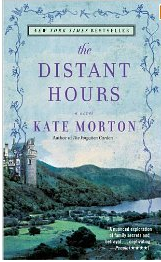 Kate Morton has been one my favorite authors ever since I read The Forgotten Garden, which is still my favorite of her books. The Distant Hours is another of Morton’s atmospheric novels about family secrets.
When a letter posted in 1941 finally reaches its destination in 1992, Edie Burchill is surprised at the emotional reaction of her usually cool mother. She finds out for the first time that her mother was an evacuee during World War II at the home of Raymond Blythe, the author of Edie’s favorite childhood book, The True History of the Mud Man.
Later, after Edie has been asked to write an introduction for a reprint of Blythe’s classic, she gets lost meeting a potential author and accidentally finds Milderhurst Castle, the once stately but now crumbling home of the Blythes. Living there are the Blythe sisters, Percy, Saffy, and the invalid Juniper. In a way, too, the house is still occupied by the memory of their overbearing father.
The novel alternates between the present time and 1941, as we discover what happened during one night in 1941 that has haunted the family ever since. Morton is deft at creating a compelling atmosphere in the moldering castle and in keeping her readers in suspense.
Morton’s latest book, The Secret Keeper, is due out in October. I can’t wait to get my copy!
Day 168: Cod: A Biography of the Fish That Changed the World
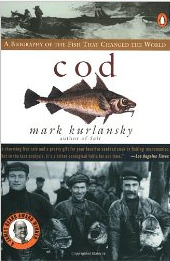 Cod is the best known of Mark Kurlansky’s interesting micro-histories. If you are not familiar with the term, a micro-history is a short book that details the history of a specific and focused subject. Cod explores the importance of cod and the history of cod fishing beginning in the early days when the Vikings and Basques dominated the industry.
It was interesting to learn that Vikings and Basques going after cod were probably the first Europeans to “discover” America. They had been fishing off the coast for years before Columbus traveled to the Americas, keeping their fishing grounds secret.
Later, the eastern seaboard provinces of Canada and the New England states dominated the industry because of their location. The abundance and importance of cod provided many years of prosperity for these areas, but the later dearth of cod has had the opposite effect. Iceland, whose economy was almost solely dependent upon cod until recent years, has been severely impacted.
Of course, there is an ecological aspect to the history of cod. During the height of the fishing industry, the fish were so plentiful that it was said a person could walk across their backs. In the present, the fisheries are in danger of dying and many families with long histories in the industry are being forced to find other work. Kurlansky shows how the fishermen’s warnings about cod disappearing were routinely ignored by scientists and governments for years.
There is some overlap with Kurlansky’s book Salt, as he explains the importance that being able to salt the cod had to the success of the fishing industry. Before salting was begun, the cod had to be dried and a lot of it spoiled onboard. The chapters about battles over international waters are also fascinating.
As always with Kurlansky, the book is interesting and well written. It employs his usual format of mixing in recipes for preparing cod with the historical information.
 What? Me Read?