
 The Best Book this week is Broken Harbor by Tana French.
Day 150: The Torso
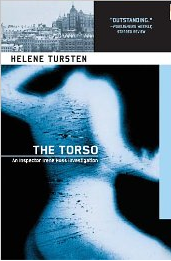 The Torso is a pedestrian police procedural by Helene Tursten. A torso washes up on a Swedish beach. The investigation finds that a similar murder occurred in Copenhagen, so Detective Irene Huss travels there to consult with the Danish police. Victims are being strangled and then after death dismembered and their organs removed. Not only are the leads to the murderer few, but the police are having difficulty identifying the original torso.
The novel is ploddingly written with no particular suspense. The characters all remain sketchily depicted except Huss, and her every thought is recorded, no matter how mundane. Unfortunately, many of her thoughts are mundane. Every character is thoroughly described including each person’s changes of outfits.
Speaking of Huss’s thoughts, despite having a loving husband and two teenage daughters, she seems to be prepared at one point to launch into an affair with a Danish policeman without any thought at all for her family.
My biggest negative reaction has to do with unlikeliness in the investigation. Perhaps police procedure is different in Sweden than here, but I was surprised to find the coroner providing a profiler lecture based upon one examination of the body and a lot of supposition. For example, there is an assumption throughout that the organs are removed to be eaten, even though there is no proof of that. In addition, the reactions of Huss and other offficers to some sights and remarks seem to be implausibly squeamish, considering their positions. It also seems implausible to me that the team would retain the obnoxious alcoholic cop Jonny, who seems to be incompetent to boot. Rather than assume Swedish procedure and police behavior is that different, I am inclined to believe that Tursten doesn’t know anything about criminal investigations.
Finally, the denoument of the novel is anticlimactic. The murderer has been stalking Huss, so we might expect a terrifying finale. No such thing happens. Although the novel is clearly meant to appeal to those who like dark, gruesome fiction, it completely fails to provide any suspense or atmosphere.
Day 149: Hons and Rebels
 After reading the other Mitfords’ criticisms of this book in The House of Mitford, I expected a biography that was cruel and critical, but Hons and Rebels is mostly an amusing story of Jessica Mitford’s teenage rebellion. The Guinesses (authors of The House of Mitford and Jessica Mitford’s nephew and great-niece), who claimed that Jessica Mitford lied on several points, do not seem to have considered the common phenomenon that people who experience the same things frequently remember them differently, from their own frames of reference. A different recollection of an event in the far past (and in one case an apparent misidentification) is not necessarily lying.
I became interested in finding a good biography of the Mitfords after re-reading several of Nancy Mitford’s novels. I was curious about the kind of family that could have spawned children with such radically different ideas and such extreme characters. Unfortunately, at the time, I was only able to find a couple of biographies written by family members, this being one.
Nancy Mitford, of course, was a brilliant social satirist and author of several light comic novels–and not as politically involved as some of the other girls. Diana left her aristocratic husband, Bryan Guiness, for the infamous British Fascist leader, Oswald Mosley, and was interred with him in prison during World War II for their pro-German sympathies. Unity Mitford became a fan and friend of Adolf Hitler and shot herself in the head the day that Britain declared war against Germany, but failed to kill herself and was mentally disabled for the rest of her life. On the other hand, Jessica as a teenager ran off to the Spanish Civil War with the socialist Esmond Romilly, whom she married. Later she moved to the United States and became a member of the American Communist Party and a famous muckraking journalist.
Hons and Rebels covers Jessica’s childhood, rebellion, later life in the States, and estrangement from the rest of the family. It is light and easy to read, and quite funny. It depicts Esmond and Jessica as extremely naive but equally unprincipled. Mitford does not attack the other family members, as I would have expected after the comments in The House of Mitford. If anything, she looks back at them all nostalgically. In fact, as I commented in my review of the other book, the Guinesses are more prone to attack and criticize the other Mitfords, particularly Jessica and Nancy, and try to mitigate the faults of the Mosleys and the fanaticism of Unity. The only biography I can find written by an unbiased author is apparently superficial and focuses on Unity, so I guess my curiosity about the Mitfords will remain unsatisfied.
Just a note for my consistent readers: I thought that by reviewing one nonfiction book a week, I would be able to continue to write nonfiction reviews indefinitely, but I have now caught up with my nonfiction reading for the past two years, which just shows how much more fiction I read. From now on, nonfiction reviews will appear as I finish the books instead of more regularly.
Day 148: The Map of True Places
 The Map of True Places is another very good book by Brunonia Barry. Zee is a psychotherapist with a shattering past. The death of her patient Lilly, a bipolar housewife who jumped off a bridge, has brought back to Zee memories of her own mother’s suicide. Her father Finch was unfaithful to her bipolar mother with another man, and when Zee was 11, her mother committed suicide by swallowing strychnine. Zee came home in time to witness the fatal convulsions.
Zee goes to visit her father and finds that his Parkinson’s disease has turned to dementia and he has kicked his partner Melville out of the house. She decides to take a leave of absence from her practice to care for Finch. Trying to come to terms with the past and figure out what to do with Finch, she begins to doubt everything in her life. As she finds out the truth about many of the myths in her life, Zee also finds clues about what happened to Lilly in her final days.
This second book of Barry’s is also set in Salem, Massachusetts, and features some of the same characters as in The Lace Reader. I have really enjoyed both of Barry’s books. She creates a strong sense of place in the quirky Salem and populates her novels with complex, interesting characters.
Day 147: Quo Vadis
 I picked up Quo Vadis because I so much enjoyed Henryk Sienkiewicz’s Polish history trilogy, as you know if you read my review of With Fire and Sword. This novel is about a young Roman patrician, Vinicius, who falls in love with Ligia, a Christian, in the time of Nero’s rule. Sienkiewicz did extensive research on the period to get the details right.
About half of the book is about Vinicius’s pursuit of Ligia, first through ruthless means, including kidnapping (presumably pagan patricians have no morals), and later through conversion to Christianity. I was frankly uninterested in either Vinicius or Ligia, who are cardboard characters, and I couldn’t care less about whether they got together.
The last half of the book is about the burning of Rome and the persecution of the Christians. It features the last days of St. Paul. The pace picks up a little here, but overall the novel is marred by its focus on extolling Christianity. All of the Christians are noble, and most of the other characters are not. Sienkiewicz was a devout Catholic, as is obvious from a few scenes in all his books, and I can only think that the added emphasis on this aspect in this particular novel gets in the way of the book’s effectiveness, at least as viewed by a modern audience.
I know that Quo Vadis was extremely popular in its time (it was published in 1896) and contributed toward Sienkiewicz winning the Nobel Prize for Literature. I also know that Sienkiewicz was capable of creating more interesting characters and writing more exciting scenes. Perhaps the times have just changed too much since this book was written for it to appeal to a wide audience now.
Day 146: Broken Harbor
 Best Book of the Week!
I have eagerly awaited each new novel by Irish author Tana French ever since reading her first, In the Woods. She has only gotten better. A technique she has employed from the first is to use a secondary character from one book as her protagonist for the next–a creative way to provide continuity for a stand-alone story.
Mick Kennedy briefly appeared in French’s last book, Faithful Place, as a brash, abrasive cop. Although not all his coworkers like his bullheaded, aggressive manner, he has a high solve rate and goes completely by the book. He lands an important case, an attack on an entire family. Pat and Jenny Spain and their two children were attacked in their home in an upscale development that has floundered since the economic downturn–in Brianstown, which Mick knows as Broken Harbor. Only Jenny has a chance of surviving. Mick takes along as partner a rookie detective he thinks has potential.
When the detectives get to Broken Harbor, they find almost a lunar landscape of half-built, crumbling houses and rubble with only a few badly built occupied homes. The Spain’s house, however, is immaculate when you look past the blood. But something strange has been going on. Holes are smashed in the walls, monitors and cameras are strategically placed, and a vicious trap is set up in the attic. The computer has been wiped, and the “floaters” discover that someone has been camping out in a nearby house and spying on the Spains.
Broken Harbor holds a mix of confusing memories for Mick. His family spent two weeks there every summer when it was a modest fishing town. He was happy there, but at the end of the last summer, his mother committed suicide. Mick has been purposefully ignoring his unresolved feelings in addition to coping with a mentally ill younger sister.
Broken Harbor is a police procedural that becomes a riveting psychological suspense novel. Unlike with some of French’s earlier books, I was unable to decide between the competing suspects. But whether you can guess the solution or not, you’ll enjoy French’s novels. They are rich with complex characterizations and intriguing plots. The suspense builds as we begin to understand what was going on in the house and Mick begins to grasp how traumatized he actually is by the events in his past. The novel is dark and disturbing–just the kind of book I like!
Special Post! Best Book of the Week!
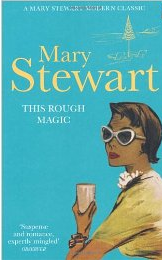 This week’s Best Book is This Rough Magic by Mary Stewart.
Day 145: Mayflower: A Story of Courage, Community, and War
 Mayflower: A Story of Courage, Community, and War is an eye-opening history of the Pilgrims, starting with their journey to America in 1620 and ending roughly 50 years later with King Philip’s War. King Philip’s War began as a small local conflict between the Plymouth Colony and King Philip, the sachem of the Pokanokets, and ended as a regional war that killed, author Nathaniel Philbrick reveals, a higher percentage of the population than any other American war.
What makes Mayflower most interesting is how Philbrick takes on the old myths–Plymouth Rock (if a rock was used, it wasn’t that one), the first Thanksgiving (actually begun by Abraham Lincoln, although there was a feast in early fall), Squanto (not such a nice guy), the courtship of Miles Standish–and provides new ways of looking at what happened.
Although the book touches on many aspects of the Pilgrims’ lives, a major theme is their relationship with the native people. The very bonds formed when Massasoit and the Pokanokets saved the original settlers from starvation and illness, when broken by the Pilgrims’ sons, are those that resulted in the destabilization of the entire New England region for years to come.
The book provides fascinating insights into these people, who had a mission for their own lives but little tolerance for others, who bravely founded a successful colony but fathered offspring whose greed, rigidity, and racism almost destroyed the results of those efforts. With his focus on relations with Native Americans, Philbrick skims over some other important elements, for example, the Pilgrims’ dissident faith, the expulsion of Roger Williams, the relationship between Plymouth and the colonies founded by Puritans and others. However, the book is focused on a topic that is interesting to a 21st century audience and has not had much discussion.
Day 144: This Rough Magic
 Best Book of the Week!
When I want to read something light, I re-read one of two authors who have been favorites for years. One of them is Mary Stewart, best known for her Merlin trilogy, which is excellent. However, it is her romantic suspense novels written from the 1950’s through the 70’s that I love to read. She continued writing into the 90’s until she was 85 years old, but her best romantic suspense work is from this earlier period.
Most of Stewart’s novels take place in exotic locales and feature appealing, literate heroines with a habit of quoting poetry. I am not normally a romance reader, although I like a good romantic suspense novel. Stewart’s books are well written, her characters intelligent and sympathetic, and her stories so well plotted that I go back to them again and again. Her descriptions of the settings are so vivid that on my travels I have caught myself looking out for places she has written about, although sadly, most of them no longer much resemble the out-of-the way places she described.
For this review, I’ve picked one of my favorite Mary Stewart novels, This Rough Magic. Lucy Waring is an actress on vacation in Corfu visiting her pregnant sister, Phyllida Forli. The Forlis are a wealthy Italian banking family who own three houses around a private bay on the island. The big gothic main house is occupied by a tenant about whom Phyllida is teasingly secretive. The other house is rented by a photographer named Godfrey Manning, who has been spending some of his time photographing Spiro, the teenage twin brother of the Forli’s housekeeper’s daughter, Miranda, swimming with a dolphin.
Lucy soon meets one of the tenants of the main house, a man who thinks she is a trespasser and tries to throw her off the property. But she is then welcomed to the house by the other occupant, the famous Shakespearean actor Julian Gale, in retirement since the tragic death of his wife and daughter. He entertains her with his theory that Corfu is the setting for The Tempest, a theory he has also related to Miranda and Spiro, as he is their godfather. The other man is Julian’s son, Max, a well-known composer. Although Julian is charming, Max is gruff and unwelcoming, and Lucy can tell something is wrong with the Gales. Later, at the Forli’s house, Lucy meets Godfrey Manning, a dashing man who is ready to admire her.
Lucy’s island idyll is broken in one harrowing day. First, when she is swimming in the bay with the dolphin, someone fires a gun at the animal, and the bullet almost hits Lucy. After a big argument with Max, whom she suspects of doing the shooting, she goes back to the Forli house to find Phyllida in distress. Godfrey has just returned from a shipboard night photography expedition to report that Spiro fell overboard and drowned. Lucy also thinks that Max met with one of the island’s smugglers, who is later found dead. Smuggling is rife between Corfu and Albania, still at that time very isolated and located across a narrow body of water from the island.
Suddenly there is a lot going on in this island paradise, and Lucy finds herself thrown into danger when Miranda confides that she has found Prospero’s books, which of course he dumped in a lake at the end of The Tempest. Loaded with atmosphere and truly gripping, This Rough Magic is a great novel to read when you just want to relax.
Day 143: West of Here
 This peculiar novel starts out as a straight intergenerational history showing how the building of a dam by a small town in 1890, which was meant to make the town prosper, ends up determining its future as a permanent backwater. The novel also tells the story of a nearly disastrous expedition into the Olympic Peninsula. The time alternates between 1890, when the dam becomes an idea of an early entrepreneur, and 2007, when the town is beginning to dismantle it.
If there is such a thing as ensemble fiction, this is it, since the book has many characters, none of whom seem to be more important than the others. Because it has many characters, it has many stories, the oddest of which is that of a mute Klallam Indian boy in 1890 who somehow shares consciousness with a troubled Indian boy in 2007. In 2007, everyone assumes the boy is psychotic and he is admitted to a mental ward. In 1890, he starts his own cult.
Characters in the historical portion are an early feminist fleeing her lover; a prostitute who is fighting with the owner of the whorehouse; the Klallam Indians, already on their way to being destroyed; and an idealistic entrepreneur. Characters in the later story are a Bigfoot enthusiast, a seafood plant worker who longs for the days when he was a high school basketball star, an ex-convict who wants to live off the land, and an environmental scientist.
Evison has written a quirky, interesting book that is sometimes humorous, but I found it a little too diffuse, with too many characters, and too much going on. Although we may be meant to contrast the vigorous original settlers with the sad sacks of the present, the seeds of the area’s troubles are there right from the beginning. Perhaps that is the point. Still, I think the intentions of the author are unclear, and the novel is muddy as a result.
 What? Me Read?