Day 142: The Man from Beijing

Cover for The Man from BeijingBefore I read The Man from Beijing, I heard it was really good, but I personally think Henning Mankell is better when he restrains the scope of his novels and refrains from long political discussions. This novel is not one of Mankell’s Kurt Wallander mysteries, but a stand-alone.

Almost everyone in a small village in remote Sweden is brutally murdered. Judge Birgitta Roslin figures out that one elderly couple was her mother’s foster parents, so she decides to go to the village and investigate.

The police are quickly convinced that the murderer is a local petty criminal, but Roslin finds diaries written by an immigrant ancestor of one of the elderly victims that she thinks may provide clues to the crime. Roslin’s story is periodically interrupted by a flashback describing the events following a man’s kidnapping in China in 1863 after he is brought to America to work on the railroad.

In the meantime, Ya Ru, a powerful Chinese businessman, is plotting a further acquisition of power and waiting to hear about the revenge he planned against the family of a man who harmed his ancestor. The novel travels to China, London, and Africa. It involves political plotting and maneuvering, corruption, and racism.

I thought the motive for the original murders was ridiculous. I also found many of the characters to be one-dimensional.

This novel is the second stand-alone I have read by Mankell, but unusually for me (because I often tire of series mysteries), I have preferred the Wallander novels. Both stand-alone novels are set partially in Africa, where Mankell lives part of the year. This novel is an improvement on the other one, which I thought was poorly written and extremely depressing, but it still has major flaws.

Day 141: Shadow of Night

Cover for Shadow of NightAs with most second books of a trilogy, Shadow of Night is transitional and therefore harder to describe than the first book.

At the end of the A Discovery of Witches, the first book of Deborah Harkness’s “All Souls Trilogy,” Diana Bishop, an Oxford scholar and nonpracticing witch, and her husband Matthew Clairmont, a geneticist and vampire, were forced to flee because a union between a witch and a vampire is forbidden. Using Diana’s newly discovered time-travel skills, they have arrived in Elizabethan England so that Diana can find a witch to help her learn her powers. Even more importantly, they want to look for Ashmole 782, an enchanted manuscript that Matthew believes may hold the secret to the existence of witches, vampires, and daemons. This decision proves potentially hazardous, though, as the age they’ve chosen is one of persecution of witches and Diana has a tendency to draw attention to herself.

In Tudor England Matthew of the past is part of an intellectual group called the School of Night, the members of which include Sir Walter Raleigh and Kit Marlowe. Kit is a deeply disturbed daemon who is insanely jealous of Diana. Another hazard is that Matthew’s acquaintances may realize he is not the same person as the person from the past. In the meantime, both Diana and Matthew’s friends and enemies back in the present time watch for clues to their existence in the past.

Although this novel is a great sequel that propels you to the next book, it has the typical middle book problem of furthering the plot without arriving anywhere. Strictly because of personal taste, I could also have done without some of the heavy romantic passages, although other readers will like them. Nevertheless, I am extremely interested to see how Diana and Matthew will resolve all their problems in the final book.

Day 140: Shoot To Thrill

Cover for Shoot To ThrillWhen I say I occasionally read P. J. Tracy’s Monkeewrench mysteries when I want something light, do not think of cozies or quaint mysteries like those written by Alexander McCall Smith. The Monkeewrench novels are thrillers with plenty of action and sometimes horrifying crimes, but they have a lightness to them that makes them fun reading, probably because of the entertaining characters and witty dialogue.

Monkeewrench Software, a team of eccentric but world-class software developers, is the focus of all of these novels, which are written by a mother-daughter writing team. The main character is Grace MacBride, a mysterious woman who lives in a protected compound because her enemies have been trying to kill her since the first book. Also on the team are the wealthy company owner, Harley Davidson, who houses the eccentric team in his mansion; the flamboyant Annie; and Roadrunner, an exercise addict.

The FBI has contacted Grace and the team to ask for help because someone, or rather a group of people, is posting videos on YouTube of murders that take place all across the country. It is not clear if the murders are real or re-enactments. But a real murder that may be related is being handled by Leo Magozzi, Grace’s lover, and his partner Gino Rolseth of the Minneapolis Police Department.

The case is interesting, but even more interesting are the relationships between the characters, particularly the one that develops between the Monkeewrench team and John Smith, a quiet, correct agent near retirement who has been assigned to be their liaison.

Day 139: Abigail Adams

Cover for Abigail AdamsI think Abigail Adams suffered from the fact that I had recently read David McCullough’s biography of John Adams, and Woody Holton’s book covers a lot of the same ground. This fact made me ponder a bit about how much a woman’s history is often treated as an echo of her famous husband’s. I am sure that not as much information is available about Abigail as there is about John, especially before they married, but I felt like these two books didn’t need to cover so much of the same territory.

The picture that emerges of Abigail Adams is of a well-meaning but bossy woman of strong views. Her feistiness had two sides. I know that people are captivated by the thought that she spoke her mind during a time when many women didn’t and behaved as if she had rights that she did not, but I had the distinct impression that on numerous occasions she would have driven a lot of people crazy, particularly in her attempts to manage her relatives. When, for example, Abigail interfered in John Quincy’s posting to Russia, he must have been very patient, or very angry.

On the other hand, Holton shows that Abigail was an expert manager of the couple’s property and fortune, actually more astute than John. She took upon herself rights that were not hers legally, from principle, and she stood up for what she believed.

I am not sure I understand the expectation at the time, but I was also struck by the fact that she made very little effort to move into or even visit the White House. I know that it was only partially built at the time and was more like a rustic men’s boarding house than the building we know today, but it seemed that John Adams spent a lot more time without his wife than was necessary, as Abigail also did not accompany him on all of his diplomatic trips. Perhaps this arrangement suited the two of them, but I had the impression that it suited her much more than it did him.

These comments are not a criticism of the biography as such, but here is one. Like many biographers do, I feel that Holton occasionally draws conclusions and makes generalizations based on too little evidence. Perhaps he is trying to avoid the problem of scholarly presentations that provide too much evidence to keep the material interesting, but if so, he goes too far the other way at times. I found myself thinking several times that he had not proven his point of view. At other times, he buries his themes in too much biographical detail. I think he was having difficulty keeping that vital balance between too much information and too little. However, Holton does usually manage to preserve a tone that is light and interesting, and Abigail Adams is certainly a compelling figure in history.

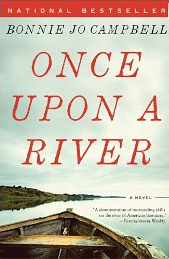
Day 138: Once Upon a River

Cover for Once Upon a RiverBest Book of the Week!

In 1970’s Michigan, Margo Crane has grown up on a tributary of the Kalamazoo River, learning how to hunt and fish from her grandfather and swimming across the river to play with her Murray cousins. The first chapters of Once Upon a River, Bonnie Jo Campbell’s coming-of-age novel, show her running wild while her depressed, alcoholic mother sleeps all day in the sun.

Margo is a young teenager when her mother abandons her and her father. The two of them manage until a party at the Murray’s, when Margo is sexually assaulted by her uncle Cal. This incident becomes very public, severing the Cranes’ ties with the Murrays. Although Margo is initially confused about how she feels, her eventual attempt to revenge herself on her uncle goes horribly wrong and results in her cousin Billy murdering her father. With no one to care for her, Margo takes a boat and her uncle’s best rifle and begins a journey on the river.

For Margo, this is a journey of discovery, about what kind of person she is and how she wants to live, about how to form her system of ethics and what it should be. Rather than being plot driven, the novel is about the people Margo meets and her interactions with them. It is a sometimes lyrical novel about a way of life that is almost completely gone except in remote areas of the continental United States.

I was attracted to reading this book because I grew up in Michigan a decade earlier than Margo. But this is a different Michigan. I had a hard time imagining that such a life was possible around the Kalamazoo, which is now and was then in a fairly populated area of the state. I would not have such a hard time with this if the novel was set further north. However, don’t misunderstand me. I am not implying that Campbell doesn’t know her subject.

I have seen the novel compared to the Adventures of Huckleberry Finn, but even though Margo travels up and down the river, the journeys here are mostly internal. Once Upon a River is beautifully written in spare prose, creating an unforgettable main character in Margo.

Day 137: Little Face

Cover for Little FaceIn Sophie Hannah’s complex thriller Little Face, Alice Fancourt leaves her infant daughter with her husband for a few hours and returns to find, she says, another baby in her place. Her husband David tells Detective Simon Waterhouse that the baby is theirs and insists his wife is crazy. David’s overbearing mother Vivienne is not so sure, but she treats Alice like she is the infant. The cops, for the most part, agree with David.

But Waterhouse is inclined to believe Alice and finds what he thinks is a very good reason to look into it further. David’s first wife was murdered. He thinks the key to the possible kidnapping may be in the first wife’s death.

Simon’s boss Detective Sergeant Charlie Zailer thinks Alice is losing her mind and refuses to let Simon investigate. She also thinks Simon is too protective of Alice and may also be inappropriately attracted to her. To add to the confusion, Simon and Charlie are navigating their own minefield of Charlie’s infatuation with Simon. But suddenly, both Alice and the baby disappear.

Sophie Hannah is a master of the psychological thriller, and Little Face is no exception. Her plots are carefully constructed, and Hannah employs her usual technique of alternating the point of view between characters. Sometimes I think that all the characters in Hannah’s books, including the detectives, are insane, but somehow this just adds to the atmosphere and the fun. You can bet with Hannah that the ending will be thrilling.

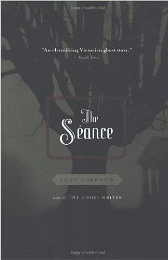
Day 136: The Séance

Cover for The SeanceThe Séance is a modern novel that is written like a Victorian gothic mystery. It features narrations by several different characters–a typical Victorian device that was used successfully in Wilkie Collins’s The Moonstone.

John Harwood’s novel is difficult to describe without going too far into the plot, because some important characters do not appear until later in the book. It begins with the story of Constance Langdon’s dreary childhood and young adulthood. Her mother has been depressed and nonfunctional since her sister died, and her father behaves as if he lives alone in the house. When Constance reaches the age of 11, her father withdraws her from school and abandons her and her mother to go live with his sister. Later, a disastrous experiment with spiritualism (very popular in Victorian times) in an attempt to help her mother results in her mother’s suicide.

Constance accepts her uncle’s invitation to live with him in order to avoid being thrust upon a father who doesn’t want her. But shortly after moving in with him, she finds she has inherited Wraxford Hall, an infamous house, old and crumbling, where two boys died; an old man mysteriously disappeared; and Magnus Wraxford was apparently murdered by his wife, Eleanor, who has also disappeared.

The next section of the novel is narrated by John Montague, a lawyer who visits Constance. He was involved in the experiment at Wraxford Hall that ended in the murder of Magnus Wraxford, and he tells the story of the experiment. This visit and Constance’s subsequent agreement to take part in a séance at Wraxford Hall lead us to Eleanor’s story, which is taken up by a diary that Eleanor wrote. Finally, we return to Constance. When she arrives at Wraxford Hall, she finds the experiment is to take place in a spooky gallery occupied by an odd-looking set of armor and a sarcophagus.

The novel is successfully creepy and mysterious. However, by the time of the séance I had figured out one character’s crucial secret identity, which made several other plot points clearer. Some readers may find it takes a long time to get to the crux of the novel, but I enjoyed the journey.

Day 135: The Sun King

Cover for The Sun KingThe Sun King is an interesting biography of Louis XIV and a history of his court, although it occasionally assumes a level of knowledge about French history that I do not have. It is also not terribly revealing of the personality of Louis XIV, who was apparently a very guarded person. For example, the book contains no revealing quotes from personal letters or anything similar.

I was interested to read that Nancy Mitford originally envisaged the book as a description and discussion of the architecture and gardens of Versailles rather than a biography, which perhaps partially explains the focus.

The book starts with the beginning of Louis’s reign, so there is no information about his early life. Chapters are organized around incidents during his reign rather than periods of history. The book describes the opulent court and details intrigues and power struggles within it. The chapter about poisoning was shocking. It is easy to see why the French court of the time had such a reputation for decadence.

The edition that I read (not the one pictured) is full of beautiful pictures of Versailles as well as sketches of the architects, artists, and gardeners responsible for creating the palace. However, there are no good pictures of Louis, presumably because none exist. He is always depicted as a tiny figure in large historical paintings of some event, so it was hard to see what he actually looked like.

Of course, the book is well written and witty. Although Mitford is best known for her humorous novels of sharp social commentary, she also wrote several well-received and thoroughly researched biographies.