
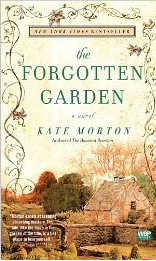
 Announcing the Best Book of Week 20: The Forgotten Garden by Kate Morton
Day 100: Appaloosa
 Woohoo! One hundred days of blogging! I hope you’re enjoying it. And now, on to the review.
I do not usually read Westerns but looked for Appaloosa after seeing the excellent movie starring Ed Harris (also the director) and Viggo Mortenson. I was surprised to find the book was written by Robert B. Parker, who I only know from the Spencer and Jesse Stone mysteries.
Virgil Cole and Everett Hitch clean up towns. The businessmen of Appaloosa hire them after the sheriff is murdered at Randall Bragg’s ranch when he goes out to arrest some of the hands. Bragg’s hands have been flagrantly breaking the law and terrorizing the town–taking merchandise without paying, assaulting women, and murdering men.
Cole works from a strict sense of law and duty, although he does it his way. He sets the laws in his towns and others must follow them or suffer the consequences. Hitch loyally backs up Cole.
Hitch and Cole get the town under control quickly, but the only witness to the sheriff’s murder, Deputy Whitfield, ran away after the shooting. However, under Cole and Hitch, the town feels safe enough for Whitfield to volunteer to testify against Bragg. Now Cole and Hitch must arrest Bragg and at the same time keep their witness safe.
In the meantime, an attractive widow named Mrs. French arrives in town and latches onto Cole, who is a bit naive when it comes to women. Hitch is skeptical of her, but after awhile, it looks like Cole may be planning to settle down.
The novel is full of action, but it stands out because of the friendship between Cole and Hitch and Parker’s ability to create distinctive characters using laconic dialogue and a bare minimum of description. And Parker has not omitted a twinkle of humor, such as when Cole marvels that Mrs. French takes a bath every single day. Although Appaloosa sounds like a traditional Western, it is unusual, especially in its denoument. I found it to be a quick, appealing read.
Day 99: Good Omens: The Nice and Accurate Prophecies of Agnes Nutter, Witch
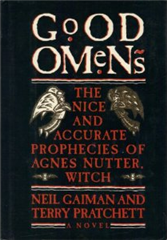 And now for something completely different. Good Omens: The Nice and Accurate Prophecies of Agnes Nutter, Witch is an absolutely wacky spoof by Terry Pratchett and Neil Gaiman. In the planning for Armageddon, a demon gives the Antichrist to a Satanist nun to swap with the baby of an American diplomat. But she mixes up the babies, and the Antichrist goes home with an ordinary British family.
Eleven years pass, and the powers, both of light and darkness, gear up for the end of the world. But one angel (Aziraphale) and one demon (Crowley) have decided they like the human race and life on earth too much to want the war between Heaven and Hell. They go off together to find the Antichrist and avert Armageddon. And then there are Agnes Nutter’s “nice and accurate” predictions.
A review on the book cover says it is like a combination of The Omen and Monty Python, and that gets it about right. It contains lots of digs at sources of apocalyptic literature. This book is not for everyone, but many of you will find it hilariously funny.
Day 98: The Poison Tree
 What starts out as a seemingly ordinary novel about a young woman who makes a fascinating, exotic new friend builds slowly to the macabre in The Poison Tree by Erin Kelly. This is not a traditional mystery, but more the foreboding story of how several characters’ lives are changed irrevocably by the incidents of a careless summer in 1993.
In a story that begins ten years before the novel’s present, Karen Clarke is a naive but high-achieving linguistics student who is soon to graduate from a college in London. Her academic success has more to do with a natural ability to learn languages than application, and she finds herself unable to decide what to do with her life. After being very focused for years, she is inclined to let her near-term future be decided by fate.
One afternoon near the end of the term she meets the flamboyant, charismatic Biba Capel and is immediately captivated by her and drawn into her circle. Biba lives in a sprawling, ramshackle house with her brother Rex and other assorted people, and they spend most of their time partying.
The novel’s present day begins with Karen picking up her husband, Rex Capel, from prison, where he has served 10 years for murder. With her is their ten-year-old daughter Alice. Karen has been supporting her small family, economically and emotionally, for years, and knows she must continue to do so, as Rex will find it difficult to get work. She is very protective of Rex and Alice and afraid their new life will be ruined if people learn about their past.
How Karen goes from the carefree life she adopts that summer—which she spends with a bunch of irresponsible young people partying all night and sleeping all day—to the fearful present involves the Capels’ tragic history. As she learns about this history and learns more about her friend, she is drawn into tragedy.
Well written and absorbing, the book slowly builds from normalcy to a sense of dread.
Day 97: The Mystery of Lewis Carroll
 The Mystery of Lewis Carroll: Discovering the Whimsical, Thoughtful, and Sometimes Lonely Man Who Created “Alice in Wonderland” examines modern ideas about Charles Dodgson (Lewis Carroll) and attempts to debunk them. Jenny Woolf does a good job of providing evidence that his friendships with children, rather than being pedophilic tendencies as is interpreted today, were regarded by Victorians as innocent and probably were innocent. She also shows that the modern interpretation of his pictures of nude children was not one held by people of his own time, and that they regarded this pastime and the resulting pictures as harmless because children were considered innocent.
In fact, Woolf provides evidence that his friendships with young women were much more subject to question and talk. She posits that he cultivated a persona of being older than he actually was so that they would not be questioned, even though these relationships were almost certainly innocent as well.
Woolf depicts the Reverend Dodgson as a sensitive, artistic man who cared for his family and loved entertaining children. His position at Oxford did not at that time allow him to marry. A number of years during the time he was a young man are missing from his diaries and he refers to feelings of guilt in later entries, leading Woolf to conclude that something happened, possibly with a woman, that he regretted. Her theory is that he cultivated relationships with young girls as a return to innocence.
The book is interesting, but with a caveat. It is very short, almost shorter than the subtitle, but Woolf is so focused on one or two ideas that it often seems repetitive. A good deal of information about Carroll’s life is missing because he or his relatives removed pages from his diaries and his relatives destroyed a great deal of material after he died. Although this has often been interpreted as the family’s attempt to hide nasty secrets, Woolf is not convinced that there was much to hide. She blames a good deal of the current perception of Carroll on the initial emergence and misapplication of certain theories of psychology in the infancy of the science.
Day 96: The Forgotten Garden
 Kate Morton’s The Forgotten Garden was one of my big discoveries two years ago. I absolutely love this book.
A four-year-old girl walks off a ship in Australia in 1913 with a little white suitcase. No one meets her. She won’t say who she is or where she came from. The harbor master takes her home, calls her Nell, and adopts her, and she forgets her previous life. When she is 21 and on the verge of marriage, he tells her about it. This information is so shocking to Nell that she breaks with her fiancé and her family and isolates herself, feeling that she has been living a lie.
In 1975, Nell’s irresponsible daughter drops her own teenage daughter, Cassandra, at Nell’s house and drives away, never to return. Nell has other plans, but puts them aside to take care of her granddaughter.
In 2005, Cassandra is mourning Nell’s death. She has inherited Nell’s property but is only vaguely aware of her history. When she looks through Nell’s things, she finds a white suitcase with a book of fairy tales in it. She also finds that Nell never stopped looking for her real family. Continuing Nell’s search, Cassandra ends up in a small Cornish village where she learns she has inherited a small cottage on the Mountrachet estate.
Cassandra finds an entrance into a walled garden, and another one from there to the estate. Eventually, she also discovers the history of her grandmother’s parentage.
The book traces Nell’s history by alternating among these times. The modern story is one of investigating one’s roots, but the older tale is more gothic. Ultimately, it is the story of two cousins, the wealthy Rose Mountrachet and the slum-born Eliza Makepeace, who comes to live with her and be her companion.
A mystery about family secrets, the story is complex and enthralling. Some readers may be daunted by its length, but once you begin reading, you will not be able to stop.
Special Post! Best Book of the Week
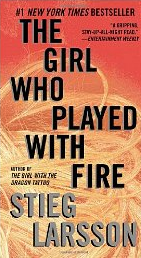 The Best Book of the Week for Week 19 is The Girl Who Played with Fire by Stieg Larsson.
Day 95: The Girl Who Played with Fire
 The Girl Who Played with Fire is the second in Stieg Larsson’s Millenium Trilogy. As the transitional book between the first and third, it is not quite up to the level of the first book; however, it is still exciting. The first time I read it, I was riveted, but on my reread, I noticed a few occasions where the writing was more journalistic than desirable. Nevertheless, it is still a real thriller and absolutely essential to read if you are going to finish the trilogy.
Lisbeth Salander’s visit to her evil guardian upon her return from her travels abroad creates a conspiracy against her. Her guardian is tired of toeing the line and decides to have her killed.
Mikael Blomqvist is soon investigating a crime, too. He has been working with a freelance journalist, Dag Svensson, to publish a piece on sex trafficking. When he stops by one evening, he finds Svensson and his girlfriend, Mia Johansson, recently shot dead.
As the investigation proceeds, Salander’s guardian is also murdered, and the police discover links to the murders of Svensson and Johansson. Lisbeth Salander finds she is being framed for all the murders, despite her never having met Svensson or Johansson.
Blomqvist is convinced that Salander is innocent. With Salander hiding out and following the leads from her side, Blomqvist tries to figure out who Svensson may have been investigating that resulted in his murder.
Day 94: The Tricking of Freya
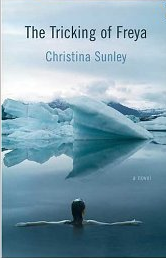 The Tricking of Freya by Christina Sunley is a novel about discovering family secrets. Freya, granddaughter of a famous poet, is a young woman of Icelandic descent who was brought up in Connecticut. Her mother, a widow, keeps her apart from her grandmother and aunt until she is 7, when they visit the Icelandic community near Winnipeg called Gimli for the summer.
The adult Freya is scarred by three traumatic events when she was a child–one from that summer, when her mother is injured badly enough to affect the rest of her life, and another when she is 13. On that occasion, her fascinating Aunt Birdie, who is always talking about their Icelandic heritage and Norse mythology and getting her to memorize Icelandic sagas, takes her off to Iceland without her mother’s permission, and while Freya is alone with her, has a massive breakdown.
Finally, Birdie commits suicide on Freya’s 14th birthday. The timing makes Freya believe the suicide must be somehow her fault, so she blames herself for that and for her mother’s accident. Since then, she has lived a sort of subdued, underachieving life, keeping her distance from others.
This book is written in the form of letters to her cousin, for Freya sets off on a journey to Iceland after she overhears something that makes her think that Birdie had a child before she died. Her intention is to find her cousin.
An involving story, the book is full of details about Icelandic culture, history, and language, which add to its interest. Its slowly unfolding mystery keeps your attention.
Day 93: The Johnstown Flood
 On May 31, 1889, the dam above Johnstown, Pennsylvania, broke, sending a wall of water and debris down the mountain to the bustling steel town. It wiped away small towns on the way down and smashed into Johnstown, destroying the town and killing more than 2,000 people. It was the biggest tragedy in America to that time and became a national scandal.
The Johnstown Flood is David McCullough’s enthralling account of the tragedy, its causes and outcomes. Although the dam was originally well built, it was repaired when the property above Johnstown was purchased by a group of wealthy industrialists, among them Andrew Carnegie and Andrew Mellon, to create a private resort. The repair work was not done by qualified people and several warnings about the state of the dam and the danger for the communities downstream had been ignored by resort managers.
The book related the events leading up to the disaster and tells the personal stories of many of the survivors. It discusses the relief efforts and lawsuits that followed and explains the outcomes for the survivors. The book is extremely well written and guaranteed to keep you riveted.
 What? Me Read?