Day 84: Bring Up the Bodies

Cover for Bring Up the BodiesBest Book of the Week! Year!

If Wolf Hall was a wonderful historical novel, Bring Up the Bodies is masterly. In this second of a trilogy, Hilary Mantel continues the story of Thomas Cromwell. Bring Up the Bodies is more focused than the last book, because it deals with a much shorter time period and defined subject–the downfall of Anne Boleyn.

The writing is elegant and impeccable. I have read a few comments that Wolf Hall was sometimes difficult to follow because the readers could not always tell who was meant by “him” or “he.” Mantel has written both books using a strict third person limited point of view, from that of Cromwell, and people don’t think of themselves by their first names. Hence, the difficulty, which I did not notice as a problem in Bring Up the Bodies. This technique is very difficult to employ successfully–we are much more used to a third person that changes from character to character or even to third person omniscient. But Mantel uses it effortlessly to create a memorable character in Cromwell–kind but implacable, one who fosters the growth of others but does not forget the crimes and indignities committed against Cardinal Wolsey, whom he loved as as a father.

Henry VIII has already decided he wants to rid himself of Anne Boleyn and marry Jane Seymour, but Anne has one more chance. She is carrying a child, and if it is born alive and is a boy, she is safe. Henry must have an heir, and he has decided that if he hasn’t been given one, God must have found some fault with his marriage to Anne just as there was one for his marriage to Katherine of Aragon. Thomas Cromwell must find him some way out of his difficulties.

Of course, Cromwell helped Anne to her position in the first place, but the Boleyns have made many enemies in their enjoyment of power, and they have treated him with disdain. More importantly, Anne Boleyn destroyed the Cardinal, and her brother mocked him in his downfall.

From the moment you begin reading, you find yourself plunged into the Tudor world of shifting politics and intrigue. Of course, we know what happens to Anne Boleyn, yet the novel maintains its suspense. The Boleyn and Howard families are going to suffer a huge defeat, but they will go down fighting.

Day 83: Travels in Siberia

Cover for Travels in SiberiaIn Travels in Siberia, Ian Frazier relates the incidents and observations of several trips to Siberia over the course of 10 or so years. Frazier explains his fascination with Siberia as a sort of embarrassing infection and makes repeated trips to visit it, first crossing the Bering Strait, then traveling along the entire breadth of the region from the west to the Pacific, and finally journeying from Yakutsk to the “coldest place on earth outside Antarctica.” In doing so, he tells us about what happens to him and relates a lot of interesting history and facts.

The book is quirky and not what you would expect from a travelogue. For one thing, he seems strangely reluctant to take part in the adventure himself but often sits aside. He is sometimes an insensitive traveller–he often stays apart from his guides; he is not always grateful or gracious to his hosts, refusing to drink any vodka; insisting on viewing things that his Russian guide would rather avoid, to the point of rudeness (although maybe you had to do that in Soviet times); and actually treating his principal Russian guide at times as a menial when I believe he is a university professor trying to earn extra money.

Another fault of the book from my own point of view is that he often concentrates on his own philosophical musings. I am much more interested in the sights and people of the area. Frankly, he often doesn’t seem very interested in interacting with the people, even though he has the opportunity for some unique experiences, for example, being stopped along the highway by a wedding party and invited to attend the wedding (and contribute money to the bride and groom). This could have been an entertaining social occasion but he seems to view it more as a delay. He also sticks pretty much to the highways instead of investigating any of the byways and wilderness parks.

The book contains no photographs, but it has quite a few good little drawings that Frazier made of what he saw, like the one on the cover. It is most interesting when it is reporting the results of his research rather than his travels, however. Travels in Siberia is written about a fascinating subject, but I couldn’t help feeling that Frazier was almost the wrong person to make the trips!

Day 82: Cotillion

Cover for CotillionOne of my favorite authors if I want the lightest of reading material and a good laugh is Georgette Heyer. Although I am not a romance reader, for her meticulously researched and comic Regency romances I have to make an exception. Her period pieces are absolutely convincing, as she was an expert on Regency dress, deportment, and speech. In fact, she became such an expert on the period’s idioms that she once was able to successfully sue a plagiarizer by proving that the expression the other writer copied appeared only in some records to which she had been granted private access.

But Heyer was also an expert at creating charming comic characters and situations. Cotillion is one of my favorites of her books, and one of the silliest.

Kitty Charing is an impoverished orphan who has been raised in discomfort by her miserly old guardian, “Uncle” Matthew Penicuik. A great one for manipulating his putative heirs, Uncle Matthew announces that he will leave his entire fortune to Kitty, but only if she marries one of his four grandnephews. Then he invites them all to come calling. Priggish Reverend Hugh Rattney and doltish Lord Dolphinton arrive, and the married Lord Biddenden comes to represent his rakish brother Captain Claud Rattney, but dashing Captain Jack Westruther, whom Kitty has grown up hero-worshipping, does not make an appearance, as he is unwilling to be manipulated.

Kitty is furious that Jack doesn’t appear, but even more furious at being put in this position. She soundly rebukes all of her “cousins,” except Lord Dolphinton, who is too stupid to be responsible for his actions and has been compelled to come by his mama. But then Uncle Matthew announces that if Kitty refuses to marry one of her cousins, he will leave her with nothing. What is a spunky Heyer heroine to do but run off into a snowstorm with only a few possessions and an impractical plan to get a job as a house maid?

She arrives at the local inn to find her cousin Freddy Standen, who has absolutely no idea why he has been summoned. Freddy, not the brightest of bulbs but a kind-hearted young man, is perfectly wealthy in his own right and has no intention of getting married. When he meets Kitty at the inn, she talks him into pretending an engagement with her and inviting her to go up to London so she can acquire some “town polish,” buy some nice clothes, and (she hopes but doesn’t tell Freddy) enchant Jack into a proposal.

Freddy, an expert in deportment and fashion who can always be relied upon to accompany a young married woman to a dance or concert, is not really a lady’s man. When he and Kitty arrive in London to find his harassed mother attempting to care for a house full of children with mumps, he is dismayed to find he is left responsible for a naïve girl who tends to fall into difficulties and odd friendships.

The novel is crammed with comic characters, such as Kitty’s foolish governess “Fish,” who has a turn for quoting romantic poetry; Freddy’s frippery married sister Meg, who wears color combinations that shock him to the core and spends her time trying to avoid her mama-in-law; Camille, Kitty’s real French cousin, who is impersonating a lord; Lord Dolphinton, who is terrified of his mother but strictly charged by her to get Kitty to dump Freddy and marry him; and the silly doe-eyed Olivia, whom Kitty befriends but Jack is pursuing to be his mistress.

Special Post! Best of the Week Retrospective!

Cover for The Thousand Autumns of Jacob De ZoetSome of my readers have asked me to list my favorite books of the ones I’ve reviewed, so I decided to announce a weekly favorite. Since I haven’t done that so far, I thought I would post this special message listing my favorites for every week since I started. My criterion is simply whatever book I enjoyed reading most of the ones I chose for the week. That is a fairly arbitrary decision, since some weeks have two or more strong candidates while other weeks have none as strong. Sadly, nonfiction will be at a disadvantage because even though I may find it interesting, it isn’t likely to pull me in the way fiction does, so you nonfiction fans should pay absolutely no attention to this list! Those are my two caveats for the list, so, here goes!

Day 81: A Whistling Woman

Cover for A Whistling WomanI may have been less bemused by A Whistling Woman if I had known that it was the fourth in a series by A.S. Byatt, of which I have only read Babel Tower, and that long ago. Instead, I kept having the feeling that there was something I just wasn’t understanding. My impression was that it was about too many things, so I was relieved to find a review in The Guardian that criticizes it for having “too many ideas” and being an “over-ambitious jumble.” The intent of the series, says The Guardian, is to depict the social and imaginative life of Britain in the 1950’s and 60’s. Well, that is quite a job.

The title refers to a story published by a peripheral character about people on a perilous journey. On the way they meet creatures who are half woman and half bird and whose whistling cries are unbearable. The prince in the story has learned many languages and finds he can understand the creatures, so they tell him their tale. I don’t want to go into it further, but it is clearly a statement about feminism, which is logical since A Whistling Woman is set in 1968 and features several women who are struggling with their place in society.

The action focuses (if focuses is the word) around Frederica Potter, the host of a fashionable TV talk show; a protest movement against a university; a conference on body and mind; and the growth of a cult. Frederica is planning a show around the conference, where the scientists’ rationalism is pitted against the results of their experiments, which show that the brain is not built for reason but to make the body work. At an alternative therapy clinic, the psychoanalyst Elvet Gander is falling under the influence of his patient Joshua Ramsden, a schizophreniac, around whom a messianic cult is forming. Ramsden’s essential goodness is being muddied by his increasing psychotic episodes. Some outsiders are encouraging the students at the university to form an Anti-University, the sole purpose of which is apparently to protest.

In addition to being almost confusingly full of ideas and plots going in every direction, the book does not really echo my own experience of the times. Surely student demonstrations, at least in the States, were more meaningful and actually about something. Most of the ones I remember were about the war in Vietnam.

The book includes deep discussions of science and religion. It is interesting while offering almost too much to think about.

Day 80: Code to Zero

Cover for Code to ZeroI usually enjoy a good Ken Follett thriller, but I have to say that in Code to Zero, I felt like Follett was phoning it in. The novel is set in the depths of the Cold War, January 1958. Claude “Luke” Lucas awakens on the floor of the men’s restroom in Union Station, D.C., with no memory. He is dressed like a bum and another bum tells him how much he drank the night before.

But Luke doesn’t believe he is a bum. When the other man offers to take him on a bender, he realizes he has no desire for alcohol and concludes he must not be an alcoholic. He also quickly discovers he has other talents, like the ability to lose a shadow.

We are soon lead to conclude that Luke’s search for his identity has something to do with the launch of the Explorer I rocket, America’s last hope for competing with the Russians in the space program. We almost immediately learn (although Luke does not know) that his activities are being monitored by Anthony Carroll, a CIA operative, whose agent was the “bum” who tried to get Luke drunk. After Luke shakes off his minder, Carroll feverishly tries to locate him.

These shades of The Bourne Identity are interleaved with flashbacks to the early 40’s, when Luke is a physics student at Harvard who wants a career in rocket science. He and his friends Anthony and Bern, his girlfriend Elspeth, and Anthony’s girlfriend Billie will later be entangled in the plot.

Luke’s search for his identity and the danger he is unknowingly courting are at first compelling. The flashbacks are much less successful, because Follett doesn’t seem very interested in establishing his characters’ personalities and getting us interested in them. The latter parts of the book dealing with Luke’s unconvincingly rapid success at discovering his identity and what follows after suffer from the same problems.

Day 79: A Mountain of Crumbs

Cover for A Mountain of CrumbsIn A Mountain of Crumbs, Elena Gorokhova has written an engrossing memoir about growing up in Soviet Russia during the Cold War. What makes it most interesting, besides the details of life in such a different environment from our own, is how, while misunderstanding many things about Western culture and not being brought up with an accurate understanding of history, even of her own country, she still learns to doubt what she is taught.

Gorokhova’s upbringing is fairly ordinary, although she is both slightly privileged (her family has its own two-room apartment instead of sharing with other families) and disadvantaged (she has to earn her own way by merit since she is not the child of a peasant). However, from an early age her interest in learning English makes her fascinated with the world outside the Soviet Union. At the same time, her cynicism and disillusionment with her country grows.

Most of the book is about Gorokhova’s inability to live in lock-step, both with the state and with her own mother, so that she always feels like she is lying. As she says, “they (the state) lie to us, we know they’re lying, they know we know.”

The book is beautifully written in the first person as if Gorokhova is currently of that particular age rather than as if she were recalling her memories. (For example, when she is telling about when she is five, she narrates it as if she is five.) I can’t completely accept this style of narration for sections about her childhood, because the thoughts she claims to have are too sophisticated for a small child. In particular, I am struck by one comment she makes about thinking something is ironic. Five-year-old children don’t have thoughts about irony–it’s hard enough to get teenagers to understand what it is. However, the same narrative style works very well when she recalls her thoughts as an older child and young adult.

(As a side note, I have to contrast the chapters narrated by herself as a child with Jennifer Lauck’s wonderful memoir Blackbird, which at the beginning employs a narrative style that is absolutely convincing as the thoughts of a small child, allowing the reader to understand things that the child Jennifer doesn’t.)

I have one frustration with the book. Gorokhova describes so many misunderstandings about American life and so much anticipation and anxiety about going to live in the States that I would have liked a chapter about what it was like when she finally arrived. Instead, the book ends as she leaves Russia and contains a short epilogue about her life more than 20 years later.

Day 78: The Night Strangers

Cover of The Night StrangersIt’s been awhile since I’ve reviewed a real creepfest, but The Night Strangers by Chris Bohjalian is certainly one. The book is a combination of a ghost story and a thriller, and I don’t want to tell you what else.

Chip and Emily Linton move with their twin daughters to a small New Hampshire town after Chip has been traumatized by a horrific accident. As an experienced airline pilot, he tried to make an emergency plane landing on a lake, only to end up killing 39 people. The family moves thinking that Chip will recover sooner if he is away from people who know what happened, but of course that is impossible.

The Lintons purchase a historic house that hasn’t been lived in for awhile. The house has some strange things about it, for one thing a door in the basement that has been sealed with 39 carriage bolts.

Chip becomes obsessed with the door, and then he begins seeing three of his dead passengers. To the reader, it is not clear whether the house is haunted or whether Chip is losing his mind.

Some local women, all herbalists, begin to befriend the family. Some of them show an unusual interest in the twin girls. Soon we become aware that the history of the house is unsavory–and involves twins.

The story is uneven. At some points it seems to be going one way, at others another. Our dread rises, but we don’t know exactly which of two possible horrendous endings will come about or whether the Lintons can escape altogether. But if you appreciate a good psychological thriller and all-around creepy book, you’ll probably enjoy The Night Strangers.

Day 77: Wolf Hall

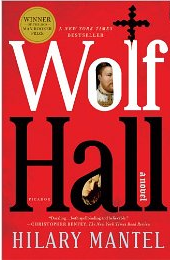
Cover for Wolf HallBest Book of Week 16!

This is a good time to write about Wolf Hall, because I was thrilled to learn that Hilary Mantel’s sequel to it has just come out. My copy is arriving soon. Mantel is always an interesting writer whose work does not occupy any one genre, although her last few books have been historical fiction. Wolf Hall won the Man Booker Prize and was one the best books I read in 2010.

The novel looks at the political and religious machinations of Henry VIII through the eyes of Thomas Cromwell, who rose from low origins to become Henry’s chief minister. Although Cromwell has traditionally been viewed as Henry’s “heavy,” recent historians have looked at his career more kindly, showing that his work as chief minister brought England into more modern statehood and that his changes created more order for government functions that were less controlled by the whims of nobility.

Mantel depicts Cromwell as a loyal man who cares for his dependents and works to reform England. He builds up a great household as he moves from the position of secretary to Cardinal Wolsey to work for the king. Later, after the Cardinal’s downfall, he slowly, almost imperceptibly, works to bring down those who furthered their own interests by destroying the Cardinal, including the rapacious Boleyns.

Cromwell is loving to his family and friends, completely faithful to the Cardinal and then to Henry, intelligent, able in many spheres of work, and decent. Mantel paints a charming pictures of his home life. In contrast, she turns the tables on Thomas More, venerated for centuries, showing him as a sadistic torturer of Protestants who is in love with his own martyrdom.

Cromwell meets Jane Seymour when she is a young, lonely lady’s maid to the queen, teased and neglected by the rest of the court, and feels pity for her. Later, after he is long widowed, he falls in love with her. The title of the book is the name of her ancestral home, Wolf Hall.

Mantel’s approach is understated, leaving the reader sometimes to connect the ideas. The details in this novel seem completely authentic, and Mantel handles the period brilliantly. She somehow manages to generate tension and suspense even about things we know all about, like what will happen to Anne Boleyn.

Day 76: When Rain Clouds Gather

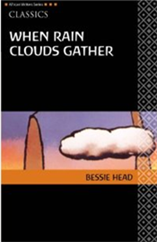
Cover for When Rain Clouds GatherMakhaya, a refugee from South Africa, slips into Botswana at the beginning of When Rain Clouds Gather by Bessie Head. It is the mid-60’s, and Botswana is peacefully gaining its independence from Britain. It is a poor country with much unarable soil and primitive farming techniques.

Makhaya has some problems settling into the village of Gomena, not the least of which is that the corrupt local Chief Matenge will not allow him in the village. He gets a job with a white man named Gilbert Balfour helping teach the villagers new agricultural methods.

The book is sparsely written and very short. Its themes are the conflict between tribalism and the newer ways, about the political changes and changes in customs occurring in the 60’s in Africa.

I found the book interesting, especially the depiction of traditional customs, but I felt it required more knowledge of the situation in Botswana and South Africa in the 60’s than I had. More is implied than expressed, which is a part of its beauty but can also be frustrating. For example, Makhaya has just left prison in South Africa, but I guess we are supposed to know what he might have been in prison for. We believe it is for political reasons, but no details are provided.

Bessie Head herself was a refugee from South Africa who settled in Botswana. I’m sure the novel reflects both some of the problems she had in making a new life and the relief she felt in being able to settle into a relatively tranquil place.