Day 75: Doc

Cover for DocThanks go to my friend K.C. for recommending this book. Writing a very interesting tale of a tragic life, Mary Doria Russell does a good job of staying true to the facts while fictionalizing what she can’t know in Doc, the story of Dr. John Henry (Doc) Holliday.

Russell begins with Holliday as a young boy, delicate, raised as a Southern gentleman and educated by his mother. Although he is frail, he shows much promise for his intelligence, grace, and wit, but his chances are hurt first by the Civil War, which ruins his wealthy family, then by the tragedy of his mother’s death caused by sickness and starving, and finally by tuberculosis.

Already by the time he sets off in his early 20’s for Dallas to work in a dentistry practice, he is ill. Shortly after he arrives, a major collapse in the world economy causes him to lose his job and casts him adrift to live as best he can. Gambling and the hope of starting his own practice bring him to Dodge City, and the Earps bring him to Tombstone for the famous gunfight.

Russell does a great job of depicting Doc: a soft-spoken gentleman with a wicked tongue, generous to his friends, profligate with his money, a fine pianist, and patient with his rapacious prostitute mistress Kate, who also fell far from a proud background.

Russell also fills out the characters of the Earps, especially happy, kind Morgan and the rather thick-headed, upright Wyatt. Bat Masterson appears as self-aggrandizing, responsible for falsely depicting Doc in the media as a hardened killer.

Russell’s approach is a little disorienting. She periodically changes her narrative style to sound more like an old codger telling a yarn and at other times sounds like she is writing a nonfiction biography. It is hard to tell whether she makes these style shifts purposely or has trouble removing herself from her source material. Although most of the book is chronological, she occasionally plays with time by going back to tell about a character’s earlier life.

Overall, Doc is a sympathetic, involving effort.
Day 74: A Caribbean Mystery

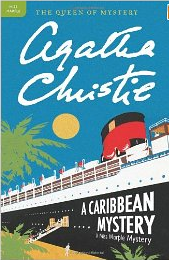
Cover for A Caribbean MysteryAgatha Christie is one of the best mystery writers of the so-called Golden Age of mystery writing because she so skillfully sketches believable characters and plots. Although many of the Golden Age mysteries concentrate on perplexing puzzles such as figuring out railway timetables, Christie was much more interested in the personality of the murderer and his or her motivations.

A Caribbean Mystery begins after Miss Marple has suffered a serious bout of pneumonia. Her affectionate nephew Raymond has arranged a vacation for her on an island in the Caribbean, where she can recover. But of course her vacation isn’t as restful as her nephew had hoped.

She is only half listening to boring Major Palgrave when he offers to show her the snapshot of  a murderer, but just then he sees something and quickly begins chatting about something else. That night he is found dead, apparently of a heart attack.

Miss Marple is having grave doubts about that heart attack when the chambermaid reports that before his death the Major Palgrave did not have the heart medication found in his room. Shortly thereafter, she is found stabbed to death.

Miss Marple begins sizing up her suspects. Molly Kendal, owner of the hotel with her husband Tim, has been behaving oddly, having nightmares and reporting blackouts and feelings of paranoia. Years ago, Greg Dyson’s wife died and he married her cousin Lucky within a month. Colonel Hillingdon and his wife Evelyn appear close, but are they really? And are they as friendly with the Dysons as they seem to be? The elderly and wealthy Mr. Rafiel is too feeble to be a murderer, but his secretary Esther Walters is secretive and Miss Marple spots his attendant Jackson skulking around.

As usual, Christie does a deft job of quickly limning believable characters and a complex mixture of motives and red herrings in a brief novel that is fun to read. I spotted the killer quickly but still enjoyed the book.

Day 73: A Thousand Splendid Suns

Cover for a Thousand Splendid SunsBest Book of Week 15!

A Thousand Splendid Suns is Khaled Hosseini’s second novel, about the love between two women set in the backdrop of the wars in Afghanistan. The novel begins in a time of peace with the story of the older woman, Mariam, who as a young illegitimate daughter of a wealthy man hero-worships her father and does not believe her mother’s warnings about him. When she is fifteen, she finds out the kind of man he is through a series of horrible events, beginning when she goes to the house of his legitimate family to ask him to take her to the movies. Her mother dies, and within days, her father’s legitimate family marries her off far away in Kabul to a much older man, Rasheed. Rasheed is kind to her at first, but when she cannot bring a child to term, he becomes abusive.

A neighbor of Rasheed and Mariam, Laila is 20 years younger than Mariam. She has been brought up and educated by her loving parents to be brave. She has always been in love with her childhood friend Tajik and they expect to marry, but Tajik’s family leaves the country during the war because of his father’s illness. Just as Laila’s parents are preparing to leave as well, they are killed. Rasheed, now in his 60’s, takes in Laila purportedly as an act of kindness and tricks her into marrying him.

Initially distrustful of each other, the two women soon each becomes the only person the other can trust as they lose all their rights under the government of the Taliban. Trapped in an abusive marriage, they must work together to survive.

Hosseini’s story-telling is absolutely compelling. The women’s existence is harsh, and he tells their story with compassion. The ending will leave you in tears.

Day 72: The Indian Bride

Cover for The Indian BrideI previously read one book by Karin Fossum and felt neutral about it, but then I read The Indian Bride. I was extremely touched and involved by this Norwegian small-town mystery.

A naive and uncomplicated bachelor farmer, Gunder Jomann, sees a picture of an Indian woman in a book and decides to go to India to find a wife. This journey is a daunting prospect for a man who has hardly ever left his small town of Elvestad, but he is determined. The story of his journey is brief but touching. He is successful and returns home to prepare for the arrival of his new wife, Poona, while she settles her affairs in India.

Just as he is leaving for the airport to pick Poona up, Gunder gets a call from the hospital. His beloved sister has been in a terrible accident. From the hospital, he calls the local taxi driver and asks him to pick up Poona, but the driver misses her at the airport. The next day Poona’s body is found in a field near Gunder’s house.

Inspector Konrad Sejer and his partner Jacob Skarre are assigned to solve the crime. Most crime novels since Sherlock Holmes deal with solving puzzles posed by clever criminals, but this novel is unusual in reflecting the type of crime that is probably more often dealt with by the police, random violence by people who are not professional criminals and not particularly clever. Some of the suspects are a local café owner, a muscle-bound young man, and an attention-seeking teenager. In a strange way, the focus of the novel reflects a more innocent world, which is exactly how I felt when reading about Gunder and Poona’s romance. I kept hoping the body would turn out to be that of some other Indian woman, not Poona.

The setting is rich, the characters are complex, the puzzle is interesting. I find Inspector Sejer not as well developed as some of his suspects, but perhaps I just need to read more Fossum.

Day 71: Thinking, Fast and Slow

Cover for Thinking, Fast and SlowEarly in his career, Daniel Kahneman got interesting in why people, even experts, do not seem to use statistics and follow economic models in making decisions and judgments. His research with his main collaborator Amos Tversky eventually ended in his winning the 2002 Nobel prize in economic science, which is unusual because he is a psychologist. Thinking, Fast and Slow explains the results of years of studies on understanding how the human brain makes decisions and judgments. His major theme in this extremely interesting, well-written book is human irrationality. His work with Tversky, he says, “challenges the idea that people are generally rational.”

For better understanding of the ideas explained in the book, Kahneman begins with the analogy that there are two systems employed in decision making: the fast-thinking, intuitive, unconscious system that keeps us safe and handles our day-to-day actions but is prone to error, and the deliberative system that reasons through more informed decisions but is lazy and has to be actively engaged.

Kahneman shows the evidence from experiments that many more of our decisions are controlled by our unconscious than by conscious decision-making, and therefore, we do not always make decisions the way that economic models have assumed. He makes his points using fairly simple experiments that you can try yourself, so that you recognize the faulty assumptions and cognitive biases underlying your own reasoning. In examining these experiments, he shows their profound implications. The result is an entertaining book full of intellectual surprises that was chosen as one of the New York Times Best Books for 2011.

Although Kahneman provides some ways of recognizing patterns that can result in bad decisions, he cautions that it may be impossible to teach yourself to always avoid these pitfalls and says that he is unable to do it consistently himself. He reminds us that all of us tend to have an exaggerated sense of our understanding of the world and shows that much more of what happens is random than we acknowledge or understand.

Day 70: The Golden Compass

Cover for The Golden CompassThe Golden Compass is the first book in Philip Pullman’s trilogy His Dark Materials, a children’s book that appeals as much to adults because it is just plain exciting.

Lyra is an adventurous eleven-year-old orphan brought up by the scholars of Oxford in a world that is similar to ours in a previous century. In this world, every person has a daemon, an animal creature who is always with the person and who shares the person’s feelings. Until a child reaches puberty, the daemon changes from one animal to another.

Lyra is a bit of a wild child who spends most of her time clambering on the college roofs with her friend Roger, the kitchen boy, and getting into fights with the town kids. She has heard rumors of the Gobblers, a group who steals children, but she hasn’t paid much attention to them. Her real adventures begin the day she sneaks into the scholar’s room, where she is not supposed to be. She is hiding when she overhears a mysterious conversation about something called “dust” and sees the Master poison her Uncle Asriel’s wine. She is able to warn her uncle in time.

After her uncle departs on an expedition to the north, her friend Roger is stolen by the Gobblers. Then Lyra and her daemon Pantalaimon are removed from Oxford by the beautiful and mysterious Mrs. Coulter and taken to London. Before she leaves, the Master gives her the golden compass, a device that can tell the future, and says she should hide it from Mrs. Coulter.

Lyra flees from Mrs. Coulter’s house when she learns that Mrs. Coulter’s monkey daemon has been spying for the compass and also figures out that Mrs. Coulter is one of the Gobblers. She throws her lot in with a gang of the gyptians, a tribe of wanderers who have joined forces to go north and fetch back the stolen children.

The Golden Compass is wonderfully inventive. Just as a side note, I also greatly admired the movie, with its cool steampunk look. Lyra is a great heroine, you just love Pantalaimon, and you get very attached to many of the other characters. Full of action and suspense, The Golden Compass is a great book.

Day 69: The Information Officer

Cover for The Information OfficerI really enjoyed Mark Mills’s book Amagansett from a few years ago and liked The Savage Garden. However, I did not find his third book, The Information Officer, as satisfying.

It is World War II during the siege of Malta. The British are trying to get their Spitfires to Malta to defend it, but in the meantime the strategic island is being heavily bombed. Major Max Chadwick’s job as information officer is to deliver updates to the local newspaper that are as positive as possible and figure out what is truth and what fiction.

Max’s good friend Freddy comes to him with information that someone is murdering Maltese dance hall girls, and there is evidence that the murderer is a British submariner. Freddy, a doctor, has already raised the problem with the high command and gotten nowhere, so Max decides to investigate. In the meantime, the murderer is plotting his moves.

The novel was interesting enough, with good descriptions of Malta and a fairly involving plot. However, I did not grow to care very much about the characters. I figured out the murderer, although not his motive, fairly easily.

Day 68: The Lace Reader

Cover for The Lace ReaderFrom the very beginning of The Lace Reader, the main character tells us she is a liar. The first time I read this book, I paid attention to that comment, but I could not detect any lies and eventually I forgot about that statement. As it turns out, Towner is not really lying, but Brunonia Barry’s novel is an outstanding example of the use of an unreliable narrator, and a haunting story.

Towner Whitney has not been home to Salem, Massachusetts, for 17 years, ever since her twin sister Lyndley committed suicide and she herself had a breakdown and was institutionalized. Now her brother calls asking her to return home because her great-aunt Eva has disappeared.

Towner’s female relatives are all unusual. She comes from a family of lace readers–people who can read the future in a piece of lace–and although she refuses to read, she is clairvoyant and can read people’s minds. These abilities, which she rejects, make her feel unstable, especially since she has gaps in her memory from electro-shock therapy. Towner’s mother May never leaves the island where she harbors abused women and teaches them how to make lace, and her aunt Emma has brain damage from a history of abuse by her husband Cal.

In Salem again, Towner waits for news of Eva. She learns that one of the police officers, Rafferty, is sure that Cal had something to do with Eva’s disappearance as he has been threatening her and other members of her family.

Salem itself is almost a character with its witch-based tourist industry, and now Cal has formed a group of religious cultists who call themselves Calvinists and who taunt the witches and threaten them with damnation. It’s a bad place for Towner to be, and she is just deciding to leave again when Eva’s body turns up.

The Lace Reader is a wonderful book, layered with secrets, an exploration in the difference between perception and reality. With an atmospheric setting, characters to care about, and a compelling plot, the book is a real page-turner. The last few paragraphs made me re-evaluate everything I had read.

Day 67: Life Itself: a Memoir

Cover for Life ItselfWriters of memoirs and biographies have the same difficult problem to deal with. There is a fine line between giving too much detail for the work to be interesting or not telling enough. (I once read a biography of Aldous Huxley written by his niece that told everything he did every single day but gave absolutely no insight into him as a person, for example, his opinions or the conversations he had with other people.) When you are writing a memoir, you have the additional difficulty of drawing the line between what should remain private and keeping readers’ interest.

In reading Life Itself, Roger Ebert’s memoir, I admit to feeling a little frustrated at times about the level of information provided while at the same time recognizing Ebert’s intent to be open. I certainly wouldn’t want to read a tell-all, because I think the world is unfortunately losing its sense of privacy, but although his memoir forthrightly confronts some issues like alcoholism in the family and his own physical problems, it seems to skip over certain periods of his life.

Ebert chooses an unusual organizational approach to his memoir. Instead of going chronologically (although the book is roughly chronological), he writes each chapter on a different topic, as if it were a series of essays. And perhaps the book originated with some of the blog entries and articles he has been writing for years. This approach made it sometimes repetitive and sometimes seem like little more than impressions and lists of things and people. Of course, it has some delightful chapters, especially the nostalgic ones about his youth.

Perhaps because Ebert is trying to protect other people’s privacy, aside from his family he hasn’t written very much about ordinary people in his adult life but a lot about the famous ones, which gives a bit of an impression that Ebert is a name-dropper (even though I don’t think he is). For example, although the information about his adult ordinary life is limited (though he writes a lot more about his life since his illness), the book contains complete chapters about famous people he interviewed only once or twice. You can’t help having the impression, time after time, that Ebert has really gotten a kick out of hanging out with famous people.

Again, this skewing gives me another reason to suspect that many of these chapters originated as blog entries and articles he has written over the years. Because of this aspect of the book, it may be more likely to appeal to people who are fascinated by everyone in show business than those like me who think famous people are just ordinary people who happen to be famous and wish everyone would leave them alone.

(As sort of an anti-intuitive “proof” of this idea, I point out the reviews on Amazon. The people who disliked the book criticize it for spending too much time on his childhood and youth, which I thought was the interesting part, and not enough time talking about famous people. In other words, they want even more information about famous people than he provided, whereas I wanted more about him as a person. Perhaps they don’t understand the point of a memoir.)

The chapters on Gene Siskel and Ebert’s wife Chaz are touching. The book is, of course, very well written. We have a lot of sympathy for Ebert’s condition–a talker who is unable talk–and come away from the book believing he is handling it with dignity and an amazing optimism. My overall impression of Ebert from this book was that he went through a lot of his life being pleased with himself for his own intelligence (and must have been extremely annoying to some of his teachers in school and professors in college) and the luck he has had in his career, but that–as he himself admits–he has finally learned later in life about what is most important.

This review sounds like I did not enjoy the book. I enjoyed it but also found it frustrating at the same time.

Day 66: The Lacuna

Cover for The LacunaBest Book of Week 14!

My experience with reading Barbara Kingsolver has been uneven. Her first books were interesting and heartwarming, but some of her later work is more political and sometimes degenerates to lecturing on certain causes. However, The Lacuna is an absolutely enthralling historical novel.

Harrison Shepherd is a young man, half Mexican and half American, who survives an upbringing by a feckless mother and a cold father and finally begins making his own way in 1930’s Mexico. He finds a job working in Diego Rivera’s kitchen and ends up as the cook and plaster mixer in Rivera’s household with Frida Kahlo. Later, when they give Leon Trotsky a home, Shepherd works for Trotsky as a secretary and translator, and finally he returns to the United States to write Aztec historical potboilers.

The novel covers major historical events in a turbulent period, including the Communist Worker’s Movement, Trotsky’s assassination, FDR’s terms in Washington, World War II, and the House Unamerican Activities Committee. Although Shepherd’s life is extraordinary by any standards, Kingsolver was able to make it feel absolutely persuasive. While I usually dislike historical novels where ordinary people keep running into famous people, I completely accepted every sentence of this book.

Told by diary entries, newspaper articles, and letters, the novel gets going a little slowly, but eventually enthralls. Kingsolver does a great job of creating colorful and believable characters from the lives of real, historic people, something that is not simple, and completely involves readers in the events of their lives.