Day 65: Arcadia Falls

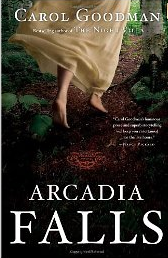
Cover for Arcadia FallsArcadia Falls by Carol Goodman is a gothic novel about a young widow, Meg Rosenthal, who has been left without much money after leading a well-to-do married life. She accepts a job at a remote high school for the fine arts where she has been able to enroll her teenaged daughter. The school was founded by two artists and authors of fairy tales, Vera Beecher and Lily Eberhardt. Lily died under mysterious circumstances by falling into a ravine during a snowstorm. The first night Meg and her daughter are installed in their new home in a secluded cottage on the grounds, one of the students also falls into the ravine.

As Meg’s thesis concerns the school, she begins digging into the death of Lily, especially trying to figure out why the current headmistress, Ivy St. Clare, disliked her so. She is aided by her accidental discovery of Lily’s diary in a hiding place in the cottage.

This book is interesting and engaging, but the solution to all the campus goings-on has a major fault that makes it difficult to accept. It hinges on the identities of three different women. I don’t want to say more, but this problem makes the ending completely unlikely.

Day 64: The River of Doubt: Theodore Roosevelt’s Darkest Journey

Cover for River of DoubtIn 1913, ex-President Theodore Roosevelt departed on a trip up an unknown river in the Amazon with a party that included his son Kermit, Brazil’s most famous explorer Candido Mariano da Silva Rondon, and the naturalist George Cherrie. Because the trip was originally planned to be less challenging and also because it was provisioned (by the leader of a failed arctic expedition) with more of an eye to comfort than practicality, the party soon found itself in dire straits, and by the end of the trip Roosevelt was near death.

In The River of Doubt: Theodore Roosevelt’s Darkest Journey, Candice Millard writes a compelling tale of this dangerous journey to a completely unexplored region, which ended by putting a 1000-mile river on the map of Brazil. In a hostile environment that the explorers found strangely lacking in food, they were at times very close to attack from the Cinta Larga Indians, who had only had a small amount of exposure to Brazilian rubber hunters–and that had been violent. The group also had to deal with boats that were unsuited to the rapids they encountered, disease, dangerous animals, and theft and murder by one of their party.

Whether Millard is explaining the scientific reasons behind the jungle’s apparent lack of food, the geology of the region, or the dramatic events of the trip, she writes with absolute clarity and interest. Although this book reminded me a great deal of The Lost City of Z, which I reviewed earlier and also enjoyed, I thought it was much more interesting and better written.

Day 63: An Atlas of Impossible Longing

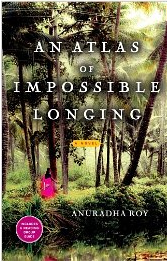
Cover for An Atlas of Impossible LongingIn An Atlas of Impossible Longing by Anuradha Roy, a family in turn of the (20th) century Bengal lives in a small remote village where the husband has moved for business. He, Amulya Babu, neglects his wife Kananbala for work, but he supports a boy in the local orphanage named Mukunda. Amulya and Kananbala have two grown sons, Kamal and Nirmal. Nirmal marries Shanti and is happy with her. But after she dies at her father’s house in childbirth, he deserts his family. His daughter Bakul is brought up in his father’s house by Kamal and his wife and by Kananbala, who is soon widowed.

On one of Nirmal’s visits after his father’s death, he goes to the orphanage to see who his father has been supporting for years and brings back Mukunda, who is casteless because no one knows his parentage. Mukunda and Bakul are raised together and allowed to run wild as each other’s only friends and companions.

The story eventually becomes about the relationship between Mukunda and Bakul and in the last section is narrated by Mukunda.

I had an ambivalent reaction to the book. I felt that the glimpses of Indian life were interesting and so was the historical context, even though momentous events are touched upon lightly. The book spans about thirty or forty years and three generations, ending in the 1940’s or 50’s. For a novel of such scope, however, it seemed too short to adequately develop the material. In the multigeneration story and the themes of the book, I was reminded of two other recent books, The God of Small Things by Arundhati Roy and The House of Blue Mangoes by David Davidar. But both of these books were much more satisfying.

I felt little connection to any of the characters, who seemed sketchily depicted. The love story that the book focuses on in the final part of the book is the least interesting part of the story because Roy has not made me care about either of the lovers. I was curious about what would happen but at the same time did not care very much about which way things would go.

Day 62: Interred with Their Bones

Cover for Interred with their BonesInterred with Their Bones by Jennifer Lee Carrell is excellent fun, the first of a literary mystery series. Kate Stanley is directing a production of Hamlet at the Globe when her estranged mentor, Rosalind Howard, a Harvard professor of Shakepeare, gives her a small box and hints that she has made an important discovery. Later that night after a fire at the Globe, Kate finds Roz dead in her office. The box turns out to contain a Victorian mourning brooch decorated with flowers associated with Ophelia.

Kate teams up with her friend, the renowned actor Sir Henry Lee, determined to solve the mystery of Roz’s discovery. She begins to believe that she is searching for the manuscript of a play called Cardenno that was produced in 1613 and that may be the same as a play with a similar name registered in 1653 but never published by William Shakespeare and John Beaumont. In her pursuit of the truth, she keeps running into Ben Pearl, a security expert, and another man who says he is related to Rosalind.

The book is a cross between traditional mystery and thriller with an admittedly ridiculous plot. Kate travels from London to Harvard to Utah and then to Spain and Washington, D.C., running down clues in a sort of parody of The Da Vinci Code. Lots of bodies pile up, and we hear about most of the crackpot theories about Shakespeare that have been vaunted over the years. The story is full of literary allusions, action-packed, witty, and fun to read. I guessed part of the mystery as soon as one character appeared, but I was too interested in the plot and characters for that to be disappointing.

Day 61: The Game of Kings

Cover for Game of KingsBest Book of Week 13!

If you love an authentic, well-researched, exciting historical novel that makes you almost feel like you are in the period, then I can’t recommend a better author than Dorothy Dunnett.  I have been trying to get people to read her for years with the caveat that her books are challenging, not for the reader of light romantic history.

Lady Dunnett is described on her Wikipedia page as a “leading light in the Scottish arts world and a renaissance woman.” Her books are loaded with detail about medieval customs, dress, politics, religion, food, and literature, and have labyrinthine plots full of action. She is most renowned for two series, the Lymond Chronicles, written in the 1960’s and 70’s and set in 16th Century Europe and Africa, and the House of Niccolò, written in the 1980’s and 90’s and set in 15th Century Europe, Asia, and Africa. Dunnett died shortly after finishing the last book in this series.

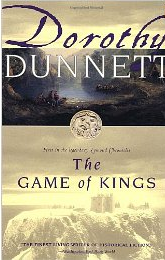
Game of Kings is the first book in my favorite series, the Lymond Chronicles. Francis Crawford of Lymond makes a rollicking and disruptive re-entrance into his home country of Scotland despite the charge of treason hanging over his head. He forms a band of outlaws and begins roaming around the countryside, sneaking across the border to play tricks on the British and harassing his own family. For quite some time, you don’t know whether he is a hero or a villain. He never explains himself, so it is left up to the reader (and the other characters) to figure out his motives for sometimes seemingly wrongful acts. His enemies think he is responsible for the explosion that killed his sister and is trying to murder his older brother Richard so he can inherit the estate. His friends are absolutely devoted to him but suffer doubts when he misbehaves, as he often does. His brother doesn’t know what to think, and his mother, Sybilla, is silent.

Francis is a mimic and a rogue, a musician and a polyglot, a poet and a swordsman, as swashbuckling a character as you will ever meet with in a novel. In among the action of cattle raids, impersonations, intrigues, duels, and archery contests, you actually learn a lot about Scottish history and politics.

Game of Kings is Dunnett’s first book, and my only criticism of it is that Lymond is a bit too fond of quoting poetry in antique languages. Most of it is incomprehensible unless you are a medieval scholar, but skipping over it does not hurt your understanding of the novel. Dunnett does this much less in the other books in the series. If you read this book and continue with the series, by the second book you won’t be able to stop.

Day 60: Mind’s Eye

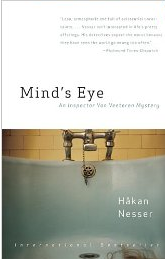
Cover for Mind's EyeMind’s Eye is the first of the Inspector Van Veteren series by Swedish mystery writer Håkan Nesser, although it is the third published in English. Mostly a police procedural, the book also is somewhat of a psychological thriller.

A woman is drowned in her bath tub and her husband, Janek Mitter, is on trial for her murder, but Inspector Van Veteren is not quite sure the police got it right. Mitter, whose only alibi is that he was asleep and who cannot remember what happened that night, is found guilty and incarcerated in a mental hospital.

One night when Mitter is not given his drugs, he remembers someone in his house the night of the murder and trieds to call Van Veteren. He also sends a note to that person. That night he is murdered. Now Van Veteren thinks the police need to start over by examining the woman’s past.

The book was interesting enough, and I am ready to read more about Van Veteren. I was able to guess the solution–although not the exact identity of the murderer–well before the end, but the book kept my attention.

Day 59: The Tiger’s Wife

Cover for The Tiger's WifeIn The Tiger’s Wife, Téa Obreht has written an involving novel about the power of myth, memory, and story-telling. In the aftermath of the Balkan war, Natalia Stefanovic travels to the “other side” to help vaccinate children. While she is there, her grandmother calls to tell her that her beloved grandfather has died after telling his family he is going to visit her. When she learns his belongings were left in the clinic of a nearby village, she goes to fetch them, particularly his copy of The Jungle Book, which he has carried since he was a boy.

In remembering her grandfather, Natalia relates two stories that she says contain everything necessary to understand his life, one that he told her and one that he didn’t, that she learned about by traveling to the village where he grew up. The story he told her is about the deathless man, a man he has met time after time who claims he cannot die. The other story is about the tiger’s wife, an abused woman who befriends a tiger that escaped from the zoo during World War II, when Natalia’s grandfather was a boy.

Although I sometimes am unable to suspend my disbelief for magical realism, that is, the technique of mixing realistic story-telling with the magical or supernatural, Obreht skirts it without falling into it. Her book is a meditation on life and death, told in an almost  a dreamy way but also in a style reminiscent of a folk tale or myth. The book is also about how people deal with the past by transforming history into myth. The realistic story is interleaved with the two tales.

Although one of the themes is the separation between the groups of people in the Balkans, it is also about their similarities. In a village where Natalia has gone to give vaccinations, she encounters the same types of stories and superstitious beliefs as reflected in her grandfather’s stories about his youth and her grandmother’s injunctions about how to treat her grandfather’s death and possessions.

The book is stunning–a meditation and tribute to the author’s own grandfather, who died before she wrote it, and memories of the country in which she was born.

Day 58: Grave Goods

Cover for Grave GoodsBest Book of Week 12!

In the year 1154 a dying monk sees what he thinks is a vision of the burial of King Arthur after an earthquake at Glastonbury Abbey. He tells his nephew about it as he dies. Twenty years later when King Henry II is putting down a Welsh rebellion, the nephew, a Welsh bard, tells him the story hoping to save his own life. Henry sends a message to Glastonbury, which has just suffered a great fire, and the monks find a coffin buried in the described location that seems to contain the corpses of a man and a woman.

The penurious Henry would love to announce that they had found the bodies of Arthur and Guinever, because the resulting monies from pilgrimages would save him having to pay to rebuild the abbey. But how can he be sure someone won’t come to claim the bones belonging to his Uncle Tom and Aunt Gladys? By summoning his “mistress in the art of death,” Adelia Aguilar, he hopes to determine at least their antiquity.

Grave Goods is a novel in Ariana Franklin’s Mistress of the Art of Death series. Adelia Aguilar is a graduate of the School of Medicine in Salerno, at the time the only such facility that would accept women, and an expert on the causes of death. She arrived in England on a previous matter, but Henry has found her so valuable that he has never granted her a passport to leave the country. Since she is a woman, her word is not respected by most men, so she pretends she is a translator for her Arab servant Mansur, who pretends to be the doctor.

Henry’s soldiers find Adelia and take her away as she is travelling with her friend Lady Emma Wolvercote to Wells to claim Emma’s son’s property from his grandmother. But when she arrives in Glastonbury after meeting with Henry in Wales, Emma has disappeared. The monks give Adelia’s party an unfriendly greeting, and while she and Mansur are looking in a crypt to find samples to compare with the corpses, someone tries to bury them alive. Something is not right at the abbey, and Adelia is not best pleased to be saved by Rawley, the Bishop of St. Albans, her ex-lover.

I have been reading this series for awhile. At first, I wasn’t sure I bought the premise, but the books are rich with historical details and the forensics information available at the time, and Ariana is a likeable heroine. It’s not her or Rawley’s fault that he was made a bishop (he was a soldier when she met him), and the blending of romance and mystery works fairly well here, which is unusual. The romance is played down in favor of action and suspense. If you like a good historical mystery, you’ll probably enjoy these books.

Day 57: A Jury of Her Peers: American Women Writers from Anne Bradstreet to Annie Proulx

Cover for A Jury of Her PeersIn A Jury of Her Peers: American Women Writers from Anne Bradstreet to Annie Proulx, Elaine Showalter has compiled an astonishingly complete literary history of the work of American women, beginning in the early 17th Century and covering through the 20th. She has written this book, she explains, because literature by American women has been consistently ignored or omitted from criticism, anthologies, and scholarly works. She points out that even novels and poetry that were very popular and widely read in their own times sank like a stone into oblivion afterwards because the works were left out of volumes of literary analysis and anthologies and not taught in literature classes. Her work is an attempt to bring attention back to many of these writers.

Showalter starts with the metaphor of a jury of her peers from a play of the same name by Susan Glaspell, written in the 1970’s. In the play, a woman has murdered her husband. While the sheriff and his male helpers loudly make jokes and judgments about the crime, their wives quietly observe the evidence that the woman has been abused. Showalter’s message is that women writers deserve judgment by their own peers–whom she defines as people who will read and think about their work on its own terms and with open minds.

She shows how works that were highly respected during their times were repeatedly trivialized or criticized as dealing with “women’s issues.” She also shows how consistently through history women have been unable to devote time to writing because of their household responsibilities or have been attacked for not devoting most of their time to those responsibilities.

Showalter’s task was monumental. She has written a short biography, career history, and description of the work of literally every serious American woman writer–and some not so serious–putting the work in context of events and themes of the times. She has even briefly covered the works of many genre writers.

Written in a readable and interesting manner, the book made me wish I had time to read it along with my Norton Anthology of Literature by Women (if I could find the works there–I know some of them are). It also made me painfully aware, avid reader though I am, of how few of these writers I have read.

As a side note of interest, the Amazon.com page for this book includes Showalter’s list of her top ten books by American women writers that you probably haven’t read. We used this list one time for one of the meetings of my book club, each person picking the one he or she wanted to read. I can personally recommend The Country of Lost Borders, a collection of stories by Mary Hunter Austin from her life in the California desert east of the Sierras, and for an entirely different experience, We Have Always Lived in a Castle by Shirley Jackson, a chilling gothic novel.

Day 56: The Redbreast

cover for RedbreastThe Redbreast by Norwegian mystery writer Jo Nesbø starts out with Detective Harry Hole embarrasing his government by shooting an unidentified secret service officer during the American president’s visit. Naturally, he is “promoted” to a political office and assigned to investigate neo-Nazi activities in Norway.

He begins tracking Sverre Olsen, a neo-Nazi who recently escaped prosecution on a technicality. But that investigation is derailed when he comes upon evidence that someone has purchased an extremely powerful, rare rifle and may be planning an assassination attempt. At the same time, someone is killing old men who fought on the Eastern Front for the Germans in World War II, believing that they would prevent their country from being annexed by the Soviet Union.

In her attempts to help Harry with the investigation of who bought the gun, his ex-partner Ellen is murdered.

The novel was interesting and complex, with the story from WWII interleaved with that of Harry’s investigation. However, I didn’t find Harry very developed as a character. This lack of character development may be because this is the seventh Harry Hole book, but I believe that series books must find a way to balance the demands of new readers without being too repetitive for readers following the series. One way is to make sure that the main characters always seem like real people. That said, I may try reading some others to see if I get to like Nesbø’s work more.