Day 57: A Jury of Her Peers: American Women Writers from Anne Bradstreet to Annie Proulx

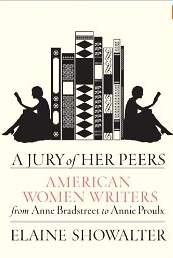
Cover for A Jury of Her PeersIn A Jury of Her Peers: American Women Writers from Anne Bradstreet to Annie Proulx, Elaine Showalter has compiled an astonishingly complete literary history of the work of American women, beginning in the early 17th Century and covering through the 20th. She has written this book, she explains, because literature by American women has been consistently ignored or omitted from criticism, anthologies, and scholarly works. She points out that even novels and poetry that were very popular and widely read in their own times sank like a stone into oblivion afterwards because the works were left out of volumes of literary analysis and anthologies and not taught in literature classes. Her work is an attempt to bring attention back to many of these writers.

Showalter starts with the metaphor of a jury of her peers from a play of the same name by Susan Glaspell, written in the 1970’s. In the play, a woman has murdered her husband. While the sheriff and his male helpers loudly make jokes and judgments about the crime, their wives quietly observe the evidence that the woman has been abused. Showalter’s message is that women writers deserve judgment by their own peers–whom she defines as people who will read and think about their work on its own terms and with open minds.

She shows how works that were highly respected during their times were repeatedly trivialized or criticized as dealing with “women’s issues.” She also shows how consistently through history women have been unable to devote time to writing because of their household responsibilities or have been attacked for not devoting most of their time to those responsibilities.

Showalter’s task was monumental. She has written a short biography, career history, and description of the work of literally every serious American woman writer–and some not so serious–putting the work in context of events and themes of the times. She has even briefly covered the works of many genre writers.

Written in a readable and interesting manner, the book made me wish I had time to read it along with my Norton Anthology of Literature by Women (if I could find the works there–I know some of them are). It also made me painfully aware, avid reader though I am, of how few of these writers I have read.

As a side note of interest, the Amazon.com page for this book includes Showalter’s list of her top ten books by American women writers that you probably haven’t read. We used this list one time for one of the meetings of my book club, each person picking the one he or she wanted to read. I can personally recommend The Country of Lost Borders, a collection of stories by Mary Hunter Austin from her life in the California desert east of the Sierras, and for an entirely different experience, We Have Always Lived in a Castle by Shirley Jackson, a chilling gothic novel.

Day 56: The Redbreast

cover for RedbreastThe Redbreast by Norwegian mystery writer Jo Nesbø starts out with Detective Harry Hole embarrasing his government by shooting an unidentified secret service officer during the American president’s visit. Naturally, he is “promoted” to a political office and assigned to investigate neo-Nazi activities in Norway.

He begins tracking Sverre Olsen, a neo-Nazi who recently escaped prosecution on a technicality. But that investigation is derailed when he comes upon evidence that someone has purchased an extremely powerful, rare rifle and may be planning an assassination attempt. At the same time, someone is killing old men who fought on the Eastern Front for the Germans in World War II, believing that they would prevent their country from being annexed by the Soviet Union.

In her attempts to help Harry with the investigation of who bought the gun, his ex-partner Ellen is murdered.

The novel was interesting and complex, with the story from WWII interleaved with that of Harry’s investigation. However, I didn’t find Harry very developed as a character. This lack of character development may be because this is the seventh Harry Hole book, but I believe that series books must find a way to balance the demands of new readers without being too repetitive for readers following the series. One way is to make sure that the main characters always seem like real people. That said, I may try reading some others to see if I get to like Nesbø’s work more.

Day 55: Guest Blog! The Hunger Games

Cover for The Hunger GamesFolks, we have something different today. After several people asked me if I had read The Hunger Games, I invited the last person who asked to write a guest blog about it. My friend Aaron has just submitted a brief review. By the way, I did actually read the book, finally.

So, here is Aaron.

—————————–

Although I was initially hesitant to read Suzanne Collins’s The Hunger Games because of its theme of teenagers killing teenagers, I was surprised to find it so engaging. Fortunately, the graphic descriptions of violence are kept to a minimum. (The novel is written for young adults, after all.)

The Hunger Games is set in the future, when a repressive government forces each of its twelve member districts to send two young adults to compete in a deadly game of survival by attrition. The winner is awarded food, a new home, and fame for being the sole survivor.

While reading Collins’s novel, I was reminded of Shirley Jackson’s short story “The Lottery,” Stephen King’s book The Running Man, and J. K. Rowling’s Harry Potter series. Those are all stories worth a second read.

The Hunger Games was difficult to put down once I started. Luckily, the story continues in two more novels. May you find the story as engaging as I did. To quote Effie Trinket, “Happy Hunger Games!”

——————————

Me again with just a little more explication of the plot. The main character is 16-year-old Katniss, who lives in the poorest of the twelve districts and has been helping support her family since her father died. When her younger sister, Prim, is picked for the games, she volunteers to go in her place. Not only must she battle the other contestants, but she must try for the viewer sympathies to get necessary supplies from “sponsors” throughout the games.

I also wanted to point out that in my opinion, the story is a sort of perverse but  logical extension of some of the “reality shows” we have on TV now. And my husband mentioned that the book reminded him of the 70’s sci-fi film Logan’s Run.

Day 54: Started Early, Took My Dog

Cover for Started EarlyKate Atkinson’s mysteries featuring Jackson Brodie are always complex and carefully plotted. The somewhat hapless Brodie is a “semi-retired” private investigator who usually works in Edinburgh, but Started Early, Took My Dog takes him back to his home town of Leeds in Yorkshire.

Jackson Brodie is trying to locate the family of Hope McMasters, a woman who was adopted in the 1970’s at the age of two. In doing so, he has stumbled upon the story of an old crime–a prostitute was murdered and the child found with her disappeared.

Tracy Waterhouse, a retired detective who works as a security guard at a mall, was originally on that case and always worried about the child. On impulse, Tracy purchases another abused child from a junkie prostitute. When Jackson tries to find her to ask her about the old crime, she thinks he is after her for kidnapping and flees.

Two separate groups of people appear to be chasing Tracy–or maybe Jackson. And what does Tracy’s friend Barry know about the crime? And how is Tillie Squires, an old actress who is going senile, involved in everything? And then there’s the dog.

Atkinson’s mysteries are edgy and well written, as well as humorous. She spends more time on characterization than the usual mystery novel, creating interesting individuals. The novel changes between viewpoint and time to tell the complex, interweaved stories about identity.

Day 53: The House of Mitford

Cover for House of MitfordMany of you may be familiar with the famous Mitford sisters from Nancy Mitford’s wonderful books The Pursuit of Love and Love in a Cold Climate, thinly veiled novels about her own eccentric family. Last year, after reading several books by Nancy Mitford and wondering about the kind of family that could have produced such extreme offspring as Nancy the social satirist, Decca the devoted communist, Diana the fascist and wife of Oswald Mosley, and Unity the fanatical worshipper of Hitler, I struggled to find an unbiased book about the Mitfords. I thought I had found one when I located The House of Mitford, which was written up as the “authoritative Mitford biography.” It wasn’t until I was halfway through that I realized the authors, Jonathan and Catherine Guinness, were Diana Mitford’s son and granddaughter. In fact, any books I could locate about the Mitfords were written by the Mitfords, a prolific family indeed.

The book is certainly interesting and often amusing, and it provides a lot of insight into the 1930’s, an especially turbulent time in Great Britain, but it has its faults.

Although the authors deplore both the extreme leftist and rightist views of the family and point out how all believed what they wanted to believe, the book shows certain biases and likes. It is much harder on Decca’s communist sympathies than on Mosley’s Naziism, for example. We are invited to admire Mosley’s ideals and prescience, and yet the book almost ignores the fact that he tolerated his followers’ rabid anti-Semitism.

On the other hand, Decca is made out to be a liar in what she writes in her book Hons and Rebels about the family, while other family members are depicted simply as having selective memories. Yet when I read Hons and Rebels after this book, expecting it to depict the family in a cruel and critical manner, I found it to be more the story of teenage rebellion. Decca (Jessica) left the family at 17 and what she remembers is colored by her feelings when she left.

Nancy, seemingly the most harmless of all the famous sisters, is depicted as two-faced. Great efforts are made to deny that Unity was a sort of groupie for Hitler, when she clearly was one. Unity’s most famous act besides the photos of her at Hitler’s rallies in Nuremburg was to shoot herself in the head on the day that England declared war on Germany.

Nevertheless, the book successfully shows that despite all the family disagreements and bickering, underlying it all was strong family affection and unity. The book didn’t do much, however, to answer my initial questions about how an admittedly eccentric but not very political upbringing could produce such extremes of personalities and beliefs in a single generation.

Day 52: Winter’s Bone

Cover for Winter's BoneI became interested in reading Winter’s Bone by Daniel Woodrell after seeing the powerful, gritty movie. If anything, the book is grittier and more compelling.

Winter’s Bone is a grim, yet touching, sparsely written tale of a young girl’s attempt to save her home. Ree Dolly is a high school student who has been supporting her mentally ill mother and two younger brothers in an area of the Ozarks that except for some modern-day conveniences doesn’t seem like it could be much different from it was a hundred years ago or more. One day the sheriff arrives to tell her that her father put their house and property up as collateral for his bail, and that if he doesn’t make his court date in a week, the family will lose their home. To Ree, this would mean a loss of all hope.

Ree sets out to find her father, whom she hasn’t seen in several months. Although almost everyone she visits is related to her in some way, most of the men are meth cookers, and her quest among the Ozark hollows is fraught with danger. Some of the women are even scarier than the men. Ree begins to feel that there is some greater mystery–that others know where her father is and aren’t telling. Initially resistant to her efforts, her terrifying Uncle Teardrop finally decides out of family loyalty to help her.

Woodrell’s prose is both lyrical and spare. You are rooting for Ree, her honest, uncorrupted spirit in stark contrast to the endemic criminality of the community.

Day 51: With Fire and Sword

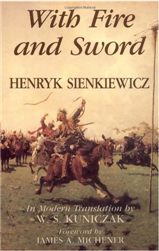
Cover for With Fire and SwordBest Book of Week 11!

Two years ago I read an exciting trilogy of Polish novels written in the 19th Century by Henryk Sienkiewicz, a Nobel prize winner for lifetime achievement in writing epic literature. The books were wildly popular for about 50 years, and Polish friends of mine tell me that they were their childhood reading. My review of the trilogy was published on Nancy Pearl’s blog (the librarian who has her own action figure), and I wrote to her awhile back asking if I could republish it here. She did not respond, so without further ado, I am going to write another review of the first book, With Fire and Sword. I will of course crib from my original review. The three books are stand-alone but with recurring characters, so you can read just one without missing important plot points.

It is 1647, and the Polish-Lithuanian Commonwealth is having some trouble—there are rumblings of rebellion among the Cossacks, who are a major force in the Polish army. Yan Skshetuski is a young Polish officer in the hussars of the Ukrainian Prince Yeremi Vishnovyetski. Prince Yeremi sends him on a mission as an emissary to Bohdan Hmyelnitzki, the leader of the Cossack rebellion. Yan has just become engaged to the beautiful Helen, but duty calls, so he makes his way through down the river to where the Cossacks are gathering.

Yan has been sent too late, though, for the rebellion has already started when he arrives, and he is made a prisoner. He escapes with difficulty and makes his way through the war-torn landscape, all the time worrying about Helen.

The political situation in Poland is very unstable, so no one comes to Prince Yeremi’s aid as he is attacked by hoards of Cossacks from the southeast. Even though Helen has been kidnapped by the wild Cossack Bohun, Yan cannot take time to look for her because he is embroiled in another mission for the Prince. So, his friends, the fat buffoon Pan Zagloba, the lovelorn knight and master swordsman Michal Volodyovski, and the gentle Lithuanian giant Longinus Podbipyenta decide to help Yan by rescuing Helen themselves.

This novel is all adventure and romance, and it is truly exciting. Along the way, you learn something about 17th century Polish history.

If you are interested in reading the book, you may have  a hard time finding it (although I see it is available in a print-on-demand basis). It is also available in several translations, about which there is some debate. The original translation by Curtin is said to be truer to the book, but I took a look at it, and it is also fairly badly written. The translation that I read by Kuniczak takes some liberties with the structure of the novel, but is eminently readable, if you can find it. The cover picture at the beginning of the article is from the edition that I read.

Day 50: Blacklands

Cover for BlacklandsBest Book of Week 10!

Belinda Bauer was another of my discoveries last year as a new writer of dark, psychologically complex novels. Blacklands is not so much a mystery as a thriller.

Twelve-year-old Steven Lamb’s uncle Billy was murdered as a child by a serial killer, and his grandmother has never gotten over it. Steven’s Nan spends all day looking out the window for her son, whose body was never found. Everyone thinks Billy was murdered by pedophile Arnold Avery, who is serving a life sentence.

Steven decides he will find his uncle’s body and that will fix his family, so he has spent all of his spare time for three years digging up the moor near his house where Avery’s victims were found. Finally he realizes the task is hopeless.

Steven feels that he is so average that he has no talents, so he is pleased when his teacher tells him he writes a good letter. He decides that maybe if he writes to the murderer, Avery will tell him where he buried Uncle Billy.

When Avery realizes that the person who has been writing to him is a boy, he decides that the situation is too delicious and he must escape from prison. Of course, he is successful.

The barren moors of Exmoor are so vividly described that they are almost a character in this chilling, suspenseful novel. At times I wasn’t totally convinced by the depiction of the thinking of the serial killer, but for the most part I was absolutely riveted.

Day 49: The Other Family

Cover for The Other FamilyI have enjoyed reading Joanna Trollope’s books about contemporary life for years. In The Other Family, she explores the effects upon two families of a man’s death.

At the death of Richie Rossiter, a musician who used to be famous, his partner Chrissie is horrified to find that he has left his piano and a substantial part of his assets to his first family–Margaret, his first wife, and his son Scott.

The book follows the reactions of both families. This disposition awakens in Chrissie a sense of further insecurity, one that has always existed, since he refused a divorce and never married her. In fact, although she wears a wedding ring, it is one she bought herself. She is hostile toward Margaret and Scott and doesn’t even want them to attend the funeral. She has also been left to pay taxes that she would not otherwise have been liable for, so her family will have to make do with less money.

Margaret, on the other hand, feels better in realizing that she has not been forgotten. She has continued to live close to the humble roots that she and Richie rose from, and has founded an established business. She is a more mature woman than Chrissie, and she has been ambitious and successful, but feels she needs a change in her life.

Two of Chrissie’s daughters are not well-developed characters, but Amy, Chrissie’s youngest daughter, becomes fascinated by her half-brother Scott and tentatively reaches out to him.

As always, Trollope does a good job of portraying the complexities and messy relationships of modern life.

Day 48: The Cruelest Journey: Six Hundred Miles to Timbuktu

Cover for The Cruelest JourneyMore than two hundred years ago, the Scottish explorer Mungo Park set off on a journey to try to discover where the Niger River ends up. At the time, it was not known whether the Niger comes out in the Mediterranean, joins with the Nile, or does something else. (It does–curves back out into the Atlantic.) Park made it as far as Timbuktu, but after he left, he was never seen again. Later he was reported to have been murdered.

In The Cruelest Journey: Six Hundred Miles to Timbuktu, Kira Salak relates her attempt to re-create Park’s journey by kayaking alone up the Niger River from Old Segou in Mali to Timbuktu. Although modern readers might believe that there are much fewer dangers in this journey than the one taken by Mungo Park, it is still one of the most desolate regions in Africa. She states that she is the first person and only Caucasian woman to travel alone in the region after one was murdered in the 30s.

Taking only what she can carry in her little kayak, Salak is forced to come ashore for food and shelter, sometimes when she would prefer not to. She encounters friendly people, hostile people, and people who are threatening, including some men who chase after her down the river to demand money. Although the river seems to be mostly slow moving, she runs into stormy weather and worries about being attacked by hippos. She has to keep paddling despite injuring her arm on the first day, and later she has an attack of dysentary after eating spoiled food fed to her by some villagers.

Although she is certainly alone for much of the time, she periodically meets up with a larger craft containing a National Geographic photographer and his crew. They have a deal that he is not to interfere in her trip, but simply to take pictures. I feel it was unfortunate that none of the photos were included in the book except on the cover. Instead an address is given to the National Geographic web site.

The book is well written and interesting, although it contains a lot more of her musings and fewer descriptions of what she saw than I would have preferred. She also appears to have made this journey without much preparation, including understanding the customs of the people she will be visiting, as she finds when she attempts to buy the freedom of some slaves.

As she approaches Timbuktu, she is struck by how much more the villagers seem to be changed by tourism than earlier on the river, increasingly hostile or begging for money as she passes by. Considering that she knew in advance that Timbuktu is no longer the legendary city it used to be, I was surprised by how disappointed she is when she reaches it. It is hard to decide which she is more disappointed about, that there is no sign of the legendary city built by the gold and salt trades or that she can’t stay in a nice hotel as she planned because the town is packed with tourists (or maybe that the town IS packed with tourists).

Although perhaps it was part of her sense of adventure to be relatively unprepared, I felt that more research before she made the trip would have been in order. I couldn’t help feeling at times that her reactions to a few events or sights were uninformed. (As one Amazon reviewer points out, she mistakes a pile of rubble for the National Museum in Bamako.) Nevertheless, it is an interesting story. I couldn’t help feeling that Salak combines in herself both courage and foolhardiness.