Day 37: The Notting Hill Mystery

Cover for Notting Hill MysteryI have always understood that the first mystery novel was The Moonstone by Wilkie Collins, but last year I read an article that said the first mystery novel was actually The Notting Hill Mystery by Charles Felix (pen name for Charles Warren Adams), which was published serially  in 1862 before being published in a book. Even more interestingly, this article made a good case for the actual author being Benjamin Disraeli, the prime minister of England (that is, for Charles Felix being a pen name for a pen name). Well, of course I had to read it.

Two wealthy sisters have a sympathetic connection that makes them each get ill when the other is ill. The stronger sister is stolen away by gypsies at the age of five.

Years later, the other sister marries a wealthy man, and she and her husband fall under the spell of a mesmerist, the sinister Baron R. He has an assistant who develops a mysterious sympathy with the wife. Baron R. figures out the two are sisters and marries his assistant.

Soon, the Baroness is dead, having apparently swallowed a bottle of acid while sleepwalking in her husband’s laboratory. It looks like an accident until the insurance investigator, Ralph Henderson, learns that Baron R. took out several life insurance policies on his wife. As he investigates, he finds there may actually have been three murders.

If you have read many 19th century mysteries, you’ll know they tend to be overcomplicated, and this one is no exception. Also in common with other early mysteries, it has a strong flavor of the gothic.

The story is narrated entirely as depositions, which makes it seem more removed from the reader. Although Wilkie Collins used a similar device in The Moonstone, his character’s depositions teem with personality, and he is much more skillful at revealing prejudices and flaws.

In addition, the mystery is not very mysterious. Within 40 pages, it was perfectly clear where things were headed. However, as a new representative of a genre, I’m certain the story was blood-curdling to Victorian readers, whose only other exposure might have been to short stories by Edgar Allan Poe featuring detective C. August Dupin. It certainly compares at least equally or even favorably with some of the “Golden Age” mysteries I have read (for example, by John Dickson Carr) that concentrate more on timetables than on character development and motives.

Day 36: Collected Stories of Carson McCullers

Cover of Collected Stories of Carson McCullersI sometimes feel frustrated with modern short works because I want them to tell more. Unlike short stories from earlier times, they don’t close any loops but simply capture a moment. This statement explains why I prefer the novel form and may not be very avant garde in my tastes.

Collected Stories of Carson McCullers contains a large number of short stories–some set in New York and some in the south–and two longer works, “The Ballad of the Sad Café” and “A Member of the Wedding,” only the last of which I had read before.

McCullers captures mostly sad moments, many of them autobiographical from what I understand from the introduction. Three of the stories are about her marriage to an alcoholic, although in one it is the wife who drinks.

Although McCullers is known as a “Southern Gothic” writer, the only piece in this collection that truly fits that description is “The Ballad of the Sad Café.” This story illustrates her ideas about love–that people love other people who are unattainable and that even the most unlikely people can be the recipients of adoration or even obsession. Several of the other stories are also about this theme.

“A Member of the Wedding” explores the unhappy adolescent, also one of McCullers’s themes. Frankie, a 12-year-old girl, becomes fixed on the idea that when her brother marries his fianceé they will take her with them on their honeymoon. She is obsessed with this idea and won’t allow herself to admit that they probably won’t. Her obsession is ultimately rooted in the degree to which she hates her town and herself.

Readers familiar with McCullers do not expect cheerful tales, but they are beautifully written and evocative.

Day 35: The End of the Wasp Season

Cover of End of the Wasp Season I have long been a fan of Denise Mina’s gritty mysteries, set in Glasgow. The End of the Wasp Season begins with two seemingly unrelated deaths: in Strathclyde, a crooked ex-millionaire banker named Lars Anderson commits suicide, and a young woman, Sarah Errol, is brutally murdered in a Glasgow suburb. Sarah was home temporarily taking care of her mother’s estate, and the wealthy suburban neighborhood is terrified by the seemingly random attack by hoodlums.

We know from the beginning that Sarah Errol was killed by two boys, but we don’t know exactly what happened or why.

As Detective Inspector Alex Morrow investigates, she runs into an old friend, the murdered woman’s housekeeper. Later Morrow’s friend Kay is accused of stealing from the dead woman’s estate. Kay’s teenaged boys are then arrested for the murder. Alex is convinced that her friend and the boys are innocent and tries to prevent a travesty.

DCI Morrow finds that one of the boys who broke into the home was the son of Lars Anderson, and that he mistakenly believed Sarah was his father’s mistress. As DCI Morrow investigates, she finds out about the boy’s horrible home life. Eventually we are lead to believe that the boys broke into Sarah’s house to scare her, and that the Anderson’s son stood there in horror and watched his companion go berserk. But the evidence is confusing.

I have been impressed by Mina’s work since I read the Garnethill series, her first three books. Her books feature strong women from working class backgrounds and criminal families who are trying to make their way on the right side of the law. Alex herself has a stepbrother who is a crime kingpin, from whom she has been trying to keep her distance.

Day 34: Your Presence Is Requested at Suvanto

Cover to Your Presence is Requested at SuvantoYour Presence Is Requested at Suvanto by Maile Chapman is an unusual and disturbing novel about the events at a hospital in Finland at the turn of the century. Sunny Taylor is an American who begins a new job as a nurse for a ward of mostly American women. These women, the wives of men in the timber industry, come regularly for treatment even though most of them are probably not really ill. The atmosphere of the ward is more one of pampering than of being treated for serious illness.

While telling of seemingly innocuous everyday incidents, the book develops a feeling of darkness and uneasiness, increased by the bleak setting of the isolated hospital.

A new doctor, Peter Weber, takes over the hospital with a plan to change the ward to a maternity ward for local women. An older, troublesome woman named Julia Dey is in his sights. Sunny begins to understand that Dr. Weber wants to teach the Finnish doctors a new uterine stitch for birth problems by having them practice on the older women who are receiving hysterectomies.

Something happens, and although Sunny thinks she remembers the day of the events, she somehow doubts her memory of what happened or who might have been involved.

The novel is an attempt at a sort of Victorian Gothic. It is certainly atmospheric, but some readers may find it rather slow-going, as it takes awhile for anything definite to happen.

Day 33: The Great Game: On Secret Service in High Asia

cover for The Great GameThe Great Game by Peter Hopkirk details the history of the 19th century shadow war for supremacy in Central Asia–that is, the spying, territory-grabbing, and general skullduggery accompanying the land grab of the Central Asian states and countries by Tsarist Russia and Victorian Great Britain. A great deal of the activity was centered around Afghanistan, which provides a lot of background about why the situation is so messed up today.

Investigations (exploring and snooping) were first begun in the area because of the British occupation of India. The greatest fear of the British occupiers was that the Russians would come swooping down on them through the Khyber Pass to take away what they had gained in India. So they sent small groups of men into the forbidding, wild regions to investigate the terrain, establish outposts, and try to make pacts with local war lords, khans, and other rulers.

This history is written by a Brit, so the Russians are the tacit bad guys. However, it would seem that often the Russians were more reliable partners to these states and countries than the British, who consistently let down their allies by doing nothing when the Russians invaded their territories. For their part, the Russians seemed often to be more brutal, but not always.

The book contains the enthralling stories of many young officers and civilians who took on dangerous missions into unknown, very wild territory with little or no backup from the British government, some of them simply to explore the areas but others to actively spy. Often these young men received no thanks from the British government for their efforts.

Note that a different edition of this same book is called The Great Game: The Struggle for Empire in Central Asia. I believe these are both the same book but that On Secret Service has been updated, taking into consideration recent events. I am not exactly sure which one I read because my edition was a special one from the Folio Society (just called The Great Game), but was published around the same time as the more recent book.

Day 32: The Girl with the Dragon Tattoo

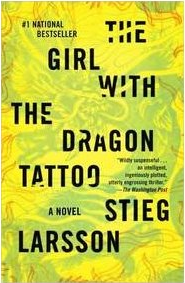
Cover for The Girl with the Dragon TattooBest Book of Week 7!

Maybe everyone has read The Girl with the Dragon Tattoo by Stieg Larsson. But if you are one of the few who have not, you are missing an exciting thriller.

Editor and writer Mikael Blomkvist has just lost a libel case brought by a billionaire industrialist named Wennerström concerning Blomkvist’s allegations of corruption. Blomkvist has been sentenced to three months in prison. He had carefully checked his facts but then one of his witnesses recanted. In order to separate his magazine, Millenium, from this problem, he resigns.

After he gets out of jail, he is approached for a job by Henrik Vanger, the retired head of Vanger Corporation. Vanger wants Blomkvist to find out what happened to his great-niece Harriet, who disappeared off the family’s private island 36 years earlier during a day when the island was cut off from the mainland by an accident blocking the only bridge. He is afraid that some member of his family murdered her. He yearly receives a pressed flower on his niece’s birthday and believes the killer is expressing remorse through this means.

Although Blomkvist is initially reluctant, he eventually accepts the job and goes to live on the island. When he decides he needs a research assistant, Vanger’s lawyer connects him with Lisbeth Salander, a child-sized woman who dresses in a goth style and has a dragon tattoo.

Salander is a computer genius with a difficult past. When she was a teenager, she was institutionalized and is still under the care of a legal guardian, who controls her money and can have her institutionalized at any time. She is hostile and uncommunicative, and few people have bothered to try to get to know her. After her guardian has a stroke, he is replaced by Nils Bjurman, who uses his position to sexually abuse her.

Bjurman has seriously misjudged Salander, however, and she takes care of this problem in one of the most satisfying scenes of the novel.

As Blomkvist and Salander investigate Harriet Vanger’s disappearance, they begin to believe that they may be on the track of a serial killer. Ultimately, Blomkvist finds himself in grave danger.

With a complex, interesting plot, an engaging hero and formidable heroine, a slew of interesting characters, and a sense of Swedish politics and law, you will lap up this book and go looking for the next one. Larsson was an activist with strong feelings about violence against women, a theme in all of his books.

Day 31: Look at Me

Cover for Look at MeIn Look at Me, Jennifer Egan explores the meaning of identity in the modern world, where new identities can easily be created with a few clicks of a mouse. This academic beginning to my review should not dissuade you from reading this absorbing book.

Charlotte Swenson is a fashion model just recovering from surgery after a horrific car accident that smashed every bone in her face. The accident happened near her home town of Rockport, Illinios, which she has not visited in years. She is vague about what happened and what she was doing there: it is hard to tell at the beginning whether she can’t remember or doesn’t want to tell. When she returns to her home in New York, she finds that not even her closest friends recognize her new face. She has become invisible.

Before she leaves for New York, Charlotte meets Charlotte Hauser, the plain sixteen-year-old daughter of her best friend from high school, whom Charlotte has also not seen in years. The younger Charlotte has met a man on a river bank who looks like he has been in an accident.

In New York Charlotte Swenson is futilely trying to resurrect her career when she hears from a private detective who is looking for a mysterious man she met a few times named Z.

In the meantime, Charlotte Hauser has begun studying with her uncle Moose, whose life was changed when he had a revelation about light and history as a young man. Moose has been trying to find a student who can take up his ideas and thinks that Charlotte may be that person. He has struggled with mental problems and was forced to leave a prestigious job in academia to teach part time at a local community college.

Because she made a “timing error” in her first sexual explorations, Charlotte has been ostracized from her high school crowd and has decided to change schools to the rougher one across the river. She is also having an affair with the man she met along the river bank.

Charlotte Swenson has always looked for a way into the “mirrored room” of fame and fortune. Now, without her famous face, she is depressed and struggling to pay the rent until an internet intrepreneur comes to her with a tempting proposal.

Egan skillfully weaves these characters’ stories into an engrossing, thought-provoking novel. Some critics felt the novel suffered from the focus on the empty life of the glitterati that fascinates Charlotte, and truthfully, sometimes you sincerely dislike her. But you also like her pluck and self-truthfulness, and the focus is necessary to the novel’s themes.

Day 30: Never End

Cover of Never EndNever End by Åke Edwardson is an interesting police procedural. A young woman is raped in the park during a sweltering summer evening in Gothenburg. What concerns the police even more than the rape is the fact that it took place in the same alcove where a girl of the same age was murdered five years ago. Jeanette, the victim, was also choked with something, perhaps a dog leash, while the murdered girl was strangled with her own belt.

Chief Inspector Erik Winter leads the investigation, and Inspector Handler tries to help while dealing with his ex-wife’s death.

The characters were interesting and the solution was difficult to guess. I have read a couple of Erik Winter books so far, and I still find myself unable to get much of a sense of the personalities of Winter and the other detectives. Edwardson provides some personal information about his detectives: Winter is happily married with a young son, and he is grappling with the idea of how much time his work takes away from his family; he is also battling with nicotine withdrawal. But Edwardson really concentrates on the methods and findings of the investigation. Perhaps as you read through the series, you slowly develop an idea of what the recurring characters are like.

Day 29: The Winter Sea

Cover for The Winter SeaLet me start out by saying that this is not my kind of book. There are carefully researched and plausible historical novels that make you feel like you understand the time and place and that may or may not include a romance. Then there are romance novels that just happen to be placed in a historical time but otherwise read as if the writer did not bother looking up a single fact. And there are all ranges in between. Despite the notes from Susanna Kearsley about her research, I would locate The Winter Sea closer to the latter end of this range.

Carrie is a writer working on a novel about one of the Jacobite rebellions. She has been living in France where all the intrigue went on, but she isn’t getting into her novel. On a visit to her agent in Scotland, she is attracted to a ruined castle. When she hears that part of the rebellion was based there, she decides to move to the nearby village, and on a suggestion by her agent, make her main character a woman. She arbitrarily picks Sophia Paterson, her own ancestor.

She begins to imagine vivid scenes, which interleave the modern story. But when she checks the facts surrounding these scenes, she finds the details are actually correct. After awhile she decides the explanation must be that she carries her ancestor’s genetic memory in her DNA, an explanation so absurd that it dumbfounded me.

The modern author’s romance with her landlord’s son is interspersed with the story she is writing about Sophia’s romance with a young Jacobite. Although the story reflects some historical research, the focus is on the romance. The dialogue in the historical section is awful, as if the writer thought all she had to do to make it authentic was stick the word “did” in constantly. (“I did arrive from Edinburgh last month.”) I almost quit reading because I could barely stand to read the dialogue. I would rather have the writer use modern English than patently fake and unconvincing archaic English.

Had the author based the writer’s insights on some form of second sight–they are in Scotland after all–I would have found that explanation more acceptable than the pseudo-scientific claptrap. Avoid this one unless you absolutely don’t care about any historical or scientific authenticity.

Day 28: Dance with Death

Barbara Nadel’s Turkish mystery novels are interesting because they usually involve one of the many minorities of Istanbul. Dance with Death takes place in the fascinating region of Cappodocia rather than in Istanbul, though. Inspector Çetin İkmen gets a call from his cousin asking him to come to Cappodocia. A body has been found in a cave, and his cousin believes it may be that of a girl with whom he was in love years ago. This girl, who was rambling around the Europe and then Turkey on vacation, simply disappeared, and he thought she had left him.

In the meantime, his colleague Mehmet Süleyman is still in Istanbul trying to catch an attacker of homosexuals.

Nadel’s Turkish mysteries are filled with detail about place and customs that I find irresistable. I almost always guess the killer fairly early, but sometimes this is my test of a mystery. If I still find it interesting even when I guess the solution, then it is worth reading. Dance with Death is full of the color of that mysterious region, and İkmen and Süleyman are sympathetic and interesting characters.

Except for one thing. A theme of men’s unfaithfulness runs through the books. Both Inspector İkmenand Süleyman have been unfaithful, even though they love their wives. I’m not sure if that is meant to indicate something cultural or not.