Day Seventeen: The Lost City of Z: A Tale of Deadly Obsession in the Amazon

Cover for The Lost City of ZThe Lost City of Z by David Grann tells the story of a famous British explorer, Percy Fawcett, and his obsession with finding the fabled city of El Dorado in the Amazon. He was the last of the great Victorian adventurers and possibly the inspiration for Indiana Jones (and for the explorer in the movie Up).

Fawcett made a career of exploring the Bolivian and Brazilian Amazon, beginning with being hired by the Bolivian government to establish its border in the Amazon. He became convinced that there had been a large city, which he called Z, in the region of the Xingu River. Hundreds of expeditions had been made to find it, beginning in the 16th century, and many of them were never seen again.

In 1925 Fawcett set off on an expedition funded by the Royal Geographical Society with a small party that included his son and son’s best friend. He sent daily dispatches back from the jungle that were published in the newspapers and waited for with anticipation by the general public. Then the dispatches stopped, and he was never seen again.

But the story wasn’t over. Others went into the jungle to try to find out what happened to him, including a famous movie star. Many of them never returned, either.

Grann, a staff writer for The New Yorker, became interested in the subject, which he came upon while working on another project. During his research, he met with members of the Fawcett family and was given access to a some previously unpublished personal papers. He is able to provide insight into the explorer’s character and thought processes, which makes for a fascinating story.

Grann also became consumed with the fate of the Fawcett expedition and found himself deciding to follow in Fawcett’s footsteps. Although his trip through the Amazon in a jeep was no Victorian expedition, he himself is no explorer. He was surprised to find the Amazon almost as wild today as it was 100 years ago.

And maybe he solved the mystery of what happened to Fawcett’s expedition. The story of Fawcett’s adventures makes compelling reading, and the ending is unexpected.

Day Sixteen: Sharp Objects

Cover for Sharp ObjectsI love dark mysteries with an edge. Two of my discoveries from last year  for this type of novel are Gillian Flynn and Belinda Bauer. My book journal for Gillian Flynn’s first book, Sharp Objects, starts out with “What a terrific book!”

Camille Preaker works for a Chicago newspaper, which sends her to her home town of Wind Gap, MO, because a young girl was murdered and another one has disappeared. Camille reluctantly returns to the home town she has avoided for eight years. Institutionalized for self-mutilation as a young girl, she has learned to resist cutting words into her body and now writes them on with a pen. But as she begins investigating her family problems and her disturbed childhood as well as the murder, she awakens her own demons.

Camille’s mother has never paid much attention to her, although she plays the doting mother outside of the home. Camille’s sister Marianne, who was loved by both Camille and her mother, died when she was young. Now Camille has a much younger stepsister, Amma, a 13-year-old who behaves like an angel at home but is a terrible bully outside the home, hanging out with a bunch of mean girls.

As Camille interviews her old friends and acquaintances, her leads all seem to be turning into dead ends, but the reader’s sense of horror grows. Discovering more of the truth about the murder and her own family, she begins spinning out of control and has difficulty resisting the urge to cut herself again.

Flynn’s writing is fast-paced and efficiently builds suspense. This book is a real page-turner.

Day Fifteen: Britten and Brülightly

Cover for Britten and BrulightlyAnd now for something completely different!

Britten and Brülightly by Hannah Berry is a noir graphic novel. I haven’t read many graphic novels, but this one seems to be outstanding. Most of them look like superhero comic books to me.

Britten is a depressed detective whose partner is a tea bag (I can’t believe I just got the pun of his name! I am so dense sometimes!) who makes humorous comments from inside the pocket of Britten’s (of course) trench coat. Britten takes a case from Charlotte Maughton, who doesn’t believe her fiancé, Berni Kudos, committed suicide. She is convinced he was actually murdered. Britten begins investigating Kudos’s job at Maughton Publishing, because Charlotte thinks Kudos’s death might be connected to a blackmailing scheme aimed at her father. During the investigation, he begins to uncover family secrets.

Although I became confused by the plethora of characters, I was impressed by the drawings, which are detailed and gorgeous. I am no expert on art, but I think they are stunning. To match with the noir theme, they look like watercolors in shades of gray with muted, subtle touches of color.

Reading this book made me more interested in exploring graphic novels, but so far I haven’t seen anything that looked as interesting. Two other highly lauded graphic novels, Persepolis, by Marjane Satrapi, and Maus, by Art Spiegelman, have compelling themes but much more primitive drawings (in the case of Maus, I couldn’t tell one character of a certain type from another), and I was attracted to Berry’s book mostly by the beautiful art and witty dialogue. Unfortunately, Berry doesn’t seem to have published anything else yet.

Day Fourteen: Salt: A World History

Cover for SaltNo, this review has nothing to do with the Angelina Jolie.

For those of you who aren’t familiar with micro-histories, they are histories about very limited topics. Micro-histories are usually fairly short because of their focus but can be fascinating and go into great detail on a very specialized subject. The best of these that I have read is Zero: The Biography of a Dangerous Idea by Charles Seife, who writes on math and science topics. However, I read that so long ago that I would not be able to write a good review of it.

Today’s review is of Salt: A World History by Mark Kurlansky, who has specialized in writing micro-histories. The book traces what is known about the collection, processing, and uses of salt from the earliest times and the role it plays in history. He quotes commentators from ancient China, Rome, and Egypt on the qualities of salt. He explains how certain cities became prominent in early times because of salt mines or salt fields on bodies of water and how empires (for example, that of Venice) were built around salt, either making it or trading it. He also discusses its close connection with cod and other things important to world history.

The book is a micro-history full of micro-histories. Kurlansky tells about the mines in Poland that have chandeliers carved from salt and explains that the downfall of the French monarchy was a result of the hated salt tax, which placed a heavier burden on the peasants than it did the aristocracy. He explains that one of the reasons for the success of Napolean’s army was the discovery by Nicolas Appert of how to preserve meat by canning (using salt), allowing the army to have a more reliable source of food than simply pillaging the villages. He explains the reasons for Mahatma Ghandi’s illegal march to the sea to gather salt and why it galvanized resistance to British rule in India. He includes recipes.

Basically, if a subject has anything to do with salt, he writes about it. Salt is an interesting book, although it contains many digressions and seems unfocused at times. To pursue a point, he sometimes goes backward and forward in history, which can be confusing. The recipes were interesting at first, as they come from all times in history and from many different countries, but after awhile I felt that they interrupted the flow, especially as some were more than a page long.

I’m told that Kurlansky’s book Cod is even better, and I have that on my shelf waiting to be read, but he said so much about cod in Salt that I’m wondering what more there is to say!

Despite my caveats, if you want to read an engrossing book that will tell you many interesting things you probably didn’t know, read Salt.

Day Thirteen: The Handmaid’s Tale

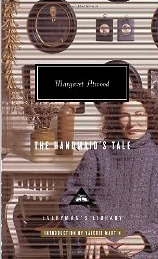
Cover for The Handmaid's TaleWhen I first read Margaret Atwood’s The Handmaid’s Tale back in the 80s, I believe my reaction was that the Canadian author might be over-reacting to the rise in American religious fundamentalism, although that also made it fairly scary reading. Not only does the novel translate well into this century, it is even more effective and foreboding in a time when hard-won civil and reproductive rights are being abrogated, education is being dumbed down and tampered with (as we know who have to fight the “intelligent design” battle every two years), and fundamentalism of all kinds is on the rise. Everyone should read or re-read this book.

Atwood presents the story skillfully. It is from the point of view of one person, the handmaid, as she struggles with her everyday life but remembers her previous one–one that we would consider normal. Instead of explaining what happened, she muses about her life as her thoughts come to her and as things happen, so it takes us awhile to understand what is going on. More than 20 years later, I still remember my horror when I realized the handmaid’s function in this dystopian society.

All we understand at first is that the handmaid lives in a rigid, stratified society in what used to be the U.S. in the not-too-distant future. It is a time of war, and there are terrifying checkpoints everywhere. All women are forced to wear uniforms in specific colors that indicate their station and function, and hers is red. She is treated as an outcast, and almost her every action is supervised. It takes us awhile to figure out that she lives in a theocracy, the laws of which were made as an apparent backlash against the successes in the late 19th century of women’s rights. In a foreword to the version I read, Atwood says that she purposefully didn’t include anything in the book that people have not already done to each other, which makes a statement in itself.

The novel is beautifully written. Although education for women is against the law, the handmaid was educated in her previous life, and constantly plays with language as she muses.

Read in the current climate, some of the themes and statements in this book will send a chill down your spine.

Day Twelve: A Heartbreaking Work of Staggering Genius

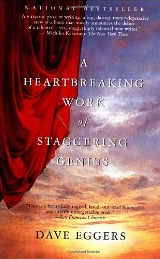
Cover for A Heartbreaking Work of Staggering GeniusBefore I start this review, I have to apologize for the untimely posts this week. I’ve told several people that I would try to post a review every weekday during my lunch, but lately we’ve been having a lot of Internet outages. So, I’m posting when I can.

A Heartbreaking Work of Staggering Genius is based upon true events of Dave Eggers’s life. When he was 22 years old, his mother and father died within months of each other, leaving his family to split up and himself in charge of his eight-year-old brother, Toph. They live in bachelor squalor while Eggers obsesses. Eventually, they move to San Francisco, where he becomes a founder of Might Magazine.

I didn’t read this book for a long time because I was put off by its title, but it received so many good reviews that I finally picked it up from curiosity. I have to preface my remarks by saying that I have lately gotten some clues that I don’t understand modern humor (i.e., I am officially a geezer), especially when I’ve tried to watch movies that are dubbed “hilarious.”

Readers might get a clue about how this book is going to proceed from its set of “Rules and Suggestions for the Enjoyment of this Book.” One of them is to skip the middle of the book. Good suggestion.

I found the first 100 pages or so about his parents’ deaths and his subsequent struggles affecting and absorbing. However, this is one of the few books that I just couldn’t finish. I found it so juvenile and smug that it was absolutely grating, but that’s not why I stopped. When Eggers abandons his straight narrative, he begins musing, and his prose devolves into unbelievably long, rambling paragraphs. His approach has been deemed “inventive” and even “the memoir as metafiction” (yikes!). I was actually only 30 pages from the end of the book when he started another of his lengthy asides, and I just couldn’t take it anymore. I gave up.

Day Eleven: Snow Flower and the Secret Fan

Cover for Snow Flower and the Secret FanBest Book of Week 3!

Lisa See, the author of Snow Flower and the Secret Fan, explains that she was inspired to write the novel after learning about nu shu, a secret, simplified writing used by women in a remote area of China to communicate with each other for centuries. The writing was suppressed for years after the Japanese invasion of China and during the Cultural Revolution, so it is now known only by a few scholars who learned it from the last women who knew it.

Snow Flower and the Secret Fan is a beautifully written story about the love between two women in 19th century China. Near the beginning of the novel, Lily’s mother delays the date of her foot binding a year from the traditional age of six so that she can enter into a special relationship, called laotong, with another girl named Snow Flower. Laotong, or “old same” girls must match each other as closely as possible in birth date and time, height, and other qualities, including the date of their foot binding. Snow Flower sends Lily an invitation to enter into this relationship written on a fan in nu shu. This relationship is supposed to be advantageous to Lily, the daughter of a farmer, because Snow Flower comes from a family that is higher in status and can teach her to be more refined. The end purpose of all this is to find her the best husband possible when the time comes.

The foot binding itself is horrifically described near the beginning of the novel, when Lily’s short life as a free child is ended by this process of trying to bend the foot so that all but the big toe meet the heel and it ends up as close to three inches long as possible.

At lot of the novel is about suffering. The way of life was circumscribed in many ways, with the women spending most of their lives in one room. As children and young women they are considered worthless burdens to their family until they “marry out.” Then they are considered burdens by their husbands and mothers-in-law until they justify their existence by having sons.

Lily’s relationship with Snow Flower opens up her world a bit. They visit a shrine together every year. Snow Flower comes to visit Lily, and they spend days and nights whispering, telling their secrets and hopes. They send messages to each other on their fan.

The hardest thing for me to explain is the extent of the innocence of these girls, how they are full of good will, despite their difficult and painful lives. How they try to do their best even though they are constantly criticized. How even the aphorisms and songs that they hear every day tell them their purpose is just to serve others, yet they try to be cheerful.

Lily relates the story from the viewpoint of an old woman to explain something that she did that she will always regret. Eventually, Lily’s successful marriage and good luck and Snow Flower’s loss of status lead to a divide between the women and then an apparent act of betrayal. The story effectively explores the linkage between love, hurt, and jealousy.

Day Ten: Before I Go to Sleep

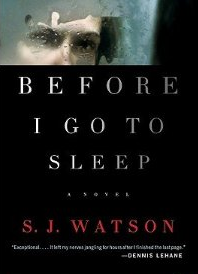
Cover for Before I Go to SleepBest Book of Week 2!

Before I Go to Sleep by S. J. Watson is a stunningly creepy novel that successfully creates a sense of growing dread. It is not really a traditional mystery, more like a slow-starting but absorbing thriller.

Every morning Christine awakens not knowing who the man in her bed is and thinking she should be younger, sometimes twenty years younger, sometimes a lot younger than that. Every morning her husband Ben has to explain who he is, show her pictures of their life together, and explain that years before she had a traumatic brain injury that causes her to forget everything when she goes to sleep at night.

A neurologist calls her each day to explain he has been treating her without her husband’s knowledge and reminds her to take out her journal and read it. As she reads and keeps her journal every day, she begins to remember a few things by herself, and she finds her husband is telling lies. She remembers having a baby, but he says they never had children. She has specific memories of a good friend who he claims moved away to Australia, but she finds out she didn’t. Her husband always has good explanations for these lies, but more and more things begin to disturb Christine.

Should she trust her husband or not? Is she falling back into the paranoia that has been a symptom of her illness? And how exactly was she injured in the first place?

Day Nine: Mary Boleyn

Cover for Mary BoleynIn the introduction to Mary Boleyn, biographer Alison Weir talks about the many misconceptions we have about Anne Boleyn’s less famous sister, which were not only derived from such popular fictions as The Tudors (wildly inaccurate, but I still loved it!) and The Other Boleyn Girl (ditto), but also from biographers and historians over the centuries. Weir calls her book both a biography and a historiography, because she tackles many published statements about Mary’s life and attempts to show the extent of their truth or even likelihood.

Because most of Mary’s life was spent in the background of her glittering, ambitious family, not many actual records or letters that mention her exist, and only a couple of her own letters survive. Even the exact date of her birth is unknown, so that there has been been debate about whether Mary is the older or younger of the two sisters. (Weir makes a good case for older.)

Weir examines Mary’s life from as early as it is known and explores such subjects as whether she had an affair with the King of France (yes, probably a short one), whether she came from that with a ruined reputation, as has been alleged (no, but her family may have sent her away from court), whether she had an affair with Henry VIII (yes, but possibly reluctantly), whether she was then labeled a “famous whore” as has also been alleged (no, hardly anyone knew about it), whether she was married off to an unworthy but complaisant husband as a result (no, she married before the affair to William Carey, a wealthy and influential courtier who was one of Henry VIII’s trusted friends), and so on.

The picture Weir paints is of a woman who has repeatedly been smeared over the centuries. She certainly did not seem to be ambitious, like the rest of her family, because she got very little from her royal lovers. She was almost certainly also not well regarded by her family, probably because she had taken these lovers without gaining an advantage. After her first husband died, she eventually remarried for love, William Stafford, a relatively poor man much lower in status who was 12 years her junior. After she was cut off from her family and court as a result, she described the time of her widowhood as “bondage” and stated in a letter to Thomas Cromwell that no one in the world cared for her except Stafford.

Mary seems to have been slighted by her family for much of her adult life and was finally exiled from them because of her second marriage. This separation may be the only reason she survived her sister and brother.

Weir makes a strong case for Mary’s first child, Katherine Carey, being the unacknowledged daughter of Henry VIII. An appendix relates what happened to Mary’s descendants. Weir remarks that Henry VIII’s line is believed to have died out with Elizabeth I, but assuming she is correct about Katherine’s birth, she provides a fascinating list of some of the famous British people who can trace their lineage back to Mary’s daugher—and so to Henry—including Winston Churchill, Charles Darwin, Lord Nelson, Vita Sackville-West, Ralph Vaughn Williams, Princess Diana, Camilla Parker-Bowles, and Queen Elizabeth II herself.

Day Eight: The Virgin Suicides

Cover for The Virgin SuicidesI haven’t read this book in a year, but my brother asked me to review it. So, excuse me if I get the chronology mixed up or something. The book is told mostly in flashbacks, and it’s hard for me to remember what happens first.

The Virgin Suicides by Jeffrey Eugenides is one of those incredible books that make you wonder how they could be someone’s first novel. I was turned off by the title and subject matter of the book so I didn’t read it at first. But I caught the movie one night on TV and was mesmerized by it, so I decided to read the book.

The Virgin Suicides is written from the point of view of a group of boys growing up in the 70s in Grand Blanc, Michigan, a wealthy suburb of Detroit. The boys are fascinated by the five beautiful Lisbon sisters and their family life. Although they all go to the same school, the girls are kept isolated from other teenagers by their mother’s strictness. Their father is an easy-going science teacher at their school.

The boys begin by spying on the girls, then collecting souvenirs of the girls’ lives, which they go over incessantly, trying to understand them. In an experiment of leniency, Mrs. Lisbon allows the sisters to have a few classmates over to the house, including the boys, but the deadly dull party ends disastrously with the suicide of the youngest girl.

As the boys begin to connect more directly with the girls and the family alternates between trying to be more normal and totally isolating the girls, the family becomes more unhinged.

The book is sometimes lyrical, sometimes sophomoric sounding, sometimes witty, and savagely ironic, painting a vivid picture of the time and place. The disintegration of urban Detroit and its surrounding areas, symbolized by the neighborhood losing all its trees to the Dutch Elm disease, parallels the disintegration of the Lisbon family.